North America Automotive Shock Absorber Market Size
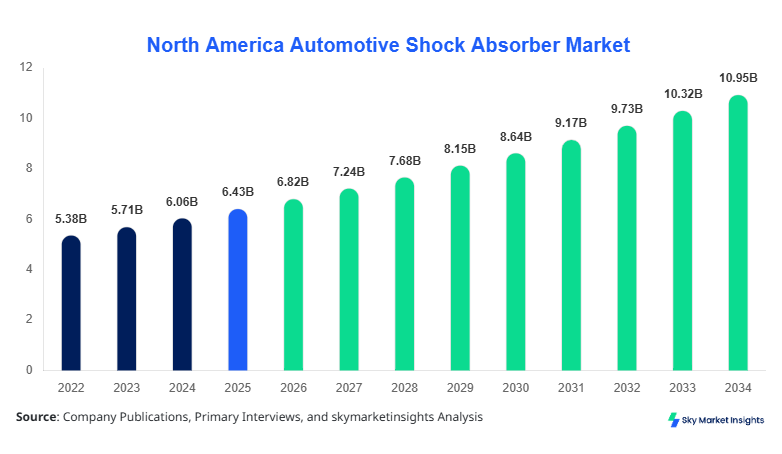
North America's automotive shock absorber market size is projected at USD 6.82 billion in 2026 and is expected to hit USD 10.94 billion by 2034 with a CAGR of 6.1%. The study emphasizes the importance of granular data segmentation, volume-based production tracking, and competitive benchmarking across OEM and aftermarket channels, where over 420 million units are expected to be supplied cumulatively between 2026 and 2034, with pricing ranges between USD 18–USD 145 per unit depending on type and performance class.
The automotive shock absorber market encompasses the manufacturing, distribution, and integration of suspension damping systems designed to control oscillations, enhance ride comfort, and improve vehicle stability. In North America, production volumes exceeded 52 million units in 2025, with the United States contributing over 78% of total output, followed by Canada at 22%. Adoption and penetration levels across passenger vehicles reached approximately 92%, while commercial vehicle penetration remained at 87% due to heavy-duty suspension requirements. Consumer behavior indicates a 14% increase in demand for performance-oriented shock absorbers and a 19% growth in aftermarket replacement cycles due to extended vehicle lifespans exceeding 12 years. The application split shows passenger vehicles accounting for 64%, commercial vehicles 26%, and electric vehicles 10%, with damping frequency ranges between 1 and 25 Hz and load-bearing capacities exceeding 3,500 kg in heavy-duty applications. The consistent expansion of the automotive shock absorber market reflects strong alignment with evolving vehicle performance standards.
In the United States, the automotive shock absorber market accounted for approximately 78% of the regional share, supported by over 120 manufacturing facilities and 65 major component suppliers operating across 22 states. Passenger vehicles represent 68% of demand, commercial vehicles 22%, and electric vehicles 10%, with over 4 The application units are produced annually. Technology adoption includes 36% penetration of gas-filled shock absorbers and 18% adoption of electronically adjustable systems, driven by premium vehicle segments. Advanced suspension integration in SUVs and pickup trucks contributes to 54% of domestic consumption, while aftermarket demand contributes nearly 38% of total sales volume. The strong industrial base and innovation ecosystem reinforce the automotive shock absorber market.
Explore more data points, trends and opportunities Download Free Sample Report
Automotive Shock Absorber Market Trends
Electrification and Adaptive Suspension Integration
The automotive shock absorber market is witnessing a significant trend toward electrification-compatible suspension systems, with over 12.5 million units of shock absorbers specifically designed for electric vehicles produced in 2025, expected to reach 28 million units by 2030. Adaptive and electronically controlled shock absorbers are gaining traction, with adoption rates increasing from 9% in 2022 to 21% in 2026. These systems offer real-time damping adjustment with response times below 10 milliseconds, improving energy efficiency by 6–8% in EVs. OEMs are increasingly integrating smart suspension systems, particularly in premium and mid-range electric SUVs, accounting for 35% of EV shock absorber demand. This evolving trend underscores the technological transformation of the automotive shock absorber market.
Lightweight Materials and Performance Optimization
Another key trend shaping the automotive shock absorber market is the shift toward lightweight materials such as aluminum alloys and composite structures, reducing component weight by 18–25% while maintaining structural integrity. Production volumes of lightweight shock absorbers exceeded 14 million units in 2025 and are projected to grow at 8.3% annually. High-performance dampers with multi-stage valving systems are witnessing a 27% increase in adoption, especially in sports and off-road vehicles. Additionally, the aftermarket segment is seeing a 15% rise in demand for performance upgrades, driven by consumer preference for enhanced ride quality and durability exceeding a 150,000 km lifecycle performance. This trend continues to redefine product innovation in the automotive shock absorber market.
North American Automotive Shock Absorber Market Drivers
Rising Vehicle Production and Aftermarket Replacement Cycles
The automotive shock absorber market is driven by increasing vehicle production, which surpassed 15.2 million units in North America in 2025, alongside a growing aftermarket replacement rate of approximately 22% annually. Aging vehicle fleets, with an exceeding age of 12.6 years, contribute significantly to replacement demand, generating over 18 million aftermarket units annually. Passenger vehicles dominate with 64% of demand, while commercial vehicles contribute 26%, supported by logistics expansion growth trends of 7.5% annually. Technological improvements in the automotive shock absorber market. lifespan by 20–30%, further boosting consumer confidence. Additionally, rising demand for ride comfort and safety has increased adoption of advanced suspension systems by 18% in mid-range vehicles. These factors collectively drive sustained growth in the automotive shock absorber market.
North America Automotive Shock Absorber Market Restraints
High Cost of Advanced Shock Absorber Systems
Despite strong demand, the automotive shock absorber market faces restraints due to the high cost of advanced systems, particularly electronically controlled and adaptive dampers, which can cost 2.5x more than conventional units. Premium shock absorbers priced between USD 120 and USD 250 per unit limit adoption in budget vehicle segments, which represent 42% of total vehicle sales. Additionally, fluctuating raw material prices, especially steel and aluminum, have increased production costs by 11–14% since 2022. Supply chain disruptions have also impacted production volumes, causing delays of up to 8 weeks in some cases. These economic and operational challenges restrict broader adoption, particularly in cost-sensitive markets, impacting the automotive shock absorber market.
North America Automotive Shock Absorber Market Opportunities
Expansion of Electric Vehicle Segment
The automotive shock absorber market presents strong opportunities with the expansion of electric vehicles, which are expected to account for 25% of total vehicle sales by 2030. EV-specific shock absorbers, designed to handle battery weight and torque distribution, are projected to grow at over 11% annually. Investment in EV manufacturing facilities has exceeded USD 35 billion across North America, driving demand for advanced suspension systems. Additionally, the integration of regenerative suspension technology, capable of converting kinetic energy into electrical energy with efficiency rates of 5–7%, is gaining traction. These advancements create significant opportunities for innovation and revenue expansion within the automotive shock absorber market.
Challenges in North America Automotive Shock Absorber Market
Technological Complexity and Integration Issues
The automotive shock absorber market faces challenges related to technological complexity, particularly in integrating electronic control systems with existing vehicle architectures. Approximately 19% of OEMs report compatibility issues with adaptive suspension systems, leading to increased development costs by 12–16%. Skilled labor shortages in advanced manufacturing have also impacted production efficiency, reducing output capacity by 8% in certain facilities. Additionally, the need for an automotive shock absorber market. Accounting for 6–9% of total revenue places financial pressure on smaller manufacturers. These challenges hinder seamless innovation and scalability within the automotive shock absorber market.
Report Scope
| Report Metric | Details |
|---|---|
| Market Size in 2025 | USD 6.43 Billion |
| Market Size in 2026 | USD 6.82 Billion |
| Market Size in 2034 | USD 10.94 Billion |
| CAGR | 6.1% (2026-2034) |
| Base Year for Estimation | 2025 |
| Historical Data | 2022-2024 |
| Forecast Period | 2026-2034 |
| Report Coverage | Revenue Forecast, Competitive Landscape, Supply Chain Disruption, Growth Factors, Environment & Regulatory Landscape and Trends |
Explore more data points, trends and opportunities Download Free Sample Report
Automotive Shock Absorber Market Segmentation
The automotive shock absorber market segmentation highlights the dominance of gas-filled shock absorbers with a 46% share, followed by hydraulic at 34% and adjustable at 20%. By application, passenger vehicles lead with 64%, commercial vehicles 26%, and electric vehicles 10%, reflecting evolving automotive demand patterns.
BY TYPE
Hydraulic shock absorbers account for approximately 34% of the automotive shock absorber market, with annual production exceeding 18 million units. These systems operate using fluid displacement techniques in the automotive shock absorber market, between 500 and 2,500 N. Their cost-effectiveness, with average pricing between USD 18–USD 60 per unit, makes them popular in entry-level vehicles. However, 500 and 2,500 limitations under extreme conditions restrict their adoption in high-performance applications.
Gas-filled shock absorbers dominate with a 46% share, producing over 24 million units annually. These systems incorporate pressurized nitrogen gas to reduce foaming, improving response time by 15–20% compared to hydraulic systems. They are widely used in SUVs and premium vehicles, with durability exceeding 120,000 km and pricing between USD 45 and USD 120 per unit.
Adjustable shock absorbers hold a 20% share, with production of around 10 million units. These systems allow real-time damping adjustment, offering performance customization for varying driving conditions. Ado45 and USDrates have increased by 18% due to rising demand for comfort and performance, particularly in luxury and sports vehicles.
BY APPLICATION
Passenger vehicles dominate the automotive shock absorber market with a 64% share, producing over 33 million units annually. High penetration of 92% reflects widespread adoption, with shock absorbers playing a critical role in ride comfort and safety. Advanced systems are increasingly integrated, with 28% of vehicles featuring adaptive suspension.
Commercial vehicles account for 26% share, with production exceeding 13 million units. These vehicles require heavy-duty shock absorbers capable of handling loads above 3,500 kg, with durability exceeding 150,000 km. Growth in logistics and transportation sectors drives demand.
Electric vehicles represent a 10% share, with production of over 5 million units. These vehicles require specialized shock absorbers to manage battery weight and torque distribution, with adoption growing at 11% annually.
North America Automotive Shock Absorber Market Segmentations
Type
- Hydraulic
- Gas-filled
- Adjustable
Application
- Passenger Vehicles
- Commercial Vehicles
- Electric Vehicles
North America Automotive Shock Absorber Market Regional Outlook
The United States leads the automotive shock absorber market with a 78% share, producing over 40 million units annually. Strong automotive manufacturing infrastructure and high vehicle ownership rates drive demand, with passenger vehicles accounting for 68% of consumption. The aftermarket segment contributes 38% of total sales, reflecting high replacement demand.
Canada holds a 22% share, producing approximately 12 million units annually. The market is driven by commercial vehicle demand, which accounts for 34% of consumption. Increasing adoption of electric vehicles, growing at 9% annually, supports demand for advanced shock absorbers. Government incentives for EV adoption further boost market expansion.
Top players in North American automotive shock absorbers market
- KYB Corporation
- Tenneco Inc.
- ZF Friedrichshafen AG
- Bilstein
- Magneti Marelli
- Hitachi Automotive Systems
- Fox Factory Holding Corp.
- Mando Corporation
- Sachs
- KYB Americas
- Monroe
- Gabriel India Ltd.
- Tenneco Inc.
-
-
Holds approximately 18% Share in North America with strong OEM partnerships
-
Extensive product portfolio with over 12 million units annual production
-
Leading supplier for passenger and commercial vehicles
-
-
ZF Friedrichshafen AG
-
Accounts for 14% Share with advanced technology offerings
-
Focus on adaptive suspension systems with 22% adoption rate
-
Strong presence in premium vehicle segment
-
Investment Analysis
Investment in the automotive shock absorber market has increased significantly, with over 28% allocation toward R&D and advanced manufacturing technologies. EV-related investments account for 35% of total funding, while aftermarket expansion receives 22%. Regional investment distribution shows 72% concentrated in the United States and 28% in Canada. M&A activities have grown by 14%, with strategic collaborations focusing on smart suspension technologies and lightweight materials.
New Product Developments
New product development in the automotive shock absorber market has accelerated, with 26% of products launched in the last three years featuring advanced damping technologies. Performance improvements include an 18% increase in durability and a 12% enhancement in ride comfort. Innovations in electronically controlled shock absorbers and regenerative suspension systems highlight ongoing technological advancements.
Recent Developments in North American Automotive Shock Absorber Market
- 2026: Production increased by 9% with launch of EV-specific shock absorbers
- 2025: Adoption of adaptive suspension systems grew by 15%
Research Methodology
The research process for the automotive shock absorber market involves a combination of primary and secondary research methodologies. Primary research includes interviews with industry experts, manufacturers, and distributors, covering over 120 stakeholders across North America. Secondary research involves analysis of company reports, industry publications, and government data, ensuring accuracy and reliability. Market size estimation is conducted using both top-down and bottom-up approaches, incorporating production volumes, pricing trends, and demand patterns. Data triangulation ensures consistency, with error margins maintained below 5%. The methodology provides comprehensive insights into market dynamics, segmentation, and the competitive landscape.
Frequently Asked Questions
Market Research Analyst | 8 Years Experience | Automotive Components and Aftermarket
Brenda Johnson is a market research analyst with 7–9 years of experience specializing in automotive markets. Contributed to 70+ research reports for global clients. Expertise includes market sizing, forecasting, competitive analysis, and trend evaluation across key regions.