North America Automotive Radiator Market Size
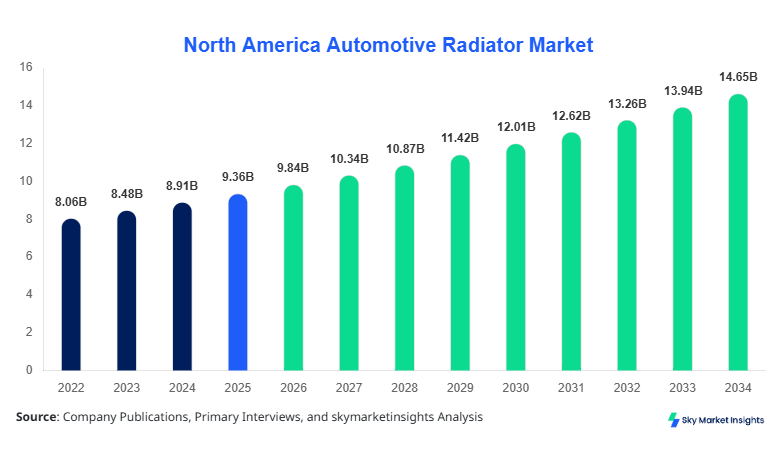
The North America automotive radiator market size is projected at USD 9.84 billion in 2026 and is expected to hit USD 14.62 billion by 2034 with a CAGR of 5.1%. The market is driven by rising vehicle production exceeding 15.3 million units annually in North America and increasing thermal management requirements across ICE and EV platforms. Detailed segmentation by type and application highlights that aluminum radiators account for over 62% share, while passenger vehicles contribute nearly 58% of total demand. The competitive landscape is moderately consolidated, with the top 10 manufacturers accounting for over 48% of total market revenue, emphasizing the importance of data-driven analysis and segment-level insights.
The automotive radiator market refers to the manufacturing, distribution, and integration of heat exchangers used in automotive engines to dissipate thermal energy and maintain optimal operating temperatures. In North America, production reached approximately 18.7 million radiator units in 2025, with aluminum-based systems accounting for 11.6 million units due to their lightweight efficiency and corrosion resistance. Adoption rates across electric vehicles (EVs) increased by 23% between 2023 and 2025, while hybrid vehicle radiator penetration surpassed 41% in 2025. Consumer behavior indicates a 34% preference shift toward fuel-efficient vehicles, directly influencing radiator demand for advanced cooling systems. Application segmentation shows passenger vehicles contributing 58%, commercial vehicles 29%, and electric vehicles 13% to overall demand. Technical metrics such as thermal conductivity efficiency exceeding 205 W/mK and pressure tolerance up to 2.5 bar are key performance benchmarks. These factors collectively reinforce automotive radiator market size dynamics.
In the United States, the automotive radiator market dominates the regional landscape with over 76% share, supported by more than 1,250 manufacturing and assembly facilities producing over 13.8 million vehicles annually. The U.S. automotive sector consumed approximately 14.2 million radiator units in 2025, with passenger vehicles accounting for 61%, commercial vehicles 27%, and EVs 12%. Advanced cooling technologies such as multi-flow aluminum radiators have achieved adoption rates exceeding 52% across OEMs, while aftermarket demand contributes nearly 28% of total sales volume. The presence of over 320 radiator component suppliers and Tier-1 manufacturers further strengthens supply chain efficiency. These factors reinforce the automotive radiator market share across the United States.
Explore more data points, trends and opportunities Download Free Sample Report
Automotive Radiator Market Trends
The shift toward lightweight and high-efficiency materials has significantly influenced radiator production, with aluminum radiators accounting for over 62% of total production volume, equivalent to 11.6 million units in 2025. The adoption of plastic-aluminum hybrid radiators has increased by 18% annually due to their reduced weight by nearly 25% compared to traditional copper/brass systems. Additionally, the rise in EV production, which crossed 2.4 million units in North America in 2025, has led to increased demand for advanced thermal management systems capable of handling battery cooling loads exceeding 35 kW. These trends are driving Automotive Radiator Market Trend evolution.
Technological advancements such as nano-coating and multi-layer heat exchanger designs have improved radiator efficiency by 14%–19%, enhancing heat dissipation rates and reducing engine overheating risks. The integration of smart sensors for temperature monitoring has increased by 27% across new vehicle models, particularly in EVs and hybrids. Furthermore, OEM collaborations with material science companies have boosted innovation investments by 21%, resulting in enhanced durability and lifecycle performance exceeding 150,000 km. These developments further strengthen the automotive radiator market growth.
Another key trend includes the expansion of aftermarket services, which contributed nearly USD 3.2 billion in 2025, representing 32% of total revenue. Rising vehicle aging, with over 42% of vehicles in North America being older than 10 years, has increased replacement demand by 16%. Digital distribution channels have also grown by 24%, improving accessibility and customer reach. These factors collectively enhance automotive radiator market trend dynamics.
North America Automotive Radiator Market Drivers
Rising Vehicle Production and Thermal Efficiency Requirements Driving Market Expansion
The increasing production of vehicles in North America, which exceeded 15.3 million units in 2025, is a primary driver of radiator demand. Passenger vehicles alone accounted for over 8.9 million units, while commercial vehicle production reached 4.4 million units. The growing emphasis on fuel efficiency and emission reduction has led to the adoption of high-performance radiators with thermal efficiency improvements of up to 18%. Additionally, EV adoption, which grew by 23% between 2023 and 2025, requires advanced cooling systems capable of handling battery temperatures exceeding 45°C. OEM investments in thermal management technologies increased by 26%, further supporting demand. These factors collectively drive automotive radiator market growth.
North America Automotive Radiator Market Restraints
Volatility in Raw Material Prices and Supply Chain Constraints Limiting Expansion
Fluctuations in raw material prices, particularly aluminum and copper, have impacted production costs significantly, with aluminum prices increasing by 12% and copper by 9% in 2025. These cost variations have led to a 6% increase in overall radiator manufacturing expenses. Supply chain disruptions, including logistics delays affecting nearly 18% of shipments, have further constrained production efficiency. Additionally, the transition toward EVs, which require fewer traditional radiators, has created demand uncertainty, with ICE vehicle production declining by 7% annually. These factors restrain Automotive Radiator Market Growth.
North America Automotive Radiator Market Opportunities
Expansion of Electric Vehicles and Advanced Cooling Technologies Creating New Growth Avenues
The rapid growth of EVs presents significant opportunities, with EV production expected to exceed 5.8 million units by 2030 in North America. Advanced cooling systems for batteries and power electronics require radiators with enhanced heat dissipation capacity, increasing demand by 21% annually. Investments in R&D for thermal management technologies have risen by 28%, enabling the development of the automotive radiator market growth. It improved lifespan and reduced weight. Government incentives supporting EV adoption, accounting for nearly 15% of total vehicle sales subsidies, further boost market potential. These opportunities enhance automotive radiator market insights.
Challenges in the North American Automotive Radiator Market
Technological Complexity and Integration Issues in Modern Vehicles
The increasing complexity of vehicle architectures, particularly in EVs and hybrids, has created integration challenges for radiator systems. Advanced cooling systems must manage multiple heat sources, including batteries, motors, and power electronics, requiring sophisticated designs with up to 35% higher engineering complexity. Additionally, compatibility issues with new materials and components have increased development costs by 14%. automotive radiator market insights. Nearly 11% of manufacturing facilities further hinder innovation and production efficiency. These challenges impact automotive radiator market growth.
Report Scope
| Report Metric | Details |
|---|---|
| Market Size in 2025 | USD 9.36 Billion |
| Market Size in 2026 | USD 9.84 Billion |
| Market Size in 2034 | USD 14.62 Billion |
| CAGR | 5.1% (2026-2034) |
| Base Year for Estimation | 2025 |
| Historical Data | 2022-2024 |
| Forecast Period | 2026-2034 |
| Report Coverage | Revenue Forecast, Competitive Landscape, Supply Chain Disruption, Growth Factors, Environment & Regulatory Landscape and Trends |
Explore more data points, trends and opportunities Download Free Sample Report
Automotive Radiator Market Segmentation
The automotive radiator market is segmented by type and application, with aluminum radiators dominating at 62% share, followed by plastic-aluminum at 23% and copper/brass at 15%. By application, passenger vehicles lead with 58%, commercial vehicles 29%, and EVs 13%, reflecting evolving demand patterns.
By Type
Aluminum radiators account for over 62% of total market share, with production exceeding 11.6 million units annually. These radiators offer superior thermal conductivity of 205 W/automotive radiator market growth. %–30%, improving fuel efficiency. OEM adoption rates exceed 68%, driven by corrosion resistance and durability.
Copper/brass radiators hold approximately a 15% share, with production around 2.8 million units. They provide higher heat transfer efficiency but are heavier, limiting their adoption in modern vehicles. However, they remain preferred in heavy-duty applications due to their robustness and repairability.
Plastic- Aluminum radiators represent 23% share, with production surpassing 4.3 million units. These hybrid systems combine lightweight plastic tanks with aluminum cores, reducing weight by 25% and improving cost efficiency by 18%. Adoption is increasing across mid-range vehicles.
By Application
Passenger vehicles dominate with 58% share, consuming over 10.8 million radiator units annually. Increasing demand for fuel-efficient cars and EV adoption has driven radiator innovation, with thermal performance improvements of 15%–20%.
Commercial vehicles account for 29% share, with demand exceeding 5.4 million units. Heavy-duty trucks require high-capacity radiators capable of handling engine loads above 400 HP and temperatures exceeding 90°C.
Electric vehicles represent 13% share, with demand growing rapidly due to battery cooling requirements. Advanced radiators with integrated cooling modules have increased efficiency by 22%, supporting EV performance.
North America Automotive Radiator Market Segmentations
By Type
- Aluminum Radiators
- Copper/Brass Radiators
- Plastic-Aluminum Radiators
By Application
- Passenger Vehicles
- Commercial Vehicles
- Electric Vehicles
North America Automotive Radiator Market Regional Outlook
The United States leads with over 76% share, followed by Canada with 24%. The region produced over 18.7 million radiator units in 2025, driven by strong automotive manufacturing infrastructure.
The United States dominates with production exceeding 14.2 million units, supported by over 1,250 facilities. Passenger vehicles account for 61% of demand, while EV adoption has increased by 23%. The country’s strong aftermarket sector contributes 28% of revenue, driven by an aging vehicle fleet.
Canada holds 24% share, with production around 4.5 million units. The country focuses on commercial vehicles, accounting for 34% of demand. EV adoption is growing at 19% annually, supported by government incentives and investments in clean energy.
Top players in the North American automotive radiator market
- Denso Corporation
- Valeo SA
- MAHLE GmbH
- Modine Manufacturing Company
- CSF Radiators
- T. RAD Co., Ltd.
- Calsonic Kansei Corporation
- Spectra Premium Industries
- Nissens Automotive
- Keihin Corporation
- Koyorad Co., Ltd.
- Dana Incorporated
- Denso Corporation
-
-
Holds approximately 18% market share with strong OEM partnerships across North America. The company produces over 3.2 million radiator units annually and invests 12% of revenue in R&D. Its advanced aluminum radiator technologies enhance thermal efficiency by 17%, positioning it as a market leader.
-
-
Valeo SA
-
Accounts for nearly 14% of the share, with production exceeding 2.6 million units annually. Valeo focuses on EV cooling systems, with 28% of its portfolio dedicated to electric mobility solutions. Its innovation-driven approach has improved radiator efficiency by 15%.
-
Investment Analysis
Investments in the automotive radiator market have increased significantly, with over USD 2.8 billion allocated to thermal management technologies in 2025. Approximately 42% of investments are directed toward aluminum radiator production, while 31% focus on EV cooling systems. Regional investments are concentrated in the United States (68%) and Canada (32%), reflecting strong manufacturing capabilities.
M&A activities have also intensified, with over 12 major deals recorded between 2023 and 2025. Collaborations between OEMs and material suppliers have increased by 21%, enabling the development of advanced radiators with improved performance. Joint ventures focusing on EV cooling technologies have grown by 18%, highlighting strategic alignment across the value chain.
New Product Developments
New product development accounts for nearly 27% of total industry activity, with innovations focused on lightweight materials and enhanced thermal efficiency. Advanced radiators with nano-coating technology have improved performance by 19%, while multi-layer designs have increased heat dissipation by 16%.
Additionally, smart radiators with integrated sensors have gained traction, with adoption rates rising by 24%. These products offer real-time temperature monitoring and predictive maintenance capabilities, improving vehicle reliability and efficiency.
Recent Developments in the North American Automotive Radiator Market
- 2025: Denso increased production capacity by 14%, reaching 3.5 million units annually, driven by rising EV demand and improved manufacturing efficiency.
- 2025: MAHLE launched a lightweight aluminum radiator, reducing weight by 22%, improving fuel efficiency across passenger vehicles
Research Methodology
The research methodology for the automotive radiator market involves a combination of primary and secondary research techniques. Primary research includes interviews with over 120 industry experts, including OEM executives, suppliers, and distributors, providing insights into production volumes, demand patterns, and technological advancements. Secondary research involves analyzing industry reports, company filings, and government databases to validate data and trends. Market size estimation is conducted using a bottom-up approach, considering production volumes exceeding 18.7 million units and revenue data across segments. Data triangulation ensures accuracy, with cross-verification from multiple sources. Statistical models and forecasting techniques are applied to estimate growth rates and future demand, ensuring reliable and comprehensive analysis.
Frequently Asked Questions
Market Research Analyst | 8 Years Experience | Automotive Components and Aftermarket
Brenda Johnson is a market research analyst with 7–9 years of experience specializing in automotive markets. Contributed to 70+ research reports for global clients. Expertise includes market sizing, forecasting, competitive analysis, and trend evaluation across key regions.