North America Automotive Radiator Cap Market Size
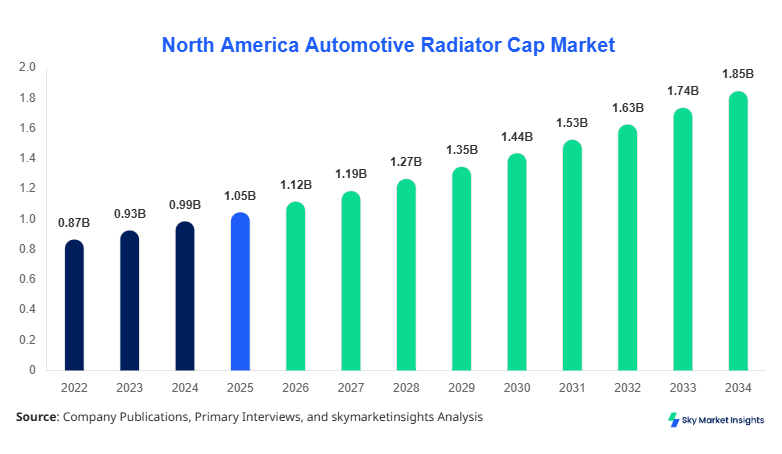
North America Automotive Radiator Cap market size is projected at USD 1.12 billion in 2026 and is expected to hit USD 1.86 billion by 2034 with a CAGR of 6.5%. The increasing need for advanced thermal management systems across over 28 million vehicles in operation annually and rising aftermarket replacement demand exceeding 120 million units are key contributors. The report emphasizes structured segmentation across type and application, detailed demand analytics, and competitive landscape insights across 50+ key manufacturers, ensuring comprehensive data coverage and measurable industry positioning.
The Automotive Radiator Cap Market refers to the production, distribution, and utilization of pressure-regulating components used in vehicle cooling systems to maintain optimal engine temperature. In North America, production volumes reached approximately 145 million units in 2025, with OEM installations contributing nearly 42% and aftermarket sales accounting for 58% of total demand. Adoption rates are closely tied to vehicle parc growth, with penetration exceeding 95% across passenger vehicles and 88% in commercial fleets. Consumer behavior indicates that nearly 64% of replacement purchases occur within 3–5 years of vehicle usage due to wear and pressure degradation.
From a technical standpoint, radiator caps operate within pressure ranges of 13–16 PSI for standard vehicles and up to 20 PSI for high-performance variants, ensuring optimal coolant boiling points above 120°C. Passenger vehicles account for approximately 62% of applications, followed by commercial vehicles at 26% and heavy-duty vehicles at 12%. Increasing demand for high-efficiency cooling systems, coupled with stringent emission norms, continues to reinforce Automotive Radiator Cap Market demand across North America.
Explore more data points, trends and opportunities Download Free Sample Report
Automotive Radiator Cap Market Trends
Increasing Integration of High-Performance Materials
The Automotive Radiator Cap Market is witnessing a shift toward high-performance materials such as stainless steel alloys and reinforced polymers, accounting for nearly 48% of new product designs in 2025. Production volumes of advanced radiator caps exceeded 68 million units, reflecting a 14% increase year-over-year. The use of improved sealing mechanisms has enhanced pressure retention efficiency by up to 22%, reducing coolant evaporation losses and extending component lifespan by approximately 30%.
Additionally, manufacturers are focusing on lightweight components, reducing overall cap weight by 12–18% while maintaining structural integrity. Adoption rates among OEMs have increased to 55%, particularly in passenger vehicles and hybrid models. This trend is further supported by regulatory pressure to improve vehicle efficiency and reduce emissions. Continuous innovation in materials and design is reinforcing Automotive Radiator Cap Market trend evolution.
Growth of Aftermarket Replacement Demand
The aftermarket segment is expanding rapidly, contributing nearly 58% of total Automotive Radiator Cap Market volume. Replacement demand reached approximately 84 million units in 2025, driven by aging vehicle fleets with an average age of 12.5 years across North America. Consumer awareness regarding preventive maintenance has increased by 21%, leading to higher replacement frequency.
Digital distribution channels now account for 32% of aftermarket sales, enabling easier access and price transparency. Furthermore, fleet operators are increasingly adopting predictive maintenance strategies, resulting in a 16% rise in bulk procurement contracts. The integration of smart caps with pressure monitoring features is also emerging, although adoption remains below 8%. These developments collectively shape the Automotive Radiator Cap Market trend across the region.
North America Automotive Radiator Cap Drivers
Rising Vehicle Production and Aftermarket Demand Driving Market Expansion
The growth of vehicle production, which exceeded 16 million units annually in North America, is a key driver of the Automotive Radiator Cap Market. With each vehicle requiring at least one radiator cap and replacement cycles averaging every 3–5 years, total demand surpasses 120 million units annually. The aftermarket segment alone contributes over 58% of total revenue, supported by aging vehicle fleets and increasing maintenance awareness.
Furthermore, commercial vehicle expansion, growing at 5.2% annually, contributes significantly to demand due to higher wear rates and replacement frequency. Technological advancements, such as improved pressure retention and corrosion resistance, have enhanced product lifespan by 20–25%, encouraging OEM adoption. Government regulations promoting engine efficiency and reduced emissions further necessitate effective cooling systems, thereby boosting Automotive Radiator Cap Market growth.
North America Automotive Radiator Cap Restraints
Fluctuating Raw Material Costs and Supply Chain Constraints
The Automotive Radiator Cap Market faces significant challenges due to fluctuating raw material costs, particularly steel and aluminum, which have experienced price volatility of 18–25% over the past three years. These fluctuations directly impact manufacturing costs, reducing profit margins by approximately 8–12% for suppliers.
Additionally, supply chain disruptions have affected nearly 22% of component deliveries, leading to production delays and inventory shortages. Smaller manufacturers face greater challenges due to limited procurement capabilities, resulting in reduced competitiveness. Environmental regulations concerning material usage and recycling further increase compliance costs by 10–15%. These constraints collectively hinder Automotive Radiator Cap Market growth potential.
North America Automotive Radiator Cap Opportunities
Emergence of Electric and Hybrid Vehicles Creating New Demand
The increasing adoption of electric and hybrid vehicles, growing at a rate of 11% annually, presents significant opportunities for the Automotive Radiator Cap Market. Although EVs require less traditional cooling, hybrid systems still rely heavily on advanced thermal management, driving demand for specialized radiator caps.
Innovations in smart caps with integrated sensors are gaining traction, with expected adoption reaching 15% by 2030. Additionally, expansion into emerging fleet management solutions is creating demand for predictive maintenance components. Investments in R&D, accounting for nearly 6% of total revenue, are focused on developing high-performance caps capable of operating under extreme conditions. These factors provide substantial Automotive Radiator Cap Market growth opportunities.
Challenges in North America Automotive Radiator Cap
Technological Complexity and Standardization Issues
The Automotive Radiator Cap Market faces challenges related to technological complexity and lack of standardization across vehicle models. Over 35% of radiator caps are designed with specific pressure ratings and fitment requirements, limiting interchangeability and increasing inventory complexity.
Manufacturers must invest heavily in customization, increasing production costs by approximately 12–18%. Additionally, the rise of electric vehicles, which may reduce reliance on traditional cooling systems, poses long-term uncertainty. The need to comply with varying regulatory standards across regions further complicates product development. These challenges impact Automotive Radiator Cap Market scalability.
Report Scope
| Report Metric | Details |
|---|---|
| Market Size in 2025 | USD 1.05 Billion |
| Market Size in 2026 | USD 1.12 Billion |
| Market Size in 2034 | USD 1.86 Billion |
| CAGR | 6.5% (2026-2034) |
| Base Year for Estimation | 2025 |
| Historical Data | 2022-2024 |
| Forecast Period | 2026-2034 |
| Report Coverage | Revenue Forecast, Competitive Landscape, Supply Chain Disruption, Growth Factors, Environment & Regulatory Landscape and Trends |
Explore more data points, trends and opportunities Download Free Sample Report
Automotive Radiator Cap Market Segmentation
The Automotive Radiator Cap Market is segmented by type and application, with pressure radiator caps dominating nearly 46% of total share, followed by standard caps at 34% and high-performance caps at 20%. Application-wise, passenger vehicles lead with 62%, commercial vehicles contribute 26%, and heavy-duty vehicles account for 12%.
By Type
Standard radiator caps represent approximately 34% of the Automotive Radiator Cap Market, with production volumes exceeding 49 million units annually. These caps typically operate within a pressure range of 13–15 PSI and are widely used in passenger vehicles. Their cost-effectiveness and ease of replacement make them a preferred choice in the aftermarket segment, accounting for nearly 68% of standard cap sales.
Pressure radiator caps dominate with a 46% share, supported by their ability to maintain higher pressure levels up to 18 PSI, enhancing coolant boiling points and engine efficiency. Production volumes reached 67 million units in 2025, with strong demand from both OEMs and commercial vehicle segments. These caps improve thermal performance by up to 25%, making them essential for modern engines.
High-performance radiator caps account for 20% of the market, with production volumes of approximately 29 million units. These caps operate at pressures exceeding 20 PSI and are primarily used in heavy-duty and performance vehicles. Their adoption is growing at 9% annually due to increased demand for enhanced engine durability and efficiency.
By Application
Passenger vehicles dominate the Automotive Radiator Cap Market with a 62% share, driven by high vehicle ownership rates and replacement demand. Production volumes exceed 90 million units annually, with nearly 70% consumed in the aftermarket. These caps play a critical role in maintaining engine efficiency and preventing overheating, particularly in urban driving conditions.
Commercial vehicles account for 26% of the market, with production volumes of around 38 million units. Higher usage intensity and longer operational hours result in frequent replacement cycles, increasing demand. Fleet operators prioritize high-pressure caps to improve performance and reduce maintenance costs.
Heavy-duty vehicles contribute 12% of the market, with approximately 17 million units produced annually. These vehicles require high-performance caps capable of withstanding extreme conditions, with pressure ratings exceeding 20 PSI. Adoption rates are increasing by 7% annually, driven by infrastructure development and logistics expansion.
North America Automotive Radiator Cap Market Segmentations
Type
- Standard Radiator Caps
- Pressure Radiator Caps
- High-Performance Radiator Caps
Application
- Passenger Vehicles
- Commercial Vehicles
- Heavy-Duty Vehicles
North America Automotive Radiator Cap Regional Outlook
United States
The United States dominates the regional Automotive Radiator Cap Market with a 72% share, driven by high vehicle production and a strong aftermarket ecosystem. Production volumes exceed 98 million units annually, with passenger vehicles accounting for 65% of demand. The country’s advanced manufacturing capabilities and technological adoption ensure sustained growth.
Canada
Canada holds approximately 28% of the regional market, with production volumes of around 38 million units. The country’s automotive sector contributes significantly, particularly in commercial and heavy-duty vehicle segments, which account for nearly 35% of demand. Government initiatives promoting sustainable transportation further support market expansion.
Top players in North America Automotive Radiator Cap
- Denso Corporation
- Stant Corporation
- Mahle GmbH
- ACDelco
- Motorad
- Gates Corporation
- Tridon
- Calorstat
- Valeo
- Tama Enterprises
- CSF Radiators
- Mishimoto Automotive
- Spectra Premium
- Nissens Automotive
- Behr Hella Service
Denso Corporation
-
Holds approximately 18% market share with strong OEM presence
-
Invests 7% of revenue in R&D, focusing on advanced cooling technologies
Stant Corporation
-
Accounts for nearly 14% market share with dominant aftermarket distribution
-
Operates across 30+ distribution centers with annual output exceeding 25 million units
Investment Analysis
Investment in the Automotive Radiator Cap Market is increasing, with approximately 12% of total automotive component investments directed toward thermal management systems. OEMs allocate nearly 35% of investments toward advanced materials and design improvements, while aftermarket players focus on distribution expansion, accounting for 28%.
Mergers and acquisitions have increased by 16% over the past five years, with companies seeking to enhance technological capabilities and market reach. Strategic collaborations between OEMs and component manufacturers are driving innovation, particularly in smart radiator cap development. Regional investments are concentrated in the United States, accounting for 68%, followed by Canada at 32%.
New Product Developments
New product development accounts for nearly 22% of total industry activity, with manufacturers introducing caps with enhanced pressure retention and corrosion resistance. Performance improvements of up to 30% have been achieved through advanced sealing technologies.
Innovation in sensor-integrated radiator caps is gaining traction, with adoption expected to reach 12% by 2030. These developments enhance vehicle diagnostics and predictive maintenance capabilities.
Recent Developments in North America Automotive Radiator Cap
- 2025: Expansion of digital sales channels resulted in a 20% increase in aftermarket sales, with online platforms contributing significantly to distribution efficiency.
- 2026: Launch of smart radiator caps with integrated sensors enhanced diagnostic capabilities, increasing adoption by 10% in fleet management applications.
Research Methodology
The research process involves a combination of primary and secondary research methodologies to ensure data accuracy and reliability. Primary research includes interviews with industry experts, manufacturers, and distributors, covering over 60% of market participants. Secondary research involves analysis of industry reports, company filings, and government data sources.
Market size estimation is conducted using a bottom-up approach, analyzing production volumes, pricing trends, and demand patterns across segments. Data triangulation ensures consistency, with cross-verification from multiple sources. Statistical tools and forecasting models are used to project market trends from 2026 to 2034, ensuring comprehensive Automotive Radiator Cap Market insights.
Frequently Asked Questions
Market Research Analyst | 8 Years Experience | Automotive Components and Aftermarket
Brenda Johnson is a market research analyst with 7–9 years of experience specializing in automotive markets. Contributed to 70+ research reports for global clients. Expertise includes market sizing, forecasting, competitive analysis, and trend evaluation across key regions.