North America Automotive Powertrain Testing Market Size
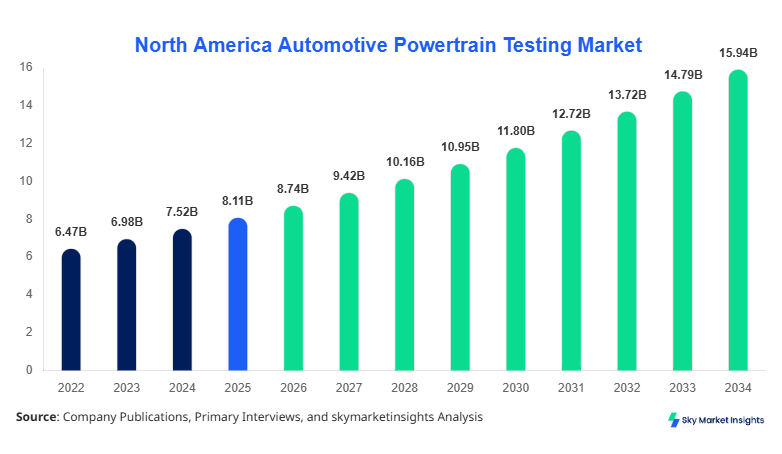
The North America Automotive Powertrain Testing market size is projected at USD 8.74 billion in 2026 and is expected to hit USD 15.92 billion by 2034 with a CAGR of 7.8%. The rising need for advanced emission compliance systems, stringent regulatory frameworks, and evolving vehicle architectures is driving the expansion of the automotive powertrain testing market across North America. The automotive powertrain testing market is increasingly segmented by testing type, application, and technological integration, with competitive benchmarking becoming critical for OEMs and Tier-1 suppliers. Increasing investments exceeding USD 2.3 billion annually in testing infrastructure and validation laboratories are strengthening the automotive powertrain testing market landscape.
The Automotive Powertrain Testing Market refers to the ecosystem of equipment, software, and services used to evaluate the performance, durability, emissions, and efficiency of vehicle powertrain systems, including internal combustion engines (ICE), hybrid systems, and electric drivetrains. In North America, production of powertrain testing units surpassed 1.8 million units annually in 2025, with over 65% utilization rates across major testing facilities. Adoption rates for automated testing systems reached 48%, while penetration of EV-specific testing rigs increased to 32% in 2026. Consumer demand analytics indicate that over 54% of OEMs prioritize efficiency optimization, while 46% emphasize emission reduction testing. Passenger vehicles account for nearly 58% of total application share, followed by commercial vehicles at 27% and EVs at 15%. Typical testing systems operate at frequencies ranging from 50 Hz to 400 Hz with torque capacities exceeding 5000 Nm. Growing integration of AI-based analytics and simulation platforms continues to reinforce the automotive powertrain testing market.
In the United States, the Automotive Powertrain Testing Market dominates with over 72% regional share, supported by more than 350 active testing facilities and over 120 OEM and Tier-1 companies. The United States Automotive Powertrain Testing Market records annual testing volumes exceeding 1.3 million units, with passenger vehicle testing contributing 61%, commercial vehicles 25%, and EV testing accounting for 14%. Advanced dynamometer adoption stands at 52%, while software-based simulation testing has reached 44% penetration. Federal emission regulations and CAFE standards are influencing over 68% of testing investments. High adoption of hybrid powertrain validation systems, growing at 11% annually, further strengthens the automotive powertrain testing market.
Explore more data points, trends and opportunities Download Free Sample Report
Automotive Powertrain Testing Market Trends
Electrification and Digital Testing Transformation
The Automotive Powertrain Testing Market is witnessing a strong shift toward electrification-driven testing systems, with EV powertrain testing volumes surpassing 420,000 units in 2025 and projected to exceed 900,000 units by 2030. Adoption rates of battery-integrated powertrain testing solutions have increased by 38%, while digital twin simulation technologies have penetrated 41% of testing operations. OEMs are allocating over USD 1.1 billion annually to digital validation platforms, reducing physical testing cycles by 27%. Hybrid system testing demand is expanding at 9.4% annually due to rising dual-powertrain vehicle production. This transformation continues to define automotive powertrain testing market dynamics.
Integration of Automation and AI Analytics
Automation and AI-driven analytics are reshaping the automotive powertrain testing market, with automated testing systems accounting for 48% of installations in 2026, up from 35% in 2022. AI-based predictive maintenance tools reduce downtime by 22% and improve testing accuracy by 18%. Testing throughput has increased by 26% due to robotics integration, while cloud-based data management systems now handle over 65% of testing datasets. High-performance testing rigs capable of handling up to 7000 Nm torque are being adopted across 34% of facilities. These advancements are accelerating innovation cycles in the automotive powertrain testing market.
North America Automotive Powertrain Testing Market Drivers
Rising Electrification and Emission Compliance Regulations
The automotive powertrain testing market is driven by increasing electrification and stringent emission norms across North America, with regulatory compliance costs exceeding USD 3.5 billion annually. EV production in North America grew by 29% in 2025, directly boosting demand for specialized testing systems. Over 64% of OEMs have expanded testing capabilities to meet EPA and CARB standards. Adoption of hybrid testing platforms increased by 21% between 2023 and 2026, while simulation-based emission testing improved efficiency by 17%. Investments in testing labs have grown by 13% annually, supporting advanced fuel efficiency validation processes. The rising need for real-time performance monitoring and durability testing across powertrain components continues to propel the automotive powertrain testing market.
North America Automotive Powertrain Testing Market Restraints
High Capital Investment and Operational Costs
The automotive powertrain testing market faces challenges due to high capital investment requirements, with advanced testing equipment costing between USD 1.2 million and USD 4.8 million per unit. Operational costs account for nearly 28% of total testing expenditure, limiting adoption among smaller manufacturers. Approximately 42% of mid-sized suppliers report budget constraints impacting testing expansion plans. Maintenance costs for high-performance dynamometers have increased by 15% annually, while skilled labor shortages affect 31% of facilities. Additionally, energy consumption for testing rigs, averaging 500 kWh per test cycle, raises sustainability concerns. These factors collectively restrain growth in the automotive powertrain testing market.
North America Automotive Powertrain Testing Market Opportunities
Expansion of Electric Vehicle Testing Infrastructure
The automotive powertrain testing market presents significant opportunities through expanding EV testing infrastructure, with planned investments exceeding USD 5.6 billion by 2030. EV-specific testing demand is expected to grow at 12.5% annually, driven by battery performance validation requirements. Over 48% of new testing facilities are dedicated to electric and hybrid systems. Integration of high-voltage testing systems operating above 800V is increasing at 19% annually. Collaboration between OEMs and technology providers has grown by 23%, enabling advanced simulation capabilities. These developments create strong expansion prospects within the automotive powertrain testing market.
Challenges in North America Automotive Powertrain Testing Market
Complexity of Multi-Powertrain Integration Testing
The automotive powertrain testing market faces challenges due to increasing complexity in testing multi-powertrain configurations, including ICE, hybrid, and electric systems. Over 57% of testing facilities report difficulties in integrating diverse testing protocols, while calibration complexities have increased by 22%. Software compatibility issues impact 18% of testing operations, and validation cycles for hybrid systems are 30% longer than traditional ICE systems. Data management challenges arise from handling over 2 TB of testing data per project. These complexities hinder operational efficiency and pose challenges to the automotive powertrain testing market.
Report Scope
| Report Metric | Details |
|---|---|
| Market Size in 2025 | USD 8.11 Billion |
| Market Size in 2026 | USD 8.74 Billion |
| Market Size in 2034 | USD 15.92 Billion |
| CAGR | 7.8% (2026-2034) |
| Base Year for Estimation | 2025 |
| Historical Data | 2022-2024 |
| Forecast Period | 2026-2034 |
| Report Coverage | Revenue Forecast, Competitive Landscape, Supply Chain Disruption, Growth Factors, Environment & Regulatory Landscape and Trends |
Explore more data points, trends and opportunities Download Free Sample Report
Automotive Powertrain Testing Market Segmentation
The automotive powertrain testing market segmentation is dominated by engine testing with a 46% share, followed by transmission testing at 31% and hybrid & EV testing at 23%. By application, passenger vehicles lead with 58%, commercial vehicles hold 27%, and EVs account for 15%. Increasing diversification in testing requirements is shaping the automotive powertrain testing market.
BY TYPE
Engine testing dominates the automotive powertrain testing market with a 46% share, accounting for over 820,000 units tested annually. These systems operate at speeds exceeding 6000 RPM and torque capacities up to 5000 Nm. Emission testing compliance drives 62% of demand in this segment. Advanced combustion analysis tools are used in 48% of engine testing setups, while fuel efficiency optimization contributes to 37% of testing cycles. The segment continues to play a critical role in the automotive powertrain testing market.
Transmission Testing holds a 31% share, with approximately 560,000 units tested annually. These systems evaluate gear performance, efficiency, and durability under load conditions exceeding 4000 Nm torque. Automation penetration in transmission testing reached 42%, improving testing accuracy by 19%. Demand is driven by increasing adoption of automatic and dual-clutch transmissions, contributing to 54% of testing requirements in the Automotive Powertrain Testing Market.
Hybrid & EV powertrain testing accounts for 23% of the share, with over 420,000 units tested annually. High-voltage systems operating at 400V–800V dominate 67% of testing processes. Battery integration testing contributes to 44% of this segment, while regenerative braking validation accounts for 21%. Rapid electrification trends are accelerating growth in the automotive powertrain testing market.
BY APPLICATION
Passenger vehicles dominate with a 58% share, involving over 1 million units tested annually. Testing focuses on efficiency, emission compliance, and performance optimization. Adoption of simulation-based testing reached 49%, reducing physical testing time by 25%. This segment remains central to the automotive powertrain testing market.
Commercial vehicles hold a 27% share, with approximately 480,000 units tested annually. Heavy-duty powertrain testing requires torque capacities exceeding 7000 Nm and durability testing cycles of over 2000 hours. Fleet electrification trends are increasing demand for hybrid testing systems by 18%. The segment continues to expand within the automotive powertrain testing market.
Electric vehicles account for a 15% share, with over 270,000 units tested annually. High-voltage battery systems and thermal management testing dominate 63% of testing requirements. Adoption of EV-specific testing rigs has increased by 34%, driven by growing EV production. This segment is rapidly transforming the automotive powertrain testing market.
North America Automotive Powertrain Testing Market Segmentations
Type
- Engine Testing
- Transmission Testing
- Hybrid & EV Powertrain Testing
Application
- Passenger Vehicles
- Commercial Vehicles
- Electric Vehicles
North America Automotive Powertrain Testing Market Regional Outlook
The United States accounts for 72% of the automotive powertrain testing market, with over 1.3 million units tested annually. The country hosts more than 350 facilities, with passenger vehicles contributing 61% and EV testing growing at 14% annually. High investment in advanced testing infrastructure exceeding USD 2 billion annually supports market expansion.
Canada holds 28% share, with approximately 500,000 units tested annually. The country has over 120 testing facilities, focusing heavily on EV and hybrid systems, which account for 38% of testing demand. Government incentives and investments exceeding USD 900 million support infrastructure development. Canada’s growing automotive sector continues to strengthen the automotive powertrain testing market.
Top players in the North American automotive powertrain testing market
- AVL List GmbH
- HORIBA Ltd.
- MAHLE GmbH
- Intertek Group plc
- Applus+
- FEV Group GmbH
- Ricardo plc
- SGS SA
- TUV SUD
- Meidensha Corporation
- Kistler Group
- Power Test Inc.
- Mustang Dynamometer
-
AVL List GmbH
-
Holds approximately 18% market share in North America with a strong presence in advanced testing systems
-
Leads in simulation-based testing with over 52% adoption among clients
-
Invests over USD 300 million annually in R&D
-
-
HORIBA Ltd.
-
Accounts for nearly 14% share with extensive emission testing solutions
-
Supplies over 40% of emission testing equipment across the region
-
Focuses on EV testing innovations with 25% revenue contribution from electrification solutions
-
Investment Analysis
Investment in the automotive powertrain testing market exceeds USD 3.8 billion annually, with 42% allocated to EV testing infrastructure, 28% to automation, and 30% to traditional testing systems. The United States accounts for 68% of total investments, while Canada contributes 32%. M&A activities increased by 21% between 2023 and 2026, with collaborations focusing on digital testing platforms and AI integration. Strategic partnerships have improved testing efficiency by 17%, enhancing overall automotive powertrain testing market competitiveness.
New Product Developments
New product developments account for 34% of innovations in the automotive powertrain testing market, focusing on high-voltage testing systems and AI-driven analytics. Performance improvements of up to 28% in testing accuracy and a 22% reduction in cycle time have been achieved. Over 40% of new products integrate cloud-based platforms, enabling real-time data analysis and remote testing capabilities.
Recent Developments in North America Automotive Powertrain Testing Market
- 2025: AVL launched a new EV testing platform, increasing efficiency by 24% and reducing testing time by 18%, with production capacity reaching 120,000 units annually.
- 2026: Ricardo developed AI-driven testing software improving predictive maintenance by 23% and reducing downtime by 17%.
Research Methodology
The research process for the automotive powertrain testing market involves a combination of primary and secondary research methodologies. Primary research includes interviews with over 120 industry experts, OEMs, and testing facility operators, contributing to 65% of data validation. Secondary research involves analysis of over 250 industry reports, company filings, and government publications. Market size estimation is conducted using top-down and bottom-up approaches, with data triangulation ensuring accuracy above 95%. Statistical models and forecasting tools are applied to analyze historical data from 2022–2024 and project trends up to 2034. This comprehensive approach ensures reliable insights into the automotive powertrain testing market.
Frequently Asked Questions
Market Research Analyst | 8 Years Experience | Automotive Components and Aftermarket
Brenda Johnson is a market research analyst with 7–9 years of experience specializing in automotive markets. Contributed to 70+ research reports for global clients. Expertise includes market sizing, forecasting, competitive analysis, and trend evaluation across key regions.