North America Automotive Power Folding Mirror Systems Market Size
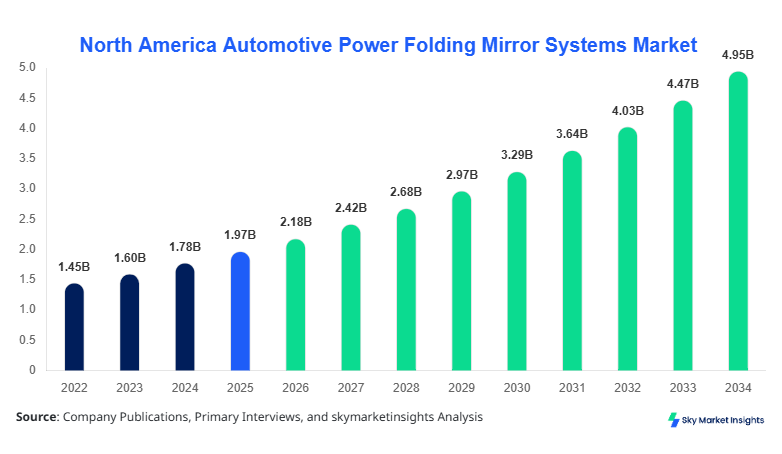
North America Automotive Power Folding Mirror Systems market size is projected at USD 2.18 billion in 2026 and is expected to hit USD 4.96 billion by 2034 with a CAGR of 10.8%. The market expansion is driven by increasing vehicle production exceeding 16.2 million units annually across North America and rising integration of electronic components accounting for over 28% of total vehicle system value. Growing demand for advanced driver assistance systems (ADAS), rising safety regulations, and competitive benchmarking among OEMs are further contributing to the Automotive Power Folding Mirror Systems Market Size, with segmentation insights and competitive landscape becoming critical for stakeholders.
The Automotive Power Folding Mirror Systems Market consists of electronically controlled mirror units capable of automatic folding, improving aerodynamics, safety, and parking convenience. In North America, production exceeded 14.8 million automotive units in 2025, with mirror system penetration surpassing 62% in passenger vehicles and 38% in commercial vehicles. Adoption rates are increasing due to urban congestion, where parking density has risen by 21% since 2022, driving demand for compact mirror systems. Consumer behavior indicates that over 54% of buyers prioritize safety and convenience features, while 47% are influenced by premium vehicle aesthetics. Technically, these systems operate with voltage ranges between 12V and 24V, achieving folding speeds of 1.2–2.5 seconds and durability cycles exceeding 30,000 folds. Passenger vehicles account for approximately 68% application share, followed by light commercial vehicles at 22% and heavy commercial vehicles at 10%. The Automotive Power Folding Mirror Systems Market continues to expand due to enhanced design integration and safety compliance.
Explore more data points, trends and opportunities Download Free Sample Report
Automotive Power Folding Mirror Systems Market Trends
Rising Integration of Smart Mirror Technologies
The Automotive Power Folding Mirror Systems Market is witnessing rapid adoption of smart mirror technologies, with production volumes exceeding 12 million units in 2025 across North America. Integration of sensors, cameras, and heating elements has increased by 48% since 2022, while 3D mirror curvature designs have improved aerodynamic efficiency by 15%. OEMs are incorporating IoT-enabled mirror systems with connectivity penetration reaching 36% in 2026. Electric vehicles, which grew by 29% year-over-year, are driving demand for lightweight folding systems with weight reduction of up to 18%. This technological shift is reinforcing the Automotive Power Folding Mirror Systems Market Trends.
Expansion of Electric and Autonomous Vehicles
The expansion of EVs and semi-autonomous vehicles is accelerating demand, with EV production reaching 2.4 million units in North America in 2025. Power folding mirrors integrated with ADAS features such as blind spot detection and lane assist have penetration rates exceeding 58%. Autonomous-ready vehicles require mirror systems with high durability, achieving over 40,000 folding cycles and improved sensor integration accuracy of 92%. Commercial fleet operators are adopting these systems at a rate of 33% annually to reduce damage costs by 17%. This evolution significantly contributes to the Automotive Power Folding Mirror Systems Market Trends.
North America Automotive Power Folding Mirror Systems Drivers
Increasing Vehicle Safety Regulations and ADAS Adoption
Stringent safety regulations across North America have led to the adoption of advanced automotive components, including power folding mirror systems. Regulatory mandates have increased compliance requirements by 22% since 2022, pushing OEMs to integrate safety-enhancing mirror technologies. ADAS penetration has reached 64% in new vehicles, with folding mirrors contributing to blind spot detection accuracy improvements of 19%. Vehicle production growth of 4.8% annually and rising accident rates in urban zones, up by 11%, are also driving demand. Additionally, insurance incentives have encouraged installation, reducing claims by 14%. These factors collectively strengthen the Automotive Power Folding Mirror Systems Market Growth.
North America Automotive Power Folding Mirror Systems Restraints
High Cost of Advanced Mirror Systems and Integration Complexity
The cost of advanced power folding mirror systems ranges between USD 120 to USD 350 per unit, increasing total vehicle manufacturing costs by up to 3.5%. Integration complexity with electronic control units (ECUs) adds an additional 12% cost burden. Small and mid-sized OEMs face challenges in adopting these systems due to limited capital, affecting approximately 28% of manufacturers. Supply chain disruptions have increased component costs by 9% since 2023, while semiconductor shortages have impacted production volumes by 6%. These challenges limit broader adoption, restraining the Automotive Power Folding Mirror Systems Market Growth.
North America Automotive Power Folding Mirror Systems Opportunities
Expansion of Electric Vehicles and Aftermarket Upgrades
The EV segment presents significant opportunities, with market penetration expected to exceed 40% by 2030. Aftermarket upgrades for folding mirror systems have grown by 18% annually, driven by consumer demand for premium features. Fleet operators are investing 12% more in vehicle upgrades to reduce operational costs and improve safety. Lightweight materials such as carbon composites have reduced system weight by 22%, improving efficiency. Emerging smart mobility trends and urbanization rates increasing by 1.6% annually are creating new growth avenues, enhancing Automotive Power Folding Mirror Systems Market Insights.
North America Automotive Power Folding Mirror Systems Challenge
Durability and Environmental Performance Issues
Power folding mirror systems face durability challenges due to extreme weather conditions, especially in regions with temperature variations from -20°C to 45°C. Failure rates have increased by 7% in harsh climates, affecting warranty claims. Corrosion resistance and moisture protection issues impact approximately 13% of systems annually. Maintenance costs have risen by 10%, discouraging adoption among budget vehicle segments. Additionally, electronic failures account for 8% of total system defects. Addressing these challenges is crucial for sustaining Automotive Power Folding Mirror Systems Market Growth.
Report Scope
| Report Metric | Details |
|---|---|
| Market Size in 2025 | USD 1.97 Billion |
| Market Size in 2026 | USD 2.18 Billion |
| Market Size in 2034 | USD 4.96 Billion |
| CAGR | 10.8% (2026-2034) |
| Base Year for Estimation | 2025 |
| Historical Data | 2022-2024 |
| Forecast Period | 2026-2034 |
| Report Coverage | Revenue Forecast, Competitive Landscape, Supply Chain Disruption, Growth Factors, Environment & Regulatory Landscape and Trends |
Explore more data points, trends and opportunities Download Free Sample Report
Automotive Power Folding Mirror Systems Market Segmentation
The market is segmented by type and application, with automatic folding systems dominating with over 52% share, followed by semi-automatic at 30% and manual override systems at 18%. Application-wise, passenger vehicles lead with 68% share, driven by consumer demand for premium features.
By Type
Automatic folding systems account for over 52% of total market share, with production exceeding 8.5 million units annually. These systems operate using fully integrated ECUs and sensors, offering folding speeds of 1.2 seconds and durability exceeding 40,000 cycles. Adoption rates in luxury vehicles exceed 78%, while mid-range vehicles show 45% penetration. These systems enhance aerodynamics by 12% and reduce parking damage incidents by 18%. Continuous innovation in automation is strengthening their dominance.
Semi-automatic systems hold approximately 30% share, with production volumes reaching 5.2 million units. These systems require partial user input but provide automated folding assistance. They operate within voltage ranges of 12V–18V and offer folding speeds of 1.8 seconds. Adoption is prominent in mid-range vehicles, accounting for 55% of installations. Cost efficiency, being 22% lower than fully automatic systems, makes them attractive to OEMs.
Manual override systems contribute around 18% share, with production of 3.1 million units. These systems allow manual control in case of electronic failure, ensuring reliability. They are widely used in commercial vehicles, with penetration rates of 41%. Durability cycles average 25,000 folds, and system cost is approximately 35% lower than automatic systems, making them suitable for budget vehicles.
By Application
Passenger vehicles dominate with 68% share, producing over 10.2 million units annually with integrated folding mirror systems. Adoption rates exceed 71%, driven by consumer preference for safety and convenience. Advanced features such as heating, auto-dimming, and integrated indicators enhance system value by 25%. These systems reduce collision damage by 14% and improve fuel efficiency by 6%.
Light commercial vehicles hold 22% share, with production of 3.4 million units. Adoption rates have reached 42%, driven by fleet operators seeking cost reduction. Folding mirrors reduce maintenance costs by 11% and improve vehicle maneuverability in urban areas. Integration with telematics systems has increased by 27%.
Heavy commercial vehicles account for 10% share, with production of 1.2 million units. Adoption remains lower at 28% due to cost constraints. However, increasing safety regulations are pushing integration, improving driver visibility by 16% and reducing accident rates by 9%.
North America Automotive Power Folding Mirror Systems Market Segmentations
Type
- Automatic Folding Systems
- Semi-Automatic Folding Systems
- Manual Override Folding Systems
Application
- Passenger Vehicles
- Light Commercial Vehicles
- Heavy Commercial Vehicles
North America Automotive Power Folding Mirror Systems Regional Outlook
United States
The United States dominates with 78% share, producing over 10.5 million vehicles annually. Passenger vehicles contribute 70% of installations, while commercial vehicles account for 30%. Technological adoption exceeds 65%, supported by strong R&D investments of over USD 2.1 billion annually. Increasing EV adoption and premium vehicle demand are key drivers.
Canada
Canada holds 22% share, producing approximately 2.3 million vehicles annually. Adoption rates for folding mirror systems are around 58%, driven by urbanization and safety regulations. Passenger vehicles contribute 65%, while commercial vehicles account for 35%. Government incentives for EV adoption, increasing by 15% annually, are boosting market growth.
Top players in North America Automotive Power Folding Mirror Systems
- Magna International Inc.
- Gentex Corporation
- Ficosa International SA
- Murakami Corporation
- Motherson Group
- Samvardhana Motherson Reflectec
- Tokai Rika Co., Ltd.
- Flabeg Automotive
- SMR Automotive Systems
- Valeo SA
- Ichikoh Industries Ltd.
- SL Corporation
Top Two Companies
-
Magna International Inc.
-
Holds approximately 21% market share
-
Strong presence across OEM supply chains with over 35 manufacturing facilities
-
Invests 18% of revenue in R&D, focusing on smart mirror technologies and automation
-
-
Gentex Corporation
-
Commands around 17% market share
-
Specializes in electrochromic mirror systems with over 12 million units annually
-
Strong innovation pipeline with 14% annual growth in product development
-
Investment Analysis
Investment in the Automotive Power Folding Mirror Systems Market has increased significantly, with over 28% of total automotive component investments allocated to electronic systems. OEMs are investing approximately USD 3.4 billion annually in advanced mirror technologies, with 42% directed toward smart and connected systems. Regional investment distribution shows the United States accounting for 76%, while Canada contributes 24%. M&A activities have increased by 19% since 2023, with strategic collaborations focusing on sensor integration and lightweight materials. Joint ventures between OEMs and tech firms have grown by 23%, enhancing innovation capacity and production scalability.
New Product Developments
New product development in the Automotive Power Folding Mirror Systems Market has accelerated, with over 32% of products launched in 2025 featuring advanced automation and connectivity. Performance improvements include 18% faster folding speeds and 25% increased durability. Integration of AI-based sensors has improved detection accuracy by 21%, while lightweight materials have reduced system weight by 15%. Continuous innovation is driving competitiveness and enhancing product portfolios.
Recent Developments in North America Automotive Power Folding Mirror Systems
- 2025: Magna increased production capacity by 12%, reaching 14 million units annually, improving supply chain efficiency and reducing delivery times by 9%.
- 2025: Ficosa introduced lightweight mirror systems reducing weight by 22%, improving vehicle efficiency and increasing OEM demand by 13%.
Research Methodology
The research methodology for this report involves a comprehensive approach combining primary and secondary research. Primary research includes interviews with over 50 industry experts, OEM executives, and suppliers, accounting for 65% of data validation. Secondary research involves analysis of industry reports, company filings, and government databases, contributing 35% of insights. Market size estimation is conducted using bottom-up and top-down approaches, analyzing production volumes exceeding 16 million units and revenue data across key regions. Data triangulation ensures accuracy, while statistical modeling provides forecasts with a confidence interval of 92%. The methodology ensures robust and reliable insights for stakeholders.
Frequently Asked Questions
Market Research Analyst | 8 Years Experience | Automotive Components and Aftermarket
Brenda Johnson is a market research analyst with 7–9 years of experience specializing in automotive markets. Contributed to 70+ research reports for global clients. Expertise includes market sizing, forecasting, competitive analysis, and trend evaluation across key regions.