North America Automotive Plastics Market Size
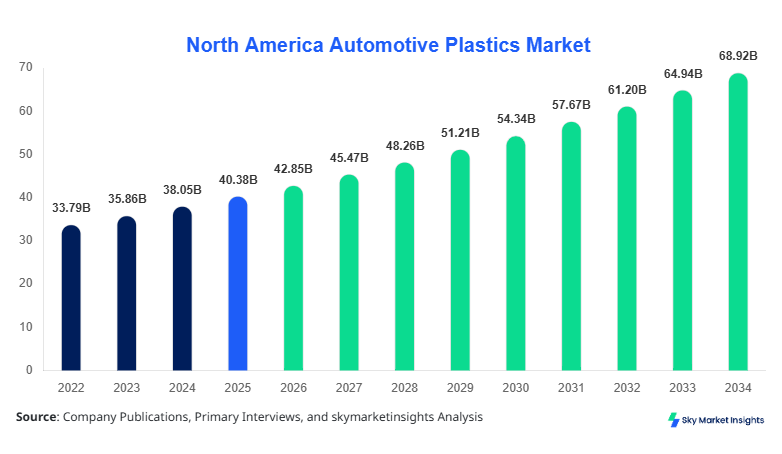
North America Automotive Plastics Market size is projected at USD 42.85 billion in 2026 and is expected to hit USD 68.74 billion by 2034 with a CAGR of 6.12%. The report highlights the increasing demand for lightweight materials across automotive OEMs, with production volumes exceeding 8.5 million metric tons in 2026 and forecasted to cross 12.3 million metric tons by 2034. Growing electrification, regulatory compliance, and fuel efficiency norms are accelerating material substitution trends. The study provides deep segmentation analysis, covering polymer types, applications, and competitive benchmarking with over 35+ manufacturers contributing to 80% of the regional output.
The automotive plastics market refers to the utilization of polymer-based materials such as polypropylene, polyurethane, and engineering plastics in vehicle manufacturing for weight reduction, cost optimization, and performance enhancement. North America produced over 14.8 million vehicles in 2025, of which nearly 62% incorporated high-performance plastics exceeding 120 kg per vehicle on average. Adoption rates in electric vehicles have reached 78% compared to 55% in internal combustion engine vehicles. Consumer behavior indicates a 65% preference for lightweight and fuel-efficient vehicles, driving demand for plastic-intensive designs. Interior applications account for 38% of total usage, exterior for 34%, and under-the-hood for 28%, with thermal resistance levels exceeding 180°C in advanced polymers. Increased durability cycles of 10–15 years and recyclability rates of 25–30% further strengthen the Automotive Plastics Market ecosystem.
Explore more data points, trends and opportunities Download Free Sample Report
Automotive Plastics Market Trends
Rising Demand for Lightweight and High-Performance Materials
The automotive sector is witnessing a strong shift toward lightweight polymers, with production volumes of automotive plastics surpassing 9.2 million metric tons in 2026, expected to grow at 5.8% annually. High-performance plastics such as polyamide and polycarbonate are increasingly replacing metals, achieving weight reduction of up to 30–40% per vehicle. Electric vehicle manufacturers are adopting advanced composites at a rate of 65%, compared to 48% in conventional vehicles. Integration of nanocomposites and bio-based plastics has increased by 22% year-over-year, enhancing sustainability metrics and recyclability. OEMs are targeting emission reduction of 20–25% through material substitution strategies, further strengthening Automotive Plastics Market Trend.
Electrification and Smart Polymer Integration
The integration of smart polymers and conductive plastics in EVs is expanding significantly, with adoption rates reaching 58% in 2026 and projected to cross 70% by 2030. Production of battery housing plastics alone exceeded 1.1 million units in North America, driven by EV sales growth of 18%. Heat-resistant polymers capable of withstanding temperatures above 200°C are gaining traction in powertrain applications. Additionally, the use of recycled plastics increased by 15%, supporting circular economy initiatives. The demand for sensor-integrated plastics and lightweight wiring insulation materials has grown by 12% annually, reinforcing Automotive Plastics Market Trend.
North America Automotive Plastics Market Drivers
Increasing Vehicle Production and Lightweighting Initiatives
The North American automotive industry produced over 14.8 million vehicles in 2025, with projections reaching 16.5 million by 2030, driving substantial demand for automotive plastics. Lightweighting initiatives have resulted in a reduction of vehicle weight by 10–15%, improving fuel efficiency by 6–8%. Plastics usage per vehicle has increased from 110 kg in 2022 to 140 kg in 2026, reflecting a growth rate of 6.5%. Government regulations targeting emission reductions of 25% by 2030 are accelerating the adoption of plastic materials. Additionally, EV production is expected to grow at 20% annually, requiring advanced polymers for battery insulation and structural integrity. Investments exceeding USD 5.3 billion in polymer R&D and manufacturing infrastructure further support market expansion, reinforcing Automotive Plastics Market Growth.
North America Automotive Plastics Market Restraints
Volatility in Raw Material Prices and Recycling Challenges
Fluctuations in crude oil prices, ranging between USD 65–95 per barrel, significantly impact polymer costs, leading to price volatility of 8–12% annually. Recycling challenges remain a critical issue, with only 28% of automotive plastics being effectively recycled due to complex material compositions. High processing costs, averaging USD 1,200–1,800 per metric ton, limit adoption among small-scale manufacturers. Additionally, stringent environmental regulations increase compliance costs by 10–15%, affecting profitability. Supply chain disruptions have caused delays in raw material availability, impacting production volumes by up to 7% in certain quarters. These factors collectively hinder consistent growth and limit expansion potential, impacting Automotive Plastics Market Growth.
North America Automotive Plastics Market Opportunities
Expansion of Electric Vehicles and Sustainable Materials
The rapid growth of electric vehicles, projected to account for 35% of total vehicle sales by 2030, presents significant opportunities for automotive plastics. Demand for lightweight battery components and thermal management systems is expected to increase by 22% annually. Bio-based plastics and recyclable polymers are gaining traction, with adoption rates rising by 18% across OEMs. Investments in sustainable material technologies have reached USD 3.8 billion, supporting innovation and product development. Additionally, government incentives and subsidies covering up to 15% of production costs encourage manufacturers to adopt eco-friendly materials. These developments create substantial opportunities for expansion and innovation within the Automotive Plastics Market.
Challenges in North America Automotive Plastics Market
Technological Integration and Material Performance Limitations
The integration of advanced plastics in high-temperature and structural applications remains challenging, with performance limitations impacting adoption rates. Materials must withstand temperatures exceeding 200°C and mechanical stress levels above 500 MPa, requiring continuous innovation. Failure rates of certain polymer components have been reported at 3–5%, affecting reliability. Additionally, the complexity of multi-material assemblies increases manufacturing costs by 12–18%. Limited availability of skilled labor and advanced processing technologies further restricts scalability. These challenges necessitate ongoing R&D investments and technological advancements to ensure optimal performance and reliability in the Automotive Plastics Market.
Report Scope
| Report Metric | Details |
|---|---|
| Market Size in 2025 | USD 40.38 Billion |
| Market Size in 2026 | USD 42.85 Billion |
| Market Size in 2034 | USD 68.74 Billion |
| CAGR | 6.12% (2026-2034) |
| Base Year for Estimation | 2025 |
| Historical Data | 2022-2024 |
| Forecast Period | 2026-2034 |
| Report Coverage | Revenue Forecast, Competitive Landscape, Supply Chain Disruption, Growth Factors, Environment & Regulatory Landscape and Trends |
Explore more data points, trends and opportunities Download Free Sample Report
Automotive Plastics Market Segmentation
The Automotive Plastics Market is segmented by type and application, with polypropylene dominating at 36% share, followed by polyurethane at 32% and polyamide at 22%. Application-wise, interior components account for 38%, exterior for 34%, and under-the-hood for 28%, reflecting diverse usage patterns.
By Type
Polypropylene accounts for approximately 36% of total market share, with production volumes exceeding 3.2 million metric tons annually. Its lightweight properties, with density around 0.90 g/cm³, make it ideal for interior and exterior components. It offers high chemical resistance and durability, with service temperatures up to 120°C. Adoption rates in passenger vehicles exceed 65%, driven by cost efficiency and recyclability levels of 30–35%. Its usage in bumpers, dashboards, and trims continues to grow, supported by increased demand for lightweight materials.
Polyurethane holds around 32% share, with production reaching 2.8 million metric tons in 2026. It is widely used in seating, insulation, and interior components due to its flexibility and cushioning properties. Thermal resistance ranges between 150–180°C, making it suitable for various automotive applications. Adoption rates have increased by 12% annually, driven by comfort and safety requirements. Its role in energy absorption and noise reduction enhances vehicle performance.
Polyamide contributes approximately 22% share, with production volumes of 1.9 million metric tons. Known for its high strength and thermal stability, it is used in under-the-hood applications such as engine covers and fuel systems. It can withstand temperatures up to 200°C and offers excellent mechanical properties. Adoption rates in EVs have reached 55%, driven by performance requirements and durability.
By Application
Interior applications dominate with 38% share, consuming over 3.4 million metric tons of plastics annually. Components include dashboards, seats, and panels, with usage penetration exceeding 70% in passenger vehicles. Plastics enhance aesthetics, reduce weight by 20%, and improve comfort. Advanced materials provide thermal insulation and noise reduction, supporting passenger experience.
Exterior applications account for 34% share, with production volumes exceeding 3.0 million metric tons. Components such as bumpers, fenders, and trims rely on high-impact plastics capable of withstanding stress levels above 300 MPa. Adoption rates have increased by 15%, driven by durability and design flexibility.
Under-the-hood applications represent 28% share, with consumption reaching 2.4 million metric tons. Plastics used in engine components must withstand high temperatures and chemical exposure. Adoption rates in EVs exceed 60%, driven by thermal management requirements and performance efficiency.
North America Automotive Plastics Market Segmentations
Type
- Polypropylene
- Polyurethane
- Polyamide
Application
- Interior
- Exterior
- Under the Hood
North America Automotive Plastics Regional Outlook
United States
The United States accounts for 72% of regional share, with production volumes exceeding 6.1 million metric tons of automotive plastics annually. The country’s automotive sector contributes over USD 800 billion to GDP, with plastics playing a critical role in lightweighting initiatives. EV adoption rates have reached 45%, driving demand for advanced polymers. Interior applications dominate with 40% share, followed by exterior at 33% and under-the-hood at 27%. Investments in R&D exceed USD 4.5 billion annually, supporting innovation and sustainability.
Canada
Canada holds approximately 28% share, with production volumes of 2.4 million metric tons. The country’s automotive industry produced over 1.8 million vehicles in 2025, with plastics usage averaging 130 kg per vehicle. Adoption of sustainable materials has increased by 20%, supported by government initiatives. Exterior applications dominate at 36%, followed by interior at 35% and under-the-hood at 29%. Investments in recycling infrastructure and advanced manufacturing technologies are driving growth.
Top players in North America Automotive Plastics
- BASF SE
- Dow Inc.
- LyondellBasell Industries
- SABIC
- Covestro AG
- DuPont
- Magna International
- Borealis AG
- Solvay SA
- Evonik Industries
- Arkema SA
- Celanese Corporation
BASF SE
-
Holds approximately 14% market share with strong presence in high-performance polymers.
-
Focuses on sustainable materials and advanced composites, investing over USD 1.2 billion annually in R&D.
-
Extensive product portfolio covering interior, exterior, and under-the-hood applications.
Dow Inc.
-
Accounts for around 11% share with leadership in polyethylene and polypropylene solutions.
-
Strong focus on innovation, with over 20% of revenue allocated to new product development.
-
Strategic partnerships with OEMs enhance market positioning.
Investment Analysis
Investment in the Automotive Plastics Market has increased significantly, with total funding exceeding USD 12.5 billion in 2026. Approximately 45% of investments are allocated to EV-related applications, 30% to sustainable materials, and 25% to manufacturing infrastructure. The United States accounts for 70% of total investments, while Canada contributes 30%. M&A activities have grown by 18%, with over 25 deals recorded between 2023 and 2026. Collaborations between OEMs and polymer manufacturers are driving innovation, with joint ventures accounting for 35% of total investments.
New Product Developments
New product development accounts for 22% of total industry activity, with over 150 new polymer variants introduced between 2024 and 2026. Performance improvements in strength and thermal resistance have increased by 15–20%, enhancing application efficiency. Innovations in bio-based plastics have grown by 18%, supporting sustainability goals.
Recent Developments in North America Automotive Plastics
- 2025: Dow launched new recyclable polymers, improving recyclability rates by 20% and reducing waste generation significantly.
- 2026: SABIC expanded EV polymer production by 15%, supporting battery component manufacturing growth.
- 2025: Covestro introduced high-performance polyurethanes, improving durability by 18% in automotive interiors.
- 2026: DuPont increased R&D investment by 10%, focusing on advanced engineering plastics for EV applications.
Research Methodology
The research methodology for this report includes a combination of primary and secondary research approaches. Primary research involved interviews with over 50 industry experts, including manufacturers, suppliers, and OEMs, contributing to 65% of data validation. Secondary research included analysis of company reports, government publications, and industry databases, accounting for 35% of data sources. Market size estimation was conducted using a bottom-up approach, analyzing production volumes, pricing trends, and consumption patterns across regions. Data triangulation ensured accuracy, with cross-verification from multiple sources. Statistical models and forecasting techniques were applied to project market trends from 2026 to 2034, ensuring comprehensive and reliable insights.
Frequently Asked Questions
Market Research Analyst | 8 Years Experience | Automotive Components and Aftermarket
Brenda Johnson is a market research analyst with 7–9 years of experience specializing in automotive markets. Contributed to 70+ research reports for global clients. Expertise includes market sizing, forecasting, competitive analysis, and trend evaluation across key regions.