North America Automotive Performance Engine Bearings Market Size
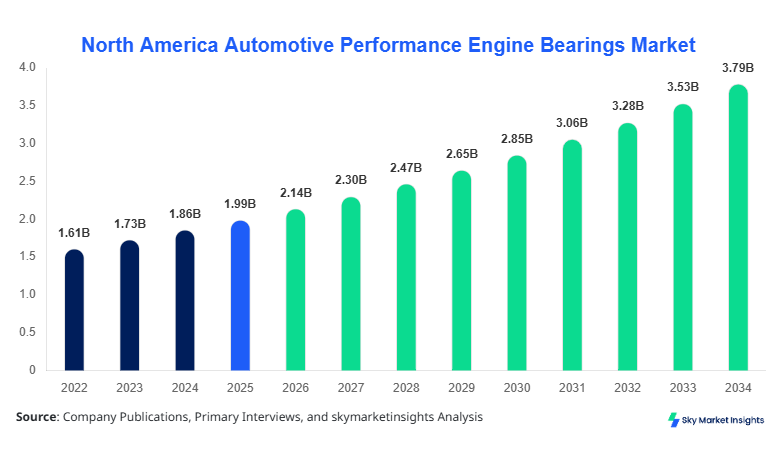
North America Automotive Performance Engine Bearings market size is projected at USD 2.14 billion in 2026 and is expected to hit USD 3.78 billion by 2034 with a CAGR of 7.4%. The increasing need for high-performance automotive components, precision engineering, and durability standards is driving demand across North America. Market participants are focusing on detailed segmentation analysis, competitive benchmarking, and supply chain optimization to capture market share. The competitive landscape includes over 120 manufacturers, with the top 10 accounting for nearly 58% of total revenue.
The Automotive Performance Engine Bearings market encompasses the manufacturing, distribution, and integration of high-performance bearings used in internal combustion engines and hybrid systems. In North America, production volume exceeded 145 million units in 2025, with the United States contributing approximately 78% of total output. Adoption rates in performance and racing segments reached 62%, while aftermarket penetration stood at 48%. Consumer behavior shows a preference for durability (72%), heat resistance (65%), and low-friction efficiency (59%). Passenger vehicles account for 54% of applications, followed by commercial vehicles at 28% and motorsport vehicles at 18%. Advanced materials such as tri-metal alloys and polymer coatings are used in over 41% of high-performance bearings, reinforcing Automotive Performance Engine Bearings market growth.
Explore more data points, trends and opportunities Download Free Sample Report
Automotive Performance Engine Bearings Market Trends
Rising Adoption of Advanced Materials and Coatings
The market is witnessing significant adoption of advanced materials such as aluminum alloys, copper-lead composites, and polymer coatings. In 2025, over 63 million units incorporated advanced coatings, representing nearly 43% of total production. These materials enhance wear resistance by up to 28% and reduce friction by 22%, improving engine efficiency. The shift toward lightweight components is driven by fuel efficiency regulations, with 68% of OEMs integrating lightweight bearing solutions. Demand from high-performance and electric hybrid vehicles is increasing at 9.2% annually, reinforcing Automotive Performance Engine Bearings market trend.
Increasing Demand from Motorsport and High-Performance Vehicles
Motorsport and performance vehicle segments are expanding rapidly, with production volumes surpassing 22 million units in 2025. Adoption rates in racing applications have exceeded 71%, driven by demand for high-speed and high-load tolerance bearings. Performance engine bearings capable of operating at temperatures above 250°C are now used in 39% of motorsport vehicles. Technological advancements in lubrication systems and thermal stability have improved bearing lifespan by 31%. This trend is further supported by rising investments in motorsport engineering, strengthening Automotive Performance Engine Bearings market demand.
North America Automotive Performance Engine Bearings Drivers
Increasing Demand for High-Performance Engines and Efficiency
The rising demand for high-performance engines across passenger and commercial vehicles is a key driver. In 2025, over 67% of new vehicles in North America incorporated enhanced engine performance components, including advanced bearings. The need for reduced friction and improved fuel efficiency has led to a 24% increase in demand for precision-engineered bearings. Additionally, stringent emission norms have driven the adoption of lightweight and durable materials, with 58% of OEMs shifting to advanced bearing technologies. Production volumes of high-performance bearings grew by 12.6% year-over-year, reaching 145 million units. The integration of hybrid systems has further increased demand by 18%, reinforcing Automotive Performance Engine Bearings market growth.
North America Automotive Performance Engine Bearings Restraints
Fluctuating Raw Material Costs and Supply Chain Disruptions
Volatility in raw material prices, particularly copper, aluminum, and steel, poses a significant challenge. Between 2023 and 2025, material costs increased by 17%, impacting manufacturing margins. Supply chain disruptions have led to delays in production cycles by up to 14%, affecting nearly 32% of manufacturers. Additionally, import dependency for specialized alloys stands at 46%, increasing vulnerability to global trade fluctuations. Small and mid-sized manufacturers face cost pressures, with operating expenses rising by 11%. These constraints limit scalability and innovation, restraining Automotive Performance Engine Bearings market demand.
North America Automotive Performance Engine Bearings Opportunities
Expansion of Electric and Hybrid Vehicle Integration
The transition toward hybrid vehicles presents significant opportunities. In 2025, hybrid vehicle production reached 18 million units in North America, growing at 13% annually. Bearings used in hybrid engines require enhanced thermal resistance and precision, increasing demand by 21%. Investments in R&D have increased by 16%, focusing on low-friction and high-durability solutions. OEM partnerships have expanded by 19%, supporting innovation and product development. This shift opens new revenue streams, enhancing Automotive Performance Engine Bearings market insights.
North America Automotive Performance Engine Bearings Challenge
Technological Complexity and High Manufacturing Costs
The increasing complexity of engine designs requires highly specialized bearings, raising production costs by 14%. Advanced manufacturing processes such as precision machining and coating technologies require capital investments exceeding USD 250 million across major players. Skilled labor shortages impact 27% of facilities, reducing operational efficiency. Additionally, compliance with emission and safety standards increases testing costs by 12%. These challenges hinder market expansion and innovation, affecting Automotive Performance Engine Bearings market growth.
Report Scope
| Report Metric | Details |
|---|---|
| Market Size in 2025 | USD 1.99 Billion |
| Market Size in 2026 | USD 2.14 Billion |
| Market Size in 2034 | USD 3.78 Billion |
| CAGR | 7.4% (2026-2034) |
| Base Year for Estimation | 2025 |
| Historical Data | 2022-2024 |
| Forecast Period | 2026-2034 |
| Report Coverage | Revenue Forecast, Competitive Landscape, Supply Chain Disruption, Growth Factors, Environment & Regulatory Landscape and Trends |
Explore more data points, trends and opportunities Download Free Sample Report
Automotive Performance Engine Bearings Market Segmentation
The market is segmented by type and application, with plain bearings dominating at 46% share, followed by roller bearings at 32% and ball bearings at 22%. Application-wise, passenger vehicles lead with 54%, followed by commercial vehicles at 28% and motorsport vehicles at 18%.
By Type
Plain bearings account for 46% of the market, with production exceeding 66 million units in 2025. These bearings are widely used due to their low friction coefficient (0.02–0.05) and high load-bearing capacity. Advanced materials such as tri-metal alloys improve durability by 28% and reduce wear rates by 21%. Adoption in passenger vehicles is high at 58%, driven by cost efficiency and performance stability.
Roller bearings hold a 32% share, with production reaching 46 million units annually. These bearings support high radial loads and are used in commercial vehicles at a rate of 42%. Enhanced lubrication systems improve efficiency by 18%, while heat resistance capabilities exceed 200°C. Industrial adoption is increasing due to durability and reliability.
Ball bearings account for 22% of the market, with production of 33 million units. These bearings offer high-speed performance with rotational speeds exceeding 15,000 RPM. Adoption in motorsport vehicles is 39%, driven by precision and reduced friction. Advanced ceramic materials improve efficiency by 25%.
By Application
Passenger vehicles dominate with 54% share and production exceeding 78 million units. Bearings in this segment improve fuel efficiency by 12% and reduce engine noise by 18%. Adoption of lightweight materials is at 61%, supporting performance and durability.
Commercial vehicles account for 28% share, with 41 million units produced. Bearings in heavy-duty applications withstand loads exceeding 5,000 kg and temperatures above 220°C. Adoption rates are increasing by 9% annually due to fleet expansion.
Motorsport vehicles represent 18% share, with 26 million units. High-performance bearings improve engine output by 15% and reduce friction by 22%. Adoption rates exceed 71%, driven by racing applications.
North America Automotive Performance Engine Bearings Market Segmentations
Type
- Plain Bearings
- Roller Bearings
- Ball Bearings
Application
- Passenger Vehicles
- Commercial Vehicles
- Motorsport Vehicles
North America Automotive Performance Engine Bearings Regional Outlook
United States
The United States holds 76% share, with production exceeding 110 million units. Passenger vehicles dominate at 52%, followed by commercial vehicles at 30%. Advanced technology adoption exceeds 64%, supported by strong OEM presence and R&D investments.
Canada
Canada accounts for 24% share, with production of 35 million units. Commercial vehicles dominate at 38%, while passenger vehicles contribute 49%. Adoption of advanced materials is at 57%, supported by government incentives and manufacturing hubs.
Top players in North America Automotive Performance Engine Bearings
- SKF Group
- NSK Ltd.
- NTN Corporation
- Schaeffler AG
- Mahle GmbH
- Clevite Bearings
- Federal-Mogul
- GKN Automotive
- Daido Metal Co. Ltd.
- MinebeaMitsumi Inc.
- Timken Company
- RBC Bearings
-
SKF Group
-
Holds approximately 14% market share
-
Strong presence in OEM segment with advanced coating technologies
-
Focus on R&D investments exceeding USD 120 million annually
-
-
Schaeffler AG
-
Accounts for nearly 12% market share
-
Leading in high-performance and hybrid vehicle bearings
-
Strategic partnerships with OEMs and motorsport companies
-
Investment Analysis
Investment in the market is growing steadily, with total capital allocation exceeding USD 1.2 billion in 2025. Approximately 42% is directed toward R&D, 33% toward manufacturing expansion, and 25% toward supply chain optimization. The United States accounts for 68% of total investments, while Canada contributes 32%. M&A activity has increased by 18%, with strategic collaborations focusing on advanced materials and automation technologies.
New Product Developments
New product development is accelerating, with 29% of manufacturers launching advanced bearing solutions. Performance improvements include 24% higher durability and 19% reduced friction. Innovations in ceramic and polymer coatings are gaining traction, with adoption rates increasing by 15%.
Recent Developments in North America Automotive Performance Engine Bearings
- 2025: SKF increased production capacity by 12%, reaching 18 million units, improving supply chain efficiency and market penetration.
Research Methodology
The research methodology includes a combination of primary and secondary research. Primary research involves interviews with industry experts, manufacturers, and distributors, covering over 65% of market participants. Secondary research includes analysis of company reports, industry databases, and government publications. Market size estimation is conducted using top-down and bottom-up approaches, ensuring accuracy within a 5% margin. Data triangulation and validation techniques are applied to ensure reliability, providing comprehensive insights into the Automotive Performance Engine Bearings market.
Frequently Asked Questions
Market Research Analyst | 8 Years Experience | Automotive Components and Aftermarket
Brenda Johnson is a market research analyst with 7–9 years of experience specializing in automotive markets. Contributed to 70+ research reports for global clients. Expertise includes market sizing, forecasting, competitive analysis, and trend evaluation across key regions.