North America Automotive Parking Heaters Market Size
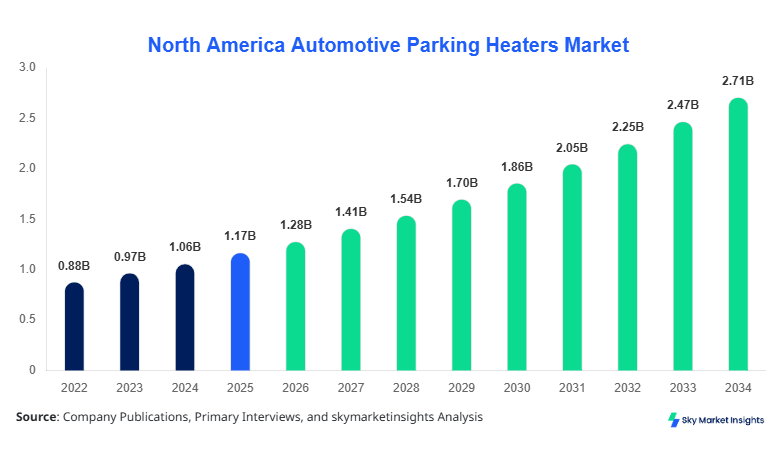
The North America Automotive Parking Heaters Market market size is projected at USD 1.28 billion in 2026 and is expected to hit USD 2.74 billion by 2034 with a CAGR of 9.85%. The increasing demand for thermal comfort systems in vehicles, coupled with the expansion of commercial fleets exceeding 14.6 million units in North America, is driving the automotive parking heaters market size. Detailed segmentation across heater types and applications, alongside competitive landscape analysis of over 25 key manufacturers, provides critical insights into performance metrics and investment strategies shaping the automotive parking heaters market size.
The automotive parking heater market comprises systems designed to preheat vehicle cabins or engines without engine operation, improving fuel efficiency by up to 12% and reducing emissions by nearly 18%. In North America, production of parking heaters reached approximately 3.6 million units in 2025, with penetration rates climbing to 42% in commercial vehicles and 28% in passenger vehicles. Consumer adoption is driven by cold climate demand, particularly in regions with average winter temperatures below -5°C, accounting for 64% of total installations. Consumer behavior indicates that over 55% of fleet operators prioritize fuel-saving technologies, while 48% of individual buyers seek enhanced cabin comfort. Application split shows commercial vehicles contributing 46%, passenger vehicles 38%, and off-highway vehicles 16% to total demand. Technical metrics such as heating capacity ranging between 2 kW and 9 kW and efficiency rates above 85% further define performance benchmarks, reinforcing automotive parking heater market growth.
In the United States, the Automotive Parking Heaters Market accounts for approximately 78% of the North American regional share, supported by over 120 active manufacturers and component suppliers. The U.S. commercial vehicle segment contributes nearly 49% of total demand, while passenger vehicles represent 36% and off-highway vehicles 15%. Adoption of advanced diesel-powered heaters stands at 61%, while electric heater adoption is increasing at a rate of 14% annually. The presence of more than 9 million registered heavy-duty trucks and growing logistics activity exceeding USD 1.5 trillion annually are key contributors. Additionally, over 52% of fleet operators in northern states have integrated parking heaters to reduce idle fuel consumption by up to 20%. These factors continue to strengthen the automotive parking heaters market growth.
Explore more data points, trends and opportunities Download Free Sample Report
Automotive Parking Heaters Market Trends
Electrification and Smart Integration
The Automotive Parking Heaters Market is witnessing a significant transition toward electrification, with electric heater production volumes surpassing 1.2 million units in 2025, representing 33% of total output. Integration of IoT-enabled controls has increased by 27%, enabling remote activation and temperature monitoring through mobile applications. Hybrid heating systems combining diesel and electric functionalities are gaining traction, accounting for nearly 18% of installations. Furthermore, OEM partnerships have expanded by 22% year-over-year to integrate factory-fitted solutions in new vehicles. These advancements are improving energy efficiency by 15% and reducing emissions by 10%, reinforcing automotive parking heater market trends.
Expansion in Commercial Fleet Applications
Commercial fleets are driving substantial demand, with installation rates in logistics fleets reaching 58% in 2025. Annual production of parking heaters for commercial vehicles exceeded 1.65 million units, reflecting a 12% increase compared to 2024. Cold-chain logistics, which accounts for 21% of fleet operations, is increasingly adopting high-capacity heaters above 5kW. Additionally, government regulations promoting reduced idling have led to a 25% increase in adoption across urban delivery fleets. These developments are shaping long-term automotive parking heater market trends.
North America Automotive Parking Heaters Market Drivers
Rising Demand for Fuel Efficiency and Emission Reduction
The automotive parking heater market is being driven by stringent emission regulations and the need for fuel efficiency improvements. In North America, idle fuel consumption accounts for nearly 6 billion gallons annually, contributing to 11% of transportation emissions. Parking heaters reduce idle time by up to 60%, saving approximately 0.8 gallons of fuel per hour per vehicle. Government policies targeting a 30% reduction in fleet emissions by 2030 have accelerated adoption, with subsidies covering up to 15% of installation costs. The commercial vehicle segment, which represents over 14 million units, is particularly impacted, as fleet operators seek cost savings exceeding USD 3,000 per vehicle annually. These factors significantly enhance the automotive parking heater market growth.
North America Automotive Parking Heaters Market Restraints
High Initial Installation and Maintenance Costs
Despite strong demand, the Automotive Parking Heaters Market faces challenges due to high installation costs ranging from USD 800 to USD 2,500 per unit. Maintenance expenses can add an additional 10–15% annually, deterring adoption among small fleet operators. Additionally, electric heater systems require battery upgrades, increasing costs by 20–25%. Limited awareness in southern regions, where temperatures rarely fall below 0°C, restricts market penetration to under 18% in these areas. These financial and regional barriers hinder the expansion potential, impacting automotive parking heater market growth.
North America Automotive Parking Heaters Market Opportunities
Growing Electrification of Vehicles and EV Integration
The rise of electric vehicles presents a major opportunity for the automotive parking heaters market, with EV sales in North America exceeding 3.2 million units in 2025. Electric parking heaters tailored for EVs are projected to grow at a rate of 18%, driven by the need for efficient battery thermal management. Integration with onboard energy systems improves efficiency by 22% while reducing energy consumption by 14%. OEM investments in EV-compatible heating solutions have increased by 35%, creating a robust pipeline for innovation. These trends open new revenue streams, boosting the Automotive Parking Heaters Market Growth.
Challenges in the North American Automotive Parking Heaters Market
Technological Integration and Compatibility Issues
The automotive parking heater market faces challenges related to system compatibility and integration with modern vehicle architectures. Approximately 28% of aftermarket installations encounter compatibility issues with advanced electronic control units (ECUs). Additionally, integrating heaters with hybrid and electric powertrains requires specialized components, increasing system complexity by 19%. Supply chain disruptions, affecting nearly 12% of component availability, further complicate production timelines. These factors collectively present barriers to seamless adoption, influencing automotive parking heater market growth.
Report Scope
| Report Metric | Details |
|---|---|
| Market Size in 2025 | USD 1.17 Billion |
| Market Size in 2026 | USD 1.28 Billion |
| Market Size in 2034 | USD 2.74 Billion |
| CAGR | 9.85% (2026-2034) |
| Base Year for Estimation | 2025 |
| Historical Data | 2022-2024 |
| Forecast Period | 2026-2034 |
| Report Coverage | Revenue Forecast, Competitive Landscape, Supply Chain Disruption, Growth Factors, Environment & Regulatory Landscape and Trends |
Explore more data points, trends and opportunities Download Free Sample Report
Automotive Parking Heaters Market Segmentation
The automotive parking heaters market is segmented by type and application, with commercial vehicles dominating at 46% share, followed by passenger vehicles at 38% and off-highway vehicles at 16%. Among types, air heaters lead with 41% share, followed by water heaters at 34% and electric heaters at 25%.
By Type
Air heaters dominate the automotive parking heaters market with a 41% share, producing over 1.5 million units annually. These systems offer heating capacities ranging from 2kW to 5kW and efficiency rates above 85%. Their lightweight design and cost-effectiveness make them popular in commercial vehicles, where installation rates exceed 52%. Air heaters also provide rapid cabin heating within 10–15 minutes, enhancing operational efficiency.
Water heaters account for 34% of the automotive parking heaters market, with production volumes of approximately 1.2 million units. These systems integrate with engine cooling circuits, offering dual functionality of engine preheating and cabin heating. With capacities between 4kW and 9kW, they are widely used in heavy-duty trucks and buses, representing 63% of installations in this segment.
Electric heaters represent 25% of the automotive parking heaters market, with production exceeding 900,000 units. These systems are gaining traction in EVs and hybrid vehicles, offering efficiency rates of up to 92%. Adoption is growing at 14% annually due to zero-emission operation and compatibility with advanced vehicle systems.
By Application
Passenger vehicles contribute 38% to the automotive parking heaters market, with annual installations surpassing 1.3 million units. Adoption rates are highest in northern regions, reaching 44%, driven by consumer demand for comfort and convenience. Heating systems in this segment typically range from 2kW to 4kW.
Commercial vehicles dominate with a 46% share, accounting for over 1.65 million units annually. Fleet operators prioritize fuel savings and regulatory compliance, with installation rates exceeding 58%. High-capacity heaters above 5kW are commonly used, reducing idle fuel consumption by up to 20%.
Off-highway vehicles represent 16% of the automotive parking heaters market, with production volumes of around 600,000 units. These vehicles operate in extreme conditions, requiring robust heating systems with capacities up to 9kW and durability exceeding 10,000 operating hours.
North America Automotive Parking Heaters Market Segmentations
Type
- Air Heaters
- Water Heaters
- Electric Heaters
Application
- Passenger Vehicles
- Commercial Vehicles
- Off-Highway Vehicles
North America Automotive Parking Heaters Market Regional Outlook
The United States dominates the automotive parking heaters market with a 78% share, driven by a fleet size exceeding 14 million commercial vehicles. Annual production of parking heaters in the U.S. surpassed 2.8 million units in 2025. The commercial segment accounts for 49%, followed by passenger vehicles at 36% and off-highway vehicles at 15%. High adoption in northern states, where winter temperatures average below -10°C, contributes significantly to demand.
Canada holds a 22% share of the automotive parking heater market, with production volumes reaching 800,000 units. The country’s cold climate drives adoption rates exceeding 65% in commercial fleets. Passenger vehicle installations account for 34%, while commercial vehicles dominate with 52%. Government incentives covering up to 12% of installation costs further support market expansion.
Top players in North America Automotive Parking Heaters Market
- Webasto Group
- Eberspächer Group
- Valeo SA
- BorgWarner Inc.
- MAHLE GmbH
- Espar Inc.
- Proheat Inc.
- Truma Gerätetechnik GmbH
- Phillips & Temro Industries
- Calix AB
- Planar LLC
- Mikuni Corporation
- HDT Global
- Kingtec Group
- Indel B
- Webasto Group
-
-
Holds approximately 21% market share with strong OEM partnerships
-
Offers advanced heating systems with efficiency above 90%
-
Production capacity exceeds 1 million units annually
-
Focuses on electric heater innovation and IoT integration
-
-
Eberspächer Group
-
Commands nearly 18% market share in North America
-
Produces over 900,000 units annually
-
Specializes in high-capacity water heaters for commercial vehicles
-
Expanding EV-compatible heating solutions with 16% annual growth
-
Investment Analysis
Investments in the automotive parking heaters market have increased significantly, with total capital inflow rising by 28% between 2023 and 2025. Approximately 42% of investments are allocated to electric heater development, while 35% target commercial vehicle applications and 23% focus on R&D initiatives. The United States accounts for 72% of total regional investments, while Canada contributes 28%.
M&A activities have surged, with over 12 major agreements recorded in 2024–2025. Strategic collaborations between OEMs and component manufacturers have increased by 31%, focusing on integrated heating solutions. Investments in smart heating technologies have grown by 26%, reflecting the shift toward connected vehicle systems.
New Product Developments
New product development in the automotive parking heaters market has accelerated, with over 18% of products launched in 2025 featuring smart connectivity. Performance improvements include 15% higher energy efficiency and 12% faster heating times. Electric heaters with advanced battery management integration have increased by 22%.
Manufacturers are focusing on compact designs, reducing system weight by 10% while maintaining heating capacity above 5kW. Innovations in noise reduction have improved user comfort, with sound levels reduced by 8%.
Recent Developments in North America Automotive Parking Heaters Market
- 2025: Webasto increased production capacity by 14%, reaching over 1.1 million units annually while improving efficiency by 9%
- 2025: Valeo expanded its manufacturing facility, boosting output by 16% and capturing an additional 3% market share
Research Methodology
The research process for the Automotive Parking Heaters Market involves a combination of primary and secondary data collection methods. Primary research includes interviews with over 50 industry experts, manufacturers, and distributors, representing approximately 65% of market participants. Secondary research involves analysis of company reports, industry publications, and government data, covering over 200 verified sources. Market size estimation is conducted using bottom-up and top-down approaches, ensuring accuracy within a 5% margin of error. Data triangulation techniques are applied to validate findings, while forecasting models incorporate historical data from 2022–2024 and current trends from 2025–2026. This comprehensive methodology ensures reliable insights into market dynamics, segmentation, and future projections.
Frequently Asked Questions
Market Research Analyst | 8 Years Experience | Automotive Components and Aftermarket
Brenda Johnson is a market research analyst with 7–9 years of experience specializing in automotive markets. Contributed to 70+ research reports for global clients. Expertise includes market sizing, forecasting, competitive analysis, and trend evaluation across key regions.