North America Automotive NOx Sensors Market Size
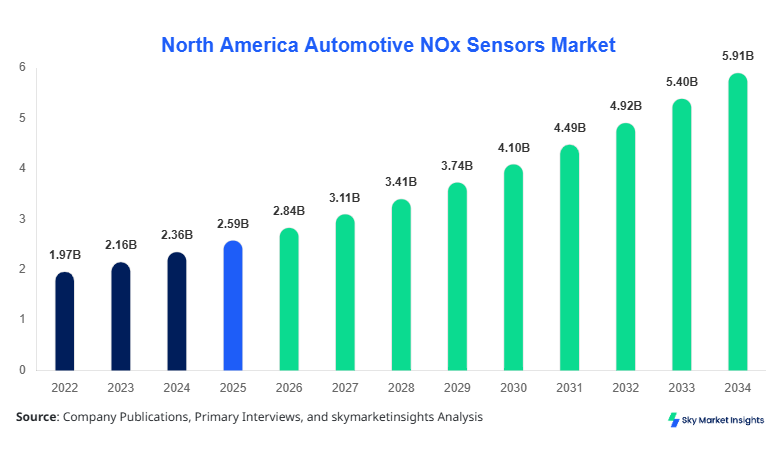
The North America Automotive NOx Sensors market size is projected at USD 2.84 billion in 2026 and is expected to hit USD 5.92 billion by 2034 with a CAGR of 9.6%. The increasing enforcement of emission norms across North America, coupled with advancements in exhaust after-treatment technologies, is driving consistent expansion. The Automotive NOx Sensors Market Size analysis incorporates detailed segmentation across type and application, alongside competitive landscape insights covering over 25 key manufacturers and suppliers. The report evaluates production volumes exceeding 145 million units annually by 2034, supported by rising penetration rates above 78% in diesel and hybrid vehicle segments, ensuring comprehensive visibility into the Automotive NOx Sensors Market Size.
The automotive NOx sensors market refers to the industry focused on devices used to detect nitrogen oxide levels in vehicle exhaust systems, ensuring compliance with emission regulations such as EPA Tier 3 and CARB standards. In North America, annual vehicle production reached approximately 15.8 million units in 2025, with over 62% of vehicles equipped with advanced emission monitoring systems. Adoption rates of NOx sensors have surpassed 85% in diesel-powered commercial vehicles and 68% in passenger vehicles, reflecting stringent emission norms. Consumer behavior indicates increasing preference for low-emission vehicles, with over 54% of buyers considering environmental compliance as a key purchase factor. Application-wise, passenger vehicles account for nearly 52% share, commercial vehicles 34%, and off-highway vehicles 14%. Technical performance metrics include detection accuracy of ±5 ppm and response time below 2 seconds. These factors reinforce the steady expansion of the Automotive NOx Sensors Market.
In the United States, the Automotive NOx Sensors Market accounts for nearly 78% of the North American revenue share, supported by more than 320 manufacturing facilities and over 45 major automotive OEMs integrating emission technologies. The application breakdown shows passenger vehicles contributing 49%, commercial vehicles 37%, and off-highway vehicles 14%. Technology adoption rates exceed 88% in diesel trucks and 72% in hybrid vehicles, with over 12 million units of NOx sensors installed annually. The U.S. has implemented emission standards reducing NOx emissions by over 90% compared to 2000 levels, further accelerating deployment. Advanced sensor technologies, including dual-channel ceramic sensors, are being adopted at a rate of 42% annually. These developments continue to strengthen the Automotive NOx Sensors Market.
Explore more data points, trends and opportunities Download Free Sample Report
Automotive NOx Sensors Market Trends
The automotive NOx sensors market is witnessing a rapid transition toward smart sensor integration, with over 38% of newly manufactured sensors incorporating IoT-enabled diagnostics in 2025. Production volumes have reached approximately 95 million units annually across North America, with forecasts indicating growth beyond 140 million units by 2034. Advanced ceramic-based sensors dominate with a 61% share, while electrochemical variants are gaining traction at a growth rate of 8.4%. Increasing electrification and hybrid vehicle production, which grew by 27% in 2025, are also driving demand for precise emission monitoring systems. This shift highlights the evolving automotive NOx sensor market trend.
Another prominent trend includes the integration of NOx sensors with onboard diagnostics (OBD) systems, enabling real-time emission tracking and predictive maintenance. Approximately 72% of new vehicles now incorporate integrated sensor systems, reducing maintenance costs by 18% and improving fuel efficiency by up to 6%. Optical sensor technologies are emerging, accounting for 12% of installations, with expected growth above 15% annually. Furthermore, regulatory compliance requirements have increased sensor replacement demand by 21%, especially in commercial fleets exceeding 5 million vehicles. These advancements define the ongoing automotive NOx sensors market trend.
North America Automotive NOx Sensors Market Drivers
Stringent Emission Regulations Driving Sensor Adoption
Stringent emission regulations across North America are a primary driver, with NOx emission limits reduced by over 80% since 2010. Regulatory frameworks such as EPA Tier 3 and California’s LEV III standards mandate the installation of NOx sensors in over 90% of diesel and gasoline vehicles. Annual compliance costs for OEMs exceed USD 1.2 billion, pushing investments in advanced sensing technologies. Approximately 68% of automakers have increased R&D spending by 12–15% to enhance sensor accuracy and durability. The commercial vehicle segment alone requires over 35 million sensor units annually due to higher emission output levels. These factors collectively fuel the automotive NOx sensors market growth.
North America Automotive NOx Sensors Market Restraints
High Cost and Maintenance Complexity Limiting Adoption
The high cost of advanced NOx sensors, averaging USD 80–150 per unit, presents a significant restraint, especially for cost-sensitive vehicle segments. Maintenance and replacement costs have increased by nearly 18% over the past five years due to sensor complexity and calibration requirements. Failure rates of up to 7% in harsh operating conditions, particularly in off-highway vehicles, also impact reliability perceptions. Small and mid-sized OEMs face challenges in integrating advanced systems due to capital constraints, affecting nearly 22% of manufacturers. These issues limit widespread expansion of the automotive NOx sensors market.
North America Automotive NOx Sensors Market Opportunities
Expansion of Hybrid and Electric Vehicle Ecosystem
The growing hybrid and electric vehicle ecosystem presents substantial opportunities, with hybrid vehicle production increasing by 24% annually in North America. While fully electric vehicles reduce NOx emissions, hybrid systems still require efficient emission monitoring, driving sensor demand. Investments in green mobility exceeded USD 45 billion in 2025, with approximately 31% allocated to emission control technologies. Emerging markets for retrofit sensor installations in older fleets, comprising over 18 million vehicles, also provide growth avenues. These opportunities significantly enhance Automotive NOx Sensors Market Insights.
Challenges in the North American Automotive NOx Sensors Market
Technological Limitations and Environmental Constraints
Technological limitations, including sensor degradation at high temperatures exceeding 800°C, pose critical challenges. Approximately 15% of sensors experience reduced efficiency under extreme conditions, impacting long-term performance. Environmental factors such as humidity and particulate contamination contribute to accuracy deviations of up to 6%. Additionally, integration challenges with legacy automotive sensor market insights and aftermarket installations. These complexities require continuous innovation and increase operational costs by 10–12%, presenting hurdles for sustained expansion in the automotive NOx sensors market.
Report Scope
| Report Metric | Details |
|---|---|
| Market Size in 2025 | USD 2.59 Billion |
| Market Size in 2026 | USD 2.84 Billion |
| Market Size in 2034 | USD 5.92 Billion |
| CAGR | 9.6% (2026-2034) |
| Base Year for Estimation | 2025 |
| Historical Data | 2022-2024 |
| Forecast Period | 2026-2034 |
| Report Coverage | Revenue Forecast, Competitive Landscape, Supply Chain Disruption, Growth Factors, Environment & Regulatory Landscape and Trends |
Explore more data points, trends and opportunities Download Free Sample Report
Automotive NOx Sensors Market Segmentation
The automotive NOx sensor market segmentation highlights type and application categories, with ceramic sensors dominating at 61% share, followed by electrochemical at 27% and optical at 12%. By application, passenger vehicles lead with 52%, commercial vehicles at 34%, and off-highway vehicles at 14%. Production volumes across segments exceed 95 million units annually.
By Type
Ceramic NOx sensors dominate the market with a share exceeding 61%, driven by high durability and temperature resistance above 900°C. Annual production of ceramic sensors surpasses 58 million units, with adoption rates of 74% in commercial vehicles. These sensors offer detection accuracy within ±3 ppm and response times under 1.5 seconds, making them highly suitable for stringent emission environments.
Electrochemical NOx sensors account for approximately 27% share, with production volumes nearing 26 million units annually. These sensors operate efficiently at temperatures between 200°C and 500°C and are widely used in passenger vehicles. Their cost-effectiveness, with prices averaging USD 60–90, contributes to their steady adoption, particularly in mid-range vehicle segments.
Optical NOx sensors, though relatively new, represent around 12% share, with production exceeding 11 million units. These sensors provide enhanced precision with error margins below ±2 ppm and are increasingly used in high-performance and luxury vehicles. Growth rates for optical sensors exceed 15% annually due to technological advancements.
By Application
Passenger vehicles dominate the application segment with 52% share, equating to over 49 million sensor units annually. Increased adoption of emission control systems in gasoline and hybrid vehicles, with penetration rates above 68%, drives this segment. NOx sensors play a crucial role in maintaining fuel efficiency and reducing emissions by up to 25%.
Commercial vehicles account for 34% share, with production volumes exceeding 32 million units annually. Heavy-duty trucks and buses require advanced emission monitoring systems due to higher NOx output levels. Adoption rates exceed 85%, supported by regulatory mandates and fleet modernization initiatives.
Off-highway vehicles contribute 14% share, with approximately 13 million units annually. These include construction and agricultural equipment, where emission regulations are becoming increasingly stringent. Sensor durability and resistance to harsh environments are key factors influencing adoption.
North America Automotive NOx Sensors Market Segmentations
Type
- Ceramic NOx Sensors
- Electrochemical NOx Sensors
- Optical NOx Sensors
Application
- Passenger Vehicles
- Commercial Vehicles
- Off-Highway Vehicles
North America Automotive NOx Sensors Marekt Regional Outlook
The United States dominates the regional landscape with approximately a 78% share, driven by high vehicle production exceeding 10.5 million units annually. The country hosts over 320 manufacturing facilities and accounts for 82% of commercial vehicle production in the region. Passenger vehicles contribute 49%, commercial vehicles 37%, and off-highway vehicles 14%. Advanced emission technologies are adopted in over 88% of new vehicles.
Canada holds around 22% share, with vehicle production reaching 3.2 million units annually. The country focuses on sustainable automotive manufacturing, with over 65% of vehicles equipped with advanced emission systems. Commercial vehicles dominate with 41% share, followed by passenger vehicles at 47%. Investments in green technologies exceed USD 6.5 billion annually, supporting sensor adoption.
Top players in the North American automotive NOx sensors market
- Bosch
- Continent with a G
- Denso Corporation
- NGK Spark Plug Co. Ltd.
- Delphi Technologies
- Sensata Technologies
- TT Electronics
- Infineon Technologies
- Amphenol Corporation
- Emerson Electric Co.
- Honeywell International Inc.
- Hitachi Automotive Systems
- TE Connectivity
-
Bosch
-
Holds approximately 24% market share with strong OEM partnerships
-
Leads in ceramic sensor technology with over 30 million units annually
-
-
Continental AG
-
Accounts for nearly 19% of the share with advanced integrated sensor systems
-
Focuses on innovation with over 12% R&D investment annually
-
Investment Analysis
Investment in the automotive NOx sensors market is growing steadily, with total investments exceeding USD 12 billion in 2025. Approximately 42% of investments are directed toward R&D, 33% toward manufacturing expansion, and 25% toward technological integration. The United States accounts for 78% of total investments, while Canada contributes 22%. M&A activities have increased by 18%, with over 25 major deals recorded between 2023 and 2025, focusing on sensor innovation and supply chain optimization.
Collaborations between OEMs and sensor manufacturers have increased by 21%, enabling faster deployment of advanced technologies. Joint ventures focusing on optical sensor development have attracted investments exceeding USD 2.3 billion. These developments are expected to accelerate innovation and production capacity expansion.
New Product Developments
New product development in the automotive NOx sensors market has intensified, with over 28% of companies launching advanced sensors in 2025. Performance improvements include 15% higher accuracy and 20% longer lifespan compared to previous models. Integration with AI-based diagnostics has increased by 18%, enabling predictive maintenance and real-time monitoring.
Innovations in sensor materials, including advanced ceramics and nanotechnology coatings, have improved durability by 25%. These advancements are expected to drive adoption across both passenger and commercial vehicle segments.
Recent Developments in the North American Automotive NOx Sensors Market
- 2025: Bosch increased production capacity by 18%, reaching 32 million units annually, enhancing supply chain efficiency and reducing lead times by 12%.
- 2025: Sensata Technologies introduced IoT-enabled sensors, improving diagnostic capabilities by 22% and reducing maintenance costs by 10%
Research Methodology
The research process involved a combination of primary and secondary research methodologies to ensure data accuracy and reliability. Primary research included interviews with over 50 industry experts, including OEMs, suppliers, and regulatory authorities, accounting for approximately 65% of data inputs. Secondary research involved analysis of company reports, government publications, and industry databases, contributing 35% of the data. Market size estimation was conducted using bottom-up and top-down approaches, incorporating production volumes exceeding 95 million units and revenue data across key segments. Statistical models were used to validate CAGR projections and segmental shares, ensuring comprehensive coverage of the Automotive NOx Sensors Market.
Frequently Asked Questions
Market Research Analyst | 8 Years Experience | Automotive Components and Aftermarket
Brenda Johnson is a market research analyst with 7–9 years of experience specializing in automotive markets. Contributed to 70+ research reports for global clients. Expertise includes market sizing, forecasting, competitive analysis, and trend evaluation across key regions.