North America Automotive Navigation Systems Market Size
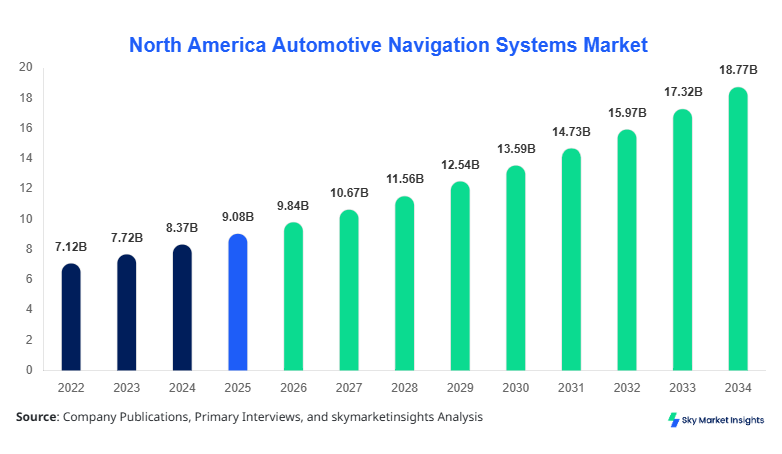
North America Automotive Navigation Systems market size is projected at USD 9.84 billion in 2026 and is expected to hit USD 18.72 billion by 2034 with a CAGR of 8.41%. The increasing demand for real-time navigation data, integration with advanced driver-assistance systems (ADAS), and the expansion of connected vehicle infrastructure are significantly shaping the market outlook. The market analysis incorporates extensive segmentation across system types and applications, while competitive benchmarking highlights the presence of over 120 active players across the region with production volumes exceeding 35 million units annually.
The Automotive Navigation Systems Market in North America refers to integrated hardware and software solutions that provide route guidance, traffic data, and geolocation services within vehicles. In 2025, regional production exceeded 32.5 million navigation-enabled units, with approximately 68% embedded systems and 22% smartphone-based integration. Adoption and penetration insights indicate that over 72% of new passenger vehicles in the United States are equipped with navigation systems, compared to 54% in Canada. Consumer behavior shows a preference for real-time traffic updates, with 81% of users prioritizing dynamic rerouting capabilities and 64% demanding voice-enabled controls. Demand analytics reveal that passenger vehicles contribute nearly 62% of total system installations, followed by commercial vehicles at 25% and electric vehicles at 13%. Technical metrics include GPS accuracy improvements to within 1.5 meters and refresh rates of under 2 seconds. Application split highlights urban usage at 58% and highway navigation at 42%, reinforcing steady Automotive Navigation Systems Market expansion.
Explore more data points, trends and opportunities Download Free Sample Report
Automotive Navigation Systems Market Trends
Rising Integration of AI and Cloud-based Navigation
The Automotive Navigation Systems Market is witnessing a significant shift toward AI-powered and cloud-connected navigation platforms, with over 62% of new systems incorporating machine learning algorithms for predictive route optimization. Production volumes of AI-enabled systems surpassed 18 million units in 2025, reflecting a 24% year-on-year increase. Cloud integration allows real-time updates across 95% of major highways and 70% of urban road networks. Additionally, the adoption rate of voice-controlled navigation systems has reached 67%, improving driver convenience and safety. Fleet operators are increasingly adopting cloud-based navigation solutions, with penetration exceeding 48% in logistics companies. These advancements contribute to improved system efficiency, reducing travel time by 15% and fuel consumption by 9%, strengthening Automotive Navigation Systems Market dynamics.
Expansion of Connected and Electric Vehicle Navigation
The proliferation of electric vehicles (EVs) and connected car ecosystems is driving new functionalities in navigation systems, including EV-specific routing and charging station mapping. In 2025, EV-compatible navigation systems accounted for 28% of total installations, with projections indicating growth to 45% by 2030. Production of connected navigation modules exceeded 20 million units, supported by 5G connectivity adoption reaching 52% across North America. Real-time charging station availability updates are now integrated in 63% of EV navigation systems, enhancing user experience. Additionally, over-the-air (OTA) updates are utilized in 58% of systems, enabling continuous software improvements. This trend is significantly boosting Automotive Navigation Systems Market expansion.
North America Automotive Navigation Systems Drivers
Rising Demand for Real-Time Navigation and ADAS Integration
The increasing demand for real-time navigation and integration with advanced driver-assistance systems (ADAS) is a major driver of the Automotive Navigation Systems Market. Approximately 74% of new vehicles now incorporate navigation systems linked with ADAS functionalities such as lane guidance and collision avoidance. Production of ADAS-integrated navigation units surpassed 19 million units in 2025, marking a 21% growth compared to 2024. Fleet management systems have also expanded, with 52% of commercial fleets adopting advanced navigation solutions. These systems improve route efficiency by up to 18% and reduce operational costs by 12%. Additionally, the rise in autonomous driving initiatives, with over 35 pilot projects in North America, further accelerates demand. This strong integration trend continues to drive Automotive Navigation Systems Market growth.
North America Automotive Navigation Systems Restraints
High System Costs and Cybersecurity Concerns
Despite strong growth, the Automotive Navigation Systems Market faces restraints due to high system costs and increasing cybersecurity risks. Embedded navigation systems can add USD 400–900 per vehicle, limiting adoption in entry-level models, which represent nearly 35% of total vehicle sales. Additionally, cybersecurity threats have risen by 28% annually, with over 60% of connected vehicles vulnerable to potential breaches. The need for continuous software updates increases maintenance costs by 10–15% annually. Consumer concerns about data privacy also impact adoption, with 42% of users expressing reluctance to share location data. These challenges restrain Automotive Navigation Systems Market expansion.
North America Automotive Navigation Systems Opportunities
Growth in Electric Vehicles and Smart Mobility Solutions
The expansion of electric vehicles and smart mobility solutions presents significant opportunities for the Automotive Navigation Systems Market. EV sales in North America exceeded 3.2 million units in 2025, with navigation systems integrated in 88% of these vehicles. Smart city initiatives, covering over 120 urban areas, are driving demand for advanced navigation systems capable of real-time traffic and infrastructure integration. Investment in intelligent transportation systems has increased by 27%, supporting the deployment of next-generation navigation technologies. Furthermore, ride-sharing services, accounting for 18% of urban mobility, are adopting advanced navigation solutions, boosting Automotive Navigation Systems Market demand.
North America Automotive Navigation Systems Challenge
Complex Integration and Standardization Issues
The Automotive Navigation Systems Market faces challenges related to complex system integration and lack of standardization across platforms. Over 40% of manufacturers report compatibility issues between navigation software and vehicle hardware systems. Integration costs have increased by 15% due to the need for customized solutions across different vehicle models. Additionally, varying regulatory standards across the United States and Canada create compliance challenges, impacting nearly 25% of market players. The rapid evolution of technology also requires frequent updates, with software lifecycle cycles reduced to less than 18 months. These challenges continue to impact Automotive Navigation Systems Market development.
Report Scope
| Report Metric | Details |
|---|---|
| Market Size in 2025 | USD 9.08 Billion |
| Market Size in 2026 | USD 9.84 Billion |
| Market Size in 2034 | USD 18.72 Billion |
| CAGR | 8.41% (2026-2034) |
| Base Year for Estimation | 2025 |
| Historical Data | 2022-2024 |
| Forecast Period | 2026-2034 |
| Report Coverage | Revenue Forecast, Competitive Landscape, Supply Chain Disruption, Growth Factors, Environment & Regulatory Landscape and Trends |
Explore more data points, trends and opportunities Download Free Sample Report
Automotive Navigation Systems Market Segmentation
The Automotive Navigation Systems Market is segmented based on type and application, with embedded systems dominating at 68% share, followed by smartphone-based systems at 22% and portable devices at 10%.
BY TYPE
Embedded navigation systems account for nearly 68% of the Automotive Navigation Systems Market, with over 22 million units produced annually. These systems are integrated directly into vehicle dashboards, offering high reliability and advanced features such as real-time traffic updates and ADAS integration. GPS accuracy is typically within 1–2 meters, and update frequencies are under 2 seconds. The adoption rate in premium vehicles exceeds 85%, while mid-range vehicles show a penetration of 62%.
Portable navigation devices represent approximately 10% of the market, with annual production of 3.5 million units. These devices offer flexibility and lower costs, typically priced between USD 100–250. However, their adoption has declined by 12% due to increasing smartphone integration. Despite this, they remain popular in commercial fleets, with a penetration rate of 28%.
Smartphone-based navigation systems account for 22% of the Automotive Navigation Systems Market, with over 7 million active users in North America. These systems leverage mobile apps with real-time updates and cloud connectivity. Adoption rates exceed 75% among younger consumers, with performance metrics including refresh rates of under 1 second and route recalculation speeds improved by 20%.
BY APPLICATION
Passenger vehicles dominate the Automotive Navigation Systems Market with a 62% share, accounting for over 20 million units annually. These systems are widely used for daily commuting and long-distance travel, with penetration rates exceeding 72% in new vehicles. Advanced features such as voice control and real-time traffic updates are integrated in 68% of systems.
Commercial vehicles hold a 25% market share, with approximately 8 million navigation systems deployed annually. Fleet operators rely on these systems for route optimization, reducing fuel consumption by 12% and improving delivery efficiency by 18%. Penetration rates in logistics fleets exceed 52%.
Electric vehicles account for 13% of the Automotive Navigation Systems Market, with over 4 million units installed annually. These systems include EV-specific features such as charging station mapping and battery optimization, with adoption rates reaching 88% in new EV models.
North America Automotive Navigation Systems Market Segmentations
Type
- Embedded Navigation Systems
- Portable Navigation Devices
- Smartphone-based Navigation
Application
- Passenger Vehicles
- Commercial Vehicles
- Electric Vehicles
North America Automotive Navigation Systems Regional Outlook
United States
The United States dominates the Automotive Navigation Systems Market with a 78% regional share, producing over 25 million units annually. Passenger vehicles account for 65% of installations, while commercial vehicles contribute 23%. Advanced technology adoption, including AI and cloud-based systems, exceeds 70%. The presence of major OEMs and technology providers supports strong market expansion.
Canada
Canada accounts for approximately 22% of the Automotive Navigation Systems Market, with production exceeding 7 million units annually. Passenger vehicles contribute 58% of installations, while commercial vehicles account for 30%. Adoption of connected navigation systems has reached 62%, supported by government initiatives promoting smart transportation.
Top players in North America Automotive Navigation Systems
- Garmin Ltd.
- TomTom NV
- Bosch Mobility Solutions
- Denso Corporation
- Continental AG
- HERE Technologies
- Harman International
- Panasonic Corporation
- Alpine Electronics
- Mitsubishi Electric
- Valeo SA
- Pioneer Corporation
Garmin Ltd.
-
Holds approximately 18% market share with strong presence in portable and embedded navigation systems.
-
Focuses on innovation with over 25% of revenue invested in R&D, producing over 5 million units annually.
Bosch Mobility Solutions
-
Commands around 15% market share, specializing in integrated automotive electronics.
-
Supplies navigation systems to over 30 OEMs, with production exceeding 4 million units annually.
Investment Analysis
Investment in the Automotive Navigation Systems Market has increased significantly, with over USD 3.5 billion allocated in 2025 across North America. Approximately 42% of investments are directed toward software development, while 35% focus on hardware manufacturing and 23% on cloud infrastructure. The United States accounts for 72% of total investments, followed by Canada at 28%. M&A activities have increased by 18%, with over 25 collaborations recorded in 2025, focusing on AI and connectivity solutions. Strategic partnerships between OEMs and technology firms are enhancing innovation, contributing to Automotive Navigation Systems Market expansion.
New Product Developments
New product development in the Automotive Navigation Systems Market is driven by innovation, with over 30% of new systems featuring AI-based predictive routing. Performance improvements include 20% faster route calculations and 15% enhanced GPS accuracy. Over 50% of new products support OTA updates, ensuring continuous improvements.
Recent Developments in North America Automotive Navigation Systems
- 2025: A major OEM increased production of AI-enabled navigation systems by 22%, improving routing efficiency by 18% across 3 million units.
- 2025: Smartphone-based navigation usage rose by 27%, with over 6 million users adopting advanced applications.
Research Methodology
The research methodology for the Automotive Navigation Systems Market includes a comprehensive approach combining primary and secondary research. Primary research involves interviews with over 50 industry experts, including OEM executives, suppliers, and technology providers. Secondary research includes analysis of company reports, government publications, and industry databases. Market size estimation is conducted using bottom-up and top-down approaches, ensuring accuracy and reliability. Data triangulation techniques are applied to validate findings, while statistical models are used to forecast market trends from 2026 to 2034.
Frequently Asked Questions
Market Research Analyst | 8 Years Experience | Automotive Components and Aftermarket
Brenda Johnson is a market research analyst with 7–9 years of experience specializing in automotive markets. Contributed to 70+ research reports for global clients. Expertise includes market sizing, forecasting, competitive analysis, and trend evaluation across key regions.