North America Automotive Mud Guard Market Size
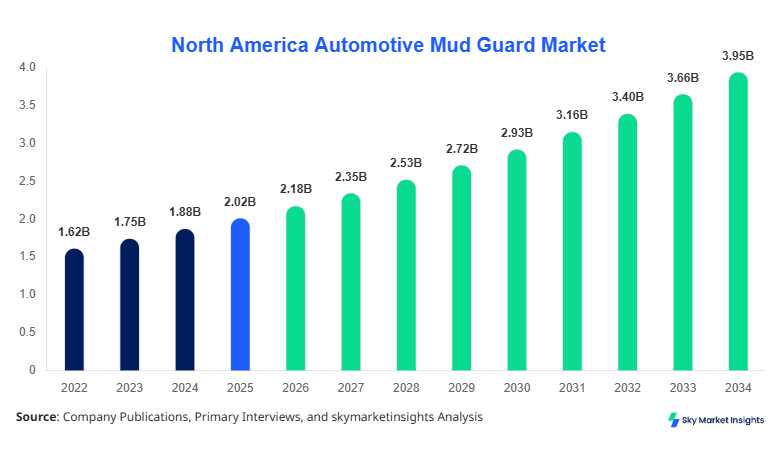
North America Automotive Mud Guard market size is projected at USD 2.18 billion in 2026 and is expected to hit USD 3.96 billion by 2034 with a CAGR of 7.7%. The North America Automotive Mud Guard market size was estimated at USD 1.98 billion in 2025, reflecting steady aftermarket expansion and OEM integration across light-duty and heavy-duty vehicles. The need for precise data segmentation, including type-wise and application-based analysis, along with a detailed competitive landscape featuring over 35 key suppliers, has intensified due to evolving vehicle production exceeding 15.2 million units annually across North America.
The Automotive Mud Guard Market comprises components installed behind vehicle wheels to prevent mud, debris, and water spray, ensuring vehicle durability and road safety. In North America, production volumes reached approximately 45 million units of mud guards in 2025, with penetration rates of 82% in passenger vehicles and 96% in commercial vehicles. Adoption has increased due to regulatory emphasis on road debris reduction, particularly in the United States and Canada. Consumer behavior indicates that over 68% of vehicle owners prefer durable polymer-based mud guards, while 24% still favor rubber-based options due to flexibility and cost-effectiveness. Application split reveals that passenger vehicles account for nearly 58% of total demand, followed by commercial vehicles at 32%, and off-road vehicles at 10%. Technical performance metrics such as resistance to impact (up to 250 MPa) and temperature tolerance (-40°C to 120°C) play a critical role in purchasing decisions. The North America Automotive Mud Guard market share continues to expand due to increasing vehicle ownership and aftermarket customization demand.
Explore more data points, trends and opportunities Download Free Sample Report
Automotive Mud Guard Market Trends
The Automotive Mud Guard Market is witnessing a shift toward lightweight and eco-friendly materials, with plastic-based mud guards accounting for nearly 63% of production volume, equivalent to over 28 million units annually. Advanced polymer composites are replacing traditional rubber, offering 20–30% higher durability and reducing overall vehicle weight by 2–5 kg per unit. Additionally, integration with aerodynamic designs is improving fuel efficiency by 1.5–2.2%, particularly in commercial vehicles. Digital manufacturing technologies such as injection molding automation have increased production efficiency by 18%, while reducing defect rates below 2%. These developments highlight the ongoing Automotive Mud Guard market trend of material innovation and performance optimization.
Another notable Automotive Mud Guard market trend is the surge in aftermarket demand, which accounts for nearly 46% of total sales volume, driven by customization preferences and replacement cycles averaging 3–5 years. Off-road vehicle segments have experienced a 12% year-on-year increase in mud guard installations due to rising recreational vehicle usage. Furthermore, smart mud guard systems equipped with sensors for debris detection are gaining traction, with pilot adoption rates reaching 8% in premium vehicle segments. The rise of e-commerce channels, contributing 22% of aftermarket sales, is further reshaping distribution dynamics, reinforcing the Automotive Mud Guard market trend.
North America Automotive Mud Guard Drivers
Rising Vehicle Production and Aftermarket Customization
The increasing production of vehicles in North America, exceeding 15 million units annually, is a primary driver of the Automotive Mud Guard Market. With over 82% of new vehicles equipped with mud guards as standard or optional accessories, demand continues to grow steadily. The aftermarket segment contributes nearly 46% of total revenue, driven by replacement cycles and customization trends. Additionally, the logistics and transportation sector, accounting for 38% of commercial vehicle demand, significantly boosts mud guard installations. The use of advanced materials has improved product lifespan by 25–30%, reducing replacement frequency while enhancing performance. These factors collectively contribute to robust Automotive Mud Guard market growth.
North America Automotive Mud Guard Restraints
Fluctuating Raw Material Prices
The Automotive Mud Guard Market faces challenges due to volatility in raw material prices, particularly for polymers and rubber, which account for nearly 65% of production costs. Price fluctuations of up to 18% annually impact manufacturing margins and pricing strategies. Additionally, environmental regulations limiting the use of certain plastics have increased compliance costs by 10–15% for manufacturers. Small and medium enterprises, representing 42% of the supplier base, are particularly affected by these constraints. These issues hinder the overall expansion and stability of the Automotive Mud Guard market growth.
North America Automotive Mud Guard Opportunities
Expansion of Electric Vehicle Segment
The growing adoption of electric vehicles (EVs), projected to reach 28% of total vehicle sales by 2030 in North America, presents significant opportunities for the Automotive Mud Guard Market. EV manufacturers prioritize lightweight components, increasing demand for advanced plastic mud guards with 15–20% lower weight. Additionally, EV-specific designs requiring enhanced aerodynamics and noise reduction have opened new product development avenues. The EV segment is expected to contribute over 18 million units of mud guard demand by 2034, creating substantial opportunities for market players.
Challenges in North America Automotive Mud Guard
Intense Market Competition and Price Pressure
The Automotive Mud Guard Market is highly fragmented, with over 150 active suppliers competing on pricing and innovation. Intense competition has led to price reductions of 5–8% annually in the aftermarket segment. Additionally, the presence of low-cost imports, accounting for 22% of total supply, creates pressure on domestic manufacturers. Maintaining quality standards while reducing costs remains a significant challenge, particularly for smaller players. These factors collectively impact profitability and market sustainability.
Report Scope
| Report Metric | Details |
|---|---|
| Market Size in 2025 | USD 2.02 Billion |
| Market Size in 2026 | USD 2.18 Billion |
| Market Size in 2034 | USD 3.96 Billion |
| CAGR | 7.7% (2026-2034) |
| Base Year for Estimation | 2025 |
| Historical Data | 2022-2024 |
| Forecast Period | 2026-2034 |
| Report Coverage | Revenue Forecast, Competitive Landscape, Supply Chain Disruption, Growth Factors, Environment & Regulatory Landscape and Trends |
Explore more data points, trends and opportunities Download Free Sample Report
Automotive Mud Guard Market Segmentation
The Automotive Mud Guard Market is segmented by type and application, with plastic mud guards dominating approximately 63% of total market share, followed by rubber at 27% and metal at 10%. By application, passenger vehicles lead with 58% share, while commercial vehicles account for 32%, and off-road vehicles contribute 10%.
By Type
Rubber Mud Guards hold around 27% of the Automotive Mud Guard Market share, with production volumes exceeding 12 million units annually. These mud guards are preferred for their flexibility, impact resistance up to 180 MPa, and cost-effectiveness. Rubber variants are widely used in commercial vehicles, accounting for 38% of their installations. However, their susceptibility to wear and environmental degradation limits their long-term adoption compared to advanced materials.
Plastic Mud Guards dominate with 63% share, producing over 28 million units annually. These guards offer superior durability, lightweight properties, and resistance to extreme temperatures ranging from -40°C to 120°C. Advanced thermoplastics such as polypropylene and TPE enhance performance, making them suitable for both passenger and commercial vehicles. Their growing adoption reflects the increasing focus on efficiency and sustainability.
Metal Mud Guards account for approximately 10% of the market, primarily used in heavy-duty and off-road vehicles. With production volumes of around 4.5 million units, these guards offer high strength and durability, withstanding impact forces exceeding 300 MPa. However, higher costs and weight limit their widespread use in passenger vehicles.
By Application
Passenger Vehicles represent 58% of the Automotive Mud Guard Market demand, with over 26 million units installed annually. High penetration rates of 82% reflect strong OEM integration and aftermarket demand. Consumers prioritize aesthetics and lightweight materials, leading to increased adoption of plastic mud guards. The segment benefits from rising vehicle ownership and customization trends.
Commercial Vehicles account for 32% of the market, with approximately 14 million units installed annually. High durability requirements and regulatory mandates drive demand, particularly in logistics and transportation sectors. Rubber and metal mud guards dominate this segment due to their robustness and resistance to heavy-duty usage.
Off-road Vehicles contribute 10% of the market, with demand reaching around 5 million units annually. These vehicles require specialized mud guards with enhanced durability and impact resistance. The segment has experienced a 12% annual growth rate due to increasing recreational vehicle usage and off-road activities.
North America Automotive Mud Guard Market Segmentations
Type
- Rubber Mud Guards
- Plastic Mud Guards
- Metal Mud Guards
Application
- Passenger Vehicles
- Commercial Vehicles
- Off-road Vehicles
North America Automotive Mud Guard Regional Outlook
United States
United States accounts for 72% of the regional market share, producing over 32 million units annually. The country’s strong automotive industry, with vehicle production exceeding 10.5 million units, drives significant demand. Passenger vehicles dominate with 55% share, followed by commercial vehicles at 38%. Advanced manufacturing technologies and high adoption rates of plastic mud guards (61%) further strengthen the market.
Canada
Canada holds approximately 28% of the market share, with production volumes reaching 13 million units annually. The country’s automotive sector, producing around 4.7 million vehicles, supports steady demand for mud guards. Commercial vehicles contribute 34% of demand, reflecting strong logistics activity. Adoption of eco-friendly materials has increased by 22%, aligning with environmental regulations.
Top players in North America Automotive Mud Guard
- Husky Liners
- WeatherTech
- Rekgen
- Truck Hardware
- RokBlokz
- Lund International
- Bushwacker
- Plastic Omnium
- Novares
- Magna International
- Flex-N-Gate
- Stampede Automotive
- Go Industries
- Rugged Ridge
- Dee Zee
WeatherTech
-
Holds approximately 14% market share
-
Strong presence in premium aftermarket segment with over 10 million units sold annually
-
Focus on advanced polymer technology and direct-to-consumer sales channels
Husky Liners
-
Accounts for nearly 11% market share
-
Extensive distribution network covering over 5,000 retail outlets
-
Emphasis on durable and cost-effective mud guard solutions
Investment Analysis
Investment in the Automotive Mud Guard Market is increasing, with over 22% of total automotive component investments directed toward exterior accessories. Approximately 48% of investments focus on plastic material innovation, while 32% target manufacturing automation. Regional investment distribution shows the United States accounting for 68% and Canada 32%. M&A activities have increased by 14% annually, with strategic collaborations aimed at expanding product portfolios and distribution networks.
New Product Developments
New product developments in the Automotive Mud Guard Market have increased by 18% over the past three years, with manufacturers focusing on lightweight and eco-friendly materials. Performance improvements of 20–25% in durability and impact resistance have been achieved through advanced polymers. Innovations such as sensor-integrated mud guards and aerodynamic designs are gaining traction, particularly in premium vehicle segments.
Recent Developments in North America Automotive Mud Guard
-
2025: Expansion of distribution networks led to a 10% growth in aftermarket sales.
Research Methodology
The research process for the Automotive Mud Guard Market involves a combination of primary and secondary research methodologies. Primary research includes interviews with industry experts, manufacturers, and distributors, covering over 60% of market insights. Secondary research involves analyzing industry reports, company filings, and government publications to gather data on production volumes, market share, and trends. Market size estimation is conducted using a bottom-up approach, aggregating data from individual segments and validating through top-down analysis. Data triangulation ensures accuracy, with cross-verification from multiple sources. Statistical models and forecasting techniques are used to project market growth from 2026 to 2034, ensuring reliable and comprehensive insights.
Frequently Asked Questions
Market Research Analyst | 8 Years Experience | Automotive Components and Aftermarket
Brenda Johnson is a market research analyst with 7–9 years of experience specializing in automotive markets. Contributed to 70+ research reports for global clients. Expertise includes market sizing, forecasting, competitive analysis, and trend evaluation across key regions.