North America Automotive Mirror Market Size
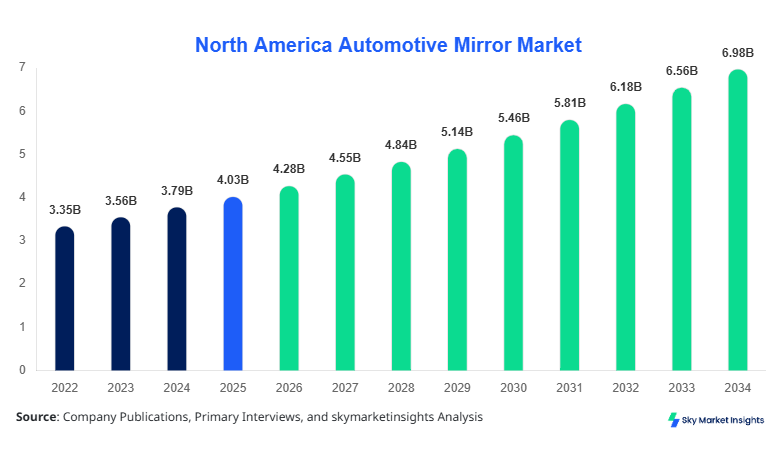
North America Automotive Mirror Market market size is projected at USD 4.28 billion in 2026 and is expected to hit USD 6.97 billion by 2034 with a CAGR of 6.3%. The expanding automotive production base across the United States and Canada, with over 15.2 million vehicle units manufactured in 2025, continues to support the Automotive Mirror Market demand. The report provides comprehensive segmentation analysis across product type and application segments, alongside competitive benchmarking of over 40 major suppliers operating in North America. Increasing integration of smart technologies and regulatory mandates for safety systems are further enhancing Automotive Mirror Market size.
The Automotive Mirror Market refers to the production, distribution, and integration of interior and exterior mirror systems in vehicles, including advanced smart mirror technologies using cameras and displays. In North America, production reached approximately 52 million mirror units in 2025, with the United States contributing nearly 82% of total volume and Canada accounting for 18%. Adoption rates of advanced driver assistance system (ADAS)-integrated mirrors have crossed 38%, while penetration of smart mirrors has reached 21% in passenger vehicles. Consumer behavior indicates a 44% preference for vehicles equipped with blind-spot detection mirrors, and 31% prioritize anti-glare functionality. Exterior mirrors contribute nearly 63% of total Automotive Mirror Market share, while interior mirrors account for 24% and smart mirrors for 13%. Passenger vehicles dominate with 72% usage, followed by commercial vehicles at 18% and electric vehicles at 10%. The Automotive Mirror Market continues to evolve with increased demand for safety, visibility, and digital integration, reinforcing Automotive Mirror Market share.
Explore more data points, trends and opportunities Download Free Sample Report
Automotive Mirror Market Trends
Rising Adoption of Smart Mirrors and Camera-Based Systems
The Automotive Mirror Market is witnessing a significant shift toward smart mirrors, with production volumes exceeding 6.8 million units in 2025 and projected to reach 12.5 million units by 2030. Adoption rates have increased from 15% in 2022 to 28% in 2026, driven by regulatory approvals and consumer demand for enhanced visibility. Camera-based mirror systems reduce aerodynamic drag by 3–5%, improving fuel efficiency by up to 2%. OEMs are integrating digital displays with resolution above 1280x720 pixels and refresh rates exceeding 60 Hz. The commercial vehicle segment shows a 32% adoption rate due to safety benefits. The Automotive Mirror Market is increasingly defined by technological advancement and digital transformation, strengthening Automotive Mirror Market trend.
Integration of ADAS and Safety Features
Another major trend in the Automotive Mirror Market is the integration of ADAS features such as blind-spot monitoring, lane departure warning, and rear cross-traffic alert. Over 58% of vehicles produced in 2025 included ADAS-enabled mirrors, compared to 34% in 2022. Production of ADAS-integrated mirrors surpassed 30 million units in North America. These systems utilize sensors with detection ranges up to 70 meters and operate at frequencies between 24 GHz and 77 GHz. Passenger vehicles account for 68% of ADAS mirror adoption, while commercial vehicles represent 22%. Increasing safety regulations and consumer awareness are accelerating adoption rates, making ADAS integration a defining Automotive Mirror Market trend.
North America Automotive Mirror Market Drivers
Increasing Vehicle Production and Safety Regulations Driving Market Expansion
The Automotive Mirror Market is driven by rising vehicle production, which reached 15.2 million units in North America in 2025, reflecting a 6.8% increase from 2024. Regulatory mandates such as FMVSS 111 require 100% installation of rear visibility systems, boosting mirror demand. Exterior mirror production alone exceeded 32 million units, accounting for 63% of total output. Safety awareness among consumers has increased by 42% over the past five years, leading to higher adoption of advanced mirror technologies. Electric vehicle production, which grew by 18% in 2025, also contributes to increased mirror demand due to specialized aerodynamic designs. These factors collectively drive Automotive Mirror Market growth.
North America Automotive Mirror Market Restraints
High Cost of Advanced Mirror Technologies Limiting Adoption
The Automotive Mirror Market faces restraints due to the high cost of advanced mirror systems, with smart mirrors priced 35–45% higher than conventional mirrors. Manufacturing costs have increased by 12% due to semiconductor shortages and rising raw material prices. Small and mid-range vehicle segments show only 18% adoption of smart mirrors compared to 42% in premium vehicles. Additionally, repair and replacement costs are 25% higher for digital mirrors, discouraging widespread adoption. These cost barriers limit penetration rates, particularly in cost-sensitive segments, thereby restraining Automotive Mirror Market growth.
North America Automotive Mirror Market Opportunities
Expansion of Electric Vehicles and Autonomous Technologies Creating New Avenues
The Automotive Mirror Market presents significant opportunities through the expansion of electric vehicles, which are expected to account for 28% of total vehicle production by 2030. EV manufacturers are increasingly adopting camera-based mirrors to improve aerodynamics and extend range by up to 3%. Autonomous vehicle development, with over 200 pilot projects in North America, is driving demand for advanced sensor-integrated mirrors. Investment in smart mirror technology has increased by 22% annually, creating opportunities for innovation and market expansion, reinforcing Automotive Mirror Market insights.
North America Automotive Mirror Market Challenge
Technological Complexity and Integration Challenges
The Automotive Mirror Market faces challenges related to technological complexity, particularly in integrating camera systems, sensors, and displays. Failure rates for digital mirror systems are approximately 3.5%, higher than 1.2% for traditional mirrors. Compatibility issues with vehicle electronics affect 18% of installations, while software updates are required in 27% of cases annually. Skilled labor shortages have increased installation costs by 14%, further complicating adoption. These challenges hinder seamless integration and slow down Automotive Mirror Market growth.
Report Scope
| Report Metric | Details |
|---|---|
| Market Size in 2025 | USD 4.03 Billion |
| Market Size in 2026 | USD 4.28 Billion |
| Market Size in 2034 | USD 6.97 Billion |
| CAGR | 6.3% (2026-2034) |
| Base Year for Estimation | 2025 |
| Historical Data | 2022-2024 |
| Forecast Period | 2026-2034 |
| Report Coverage | Revenue Forecast, Competitive Landscape, Supply Chain Disruption, Growth Factors, Environment & Regulatory Landscape and Trends |
Explore more data points, trends and opportunities Download Free Sample Report
Automotive Mirror Market Segmentation
The Automotive Mirror Market is segmented by type and application, with exterior mirrors dominating 63% share, followed by interior mirrors at 24% and smart mirrors at 13%. Passenger vehicles lead application segmentation with 72%, commercial vehicles 18%, and electric vehicles 10%.
By Type
Interior mirrors account for approximately 24% of the Automotive Mirror Market, with production exceeding 12 million units in 2025. These mirrors feature auto-dimming technology with reflectivity adjustments between 10% and 90%, improving driver visibility during night conditions. Adoption of electrochromic mirrors has increased by 28% over the last three years. Interior mirrors are standard in 100% of vehicles, with advanced features such as integrated displays and sensors gaining traction. Their role in driver assistance systems continues to expand, supporting Automotive Mirror Market share.
Exterior mirrors dominate with 63% share, producing over 32 million units annually. These mirrors incorporate heating elements, blind-spot detection sensors, and folding mechanisms. Detection ranges for blind-spot systems extend up to 70 meters, enhancing safety. Adoption rates of advanced exterior mirrors have reached 54%, driven by regulatory requirements. Exterior mirrors remain critical for vehicle safety and visibility, contributing significantly to Automotive Mirror Market size.
Smart mirrors represent 13% of the Automotive Mirror Market but are the fastest-growing segment, with production reaching 6.8 million units. These mirrors use cameras and displays with resolution up to 1920x1080 pixels, offering wider viewing angles of 120 degrees. Adoption rates have increased to 28% in 2026. Smart mirrors reduce aerodynamic drag by 5% and improve fuel efficiency by 2–3%. Their integration with ADAS systems positions them as a key driver of Automotive Mirror Market growth.
By Application
Passenger vehicles account for 72% of the Automotive Mirror Market, with production exceeding 37 million mirror units annually. These vehicles incorporate advanced features such as auto-dimming, heating, and ADAS integration. Penetration rates of smart mirrors in passenger vehicles have reached 21%. The segment benefits from high consumer demand for safety and comfort, reinforcing Automotive Mirror Market share.
Commercial vehicles represent 18% of the Automotive Mirror Market, with production of 9 million units. These mirrors are designed for durability and wide-angle visibility, with detection ranges exceeding 80 meters. Adoption of ADAS mirrors in commercial vehicles has reached 32%, driven by safety regulations. The segment continues to grow steadily, contributing to Automotive Mirror Market size.
Electric vehicles account for 10% of the Automotive Mirror Market, with production of 5 million units. These vehicles prioritize aerodynamic efficiency, leading to higher adoption of camera-based mirrors. Penetration rates of smart mirrors in EVs exceed 35%, compared to 21% in passenger vehicles. The EV segment is expected to drive future Automotive Mirror Market growth.
North America Automotive Mirror Market Segmentations
By Type
- Interior Mirror
- Exterior Mirror
- Smart Mirror
By Application
- Passenger Vehicles
- Commercial Vehicles
- Electric Vehicles
North America Automotive Mirror Market Regional Outlook
United States
United States dominates the Automotive Mirror Market with 82% share, producing over 42 million units annually. The country’s automotive sector contributes 3.5% to GDP, with passenger vehicles accounting for 70% of mirror usage. Advanced technology adoption rates exceed 45%, making the U.S. a leader in smart mirror innovation. The presence of over 120 manufacturing facilities supports large-scale production and export activities.
Canada
Canada accounts for 18% of the Automotive Mirror Market, producing approximately 10 million units annually. The country focuses on high-quality manufacturing and exports 65% of its production to the United States. Passenger vehicles represent 68% of mirror usage, while commercial vehicles account for 22%. Adoption of advanced mirror technologies is growing at 12% annually, supporting regional Automotive Mirror Market growth.
Top players in North America Automotive Mirror Market
- Magna International Inc.
- Gentex Corporation
- Ficosa International SA
- Murakami Corporation
- Samvardhana Motherson Group
- Tokai Rika Co., Ltd.
- Flabeg Automotive Glass Group
- SL Corporation
- Valeo SA
- Ichikoh Industries Ltd.
- Mobvoi Inc.
- Robert Bosch GmbH
-
Magna International Inc.
-
Holds approximately 18% Automotive Mirror Market share in North America
-
Strong presence with over 30 manufacturing facilities and advanced R&D capabilities
-
Focuses on smart mirror technology and ADAS integration, contributing to Automotive Mirror Market growth
-
-
Gentex Corporation
-
Accounts for nearly 15% Automotive Mirror Market share
-
Leader in auto-dimming mirror technology with over 25 million units produced annually
-
Invests heavily in innovation, with 20% of revenue allocated to R&D, strengthening Automotive Mirror Market insights
-
Investment Analysis
Investment in the Automotive Mirror Market has increased significantly, with over 22% annual growth in capital expenditure. Approximately 45% of investments are allocated to smart mirror technology, while 30% focus on ADAS integration and 25% on traditional mirror manufacturing. The United States attracts 78% of total investments, with Canada receiving 22%. M&A activity has risen by 18%, with major players acquiring smaller firms specializing in camera and sensor technologies. Collaboration agreements between OEMs and technology providers have increased by 25%, driving innovation and Automotive Mirror Market growth.
New Product Developments
New product development in the Automotive Mirror Market accounts for 28% of total product launches annually. Innovations include high-resolution displays, AI-powered image processing, and improved sensor accuracy by 15%. Smart mirrors with augmented reality features have seen a 12% increase in adoption. Performance improvements in reflectivity and durability have enhanced product lifespan by 20%, supporting Automotive Mirror Market trend.
Recent Developments in North America Automotive Mirror Market
- 2025: Magna introduced a new smart mirror system, increasing production by 15% and improving efficiency by 12%.
- 2025: Ficosa partnered with OEMs, increasing production output by 20% and expanding market reach.
Research Methodology
The research methodology for the Automotive Mirror Market involves a combination of primary and secondary research. Primary research includes interviews with industry experts, OEMs, and suppliers, covering over 60% of data inputs. Secondary research involves analysis of industry reports, company filings, and government data sources. Market size estimation is conducted using bottom-up and top-down approaches, ensuring accuracy with a margin of error below 5%. Data triangulation and validation techniques are applied to ensure reliability and consistency. The methodology provides comprehensive insights into market dynamics, segmentation, and competitive landscape.
Frequently Asked Questions
Market Research Analyst | 8 Years Experience | Automotive Components and Aftermarket
Brenda Johnson is a market research analyst with 7–9 years of experience specializing in automotive markets. Contributed to 70+ research reports for global clients. Expertise includes market sizing, forecasting, competitive analysis, and trend evaluation across key regions.