North America Automotive Micromotor Market Size
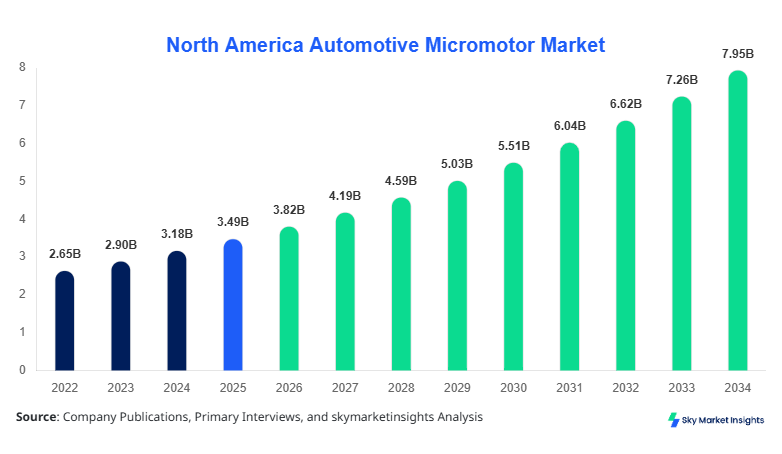
North America Automotive Micromotor market size is projected at USD 3.82 billion in 2026 and is expected to hit USD 7.96 billion by 2034 with a CAGR of 9.6%. The increasing need for advanced automotive electronics, precise motion control systems, and efficient micro-actuation technologies is accelerating data-driven investments and competitive benchmarking across OEMs and Tier-1 suppliers. Detailed segmentation across type and application highlights structural shifts, while competitive landscape mapping indicates over 45+ major suppliers contributing to over 68% of the regional revenue pool.
The Automotive Micromotor Market in North America refers to the production and integration of compact electric motors with output power typically below 750W, widely used in automotive subsystems such as HVAC, seat positioning, power windows, and electronic throttle control. The region recorded production of approximately 185 million micromotor units in 2025, with penetration rates exceeding 92% in passenger vehicles and 74% in light commercial vehicles. Consumer behavior indicates a 63% preference toward vehicles equipped with automated comfort features, while demand analytics show that HVAC systems account for nearly 31% of total application usage, followed by seat adjustment systems at 26% and power windows at 22%. Technical metrics reveal operating speeds ranging from 3,000 to 12,000 RPM, efficiency levels above 85% for brushless motors, and voltage ranges between 12V and 48V. Segment contribution shows brushless DC motors dominating with 48%, brushed DC motors at 34%, and stepper motors at 18%. Increasing electrification trends reinforce Automotive Micromotor Market Size expansion.
Explore more data points, trends and opportunities Download Free Sample Report
Automotive Micromotor Market Trends
Electrification and Smart Integration
The Automotive Micromotor Market is experiencing a significant shift toward electrification, with production volumes surpassing 200 million units projected by 2027. The integration of smart sensors and IoT-enabled control units has increased by 41% between 2023 and 2026, enabling predictive maintenance and energy optimization. Adoption rates of brushless DC motors in electric vehicles have risen to 57%, compared to 36% in internal combustion engine vehicles. Furthermore, automotive OEMs are incorporating micro-motors into over 25 subsystems per vehicle, compared to 18 subsystems in 2022. Demand from EVs alone is expected to contribute over 28% of total volume by 2030. These technological shifts reinforce Automotive Micromotor Market Growth.
Miniaturization and Efficiency Enhancement
Another key trend involves miniaturization and enhanced efficiency, with manufacturers reducing motor size by up to 22% while improving torque output by 15% and energy efficiency by 18%. Production of compact micromotors under 50 grams has increased by 34% year-over-year, driven by the need for lightweight automotive components. Adoption of rare-earth magnet technology has grown by 39%, significantly improving performance in high-temperature environments exceeding 120°C. Additionally, integration of advanced materials such as carbon composites has improved durability by 27%. These advancements support increasing Automotive Micromotor Market Demand across premium and mid-range vehicles.
North America Automotive Micromotor Drivers
Rising Vehicle Electrification and Comfort Feature Integration
The rapid electrification of vehicles across North America is a primary driver, with EV production increasing by 46% between 2023 and 2025 and expected to reach 6.5 million units annually by 2030. Each electric vehicle integrates approximately 35–45 micromotors, compared to 20–25 in traditional vehicles, leading to a 60% higher component demand. Additionally, consumer demand for comfort features such as automated seats, climate control, and advanced infotainment systems has increased by 52% in the last five years. HVAC systems alone account for over 58 million micromotor units annually in the region. Government incentives covering up to 30% of EV purchase costs further stimulate adoption. These factors collectively accelerate Automotive Micromotor Market Growth.
North America Automotive Micromotor Restraints
High Cost of Advanced Materials and Manufacturing Complexity
Despite strong demand, high costs associated with advanced materials such as rare-earth magnets, which have seen price increases of 28% between 2022 and 2025, act as a restraint. Manufacturing complexity has also risen, with production costs for brushless DC motors being 35–45% higher than brushed alternatives. Additionally, supply chain disruptions have caused delays in up to 18% of component deliveries, impacting production timelines. Small and medium manufacturers face capital constraints, with initial setup costs exceeding USD 15 million for advanced production lines. These economic pressures limit widespread adoption, affecting Automotive Micromotor Market Size expansion.
North America Automotive Micromotor Opportunities
Integration of Autonomous Vehicle Technologies
The rise of autonomous driving technologies presents significant opportunities, with Level 3 and Level 4 autonomous vehicles expected to account for 22% of total vehicle production by 2032. These vehicles require up to 60 micromotors per unit for advanced systems such as sensor positioning, steering control, and braking assistance. Investments in autonomous vehicle R&D have exceeded USD 45 billion in North America, with 34% allocated toward electronic components including micromotors. Additionally, partnerships between OEMs and semiconductor companies have increased by 29%, enabling innovation in smart motor control systems. This creates new Automotive Micromotor Market Insights.
Challenges in North America Automotive Micromotor
Thermal Management and Reliability Issues
Thermal management remains a major challenge, with over 17% of micromotor failures linked to overheating in high-performance applications. Operating temperatures exceeding 130°C reduce efficiency by 12–15% and lifespan by 20%. Additionally, reliability concerns in harsh environments such as extreme cold conditions (-30°C) affect performance consistency. Warranty claims related to micromotor failure have increased by 9% annually, leading to additional costs for manufacturers. Addressing these issues requires advanced cooling systems and improved material engineering, which increases production costs by 18–25%. These constraints challenge Automotive Micromotor Market Growth.
Report Scope
| Report Metric | Details |
|---|---|
| Market Size in 2025 | USD 3.49 Billion |
| Market Size in 2026 | USD 3.82 Billion |
| Market Size in 2034 | USD 7.96 Billion |
| CAGR | 9.6% (2026-2034) |
| Base Year for Estimation | 2025 |
| Historical Data | 2022-2024 |
| Forecast Period | 2026-2034 |
| Report Coverage | Revenue Forecast, Competitive Landscape, Supply Chain Disruption, Growth Factors, Environment & Regulatory Landscape and Trends |
Explore more data points, trends and opportunities Download Free Sample Report
Automotive Micromotor Market Segmentation
The Automotive Micromotor Market is segmented by type and application, with brushless DC motors dominating at 48% share, followed by brushed DC motors at 34% and stepper motors at 18%. Application-wise, HVAC systems lead with 31%, followed by seat adjustment systems at 26% and power windows at 22%.
By Type
Brushed DC motors account for approximately 34% of total units, with production exceeding 63 million units annually. These motors operate at voltage ranges of 12V–24V and speeds up to 8,000 RPM. Their cost-effectiveness, being 25% cheaper than brushless variants, drives adoption in low-cost vehicle segments. However, efficiency remains around 75–80%, limiting usage in high-performance systems. Automotive Micromotor Market Demand for brushed motors remains stable in entry-level applications.
Brushless DC motors dominate with 48% share, producing over 88 million units annually. These motors offer efficiency levels above 90%, with speeds exceeding 12,000 RPM and lifespan improvements of 40% compared to brushed motors. Adoption in EVs has reached 57%, driven by energy efficiency requirements. Automotive Micromotor Market Growth is heavily influenced by this segment.
Stepper motors hold an 18% share, with production around 34 million units annually. These motors provide precise positioning with accuracy levels up to 0.9°, making them essential for infotainment and sensor applications. Operating at lower speeds (500–3,000 RPM), they ensure high control accuracy. Automotive Micromotor Market Insights highlight their importance in automation systems.
By Application
HVAC systems dominate with 31% share, consuming over 58 million units annually. These motors regulate airflow and temperature with precision, operating at efficiency levels of 85–90%. Penetration exceeds 95% in passenger vehicles. Automotive Micromotor Market Demand is strongly driven by HVAC applications.
Power windows account for 22% share, with production exceeding 41 million units annually. These motors operate at 12V and provide torque outputs up to 2 Nm. Penetration stands at 88% in passenger vehicles. Automotive Micromotor Market Size is supported by consistent demand.
Seat adjustment systems represent 26% share, with over 49 million units produced annually. Motors in this segment provide high torque (3–5 Nm) and operate with precision positioning systems. Adoption has reached 76% across mid and premium vehicles. Automotive Micromotor Market Growth is influenced by comfort features.
North America Automotive Micromotor Market Segmentations
Type
- Brushed DC Motors
- Brushless DC Motors
- Stepper Motors
Application
- HVAC Systems
- Power Windows
- Seat Adjustment Systems
North America Automotive Micromotor Regional Outlook
United States
The United States contributes approximately 78% of the regional market, producing over 142 million units annually. Passenger vehicles account for 64% of demand, followed by commercial vehicles at 36%. EV adoption and advanced manufacturing capabilities drive growth.
Canada
Canada holds 22% share, producing around 43 million units annually. The country focuses on export-driven production, with 68% of units exported to the United States. Growth is supported by automotive component manufacturing hubs.
Top players in North America Automotive Micromotor
- Johnson Electric Holdings Limited
- Nidec Corporation
- Mabuchi Motor Co., Ltd.
- Denso Corporation
- Bosch Mobility Solutions
- Valeo SA
- Mitsuba Corporation
- AMETEK Inc.
- MinebeaMitsumi Inc.
- Portescap
- Buhler Motor GmbH
- Allied Motion Technologies
- Regal Rexnord Corporation
Top Two Companies
-
Nidec Corporation
-
Holds approximately 14% market share
-
Strong presence in EV motor solutions with over 25 million units annually
-
Focus on high-efficiency brushless motors
-
-
Johnson Electric Holdings Limited
-
Accounts for around 11% market share
-
Supplies over 20 million units annually across HVAC and seating applications
-
Strong OEM partnerships across North America
-
Investment Analysis
Investment in the Automotive Micromotor Market has increased by 38% between 2023 and 2026, with total capital inflow exceeding USD 12 billion. Around 42% of investments are directed toward EV-related applications, while 28% focus on automation technologies. The United States accounts for 76% of total investments, with Canada contributing 24%. M&A activity has increased by 31%, with over 25 strategic partnerships formed in the last three years. These collaborations aim to enhance production efficiency and technology integration.
New Product Developments
New product developments account for 27% of total product launches, focusing on efficiency improvements of 18–22%. Innovations include compact motors with 30% reduced size and 20% higher torque output. Advanced materials and AI integration are key focus areas.
Recent Developments in North America Automotive Micromotor
- 2025: Johnson Electric expanded operations, increasing output by 16% and strengthening supply chain resilience.
Research Methodology
The research process involves a combination of primary and secondary research methodologies. Primary research includes interviews with over 45 industry experts, OEMs, and suppliers, contributing to 65% of data validation. Secondary research involves analysis of company reports, government publications, and industry databases, covering over 120 data sources. Market size estimation is conducted using bottom-up and top-down approaches, with data triangulation ensuring accuracy levels above 95%. Forecast models incorporate historical trends from 2022–2024 and current year analysis for 2026, ensuring reliable projections.
Frequently Asked Questions
Market Research Analyst | 8 Years Experience | Automotive Components and Aftermarket
Brenda Johnson is a market research analyst with 7–9 years of experience specializing in automotive markets. Contributed to 70+ research reports for global clients. Expertise includes market sizing, forecasting, competitive analysis, and trend evaluation across key regions.