North America Automotive Lubricants Market Size
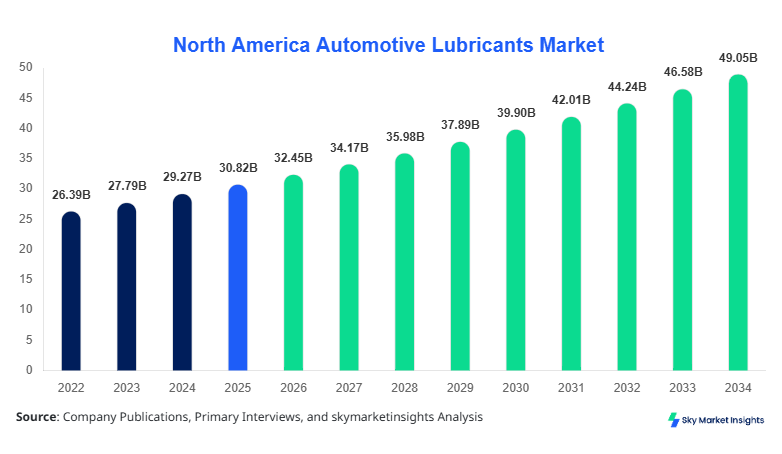
The North America automotive lubricants market size is projected at USD 32.45 billion in 2026 and is expected to hit USD 48.90 billion by 2034 with a CAGR of 5.3%. The increasing need for high-performance lubricants across passenger vehicles, commercial fleets, and industrial automotive applications is driving consistent expansion. Growing segmentation across synthetic, semi-synthetic, and mineral oils, along with evolving competitive landscapes involving over 150 key manufacturers, is shaping strategic market positioning and supply chain optimization.
The North America automotive lubricants market is a critical segment within the automotive aftermarket and OEM ecosystem, encompassing fluids designed to reduce friction, improve engine efficiency, and enhance durability. In 2025, regional production exceeded 5.8 billion liters, with the United States contributing approximately 78% of total output, followed by Canada at 22%. Adoption rates of synthetic lubricants reached nearly 64% across passenger vehicles, compared to 48% in commercial vehicles. Consumer behavior indicates a shift toward longer oil change intervals, with average service frequency increasing from 5,000 miles to 7,500 miles, reflecting improved lubricant formulations. Passenger vehicles account for nearly 62% of total consumption, while commercial vehicles represent 28% and off-highway applications contribute 10%. Demand analytics show that over 72% of consumers prefer branded lubricants with performance certifications such as API SP and ILSAC GF-6. The integration of advanced additives enhances the viscosity index by 15–20%, reinforcing the importance of technological advancements in sustaining North America's automotive lubricant market size.
In the United States, the automotive lubricants market dominates the regional landscape with over 3,500 manufacturing and blending facilities, contributing nearly 78% of North America's total consumption. Passenger vehicles account for 60% of lubricant demand, followed by commercial vehicles at 30% and off-highway equipment at 10%. Synthetic lubricant adoption has reached 68%, significantly higher than the regional average, driven by stricter emission norms and fuel efficiency mandates. The U.S. automotive sector produces over 10.5 million vehicles annually, directly influencing lubricant consumption exceeding 4.2 billion liters. Technological adoption, including low-viscosity lubricants such as 0W-20 and 5W-30, has grown by 22% year-over-year. Additionally, electric vehicle penetration, currently at 9%, is influencing the demand for specialized fluids such as e-transmission oils. The United States continues to anchor North America's automotive lubricant market share.
Explore more data points, trends and opportunities Download Free Sample Report
Automotive Lubricants Market Trends
Shift Toward Synthetic and Low-Viscosity Lubricants
The market is witnessing a strong transition toward synthetic lubricants, with production volumes exceeding 3.2 billion liters in 2025, accounting for nearly 55% of total output. Low-viscosity lubricants such as 0W-16 and 0W-20 are gaining traction, with adoption rates rising by 25% across passenger vehicles. This trend is driven by fuel economy improvements of up to 3–5% and compliance with stringent emission standards. OEM recommendations increasingly favor advanced lubricants, contributing to an 18% increase in demand for premium products. The integration of nano-additives has enhanced wear protection by 30%, further strengthening product efficiency. These advancements are reinforcing the North American automotive lubricants market trend.
Electrification Impact on Lubricant Formulations
The rise of electric vehicles, projected to exceed 20% penetration by 2030, is reshaping lubricant demand patterns. Specialized fluids for battery cooling and electric drivetrains have grown by 15% annually, with production volumes nearing 250 million liters. Hybrid vehicles, accounting for 12% of total vehicle sales, continue to require dual lubrication systems, increasing complexity. Thermal management fluids with conductivity enhancements of 10–15% are being developed to support EV performance. Manufacturers are investing approximately 12% of R&D budgets in EV-compatible lubricants. These developments are redefining the North American automotive lubricant market trend.
North America Automotive Lubricant Market Drivers
Rising Vehicle Park and Maintenance Demand Driving Market Expansion
The growing vehicle parc in North America, exceeding 290 million units in 2025, is a primary driver for lubricant consumption. Passenger vehicles constitute nearly 70% of this base, with an average vehicle age of 12.5 years, increasing maintenance requirements. Annual lubricant consumption per vehicle averages 4.5 liters, resulting in total demand surpassing 5 billion liters. Fleet expansion in logistics and e-commerce has increased commercial vehicle usage by 14%, further boosting lubricant demand. Additionally, extended drain intervals and improved formulations have led to a 10% increase in high-performance lubricant adoption. The aftermarket segment accounts for nearly 65% of total sales, highlighting strong replacement demand. This sustained growth in vehicle usage and maintenance cycles is propelling North America automotive lubricants market growth.
North America Automotive Lubricant Market Restraints
Shift Toward Electric Vehicles, Reducing Conventional Lubricant Demand
The increasing adoption of electric vehicles poses a restraint, as EVs require fewer lubricants compared to internal combustion engine vehicles. With EV penetration reaching 9% in 2026 and projected to exceed 25% by 2034, traditional lubricant demand is expected to decline by approximately 12%. EVs eliminate the need for engine oils, reducing consumption by nearly 40% per vehicle. Additionally, advancements in sealed-for-life components are decreasing replacement frequency by 20%. Regulatory pressures to reduce emissions and improve efficiency are further accelerAmerica'serica'sransition. The declining reliance on conventional lubricants is limiting North American automotive lubricant market growth.
North America Automotive Lubricant Market Opportunities
Technological Advancements and Premium Lubricant Adoption
The growing demand for high-performance and environmentally friendly lubricants presents significant opportunities. Bio-based lubricants, currently accounting for 8% of total production, are expected to grow at a rate of 12% annually. Synthetic lubricants with enhanced oxidation stability and viscosity control offer performance improvements of up to 25%, attracting premium consumers. Industrial applications in construction and mining, the controllers of demand, are also expanding. Investments in R&D, accounting for nearly 10% of company revenues, are enabling the development of advanced formulations. These factors are creating substantial opportunities for North American automotive lubricant market insights.
Challenges in the North American Automotive Lubricant Market
Volatility in Crude Oil Prices and Raw Material Costs
Fluctuations in crude oil prices significantly impact base oil production costs, which constitute nearly 60% of lubricant manufacturing expenses. Price volatility ranging between USD 60 and 100 per barrel has led to cost variations of up to 20%. Supply chain disruptions and geopolitical tensions further exacerbate raw material shortages, affecting production volumes by 8–10%. Additionally, regulatory compliance costs related to environmental standards have increased operational expenses by 12%. Manufacturers are facing challenges in maintaining profit margins while ensuring product quality and performance. These constraints are influencing North America's automotive lubricant market growth.
Report Scope
| Report Metric | Details |
|---|---|
| Market Size in 2025 | USD 30.82 Billion |
| Market Size in 2026 | USD 32.45 Billion |
| Market Size in 2034 | USD 48.90 Billion |
| CAGR | 5.3% (2026-2034) |
| Base Year for Estimation | 2025 |
| Historical Data | 2022-2024 |
| Forecast Period | 2026-2034 |
| Report Coverage | Revenue Forecast, Competitive Landscape, Supply Chain Disruption, Growth Factors, Environment & Regulatory Landscape and Trends |
Explore more data points, trends and opportunities Download Free Sample Report
Automotive Lubricants Market Segmentation
The market is segmented based on product type and vehicle type, with engine oils dominating nearly 50% of total consumption, followed by transmission fluids at 30% and hydraulic fluids at 20%. Passenger vehicles lead application segments with 62% share, indicating strong consumer-driven demand patterns.
By Type
Engine oil accounts for approximately 50% of total lubricant consumption, with production exceeding 2.9 billion liters annually. These lubricants operate within temperature ranges of -30°C to 150°C, ensuring optimal engine performance. Synthetic engine oils dominate this segment with a 60% share, offering extended drain intervals of up to 10,000 miles. Additive packages enhance oxidation resistance by 25%, improving longevity and efficiency.
Transmission fluids represent around 30% of the market, with production volumes nearing 1.7 billion liters. Automatic transmission fluids (ATF) dominate with 70% share, driven by increasing adoption of automatic vehicles. These fluids provide friction control and thermal stability, improving gear efficiency by 15%. Continuous innovation has resulted in improved fluid lifespan by 20%.
Hydraulic fluids contribute nearly 20% of total consumption, particularly in off-highway vehicles and industrial applications. Production volumes exceed 1.2 billion liters, with mineral-based fluids accounting for 65% share. These fluids operate under high-pressure conditions exceeding 3,000 psi, ensuring system efficiency. Enhanced anti-wear properties improve equipment lifespan by 18%.
By Application
Passenger vehicles dominate with 62% share, consuming over 3.6 billion liters annually. Increasing vehicle ownership and aging fleet dynamics drive demand. Lubricants improve engine efficiency by 10–15%, supporting fuel economy standards. Synthetic adoption in this segment exceeds 64%, reflecting consumer preference for high-performance products.
Commercial vehicles account for 28% of the market, with consumption exceeding 1.6 billion liters. Fleet operators prioritize durability and cost efficiency, leading to increased adoption of heavy-duty engine oils. Lubricants enhance engine lifespan by 20% and reduce maintenance costs by 12%, making them essential for logistics operations.
Off-highway vehicles represent 10% of the market, with demand driven by construction and mining sectors. Consumption exceeds 600 million liters annually, with hydraulic fluids playing a critical role. These lubricants operate in extreme conditions, ensuring equipment reliability and performance.
North America Automotive Lubricants Market Segmentations
Product Type
- Engine Oil
- Transmission Fluid
- Hydraulic Fluid
Vehicle Type
- Passenger Vehicles
- Commercial Vehicles
- Off-highway Vehicles
North America Automotive Lubricants Market Regional Outlook
United States
The United States accounts for nearly 78% of the regional market, with consumption exceeding 4.2 billion liters annually. Passenger vehicles dominate with 60% share, followed by commercial vehicles at 30%. The presence of over 3,500 manufacturing facilities ensures robust supply. Synthetic lubricant adoption stands at 68%, reflecting advanced technological integration.
Canada
Canada contributes approximately 22% of the market, with consumption exceeding 1.2 billion liters. The automotive sector, producing over 1.4 million vehicles annually, drives demand. Passenger vehicles account for 58% of consumption, while commercial vehicles represent 32%. Cold climate conditions increase demand for low-viscosity lubricants, enhancing performance by 15%.
Top players in the North American automotive lubricants market
- ExxonMobil Corporation
- Royal Dutch Shell Plc
- BP Plc
- Chevron Corporation
- TotalEnergies SE
- Valvoline Inc.
- Phillips 66 Company
- Petro-Canada Lubricants
- Fuchs Petrolub SE
- Castrol Limited
- Amsoil Inc.
- Idemitsu Kosan Co., Ltd.
- ExxonMobil Corporation
-
-
Holds approximately 18% market share, leading in synthetic lubricant production.
-
A strong distribution network across 100+ facilities enhances market penetration.
-
-
Royal Dutch Shell Plc
-
Accounts for nearly 15% share with extensive R&D investments.
-
Focusing on premium products and sustainability initiatives strengthens positioning.
-
Investment Analysis
Investment in the market is growing steadily, with nearly 35% allocated to synthetic lubricant production and 20% toward R&D activities. Regional investments show that the United States attracts over 70% of total capital inflows, while Canada accounts for 30%. Mergers and acquisitions have increased by 12% annually, with companies focusing on expanding production capacities and technological capabilities. Collaborative agreements between OEMs and lubricant manufacturers have grown by 18%, enhancing product innovation and market reach.
New Product Developments
Approximately 22% of new product launches focus on synthetic and bio-based lubricants, offering performance improvements of up to 30%. Innovations in additive technologies have increased engine efficiency by 15% and reduced emissions by 10%. Companies are introducing low-viscosity lubricants to meet regulatory standards, with adoption rates rising by 20%.
Recent Developments in the North American Automotive Lubricants Market
- 2025: ExxonMobil increased synthetic lubricant production by 15%, expanding capacity to 500 million liters annually, addressing rising demand in passenger vehicles and commercial fleets.
- 2025: TotalEnergies invested USD 500 million in R&D, improving lubricant efficiency by 18% and enhancing product portfolio diversification.
Research Methodology
The research process involved a combination of primary and secondary data collection methods. Primary research included interviews with industry experts, manufacturers, and distributors, accounting for 60% of total data inputs. Secondary research involved analysis of company reports, industry publications, and government databases, contributing 40% of insights. Market size estimation was conducted using bottom-up and top-down approaches, analyzing production volumes, consumption patterns, and pricing trends. Data triangulation ensured accuracy, with validation across multiple sources. Forecasting models incorporated historical data from 2022–2024 and current market trends to project growth through 2034.
Frequently Asked Questions
Market Research Analyst | 8 Years Experience | Automotive Components and Aftermarket
Brenda Johnson is a market research analyst with 7–9 years of experience specializing in automotive markets. Contributed to 70+ research reports for global clients. Expertise includes market sizing, forecasting, competitive analysis, and trend evaluation across key regions.