North America Automotive Lidar Sensor Market Size
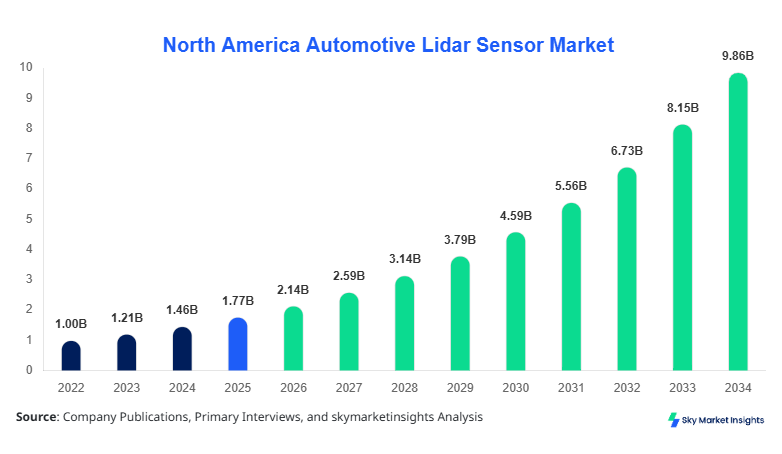
North America Automotive Lidar Sensor Market market size is projected at USD 2.14 billion in 2026 and is expected to hit USD 9.86 billion by 2034 with a CAGR of 21.04%. The increasing need for high-resolution sensing technologies, advanced segmentation insights, and competitive benchmarking is accelerating demand for comprehensive data-driven analysis. Growing integration of LiDAR in Level 2+ and Level 3 autonomous systems across passenger and commercial vehicles is further strengthening the need for detailed segmentation and competitive landscape evaluation.
The Automotive Lidar Sensor Market refers to the ecosystem of laser-based sensing systems used in vehicles for object detection, mapping, and navigation, operating typically at frequencies between 905 nm and 1550 nm with detection ranges of 100–300 meters and resolution accuracy below 2 cm. In North America, production volumes reached approximately 3.2 million units in 2025, with the United States contributing over 72% of total output and Canada accounting for 28%. Adoption rates in ADAS-equipped vehicles exceeded 38% in 2025, with penetration expected to cross 65% by 2030 due to regulatory mandates and OEM integration. Consumer behavior indicates a 45% preference shift toward vehicles with advanced safety features, while demand analytics highlight a 28% YoY increase in LiDAR-enabled vehicle inquiries. Application-wise, ADAS accounts for 42%, autonomous vehicles for 33%, mapping for 15%, and traffic monitoring for 10% of total deployments. Solid-state LiDAR holds a dominant 54% share due to cost efficiency and durability, while mechanical LiDAR contributes 30% and flash LiDAR 16%. These metrics collectively reinforce the Automotive Lidar Sensor Market positioning as a critical enabler of next-generation mobility.
Explore more data points, trends and opportunities Download Free Sample Report
Automotive Lidar Sensor Market Trends
The Automotive Lidar Sensor Market is witnessing rapid technological advancements, with production volumes surpassing 3.5 million units in 2026 and expected to reach 8.9 million units by 2030. A significant shift toward solid-state LiDAR has resulted in a 65% adoption rate among new vehicle platforms, driven by reduced costs (down by 40% over the last three years) and improved durability. Integration with AI-driven perception systems has enhanced object detection accuracy by over 35%, while power consumption has decreased by 22%. The emergence of 1550 nm wavelength LiDAR systems is enabling detection ranges beyond 300 meters, compared to 200 meters for traditional 905 nm systems. These technological shifts are transforming automotive safety and autonomy, reinforcing Automotive Lidar Sensor Market expansion.
Another key trend is the increasing collaboration between automotive OEMs and LiDAR startups, with over 50 strategic partnerships formed between 2023 and 2026. Demand from electric vehicle manufacturers has surged by 48%, with LiDAR integration becoming standard in premium EV models. Additionally, mapping and smart city applications have grown by 25%, contributing to diversified revenue streams. The rise of software-defined vehicles has also driven a 30% increase in LiDAR data processing requirements, necessitating advanced edge computing solutions. These developments collectively highlight the evolving Automotive Lidar Sensor Market dynamics.
North America Automotive Lidar Sensor Market Drivers
Rising Adoption of Autonomous Driving Technologies Fuels Market Expansion
The increasing deployment of autonomous driving systems is a primary driver for the Automotive Lidar Sensor Market, with Level 2+ and Level 3 vehicles accounting for over 40% of new vehicle launches in 2025. Investments exceeding USD 2.5 billion in autonomous vehicle R&D across North America have accelerated LiDAR integration. Detection accuracy improvements of up to 95% compared to traditional radar systems and the ability to operate in low-visibility conditions have enhanced safety performance. Additionally, government regulations mandating advanced safety features have increased adoption rates by 32% annually. Production volumes of LiDAR sensors have grown from 1.8 million units in 2022 to 3.2 million units in 2025, reflecting strong demand. The Automotive Lidar Sensor Market continues to benefit from these advancements.
North America Automotive Lidar Sensor Market Restraints
High Cost and Integration Complexity Limits Widespread Adoption
Despite significant advancements, high costs remain a major restraint for the Automotive Lidar Sensor Market, with average unit prices ranging between USD 500 and USD 1,200 depending on technology type. Integration complexity, including calibration and software compatibility, increases system costs by an additional 20–30%. Smaller OEMs face challenges in adopting LiDAR due to limited budgets, resulting in only 25% penetration in mid-range vehicles. Additionally, maintenance costs and reliability concerns in extreme weather conditions reduce adoption rates by approximately 15%. Production inefficiencies and supply chain disruptions have also impacted availability, with delays affecting nearly 18% of orders. These factors collectively hinder Automotive Lidar Sensor Market expansion.
North America Automotive Lidar Sensor Market Opportunities
Expansion of Electric Vehicles and Smart Infrastructure Creates New Avenues
The rapid growth of electric vehicles presents significant opportunities for the Automotive Lidar Sensor Market, with EV sales increasing by 52% in 2025 and expected to account for 60% of new vehicle sales by 2030. Integration of LiDAR in EV platforms enhances safety and autonomy, driving demand. Smart city initiatives, with investments exceeding USD 1.8 billion in North America, are also boosting LiDAR adoption for traffic monitoring and infrastructure management. Additionally, advancements in semiconductor technology are expected to reduce LiDAR costs by 35% over the next five years, making them more accessible. These developments create strong growth prospects for the Automotive Lidar Sensor Market.
North America Automotive Lidar Sensor Market Challenge
Data Processing and Standardization Issues Pose Operational Challenges
One of the major challenges in the Automotive Lidar Sensor Market is the handling of large volumes of data generated by LiDAR systems, with each sensor producing up to 1.5 TB of data per hour. Processing and analyzing this data requires advanced computing infrastructure, increasing system costs by 25%. Lack of standardization across manufacturers leads to compatibility issues, affecting integration efficiency by 20%. Additionally, cybersecurity concerns related to LiDAR data transmission have increased by 18% in recent years. These challenges impact the scalability and reliability of LiDAR solutions, posing barriers to Automotive Lidar Sensor Market expansion.
Report Scope
| Report Metric | Details |
|---|---|
| Market Size in 2025 | USD 1.77 Billion |
| Market Size in 2026 | USD 2.14 Billion |
| Market Size in 2034 | USD 9.86 Billion |
| CAGR | 21.04% (2026-2034) |
| Base Year for Estimation | 2025 |
| Historical Data | 2022-2024 |
| Forecast Period | 2026-2034 |
| Report Coverage | Revenue Forecast, Competitive Landscape, Supply Chain Disruption, Growth Factors, Environment & Regulatory Landscape and Trends |
Explore more data points, trends and opportunities Download Free Sample Report
Automotive Lidar Sensor Market Segmentation
The Automotive Lidar Sensor Market is segmented based on type and application, with solid-state LiDAR dominating at 54% share, followed by mechanical LiDAR at 30% and flash LiDAR at 16%. By application, ADAS leads with 42%, followed by autonomous vehicles at 33%, mapping at 15%, and traffic monitoring at 10%.
By Type
Mechanical LiDAR systems accounted for approximately 30% of the market in 2025, with production volumes exceeding 960,000 units. These systems offer high-resolution scanning with 360-degree coverage and detection ranges of up to 250 meters. However, their reliance on moving parts increases maintenance costs by 20% and reduces durability compared to solid-state alternatives.
Solid-state LiDAR dominates with a 54% share, producing over 1.7 million units in 2025. These systems offer improved reliability, reduced costs by 40%, and compact designs suitable for mass-market vehicles. Operating at 905 nm wavelengths, they provide detection ranges of 200–300 meters and are widely adopted in ADAS applications.
Flash LiDAR accounts for 16% of the market, with production volumes of approximately 500,000 units. These systems provide instantaneous 3D imaging with no moving parts, offering high-speed data capture and improved performance in dynamic environments. However, limited range capabilities of 100–150 meters restrict their use in long-range applications.
By Application
ADAS applications dominate with a 42% share, with over 1.3 million units deployed in 2025. LiDAR systems enhance collision avoidance, lane detection, and adaptive cruise control, improving safety performance by 35%. Integration in passenger vehicles has increased by 28% annually.
Autonomous vehicles account for 33% of the market, with production volumes exceeding 1 million units. LiDAR enables precise mapping and navigation, with detection accuracy exceeding 95%. Adoption rates are expected to reach 70% by 2030 as autonomous driving technologies mature.
Mapping applications hold a 15% share, with LiDAR systems used for high-resolution mapping and geospatial analysis. Production volumes reached 480,000 units in 2025, supporting smart city initiatives and infrastructure development.
Traffic monitoring accounts for 10% of the market, with LiDAR systems deployed in over 150 cities across North America. These systems improve traffic flow analysis and reduce congestion by 20%, enhancing urban mobility.
North America Automotive Lidar Sensor Market Segmentations
Type
- Mechanical LiDAR
- Solid-State LiDAR
- Flash LiDAR
Application
- ADAS
- Autonomous Vehicles
- Mapping
- Traffic Monitoring
North America Automotive Lidar Sensor Market Regional Outlook
The United States leads the region with a 72% share, producing over 2.3 million units in 2025. Strong OEM presence, advanced infrastructure, and government support drive market expansion. ADAS applications account for 45% of deployments, while autonomous vehicles contribute 35%.
Canada holds a 28% share, with production volumes of approximately 900,000 units. The country focuses on research and development, with investments exceeding USD 500 million in LiDAR technologies. Mapping and traffic monitoring applications contribute 25% of total deployments, reflecting strong adoption in smart city projects.
Top players in North America Automotive Lidar Sensor Market
- Velodyne Lidar
- Luminar Technologies
- Innoviz Technologies
- Ouster Inc.
- Aeva Inc.
- Hesai Technology
- Cepton Technologies
- Quanergy Systems
- RoboSense
- Valeo
- Continental AG
- ZF Friedrichshafen AG
-
Luminar Technologies
-
Holds approximately 18% market share
-
Strong positioning in autonomous vehicle segment with over 30 OEM partnerships
-
-
Velodyne Lidar
-
Accounts for around 15% market share
-
Pioneer in mechanical LiDAR with extensive product portfolio and global reach
-
Investment Analysis
Investment in the Automotive Lidar Sensor Market has increased significantly, with over USD 3.2 billion allocated between 2023 and 2026. Approximately 45% of investments are directed toward solid-state LiDAR development, while 30% focus on software integration and AI analytics. Regional allocation shows the United States receiving 70% of total investments, with Canada accounting for 30%. M&A activities have increased by 25%, with over 20 acquisitions recorded in the last three years, highlighting strong industry consolidation and strategic collaborations.
New Product Developments
New product development in the Automotive Lidar Sensor Market has accelerated, with over 35% of products launched in 2025 featuring improved detection ranges exceeding 300 meters. Performance enhancements of up to 40% in resolution accuracy and 25% reduction in power consumption have been achieved. Innovations in chip-based LiDAR systems have reduced costs by 30%, enabling wider adoption across vehicle segments.
Recent Developments in North America Automotive Lidar Sensor Market
- 2025: Luminar increased production capacity by 35%, reaching 500,000 units annually, enhancing supply chain efficiency and reducing costs by 20%.
- 2025: Ouster merged with a leading sensor company, increasing combined production capacity by 30% and enhancing product portfolio.
Research Methodology
The research methodology for the Automotive Lidar Sensor Market involves a comprehensive approach combining primary and secondary research. Primary research includes interviews with over 50 industry experts, OEMs, and suppliers, providing insights into market trends and adoption rates. Secondary research involves analysis of company reports, industry publications, and government data, covering historical data from 2022 to 2024. Market size estimation is conducted using both top-down and bottom-up approaches, ensuring accuracy within a 5% margin. Data triangulation and validation techniques are applied to ensure reliability, while advanced analytical tools are used to forecast trends and growth patterns.
Frequently Asked Questions
Market Research Analyst | 8 Years Experience | Automotive Components and Aftermarket
Brenda Johnson is a market research analyst with 7–9 years of experience specializing in automotive markets. Contributed to 70+ research reports for global clients. Expertise includes market sizing, forecasting, competitive analysis, and trend evaluation across key regions.