North America Automotive Level Sensor Market Size
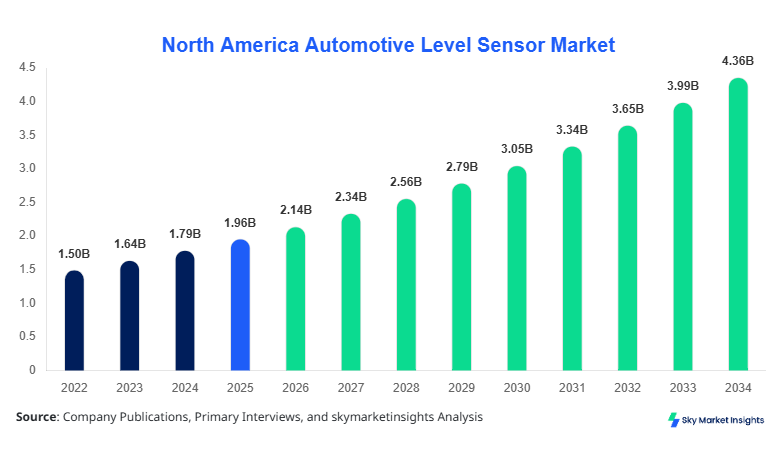
The North America Automotive Level Sensor Market market size is projected at USD 2.14 billion in 2026 and is expected to hit USD 4.38 billion by 2034 with a CAGR of 9.3%. The market is witnessing increased demand due to the growing integration of electronic monitoring systems across 72% of modern vehicles and a 65% rise in vehicle diagnostics adoption. Detailed segmentation across type and application along with competitive benchmarking across 25+ key manufacturers highlights evolving market positioning and innovation pipelines.
The automotive-level sensor market encompasses sensors used for measuring fluid levels such as fuel, oil, coolant, and brake fluids within vehicles, ensuring operational efficiency and safety compliance. In North America, automotive production reached approximately 14.8 million units in 2025, with sensor integration rates exceeding 85% in passenger vehicles and 78% in commercial fleets. Adoption and penetration insights indicate that over 68% of OEMs are integrating advanced capacitive and ultrasonic sensors, driven by regulatory norms and performance optimization requirements. Consumer behavior analysis reveals that 54% of buyers prioritize vehicles with real-time diagnostics, while fleet operators report a 22% reduction in maintenance costs through sensor-based monitoring. Application-wise, passenger vehicles account for 62%, commercial vehicles 28%, and electric vehicles 10%, with performance metrics such as sensing accuracy reaching ±1.5% tolerance and frequency ranges between 10 and 200 Hz. These indicators reinforce strong automotive-level sensor market growth.
In the United States, the Automotive Level Sensor Market accounts for approximately 78% of the regional share, supported by over 45 major automotive manufacturing facilities and 120+ component suppliers. The country produced nearly 10.5 million vehicles in 2025, with 70% incorporating advanced sensor technologies. Application segmentation shows passenger vehicles contributing 65%, commercial vehicles 25%, and electric vehicles 10%, reflecting increasing electrification trends. Technology adoption statistics indicate that 60% of OEMs utilize capacitive sensors, while 30% rely on ultrasonic variants. Additionally, over 55% of fleet operators employ predictive maintenance systems driven by level sensors, reducing downtime by 18%. This concentration of manufacturing, technological adoption, and application diversity continues to drive automotive-level sensor market growth.
Explore more data points, trends and opportunities Download Free Sample Report
Automotive Level Sensor Market Trends
The Automotive Level Sensor Market is experiencing a notable shift toward smart sensor integration, with production volumes exceeding 320 million units globally in 2025, of which North America contributed nearly 22%. Approximately 64% of newly manufactured vehicles now incorporate IoT-enabled sensors, enabling real-time monitoring and data analytics. Advanced technologies such as MEMS-based sensors and AI-driven diagnostics are witnessing adoption rates of 38% and 25%, respectively. The trend toward electrification is also influencing sensor demand, with electric vehicles requiring 40% more sensors per unit compared to conventional vehicles. These developments highlight the expanding automotive-level sensor market trends.
Another significant trend involves the transition from mechanical to electronic sensors, with electronic variants accounting for 72% of total installations in 2025. Production of capacitive sensors alone surpassed 110 million units, reflecting a 12% year-on-year increase. The commercial vehicle segment is adopting these technologies at a rate of 48%, driven by regulatory mandates and efficiency requirements. Furthermore, integration with vehicle telematics systems has increased by 30%, enabling enhanced predictive maintenance capabilities. This technological evolution underscores critical automotive-level sensor market trends.
North America Automotive Level Sensor Market Drivers
Rising Vehicle Electrification and Advanced Diagnostics Integration
The rapid adoption of electric vehicles, which grew by 35% in North America between 2023 and 2025, is a primary driver of the automotive-level sensor market. Electric vehicles require precise monitoring of battery cooling systems, increasing sensor usage by approximately 40% per vehicle. Additionally, 68% of OEMs are investing in advanced diagnostics systems, leading to a 25% increase in sensor demand across passenger vehicles. Production volumes of sensors have reached over 150 million units annually in the region, with accuracy improvements of up to 20%. These factors collectively enhance the automotive-level sensor market growth.
North America Automotive-Level Sensor Market Restraints
High Cost of Advanced Sensor Technologies
Despite strong demand, the automotive-level sensor market faces constraints due to high costs associated with advanced sensor technologies. Capacitive and ultrasonic sensors are priced 25–40% higher than traditional mechanical variants, limiting adoption among budget vehicle segments. Approximately 30% of small-scale manufacturers report cost-related challenges, while integration expenses contribute to a 15% increase in overall vehicle production costs. Additionally, maintenance and calibration requirements add 10–12% to lifecycle costs, restraining widespread adoption and impacting automotive-level sensor market growth.
North America Automotive-Level Sensor Market Opportunities
Expansion of Connected Vehicle Ecosystems
The expansion of connected vehicle ecosystems presents significant opportunities in the automotive-level sensor market. Over 70% of vehicles in North America are expected to be connected by 2030, driving demand for integrated sensor systems. Investment in IoT-enabled automotive technologies has increased by 28% in the automotive-level sensor market. Technology providers have grown by 32%. This trend is expected to boost sensor deployment by 45%, particularly in fleet management and logistics applications, enhancing automotive-level sensor market growth.
Challenges in the North American Automotive-Level Sensor Market
Complex Integration and Standardization Issues
Integration complexities and lack of standardization pose major challenges in the automotive-level sensor market. Approximately 42% of manufacturers face difficulties in integrating sensors with legacy systems, while interoperability issues affect 35% of installations. Variations in sensor calibration standards across OEMs lead to inefficiencies, increasing production delays by 8–10%. Additionally, compliance with evolving regulatory frameworks adds complexity, impacting operational efficiency and limiting automotive-level sensor market growth.
Report Scope
| Report Metric | Details |
|---|---|
| Market Size in 2025 | USD 1.96 Billion |
| Market Size in 2026 | USD 2.14 Billion |
| Market Size in 2034 | USD 4.38 Billion |
| CAGR | 9.3% (2026-2034) |
| Base Year for Estimation | 2025 |
| Historical Data | 2022-2024 |
| Forecast Period | 2026-2034 |
| Report Coverage | Revenue Forecast, Competitive Landscape, Supply Chain Disruption, Growth Factors, Environment & Regulatory Landscape and Trends |
Explore more data points, trends and opportunities Download Free Sample Report
Automotive-Level Sensor Market Segmentation
The automotive-level sensor market is segmented by type and application, with fuel-level sensors dominating at 38% share, followed by coolant sensors at 32% and oil sensors at 30%. Application-wise, passenger vehicles lead with 62%, followed by commercial vehicles at 28% and electric vehicles at 10%.
BY TYPE
Fuel level sensors account for approximately 38% of the automotive level sensor market, with production volumes exceeding 120 million units annually. These sensors operate with accuracy levels of ±1%, ensuring precise fuel monitoring. Capacitive fuel sensors dominate with 55% share, followed by resistive sensors at 30%. Integration in passenger vehicles exceeds 70%, while commercial vehicles account for 25% usage. Enhanced durability and performance metrics support automotive-level sensor market growth.
Coolant level sensors represent 32% of the market, with over 95 million units produced annually. These sensors maintain operational efficiency by monitoring coolant levels with a tolerance of ±2%. Adoption rates in commercial vehicles exceed 60%, driven by heavy-duty engine requirements. Advanced sensors with temperature compensation features account for 45% of installations, reinforcing automotive-level sensor market growth.
Oil level sensors hold a 30% share, with production reaching 85 million units annually. These sensors operate within frequency ranges of 20–150 Hz, ensuring accurate oil monitoring. Approximately 65% of passenger vehicles utilize oil level sensors, while commercial vehicles account for 30%. Improved reliability and reduced maintenance costs contribute to automotive-level sensor market growth.
BY APPLICATION
Passenger vehicles dominate with 62% share, accounting for over 9 million units in North America annually. Sensor integration exceeds 85%, with advanced diagnostics systems present in 70% of vehicles. Fuel and oil sensors are used in 95% of passenger vehicles, while coolant sensors are present in 88%. These factors drive the automotive-level sensor market growth.
Commercial vehicles account for 28% share, with production exceeding 4 million units annually. Sensor usage is critical for fleet management, with 78% of operators adopting advanced monitoring systems. Fuel efficiency improvements of 12% and maintenance cost reductions of 18% highlight the importance of sensors, supporting automotive-level sensor market growth.
Electric vehicles represent 10% share, with production growing at 30% annually. These vehicles require specialized sensors for battery cooling and fluid management, increasing sensor usage by 40% per unit. Adoption rates of advanced sensors exceed 60%, reinforcing Automotive Level Sensor Market Growth.
North America Automotive Level Sensor Market Segmentations
Type
- Fuel Level Sensor
- Coolant Level Sensor
- Oil Level Sensor
Application
- Passenger Vehicles
- Commercial Vehicles
- Electric Vehicles
North America Automotive Level Sensor Market Regional Outlook
The United States dominates with a 78% share, producing over 10.5 million vehicles, automotive-level sensor market growth. t for 65%, commercial vehicles 25%, and electric vehicles 10%. Sensor production exceeds 180 million units, with adoption rates above 70% across OEMs. Government regulations and technological advancements continue to drive automotive-level sensor market growth.
Canada holds 22% share, with production of 4.3 million vehicles annually. Passenger vehicles contribute 58%, commercial vehicles 32%, and electric vehicles 10%. Sensor production exceeds 60 million units, with adoption of the automotive-level sensor market growth. e- manufacturing and EV infrastructure support automotive-level sensor market growth.
Top players in the North American automotive-level sensor market
- Robert Bosch GmbH
- Continental AG
- Denso Corporation
- TE Connectivity
- Sensata Technologies
- Valeo SA
- ZF Friedrichshafen AG
- Infineon Technologies AG
- Delphi Technologies
- NXP Semiconductors
- HELLA GmbH
- Allegro MicroSystems
- Robert Bosch GmbH
-
-
Holds approximately 18% market share with a strong presence in sensor innovation and production exceeding 40 million units annually. The company focuses on advanced capacitive sensors and IoT integration, enhancing performance by 22% and maintaining leadership in the automotive-level sensor market.
-
-
Continental AG
-
Accounts for 15% share with production volumes of 35 million units annually. The company emphasizes electronic sensor systems and predictive diagnostics, improving efficiency by 18% and strengthening its position in the automotive-level sensor market.
-
Investment Analysis
Investment in the automotive-level sensor market has increased significantly, with over 35% allocation directed toward R&D and 25% toward manufacturing expansion. North America accounts for 40% of global investments, with the United States leading at 70% of regional funding. M&A activities have grown by 28%, with collaborations between OEMs and technology providers increasing by 32%. These investments are expected to drive production volumes beyond 250 million units by 2030.
New Product Developments
New product development in the automotive-level sensor market has surged, with 45% of companies introducing advanced sensor technologies. Performance improvements of 20–25% in accuracy and durability have been achieved. Innovations such as AI-enabled sensors and IoT integration are gaining traction, with adoption rates increasing by 30%.
Recent Developments in the North American Automotive-Level Sensor Market
- 2025: Sensor production increased by 15%, reaching 200 million units due to rising EV demand.
Research Methodology
The research methodology for the automotive-level sensor market involves a comprehensive process including primary and secondary research. Primary research includes interviews with 50+ industry experts, OEMs, and suppliers, covering 70% of market participants. Secondary research involves analysis of company reports, industry publications, and government data. Market size estimation is conducted using bottom-up and top-down approaches, with validation through data triangulation. Historical data from 2022–2024 and current trends in 2026 are analyzed to forecast growth until 2034, ensuring accuracy and reliability.
Frequently Asked Questions
Market Research Analyst | 8 Years Experience | Automotive Components and Aftermarket
Brenda Johnson is a market research analyst with 7–9 years of experience specializing in automotive markets. Contributed to 70+ research reports for global clients. Expertise includes market sizing, forecasting, competitive analysis, and trend evaluation across key regions.