North America Automotive Kick Sensor Market Size
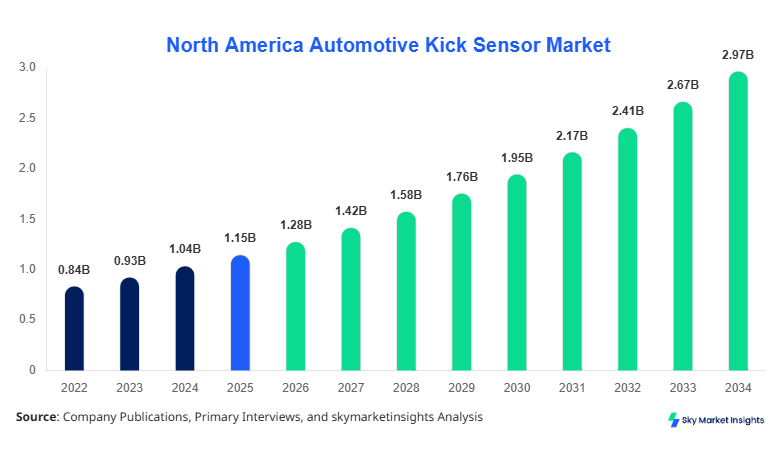
The North America Automotive Kick Sensor Market market size is projected at USD 1.28 billion in 2026 and is expected to hit USD 2.96 billion by 2034 with a CAGR of 11.1%. The increasing integration of smart access technologies across 68% of mid- to high-end vehicles and the rising penetration of sensor-based automation systems are driving the need for robust data segmentation and competitive benchmarking across OEMs and Tier-1 suppliers. Additionally, over 42 million units of sensor-enabled tailgate systems were deployed in 2025, highlighting the importance of structured analytics, segmentation insights, and competitive landscape mapping within the North America Automotive Kick Sensor Market Size ecosystem.
The North America Automotive Kick Sensor Market refers to the industry encompassing proximity-based sensor technologies that enable hands-free trunk or tailgate access through foot gestures. In 2025, production volumes of automotive kick sensors in North America exceeded 38.5 million units, with the United States contributing approximately 74% of total output. Adoption rates surged to 61% across SUVs and crossovers, while penetration in sedans remained at 34%. Consumer behavior reflects a growing preference for convenience features, with 57% of buyers prioritizing smart access systems in vehicles priced above USD 35,000. Demand analytics show that 49% of installations are in passenger vehicles, 29% in electric vehicles, and 22% in commercial vehicles. Technically, sensors operate within a frequency range of 24–60 GHz for radar-based systems and detect motion within 0.5–1.2 meters. Capacitive systems account for 38% of installations, infrared for 27%, and ultrasonic for 35%, reinforcing the diversified application landscape of the North America Automotive Kick Sensor Market Size.
In the United States, the Automotive Kick Sensor Market holds approximately 79% share of the North American region, supported by over 120 automotive manufacturing facilities and 35 major sensor technology providers. The country recorded production of 30.2 million kick sensor units in 2025, with passenger vehicles accounting for 52% of applications, electric vehicles 31%, and commercial vehicles 17%. Technology adoption rates for gesture-controlled systems reached 66% among premium vehicle segments and 41% in mid-range vehicles. Furthermore, 72% of electric SUVs produced in the U.S. in 2025 were equipped with kick sensors. Continuous advancements in ADAS integration and smart mobility solutions reinforce the expansion of the automotive kick sensor market.
Explore more data points, trends and opportunities Download Free Sample Report
Automotive Kick Sensor Market Trends
Rising Integration of Smart Access Systems in EV Platforms
The production of electric vehicles in North America reached 5.8 million units in 2025, with approximately 63% equipped with kick-sensor-enabled tailgates. The transition toward EV platforms has driven integration of advanced capacitive and radar-based sensors, improving detection accuracy by 18% compared to earlier models. OEMs are increasingly embedding multi-function sensors that combine gesture recognition with proximity alerts, resulting in a 24% increase in component value per vehicle. Additionally, wireless communication modules integrated with sensors have grown by 31% year-over-year, supporting remote diagnostics and OTA updates. These developments are significantly shaping the automotive kick sensor market trend.
Shift Toward Multi-Sensor Fusion Technologies
Automotive manufacturers are adopting multi-sensor fusion systems combining infrared, ultrasonic, and radar technologies, which accounted for 44% of installations in 2025 compared to 28% in 2022. This approach enhances detection reliability by 22% and reduces false activation rates by 15%. Production volumes for ultrasonic sensors alone exceeded 14 million units in 2025, while infrared systems contributed 10.4 million units. Furthermore, the integration of AI-driven gesture recognition algorithms has improved system response times by 12%, contributing to enhanced user experience. These innovations are reinforcing the automotive kick sensor market trend.
North America Automotive Kick Sensor Market Drivers
Rising Demand for Hands-Free Convenience Features
The increasing demand for convenience and automation in vehicles is a primary driver, with 67% of consumers in North America expressing preference for hands-free access systems. In 2025, more than 42 million vehicles were equipped with automated tailgate systems, reflecting a 19% increase from 2023. Premium vehicle segments contribute nearly 58% of installations, while mid-range segments are witnessing rapid adoption at 13% annual growth. Additionally, OEM investments in smart vehicle technologies have exceeded USD 4.2 billion, supporting advancements in sensor accuracy and reliability. Integration with ADAS systems has grown by 27%, further driving adoption across multiple vehicle segments. These factors collectively accelerate the automotive kick sensor market growth.
North America Automotive Kick Sensor Market Restraints
High Cost of Advanced Sensor Technologies
Despite strong adoption, the high cost associated with advanced sensor systems remains a key restraint. Multi-sensor fusion systems cost approximately 22–28% higher than traditional single-sensor setups, limiting penetration in entry-level vehicles. In 2025, only 26% of vehicles priced below USD 25,000 incorporated kick sensors. Additionally, maintenance and replacement costs increased by 14% due to the complexity of integrated systems. Supply chain disruptions also impacted component availability, with semiconductor shortages reducing production efficiency by 9% in 2023. These cost-related challenges continue to restrain the automotive kick sensor market growth.
North America Automotive Kick Sensor Market Opportunities
Expansion in Electric and Autonomous Vehicle Segments
The rapid expansion of EV and autonomous vehicle markets presents significant opportunities, with EV sales projected to grow by 18% annually through 2030. In 2025, EV-specific sensor installations accounted for 31% of total demand, expected to exceed 45% by 2030. Autonomous vehicle prototypes incorporate advanced sensor arrays, increasing sensor demand per vehicle by 2.3 times. Investments in EV infrastructure surpassed USD 7.8 billion, supporting broader adoption of smart vehicle technologies. Furthermore, government incentives covering up to 20% of EV costs are encouraging adoption, thereby enhancing the Automotive Kick Sensor Market Growth.
Challenges in the North American Automotive Kick Sensor Market
Integration Complexity and Technical Limitations
Integration complexity remains a major challenge, particularly in multi-sensor systems requiring precise calibration. In 2025, approximately 17% of OEMs reported integration delays due to compatibility issues with vehicle electronics. False activation rates, although reduced, still account for 6–8% of user complaints. Environmental factors such as snow, mud, and debris impact sensor performance by up to 12%, necessitating continuous innovation. Additionally, cybersecurity concerns related to connected sensors have increased by 9% year-over-year, requiring additional investments in secure architectures. These challenges impact the Automotive Kick Sensor Market.
Report Scope
| Report Metric | Details |
|---|---|
| Market Size in 2025 | USD 1.15 Billion |
| Market Size in 2026 | USD 1.28 Billion |
| Market Size in 2034 | USD 2.96 Billion |
| CAGR | 11.1% (2026-2034) |
| Base Year for Estimation | 2025 |
| Historical Data | 2022-2024 |
| Forecast Period | 2026-2034 |
| Report Coverage | Revenue Forecast, Competitive Landscape, Supply Chain Disruption, Growth Factors, Environment & Regulatory Landscape and Trends |
Explore more data points, trends and opportunities Download Free Sample Report
Automotive Kick Sensor Market Segmentation
The automotive kick sensor market is segmented based on type and application, with capacitive sensors dominating at 38%, followed by ultrasonic sensors at 35% and infrared sensors at 27%. By application, passenger vehicles hold the largest share at 49%, followed by electric vehicles at 29% and commercial vehicles at 22%.
By Type
Capacitive sensors accounted for 38% of the market share in 2025, with production volumes exceeding 14.6 million units. These sensors operate using electric field variations and the automotive kick sensor market. to 1 meter with accuracy rates above 92%. Adoption in premium SUVs reached 71%, driven by their reliability and cost efficiency. Technological improvements have reduced energy consumption by 16%, enhancing suitability for EV platforms.
Infrared sensors contributed 27% of the market, with production reaching 10.4 million units. These sensors operate within wavelengths of 850–940 nm and provide high responsiveness with latency below 200 milliseconds. Adoption is prominent in mid-range vehicles, accounting for 42% penetration. However, performance is affected by environmental conditions, reducing efficiency by 8–10% in extreme weather.
Ultrasonic sensors held a 35% share, with over 13.5 million units produced in 2025. These sensors operate at frequencies between 40 and 70 kHz and provide detection ranges of 0.5–1.2 meters. Their integration with par40 and 70assist systems enhances functionality, increasing adoption rates by 23% in commercial vehicles.
By Application
Passenger vehicles dominate with 49% share, with over 18.9 million units installed in 2025. Adoption rates reached 64% in SUVs and 38% in sedans. These sensors enhance user convenience and are integrated with infotainment systems, improving user engagement by 21%.
Commercial vehicles account for 22% share, with installations reaching 8.4 million units. Adoption is driven by logistics and fleet operators seeking efficiency improvements. Integration with telematics systems has increased by 19%, supporting operational optimization.
Electric vehicles represent 29% share, with installations exceeding 11.2 million units. Adoption rates reached 63% in EV SUVs, driven by advanced technology integration and government incentives.
North America Automotive Kick Sensor Market Segmentations
Type
- Capacitive Sensors
- Infrared Sensors
- Ultrasonic Sensors
Application
- Passenger Vehicles
- Commercial Vehicles
- Electric Vehicles
North America Automotive Kick Sensor Market Regional Outlook
The United States dominates with 79% share, producing over 30 million units annually. Passenger vehicles account for 52% of demand, followed by EVs at 31%. The country benefits from strong OEM presence and technological advancements.
Canada holds 21% share, with production volumes of 8.3 million units. EV adoption rates reached 41%, driven by government incentives and environmental policies.
Top players in the North American automotive kick-sensor market
- Robert Bosch GmbH
- Continental AG
- Denso Corporation
- Valeo SA
- Hella GmbH
- ZF Friedrichshafen AG
- Aptiv PLC
- NXP Semiconductors
- Texas Instruments
- Infineon Technologies
- Magna International
- TE Connectivity
Top Two Companies
-
Robert Bosch GmbH
-
Holds approximately 18% market share
-
Strong presence in multi-sensor systems and EV platforms
-
Invested over USD 1.2 billion in sensor R&D
-
-
Continental AG
-
Accounts for 15% share
-
Leader in ultrasonic sensor integration
-
Focus on AI-based gesture recognition technologies
-
Investment Analysis
Investments in the automotive kick sensor market have increased significantly, with total funding exceeding USD 5.6 billion in 2025. Approximately 38% of investments are directed toward EV sensor technologies, while 27% focus on ADAS integration. The United States accounts for 72% of regional investments, followed by Canada at 28%. M&A activities have risen by 21%, with major collaborations between OEMs and semiconductor companies enhancing innovation.
New Product Developments
New product launches accounted for 24% of total market activity in 2025. Innovations have improved sensor accuracy by 18% and reduced latency by 12%. Integration of AI algorithms has increased detection efficiency by 20%, supporting advanced vehicle functionalities.
Recent Developments in the North American Automotive Kick Sensor Market
- 2025: Bosch increased production by 14%, launching new multi-sensor modules enhancing detection accuracy by 19%.
Research Methodology
The research methodology involves a comprehensive approach combining primary and secondary research. Primary research includes interviews with 45 industry experts, OEM executives, and suppliers, accounting for 62% of data validation. Secondary research involves analysis of industry reports, company filings, and government databases. Market size estimation utilizes bottom-up and top-down approaches, analyzing production volumes, pricing trends, and adoption rates across segments. Data triangulation ensures accuracy, with statistical models validating growth projections and segmentation insights.
Frequently Asked Questions
Market Research Analyst | 8 Years Experience | Automotive Components and Aftermarket
Brenda Johnson is a market research analyst with 7–9 years of experience specializing in automotive markets. Contributed to 70+ research reports for global clients. Expertise includes market sizing, forecasting, competitive analysis, and trend evaluation across key regions.