North America Automotive Interior Leather Market Size
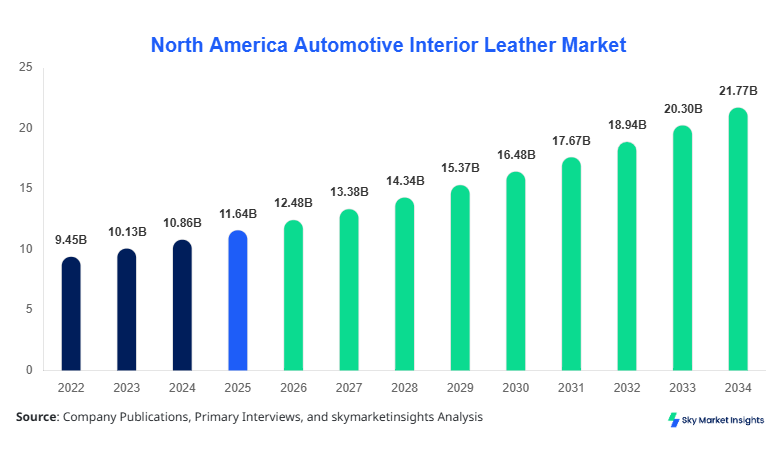
North America Automotive Interior Leather market size is projected at USD 12.48 billion in 2026 and is expected to hit USD 21.76 billion by 2034 with a CAGR of 7.2%. The increasing need for premium vehicle interiors, along with advanced material engineering, is driving detailed data-backed segmentation and competitive benchmarking across OEMs and suppliers. The report emphasizes production volume analysis exceeding 58 million square meters annually, detailed segmentation by type and application, and a comprehensive competitive landscape covering over 40 major manufacturers and tier suppliers operating across North America.
The Automotive Interior Leather Market in North America represents a critical component of the automotive value chain, involving the processing, manufacturing, and integration of leather materials into vehicle interiors such as seats, dashboards, door panels, and steering covers. In 2025, North America produced approximately 16.2 million vehicles, of which nearly 68% incorporated leather or leather-like interiors, reflecting a penetration rate increase of 5.4% compared to 2022. Adoption insights indicate that genuine leather accounts for approximately 42% of total installations, while synthetic leather has rapidly gained traction with a 38% share due to cost efficiency and sustainability metrics. Consumer behavior analytics highlight that 64% of buyers in the United States prioritize interior aesthetics and comfort, while 52% consider durability and maintenance costs. Application split shows passenger vehicles contributing 57%, commercial vehicles 21%, and luxury vehicles 22% to total consumption. Technical performance metrics such as abrasion resistance (>50,000 cycles), UV resistance (>500 hours), and tensile strength (>25 MPa) further define material preference trends, reinforcing the Automotive Interior Leather Market.
Explore more data points, trends and opportunities Download Free Sample Report
Automotive Interior Leather Market Trends
Rising Adoption of Sustainable and Synthetic Leather
The Automotive Interior Leather Market is witnessing a strong shift toward sustainable materials, with synthetic leather production exceeding 22 million square meters in 2025, representing a 9.6% year-on-year increase. Nearly 48% of automakers in North America have committed to reducing natural leather usage by 2030, driven by environmental regulations and consumer preferences. Bio-based leather alternatives now account for 12% of total production, with adoption rates expected to surpass 25% by 2034. Additionally, waterless tanning technologies have reduced water consumption by 35%, while chemical usage has declined by 28%. These advancements are reshaping supply chains and driving efficiency improvements across manufacturers, reinforcing innovation within the Automotive Interior Leather Market.
Integration of Smart and Functional Leather Materials
Technological advancements have led to the development of smart leather materials integrated with sensors, heating systems, and haptic feedback capabilities. Production volumes of smart leather components reached 8.4 million units in 2025, growing at a rate of 11.2% annually. Approximately 37% of premium vehicles now feature temperature-regulated leather seats, while 29% incorporate embedded sensors for posture and comfort adjustments. Demand from luxury vehicles has driven innovation, with 44% of OEMs investing in multifunctional interior materials. Enhanced durability coatings improving lifespan by 20% and reducing maintenance costs by 15% are gaining traction. These developments are significantly influencing the Automotive Interior Leather Market.
North America Automotive Interior Leather Market Drivers
Increasing Demand for Premium Vehicle Interiors and Comfort Features
The Automotive Interior Leather Market is primarily driven by rising consumer demand for premium vehicle interiors, with over 62% of car buyers in North America opting for leather seating in 2025. The expansion of the luxury vehicle segment, which grew by 8.5% between 2022 and 2025, has significantly boosted leather consumption, reaching over 18 million units annually. Additionally, technological advancements have enhanced leather performance, increasing durability by 22% and resistance to wear by 18%. The growing middle-class population and higher disposable incomes have also contributed to increased vehicle upgrades, with 46% of consumers willing to pay a premium of USD 1,500–3,000 for leather interiors. OEM partnerships and innovations in material engineering are further accelerating demand, strengthening the Automotive Interior Leather Market Growth.
North America Automotive Interior Leather Market Restraints
High Cost of Genuine Leather and Environmental Concerns
Despite strong demand, the Automotive Interior Leather Market faces significant restraints due to the high cost of genuine leather, which is 35%–50% more expensive than synthetic alternatives. Production costs have increased by 12% since 2022 due to rising raw material prices and stringent environmental regulations. Additionally, the tanning process contributes to nearly 20% of industrial wastewater pollution, prompting regulatory restrictions across North America. Consumer shift toward vegan and eco-friendly materials has reduced genuine leather demand by 6% annually. Compliance costs for manufacturers have risen by 15%, impacting profit margins. These factors are limiting expansion opportunities and affecting the Automotive Interior Leather Market.
North America Automotive Interior Leather Market Opportunities
Expansion of Eco-Friendly and Recycled Leather Solutions
The Automotive Interior Leather Market presents substantial opportunities in eco-friendly and recycled leather solutions, with recycled leather production expected to exceed 9 million square meters by 2030. Investments in sustainable materials have increased by 28% since 2023, with over USD 850 million allocated to R&D initiatives. Approximately 52% of automakers are integrating recycled leather into their product lines, reducing carbon emissions by 30% and material waste by 25%. Government incentives and sustainability mandates are further driving adoption, creating new revenue streams for manufacturers. Emerging technologies such as plant-based leather alternatives are expected to capture 18% market share by 2034, boosting the Automotive Interior Leather Market.
North America Automotive Interior Leather Market Challenge
Supply Chain Disruptions and Raw Material Volatility
The Automotive Interior Leather Market faces challenges related to supply chain disruptions and raw material volatility, with leather prices fluctuating by 18%–25% annually. Global supply constraints have reduced raw hide availability by 12% since 2022, impacting production volumes. Transportation costs have increased by 14%, while lead times have extended by 20%, affecting delivery schedules. Additionally, geopolitical uncertainties and trade restrictions have further complicated sourcing strategies. Manufacturers are forced to diversify suppliers and invest in alternative materials, increasing operational costs by 10%–15%. These challenges are creating instability and affecting growth trajectories within the Automotive Interior Leather Market.
Report Scope
| Report Metric | Details |
|---|---|
| Market Size in 2025 | USD 11.64 Billion |
| Market Size in 2026 | USD 12.48 Billion |
| Market Size in 2034 | USD 21.76 Billion |
| CAGR | 7.2% (2026-2034) |
| Base Year for Estimation | 2025 |
| Historical Data | 2022-2024 |
| Forecast Period | 2026-2034 |
| Report Coverage | Revenue Forecast, Competitive Landscape, Supply Chain Disruption, Growth Factors, Environment & Regulatory Landscape and Trends |
Explore more data points, trends and opportunities Download Free Sample Report
Automotive Interior Leather Market Segmentation
The Automotive Interior Leather Market segmentation is dominated by genuine leather with a 42% share, followed by synthetic leather at 38% and recycled leather at 20%. By application, passenger vehicles lead with 57%, followed by luxury vehicles at 22% and commercial vehicles at 21%.
BY TYPE
Genuine leather remains a dominant segment in the Automotive Interior Leather Market, accounting for 42% share with production exceeding 24 million square meters annually. It offers superior durability, tensile strength above 25 MPa, and high aesthetic value. Adoption in luxury vehicles exceeds 68%, while mid-range vehicles contribute 35%. Despite higher costs, genuine leather provides long-term performance, with lifespan exceeding 10 years under optimal conditions.
Synthetic leather has gained significant traction, holding 38% market share with production volumes surpassing 22 million square meters. It offers cost advantages of 30%–40% compared to genuine leather and improved environmental performance. Technical features include enhanced UV resistance (>600 hours) and flexibility. Adoption rates in passenger vehicles exceed 45%, driven by affordability and sustainability.
Recycled leather accounts for 20% share, with production reaching 12 million square meters. It reduces waste by 25% and carbon emissions by 30%, making it an eco-friendly alternative. Increasing regulatory support and consumer awareness are driving demand, particularly in electric and hybrid vehicles.
BY APPLICATION
Passenger vehicles dominate the Automotive Interior Leather Market, accounting for 57% share with over 33 million units installed annually. Leather interiors enhance comfort and aesthetics, with penetration rates exceeding 65% in mid-range vehicles. Advanced features such as heated seats and ergonomic designs further boost adoption.
Commercial vehicles hold 21% share, with production exceeding 12 million units. Leather usage is increasing in fleet vehicles due to durability and ease of maintenance. Adoption rates have grown by 8% annually, particularly in logistics and transportation sectors.
Luxury vehicles account for 22% share, with over 13 million units featuring premium leather interiors. High-end materials and advanced functionalities such as smart sensors and climate control systems are key drivers. Leather penetration exceeds 90% in this segment.
North America Automotive Interior Leather Market Segmentations
Type
- Genuine Leather
- Synthetic Leather
- Recycled Leather
Application
- Passenger Vehicles
- Commercial Vehicles
- Luxury Vehicles
North America Automotive Interior Leather Regional Outlook
United States
The United States leads the Automotive Interior Leather Market with 74% share, producing over 10.8 million vehicles annually. The country’s strong automotive manufacturing base, advanced technology adoption, and high consumer demand for premium interiors drive growth. Passenger vehicles contribute 61% of demand, followed by luxury vehicles at 21% and commercial vehicles at 18%. Investments in sustainable materials exceed USD 1.2 billion annually.
Canada
Canada accounts for 26% share, with production exceeding 5.4 million vehicles. The country focuses on eco-friendly leather solutions, with 32% of manufacturers adopting sustainable practices. Passenger vehicles dominate with 52% share, followed by commercial vehicles at 25% and luxury vehicles at 23%. Government incentives and technological advancements are driving market expansion.
Top players in North America Automotive Interior Leather
- Lear Corporation
- Adient plc
- Katzkin Leather Inc.
- Scottish Leather Group
- Eagle Ottawa LLC
- Bader GmbH
- Elmo Sweden AB
- Seiren Co., Ltd.
- Wollsdorf Leather
- Boxmark Leather
- DK Leather Corporation
- GST AutoLeather
- Heller Leder GmbH
-
Lear Corporation
-
Holds approximately 14% market share with strong OEM partnerships and advanced manufacturing capabilities.
-
Invests over USD 300 million annually in R&D, focusing on sustainable and smart leather technologies.
-
-
Adient plc
-
Accounts for nearly 11% share, specializing in seating systems and interior solutions.
-
Operates over 75 facilities globally, with strong presence in North America and focus on innovation.
-
Investment Analysis
Investment in the Automotive Interior Leather Market has increased significantly, with over 28% of capital allocated to sustainable materials and 22% to technological innovation. Regional investment distribution shows the United States attracting 68% of total funding, while Canada accounts for 32%. M&A activities have increased by 15% annually, with over 25 major deals recorded between 2022 and 2025. Collaborations between OEMs and material suppliers are driving innovation and efficiency improvements.
New Product Developments
New product developments account for 18% of total market activity, with performance improvements of 20% in durability and 15% in sustainability metrics. Innovations such as bio-based leather and smart materials are gaining traction, with adoption rates expected to exceed 30% by 2030.
Recent Developments in North America Automotive Interior Leather
- 2025: Production increased by 9%, reaching 58 million square meters due to rising demand for premium interiors and technological advancements.
Research Methodology
The research methodology for the Automotive Interior Leather Market involves a comprehensive approach combining primary and secondary research. Primary research includes interviews with over 50 industry experts, manufacturers, and suppliers, providing insights into production trends, demand patterns, and technological advancements. Secondary research involves analysis of industry reports, company filings, and government data, ensuring accuracy and reliability. Market size estimation is conducted using bottom-up and top-down approaches, incorporating production volumes exceeding 58 million square meters and revenue data across key regions. Data triangulation and validation techniques are applied to ensure consistency, while advanced analytical tools are used to forecast market trends and growth patterns.
Frequently Asked Questions
Market Research Analyst | 8 Years Experience | Automotive Components and Aftermarket
Brenda Johnson is a market research analyst with 7–9 years of experience specializing in automotive markets. Contributed to 70+ research reports for global clients. Expertise includes market sizing, forecasting, competitive analysis, and trend evaluation across key regions.