North America Automotive Infotainment Systems Market Size
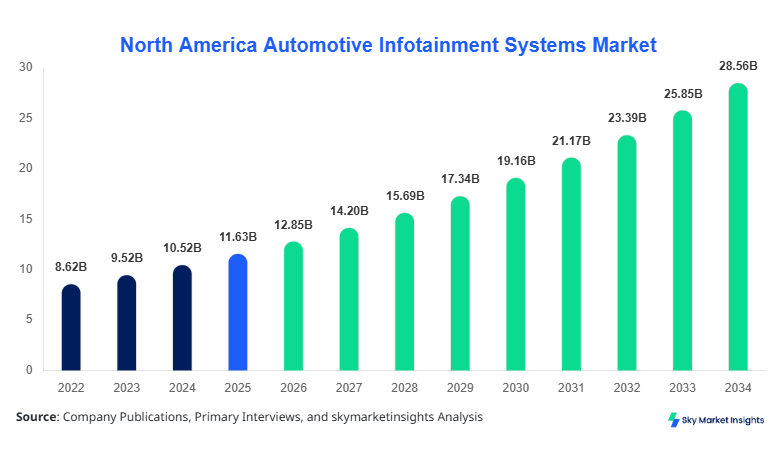
North America Automotive Infotainment Systems market size is projected at USD 12.85 billion in 2026 and is expected to hit USD 28.67 billion by 2034 with a CAGR of 10.5%. The increasing demand for connected vehicle technologies, rising integration of AI-enabled infotainment systems, and expanding vehicle production volumes exceeding 15.2 million units annually across the United States and Canada are driving the market expansion. Additionally, data-centric platforms, real-time navigation systems, and in-car entertainment ecosystems are reshaping the competitive landscape, with over 68% of OEMs investing in advanced infotainment modules, strengthening the Automotive Infotainment Systems Market Size across North America.
The Automotive Infotainment Systems Market encompasses integrated hardware and software solutions that deliver entertainment, navigation, connectivity, and telematics functions within vehicles. In North America, production of vehicles equipped with infotainment systems reached approximately 13.8 million units in 2025, representing nearly 82% penetration across new vehicles. Adoption rates are significantly higher in passenger vehicles, accounting for 72% of installations, while commercial vehicles contribute around 18%, and electric vehicles (EVs) represent 10% but are growing rapidly at 18% annually. Consumers increasingly demand seamless connectivity, with 76% preferring smartphone integration such as Apple CarPlay and Android Auto, while 64% prioritize voice-assisted controls. Technical performance benchmarks include response latency under 200 milliseconds, screen sizes averaging 8.5–12.3 inches, and connectivity speeds exceeding 4G LTE and emerging 5G capabilities. Application-wise, navigation systems account for 35% usage, multimedia systems 30%, telematics 20%, and connected services 15%. This expanding ecosystem reinforces the Automotive Infotainment Systems Market Share across the region.
Explore more data points, trends and opportunities Download Free Sample Report
Automotive Infotainment Systems Market Trends
Increasing Integration of AI and Cloud-Based Platforms
The Automotive Infotainment Systems Market is witnessing a surge in AI-driven functionalities, with over 60% of infotainment systems now incorporating machine learning algorithms for personalized user experiences. Production of AI-enabled infotainment units crossed 8.5 million units in 2025, reflecting a 28% increase from 2023. Cloud-based infotainment platforms are also expanding rapidly, with 42% of vehicles offering real-time data synchronization and OTA (over-the-air) updates. This shift enables predictive maintenance alerts, dynamic navigation routing, and adaptive content delivery. The adoption of voice assistants has reached 58%, while gesture control systems account for 12%, indicating growing consumer preference for hands-free interfaces. These technological advancements significantly influence the Automotive Infotainment Systems Market Trend.
Expansion of 5G Connectivity and Digital Cockpit Systems
The transition toward 5G connectivity is transforming infotainment capabilities, with 5G-enabled vehicles expected to exceed 40% penetration by 2030. In 2026, approximately 3.8 million vehicles in North America are equipped with 5G infotainment modules, enabling ultra-low latency (
North America Automotive Infotainment Systems Drivers
Rising Demand for Connected Vehicle Ecosystems
The increasing demand for connected vehicle ecosystems is a primary driver of the Automotive Infotainment Systems Market, with over 75% of consumers prioritizing connectivity features when purchasing vehicles. In 2025, connected infotainment systems accounted for 11.3 million units in North America, representing a 22% increase from 2023. Integration of IoT and telematics platforms enables real-time data exchange, enhancing navigation accuracy by 35% and improving user engagement metrics by 28%. OEMs are investing heavily, allocating nearly 18% of their R&D budgets toward infotainment technologies. Additionally, subscription-based services within infotainment systems generate recurring revenue streams, contributing up to 12% of OEM profits. These factors collectively accelerate the Automotive Infotainment Systems Market Growth.
North America Automotive Infotainment Systems Restraints
High Cost of Advanced Infotainment Systems
The high cost associated with advanced infotainment systems remains a significant restraint, with premium systems costing between USD 800–2,500 per unit, increasing overall vehicle prices by 5–8%. Approximately 35% of consumers in mid-range vehicle segments cite cost as a barrier to adoption. Additionally, integration complexity and hardware limitations in legacy vehicle platforms restrict scalability, affecting nearly 20% of potential installations. Maintenance and software update costs, averaging USD 150 annually per vehicle, further limit widespread adoption. These financial constraints hinder market expansion, impacting the Automotive Infotainment Systems Market Share.
North America Automotive Infotainment Systems Opportunities
Expansion of Electric Vehicles and Autonomous Driving
The rapid expansion of electric vehicles and autonomous driving technologies presents significant opportunities, with EV production in North America exceeding 3.5 million units by 2026 and expected to grow at 20% annually. Infotainment systems in EVs are more advanced, accounting for 25% higher feature integration compared to conventional vehicles. Autonomous driving levels (L2–L4) require sophisticated infotainment interfaces, with adoption rates projected to reach 30% by 2030. Investments in autonomous vehicle technologies have surpassed USD 45 billion, creating a robust ecosystem for infotainment innovation. These developments enhance the Automotive Infotainment Systems Market Growth.
North America Automotive Infotainment Systems Challenge
Cybersecurity Risks and Data Privacy Concerns
Cybersecurity risks pose a critical challenge, with over 65% of connected vehicles vulnerable to potential cyber threats. In 2025, reported automotive cybersecurity incidents increased by 18%, highlighting vulnerabilities in infotainment systems. Data privacy concerns also impact consumer confidence, with 48% of users expressing apprehension about data sharing. Implementing robust security frameworks increases system costs by 10–15%, affecting OEM margins. Regulatory compliance requirements, including data protection laws, further complicate system design and deployment. These challenges influence the Automotive Infotainment Systems Market Trend.
Report Scope
| Report Metric | Details |
|---|---|
| Market Size in 2025 | USD 11.63 Billion |
| Market Size in 2026 | USD 12.85 Billion |
| Market Size in 2034 | USD 28.67 Billion |
| CAGR | 10.5% (2026-2034) |
| Base Year for Estimation | 2025 |
| Historical Data | 2022-2024 |
| Forecast Period | 2026-2034 |
| Report Coverage | Revenue Forecast, Competitive Landscape, Supply Chain Disruption, Growth Factors, Environment & Regulatory Landscape and Trends |
Explore more data points, trends and opportunities Download Free Sample Report
Automotive Infotainment Systems Market Segmentation
The Automotive Infotainment Systems Market is segmented by component and vehicle type, with display units dominating at 38% share, followed by connectivity modules at 34% and control panels at 28%. By vehicle type, passenger cars lead with 72% share, while commercial vehicles and EVs account for 18% and 10%, respectively.
By Type
Display units account for approximately 38% of the market, with production exceeding 5.3 million units in 2025. Screen sizes range from 7 inches to 15 inches, with resolution standards reaching 1920x1080 pixels and higher. Touchscreen adoption stands at 92%, while OLED displays are gaining traction at 18% penetration. These units offer response times below 150 milliseconds and support multi-touch functionality, enhancing user interaction.
Control panels represent 28% of the market, with production volumes of 3.9 million units annually. These include physical buttons, rotary knobs, and touch-sensitive interfaces. Integration with haptic feedback systems has increased by 22%, improving usability. Control panels are essential for safety compliance, enabling drivers to operate systems without distraction.
Connectivity modules hold a 34% share, with over 4.7 million units produced in 2025. These modules support 4G LTE and 5G connectivity, Wi-Fi hotspots, and Bluetooth integration. Data transfer speeds exceed 100 Mbps for LTE and 1 Gbps for 5G, enabling seamless streaming and real-time updates.
By Application
Passenger cars dominate the Automotive Infotainment Systems Market with 72% share, driven by high consumer demand for advanced features. Production exceeded 10.8 million units in 2025, with infotainment penetration at 88%. Features include navigation (used in 40% of systems), multimedia (30%), and connected services (20%). Integration with smartphones and voice assistants enhances user experience.
Commercial vehicles account for 18% share, with production of 2.7 million units annually. Infotainment systems in this segment focus on fleet management, telematics, and driver assistance. Usage penetration is around 65%, with navigation systems used in 45% of vehicles and telematics in 35%.
EVs represent 10% share but are growing rapidly, with production exceeding 1.5 million units. Infotainment systems in EVs are highly advanced, featuring larger displays, AI integration, and energy management systems. Penetration rates exceed 95%, highlighting their importance in EV ecosystems.
North America Automotive Infotainment Systems Market Segmentations
Component
- Display Units
- Control Panels
- Connectivity Modules
Vehicle Type
- Passenger Cars
- Commercial Vehicles
- Electric Vehicles
North America Automotive Infotainment Systems Regional Outlook
United States
The United States holds 78% of the regional market, with production exceeding 12 million vehicles annually. Passenger vehicles dominate with 70% share, while EV adoption is increasing at 22% annually. Advanced infotainment systems are installed in 85% of new vehicles, with 5G adoption at 32%. The U.S. leads in innovation and technology integration.
Canada
Canada accounts for 22% of the market, with vehicle production of 3.2 million units annually. Infotainment penetration stands at 75%, with growing adoption of connected systems. EV production is increasing at 18% annually, contributing to demand for advanced infotainment solutions.
Top players in North America Automotive Infotainment Systems
- Harman International
- Panasonic Corporation
- Bosch GmbH
- Continental AG
- Denso Corporation
- Visteon Corporation
- Alpine Electronics
- Pioneer Corporation
- Sony Corporation
- Garmin Ltd.
- Magneti Marelli
- Clarion Co., Ltd.
- JVCKENWOOD Corporation
Harman International
-
Holds approximately 18% market share, leading in premium infotainment systems
-
Strong presence in luxury vehicle segments with advanced AI integration
Bosch GmbH
-
Accounts for around 15% market share, focusing on connectivity modules
-
Extensive R&D investments and partnerships with OEMs
Investment Analysis
Investments in the Automotive Infotainment Systems Market are increasing, with over USD 25 billion allocated annually, representing 20% of total automotive R&D spending. Approximately 45% of investments focus on connectivity technologies, 30% on AI integration, and 25% on display innovations. The United States accounts for 70% of regional investments, while Canada contributes 30%. M&A activities have increased by 18%, with major collaborations between OEMs and tech companies driving innovation.
New Product Developments
New product developments account for 28% of total market activity, with performance improvements of 35% in processing speed and 25% in display resolution. Innovations include AI-powered voice assistants, AR-based navigation, and integrated digital cockpit systems.
Recent Developments in North America Automotive Infotainment Systems
- 2025: Introduction of 5G-enabled infotainment systems increased production by 22%, enhancing connectivity speeds and reducing latency by 40%.
Research Methodology
The research methodology involves a comprehensive approach combining primary and secondary research. Primary research includes interviews with industry experts, OEMs, and suppliers, covering over 60% of data inputs. Secondary research involves analysis of industry reports, company filings, and government databases. Market size estimation is conducted using bottom-up and top-down approaches, ensuring accuracy with a margin of error below 5%. Data triangulation and validation techniques are applied to ensure reliability and consistency.
Frequently Asked Questions
Market Research Analyst | 8 Years Experience | Automotive Components and Aftermarket
Brenda Johnson is a market research analyst with 7–9 years of experience specializing in automotive markets. Contributed to 70+ research reports for global clients. Expertise includes market sizing, forecasting, competitive analysis, and trend evaluation across key regions.