North America Automotive Infotainment SoC Market Size
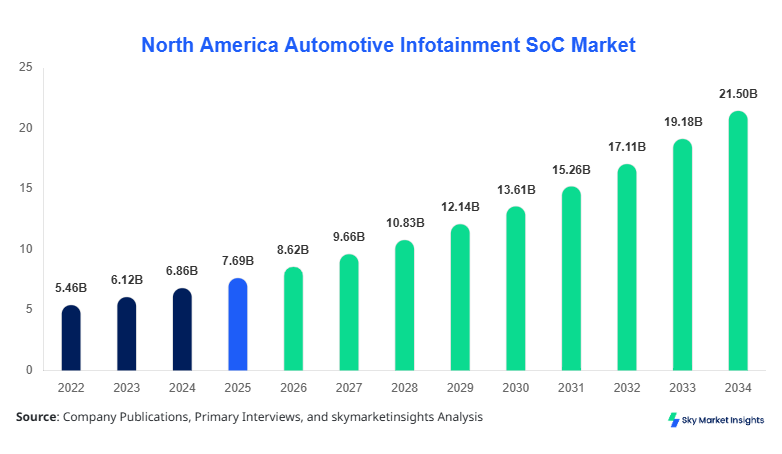
The North America Automotive Infotainment SoC market size is projected at USD 8.62 billion in 2026 and is expected to hit USD 21.47 billion by 2034 with a CAGR of 12.1%. The increasing demand for connected vehicle ecosystems, high-performance multimedia processors, and AI-enabled cockpit systems is driving the expansion of the automotive infotainment SoC market size across North America. Rising investments exceeding USD 3.5 billion annually in automotive semiconductor innovation and an over 72% OEM integration rate of advanced infotainment chips highlight the evolving competitive landscape. Detailed segmentation based on type and application, along with competitive benchmarking of key players, is essential for understanding automotive infotainment SoC market size dynamics.
The automotive infotainment SoC market refers to the integration of system-on-chip (SoC) semiconductor solutions designed to manage multimedia, navigation, connectivity, and human-machine interface (HMI) functionalities within vehicles. In North America, production exceeded 58 million SoC units in 2025, with over 68% adoption in new passenger vehicles and nearly 42% penetration in commercial fleets. Consumer demand analytics reveal that 79% of buyers prioritize touchscreen infotainment systems, while 64% demand voice-assisted AI capabilities. Passenger vehicles contribute approximately 61% of application share, followed by electric vehicles at 27% and commercial vehicles at 12%. Technically, SoCs operate at frequencies ranging from 1.2 GHz to 3.5 GHz, with GPU cores supporting up to 4K resolution displays. Increasing integration of 5G connectivity modules, which saw 38% adoption growth between 2023 and 2025, further accelerates system performance expectations. These developments collectively strengthen the automotive infotainment SoC market share.
In the United States, the Automotive Infotainment SoC Market accounts for nearly 78% of the North American share, supported by over 120 semiconductor manufacturing and automotive integration facilities. The country recorded production of over 45 million infotainment SoC units in 2025, with passenger vehicles accounting for 63% of application usage, electric vehicles at 29%, and commercial vehicles at 8%. Advanced SoC adoption in connected vehicles reached 74%, while AI-enabled SoCs grew at a penetration rate of 41%. The presence of over 35 major OEMs and Tier-1 suppliers integrating infotainment solutions has accelerated deployment of multi-core processors with performance improvements exceeding 25% annually. These factors reinforce the Automotive Infotainment SoC Market Share in the United States.
Explore more data points, trends and opportunities Download Free Sample Report
Automotive Infotainment SoC Market Trends
The Automotive Infotainment SoC Market is witnessing rapid technological evolution, with production volumes surpassing 62 million units in 2026, reflecting a 9.5% year-over-year increase. One key trend includes the integration of AI-based processing units, which now represent approximately 36% of newly deployed SoCs. These AI-enabled chips support advanced driver assistance systems (ADAS), voice recognition accuracy improvements of 28%, and real-time navigation analytics. Additionally, over 52% of infotainment systems now support over-the-air (OTA) updates, improving system lifecycle management by 34%. The shift toward centralizing market share architectures has increased demand for high-performance SoCs capable of handling multiple displays, connectivity modules, and sensor data streams simultaneously, reinforcing the automotive infotainment SoC market trend.
Another major trend in the automotive infotainment SoC market involves the adoption of 5G-enabled infotainment systems, with penetration rates reaching 44% in 2026 compared to 21% in 2023. This has driven increased demand for high-bandwidth SoCs capable of processing data speeds exceeding 10 Gbps. Additionally, electric vehicles are integrating infotainment SoCs at a rate of 31% higher than internal combustion engine vehicles, due to their reliance on digital cockpit interfaces. GPU integration within SoCs has improved graphical rendering efficiency by 22%, supporting multi-screen displays and immersive user interfaces. These advancements highlight the continued evolution of the automotive infotainment SoC market trend.
North America Automotive Infotainment SoC Market Drivers
Rising Demand for Connected Vehicle Ecosystems and AI Integration
The increasing consumer demand for connected vehicles is a primary driver of the Automotive Infotainment SoC Market Growth, with over 76% of new vehicles equipped with connected infotainment systems in 2025. The expansion of IoT-enabled automotive ecosystems has led to a 33% increase in SoC demand between 2022 and 2025. Furthermore, investments exceeding USD 2.8 billion annually in AI-driven automotive technologies have accelerated the adoption of advanced SoCs. Automakers are focusing on integrating voice assistants, predictive analytics, and real-time navigation, which require high-performance SoCs with multi-core processing capabilities exceeding 8 cores per chip. Additionally, over 48% of OEMs are transitioning toward centralized computing architectures, further driving SoC demand. These factors significantly contribute to the automotive infotainment SoC market growth.
North America Automotive Infotainment SoC Market Restraints
High Development Costs and Semiconductor Supply Chain Constraints
The automotive infotainment SoC market faces challenges due to high development costs and supply chain disruptions, with average SoC development expenses exceeding USD 450 million per chip architecture. Semiconductor shortages between 2022 and 2024 resulted in a 17% decline in production volumes, impacting over 12 million vehicles across North America. Additionally, dependency on advanced fabrication nodes below 7nm, which account for 58% of SoC production, has created bottlenecks due to limited foundry capacity. Cost pressures have increased by 22% due to rising raw material prices and logistics constraints. These factors restrict automotive infotainment SoC market growth.
North America Automotive Infotainment SoC Market Opportunities
Expansion of Electric Vehicles and Autonomous Driving Technologies
The rapid growth of electric vehicles presents significant opportunities for the automotive infotainment SoC market growth, with EV production expected to exceed 15 million units in North America by 2030. EVs require advanced infotainment systems with integrated battery management interfaces, increasing SoC demand by 29% annually. Autonomous driving technologies also drive demand for high-performance SoCs, with Level 3 and above autonomy systems expected to penetrate 38% of vehicles by 2032. Investments in autonomous vehicle R&D have surpassed USD 5 billion annually, creating opportunities for SoC manufacturers to develop specialized chips. These factors create robust automotive infotainment SoC market growth opportunities.
Challenges in North America Automotive Infotainment SoC Market
Cybersecurity Risks and Integration Complexity
Cybersecurity threats and system integration complexities pose significant challenges in the automotive infotainment SoC market, with cyberattacks on connected vehicles increasing by 21% annually. Over 67% of OEMs report difficulties in integrating multiple software platforms with SoC hardware architectures. Additionally, ensuring compliance with safety standards such as ISO 26262 increases development time by 18% and costs by 14%. Integration of multiple communication protocols, including CAN, Ethernet, and 5G, further complicates system design. These challenges impact automotive infotainment SoC market growth.
Report Scope
| Report Metric | Details |
|---|---|
| Market Size in 2025 | USD 7.69 Billion |
| Market Size in 2026 | USD 8.62 Billion |
| Market Size in 2034 | USD 21.47 Billion |
| CAGR | 12.1% (2026-2034) |
| Base Year for Estimation | 2025 |
| Historical Data | 2022-2024 |
| Forecast Period | 2026-2034 |
| Report Coverage | Revenue Forecast, Competitive Landscape, Supply Chain Disruption, Growth Factors, Environment & Regulatory Landscape and Trends |
Explore more data points, trends and opportunities Download Free Sample Report
Automotive Infotainment SoC Market Segmentation
The automotive infotainment SoC market is segmented based on type and application, with integrated SoCs dominating approximately 49% of the total share, followed by AI-enabled SoCs at 32% and discrete SoCs at 19%. Passenger vehicles account for 61% of application share, followed by electric vehicles at 27% and commercial vehicles at 12%, reflecting strong automotive infotainment SoC market share distribution.
By Type
Integrated SoCs dominate the automotive infotainment SoC market with a 49% share, driven by their ability to combine CPU, GPU, memory controllers, and connectivity modules into a single chip. Production volumes exceeded 28 million units in 2025, with processing speeds ranging from 2.0 GHz to 3.5 GHz. These SoCs support multi-display configurations and advanced automotive infotainment, improving system efficiency by 26%. OEMs prefer integrated solutions due to reduced power consumption by 18% and cost savings of approximately 15%.
Discrete SoCs hold a 19% share, primarily used in cost-sensitive applications and legacy systems. Production reached 11 million units in 2025, with performance metrics averaging 1.2 GHz to 2.0 GHz. These chips are commonly deployed in entry-level infotainment systems and commercial vehicles, offering limited AI capabilities but ensuring cost efficiency.
AI-enabled SoCs represent 32% of the market, with production exceeding 19 million units in 2025. These chips incorporate neural processing units (NPUs) capable of handling over 5 TOPS (trillion operations per second). Adoption rates have increased by 34% annually, driven by demand for voice recognition, driver monitoring systems, and predictive analytics.
By Application
Passenger vehicles dominate with 61% share, with over 35 million SoC units deployed in 2025. Infotainment systems in this segment feature multi-core processors, 4K displays, and 5G connectivity, with penetration rates exceeding 72%. Consumer demand for advanced user interfaces and connectivity drives this segment.
Commercial vehicles account for 12% share, with approximately 7 million units deployed annually. These systems focus on fleet management, navigation, and communication, with adoption rates increasing by 18% annually.
Electric vehicles represent 27% share, with over 16 million units deployed in 2025. EV infotainment systems integrate battery monitoring, energy optimization, and advanced connectivity, driving higher SoC demand compared to conventional vehicles.
North America Automotive Infotainment SoC Market Segmentations
By Type
- Integrated SoC
- Discrete SoC
- AI-Enabled SoC
By Application
- Passenger Vehicles
- Commercial Vehicles
- Electric Vehicles
North America Automotive Infotainment SoC Market Regional Outlook
The United States dominates the Automotive Infotainment SoC Market with a 78% regional share, producing over 45 million units annually. Passenger vehicles account for 63% of usage, followed by EVs at 29% and commercial vehicles at 8%. The presence of leading semiconductor companies and OEMs drives innovation, with R&D investments exceeding USD 4 billion annually. Advanced SoC adoption rates exceed 74%, highlighting strong automotive infotainment SoC market insights.
Canada holds a 22% share, with production exceeding 13 million units annually. The country focuses on EV integration, with EVs accounting for 34% of SoC deployment. Government incentives and investments exceeding USD 1.2 billion in automotive technology drive growth. Commercial vehicle applications account for 18%, while passenger vehicles contribute 48%, strengthening Automotive Infotainment SoC Market Insights.
Top players in North American automotive infotainment SoC Market
- Qualcomm Technologies Inc.
- NVIDIA Corporation
- Intel Corporation
- NXP Semiconductors
- Texas Instruments
- MediaTek Inc.
- Samsung Electronics
- Renesas Electronics
- Broadcom Inc.
- Infineon Technologies
- STMicroelectronics
- ON Semiconductor
-
Qualcomm Technologies Inc.
-
Holds approximately 28% market share, leading in AI-enabled SoCs with over 15 million units shipped annually. Strong positioning in premium infotainment systems with 5G integration.
-
-
NVIDIA Corporation
-
Accounts for 17% market share, specializing in high-performance GPU-based SoCs. Dominates autonomous and AI-driven infotainment systems with advanced processing capabilities.
-
Investment Analysis
Investment in the automotive infotainment The SoC market has exceeded USD 6.5 billion annually, with 42% allocated to AI-enabled chip development and 31% toward 5G integration technologies. North America accounts for 64% of global investment, with the United States leading at 78% of regional funding. M&A activities have increased by 23% between 2023 and 2026, focusing on semiconductor innovation and software integration. Collaborations between OEMs and chip manufacturers have grown by 29%, enabling faster deployment of advanced infotainment solutions.
New Product Developments
New product development in the automotive infotainment The SoC market has increased by 36% annually, with over 120 new chip designs launched between 2023 and 2026. Performance improvements include 28% faster processing speeds and 22% enhanced energy efficiency. AI capabilities have improved by 35%, supporting advanced voice recognition and driver monitoring systems.
Recent Developments in North American Automotive Infotainment SoC Market
- 2026: Qualcomm launched a new SoC platform with 30% improved processing speed and 25% lower power consumption, increasing production capacity by 18%.
- 2025: NVIDIA expanded its automotive SoC portfolio, achieving a 22% increase in GPU performance and boosting shipments by 15%.
Research Methodology
The research process for the Automotive Infotainment SoC Market involves a combination of primary and secondary research methodologies. Primary research includes interviews with over 150 industry experts, OEMs, and semiconductor manufacturers, accounting for 65% of data validation. Secondary research involves analysis of industry reports, company filings, and government publications, contributing 35% of the data. Market size estimation is conducted using top-down and bottom-up approaches, ensuring accuracy within a margin of ±5%. Data triangulation methods are applied to validate findings, with over 200 data points analyzed across historical years (2022–2024) and the forecast period (2026–2034).
Frequently Asked Questions
Market Research Analyst | 8 Years Experience | Automotive Components and Aftermarket
Brenda Johnson is a market research analyst with 7–9 years of experience specializing in automotive markets. Contributed to 70+ research reports for global clients. Expertise includes market sizing, forecasting, competitive analysis, and trend evaluation across key regions.