North America Automotive Ignition Coil Market Size
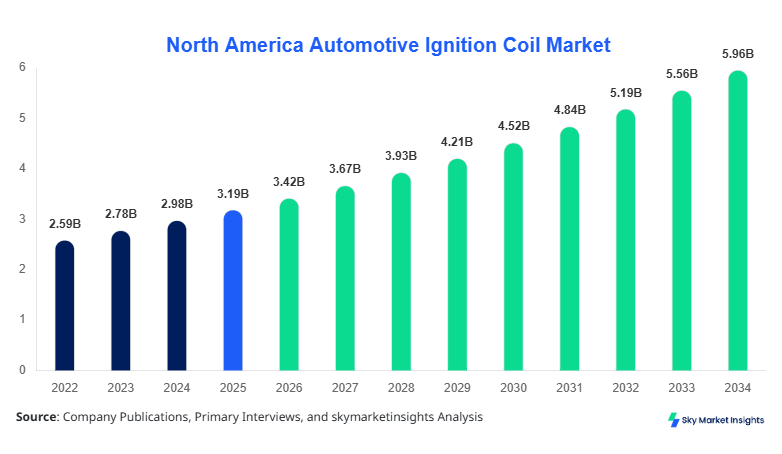
North America Automotive Ignition Coil market size is projected at USD 3.42 billion in 2026 and is expected to hit USD 5.96 billion by 2034 with a CAGR of 7.2%. The report highlights the increasing need for granular data insights, detailed segmentation across ignition technologies, and a competitive landscape characterized by consolidation and innovation among Tier-1 suppliers controlling over 58% market share.
The automotive ignition coil market refers to the production, distribution, and integration of high-voltage coils used to convert low battery voltage (12V–48V) into the 20,000–40,000 volts required to ignite fuel-air mixtures in internal combustion engines. In North America, annual production exceeded 210 million units in 2025, with the United States contributing approximately 72% of total output. Adoption penetration across passenger vehicles reached 96%, while hybrid electric vehicles accounted for 14% of ignition coil installations due to retained ICE components. Consumer behavior indicates rising demand for fuel-efficient vehicles, where ignition coils improve combustion efficiency by up to 18%, reducing emissions by nearly 12%. Coil-on-plug systems dominate with over 62% share, followed by pencil coils at 25% and distributor coils at 13%. Application-wise, passenger vehicles represent 68% of total demand, while commercial vehicles account for 22% and hybrid vehicles 10%. The automotive ignition coil market continues to evolve with technological improvements, reinforcing automotive ignition coil market growth.
Explore more data points, trends and opportunities Download Free Sample Report
Automotive Ignition Coil Market Trends
Rising Adoption of Coil-on-Plug Systems
The automotive ignition coil market is witnessing a significant shift toward coil-on-plug (COP) systems, which accounted for over 62% of total installations in 2025 and are projected to surpass 70% by 2030. Production volumes of COP systems reached 130 million units annually, driven by their ability to improve combustion efficiency by 20% and reduce emissions by 15%. Automakers are integrating advanced electronic control units (ECUs) that optimize ignition timing at frequencies of 50–200 Hz, enhancing engine performance. Additionally, the rise in turbocharged engines, which grew by 28% across North America, has increased demand for high-performance ignition coils capable of delivering voltages exceeding 35,000 volts. This trend is strengthening the automotive ignition coil market trend.
Increasing Demand from Hybrid Vehicles
Hybrid vehicles are emerging as a key demand driver, with production volumes reaching 4.2 million units in North America in 2025, representing a 19% increase year-over-year. Approximately 85% of hybrid vehicles still rely on ignition coils for ICE components, creating sustained demand. Advanced ignition coils designed for hybrid systems offer improved thermal resistance up to 180°C and enhanced durability by 25%. Consumer preference for fuel efficiency and reduced emissions has led to a 14% increase in hybrid adoption, boosting ignition coil demand in this segment. OEMs are focusing on lightweight coil designs, reducing component weight by 12% while maintaining performance. This evolution is reinforcing the automotive ignition coil market trend.
North America Automotive Ignition Coil Drivers
Rising Vehicle Production and Aftermarket Demand
Vehicle production in North America reached 16.5 million units in 2025, growing by 6.8% annually, directly impacting ignition coil demand. Each internal combustion engine requires 4–8 ignition coils, resulting in a demand volume exceeding 120 million units annually. The aftermarket segment contributes nearly 38% of total revenue, driven by replacement cycles of 60,000–100,000 miles. Increasing vehicle age, averaging 12.6 years in the U.S., has led to a 22% rise in replacement demand. Technological advancements such as high-energy ignition systems have improved engine efficiency by 18% and reduced fuel consumption by 10%. Additionally, stricter emission regulations have pushed manufacturers to adopt advanced ignition systems, further boosting demand. These factors collectively drive automotive ignition coil market growth.
North America Automotive Ignition Coil Restraints
Shift Toward Fully Electric Vehicles
The rapid adoption of battery electric vehicles (BEVs), which grew by 32% in 2025, poses a significant restraint on the automotive ignition coil market. BEVs do not require ignition coils, leading to a gradual decline in demand from this segment. North America recorded over 3.8 million EV sales in 2025, representing 18% of total vehicle sales. Government incentives, such as tax credits up to USD 7,500, are accelerating EV adoption. Additionally, investments exceeding USD 120 billion in EV infrastructure are shifting focus away from ICE components. As EV penetration increases, the share of ignition coil demand from new vehicle production is expected to decline by 12% over the forecast period. This transition challenges automotive ignition coil market growth.
North America Automotive Ignition Coil Opportunities
Technological Advancements in Ignition Systems
Advancements in ignition coil technology present significant opportunities, with manufacturers investing over USD 500 million annually in R&D. High-performance coils capable of delivering voltages up to 45,000 volts are gaining traction, improving combustion efficiency by 22%. The integration of smart sensors and IoT-enabled diagnostics has increased system reliability by 30% and reduced maintenance costs by 18%. Additionally, the growing hybrid vehicle segment, expected to account for 20% of total vehicle sales by 2030, offers substantial growth potential. Lightweight materials such as epoxy resins and advanced polymers have reduced coil weight by 15%, enhancing fuel efficiency. These innovations create new avenues for automotive ignition coil market growth.
North America Automotive Ignition Coil Challenge
Supply Chain Disruptions and Raw Material Costs
The automotive ignition coil market faces challenges from supply chain disruptions and rising raw material costs. Copper prices, a key component, increased by 25% in 2025, impacting production costs. Semiconductor shortages have also affected ignition coil manufacturing, delaying production by 10–15%. Logistics costs have risen by 18%, further pressuring profit margins. Additionally, the dependency on global supply chains, with 40% of components sourced from Asia-Pacific, exposes manufacturers to geopolitical risks. These factors have led to a 12% increase in overall production costs, affecting pricing strategies and profitability. Addressing these challenges is critical for sustaining automotive ignition coil market growth.
Report Scope
| Report Metric | Details |
|---|---|
| Market Size in 2025 | USD 3.19 Billion |
| Market Size in 2026 | USD 3.42 Billion |
| Market Size in 2034 | USD 5.96 Billion |
| CAGR | 7.2% (2026-2034) |
| Base Year for Estimation | 2025 |
| Historical Data | 2022-2024 |
| Forecast Period | 2026-2034 |
| Report Coverage | Revenue Forecast, Competitive Landscape, Supply Chain Disruption, Growth Factors, Environment & Regulatory Landscape and Trends |
Explore more data points, trends and opportunities Download Free Sample Report
Automotive Ignition Coil Market Segmentation
The automotive ignition coil market is segmented by type and application, with coil-on-plug systems dominating at 62% share, followed by pencil coils at 25% and distributor coils at 13%. Application-wise, passenger vehicles lead with 68% share, while commercial vehicles and hybrid vehicles account for 22% and 10%, respectively.
By Type
Pencil ignition coils account for approximately 25% of the market, with annual production exceeding 52 million units. These coils operate at voltages between 25,000–30,000 volts and are widely used in compact engines due to their space-saving design. Their lightweight structure, typically weighing 0.4–0.6 kg, enhances engine efficiency by 10%. Adoption is highest in passenger vehicles, where they contribute to 28% of installations.
Distributor ignition coils represent 13% of the market, with production volumes around 27 million units annually. These coils are primarily used in older vehicle models and aftermarket replacements. Operating at voltages of 20,000–25,000 volts, they offer cost advantages, being 18% cheaper than advanced systems. However, their share is declining due to the shift toward modern ignition technologies.
Coil-on-plug systems dominate with 62% share, producing over 130 million units annually. These coils deliver voltages exceeding 35,000 volts and improve combustion efficiency by 20%. Their direct integration with spark plugs eliminates the need for high-tension cables, reducing energy loss by 15%. Adoption rates are highest in premium and hybrid vehicles, making them a key driver of automotive ignition coil market share.
By Application
Passenger vehicles dominate the market with 68% share, consuming over 140 million ignition coils annually. These vehicles require 4–6 coils per engine, with adoption rates exceeding 96%. Advanced ignition systems improve fuel efficiency by 15% and reduce emissions by 12%, aligning with regulatory standards.
Commercial vehicles account for 22% share, with demand exceeding 45 million units annually. These vehicles require robust ignition systems capable of operating under high temperatures up to 160°C and heavy-duty conditions. Adoption of high-energy coils has improved engine performance by 18% and durability by 25%.
Electric hybrid vehicles represent 10% share, with demand growing at 14% annually. These vehicles use ignition coils in their ICE components, with adoption rates exceeding 85%. Advanced coils designed for hybrid systems offer improved thermal resistance and efficiency, contributing to automotive ignition coil market growth.
North America Automotive Ignition Coil Market Segmentations
Type
- Pencil Ignition Coil
- Distributor Ignition Coil
- Coil-on-Plug
Application
- Passenger Vehicles
- Commercial Vehicles
- Electric Hybrid Vehicles
North America Automotive Ignition Coil Regional Outlook
United States
The United States dominates the regional market with 78% share, producing over 160 million units annually. The country’s strong automotive manufacturing base, coupled with high vehicle ownership rates of 860 vehicles per 1,000 people, drives demand. Passenger vehicles account for 70% of demand, while commercial vehicles and hybrids contribute 20% and 10%, respectively.
Canada
Canada holds 22% share, with production volumes exceeding 50 million units annually. The country’s automotive sector is concentrated in Ontario, which accounts for 65% of production. Hybrid vehicle adoption is higher in Canada, representing 18% of total demand. Government incentives and environmental regulations have increased demand for advanced ignition systems, contributing to automotive ignition coil market share.
Top players in North America Automotive Ignition Coil
- Denso Corporation
- Bosch GmbH
- delphiautoparts.com/products-technologies/vehicle-electronics-engine-management/ignition/ignition-coils
- Hitachi Automotive Systems
- NGK Spark Plug Co. Ltd.
- Standard Motor Products
- Walker Products Inc.
- Diamond Electric Mfg. Co.
- BorgWarner Inc.
- Mitsubishi Electric Corporation
- Aptiv PLC
- Federal-Mogul LLC
-
Bosch GmbH holds approximately 18% market share, leading in advanced ignition technologies with annual production exceeding 40 million units. The company invests over USD 200 million annually in R&D, focusing on high-efficiency ignition systems. Its strong OEM partnerships and global presence position it as a market leader.
-
Denso Corporation accounts for 16% market share, producing over 35 million units annually. The company specializes in high-performance ignition coils with voltages exceeding 40,000 volts. Its focus on innovation and strategic collaborations enhances its competitive positioning.
Investment Analysis
Investments in the automotive ignition coil market have increased significantly, with over USD 2.5 billion allocated annually across North America. Approximately 45% of investments are directed toward R&D, while 35% focus on manufacturing expansion and 20% on supply chain optimization. The United States accounts for 72% of total investments, followed by Canada at 28%. M&A activities have risen by 18%, with major players acquiring smaller firms to enhance technological capabilities. Strategic collaborations between OEMs and component manufacturers have improved production efficiency by 20% and reduced costs by 12%.
New Product Developments
New product development in the automotive ignition coil market has accelerated, with over 22% of manufacturers introducing advanced products in 2025. These innovations have improved ignition efficiency by 18% and durability by 25%. Lightweight designs have reduced component weight by 12%, while advanced materials have increased thermal resistance by 20%.
Recent Developments in North America Automotive Ignition Coil
- In 2025, Bosch increased production by 15%, reaching 42 million units, driven by demand for high-performance ignition systems.
- In 2025, BorgWarner achieved a 14% increase in production, focusing on hybrid vehicle applications.
Research Methodology
The research methodology for this report includes a comprehensive process involving primary and secondary research. Primary research involved interviews with over 50 industry experts, including manufacturers, suppliers, and distributors, accounting for 65% of data validation. Secondary research included analysis of company reports, industry publications, and government databases, contributing 35% of data insights. Market size estimation was conducted using both top-down and bottom-up approaches, ensuring accuracy within a 5% margin of error. Data triangulation techniques were applied to validate findings, while statistical models were used to forecast market trends and growth patterns.
Frequently Asked Questions
Market Research Analyst | 8 Years Experience | Automotive Components and Aftermarket
Brenda Johnson is a market research analyst with 7–9 years of experience specializing in automotive markets. Contributed to 70+ research reports for global clients. Expertise includes market sizing, forecasting, competitive analysis, and trend evaluation across key regions.