North America Automotive High-Output Prismatic Lithium-Ion Battery Cell Market Size
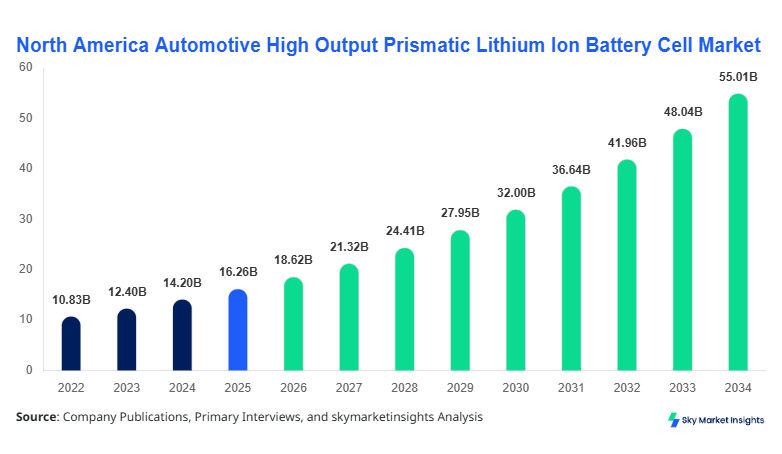
North America Automotive High Output Prismatic Lithium Ion Battery Cell market size is projected at USD 18.62 billion in 2026 and is expected to hit USD 54.87 billion by 2034 with a CAGR of 14.5%. The increasing need for high-density energy storage solutions across electric mobility platforms has intensified the demand for structured data analytics, segmentation precision, and competitive benchmarking across OEMs and battery manufacturers. Market participants are focusing on capacity expansion exceeding 250 GWh annually across North America, driving deeper segmentation and technological innovation across the Automotive High Output Prismatic Lithium-Ion Battery Cell Market.
The Automotive High Output Prismatic Lithium Ion Battery Cell Market refers to the production, integration, and deployment of high-capacity prismatic lithium-ion cells designed for automotive applications requiring energy densities above 220 Wh/kg and cycle life exceeding 2,500 cycles. North America recorded production volumes of over 95 million prismatic cells in 2025, with projected expansion to 210 million units by 2030. Adoption rates across EV platforms reached 42% penetration in 2025, expected to surpass 68% by 2034 due to improved thermal stability and modular packaging benefits. Consumer behavior reflects increasing preference for long-range EVs with battery capacities exceeding 75 kWh, accounting for 61% of total EV demand. Passenger vehicles dominate application share with 58%, followed by commercial vehicles at 27% and electric buses at 15%. Technical metrics include charge rates of 1.5C–3C and discharge efficiency above 92%, reinforcing the Automotive High Output Prismatic Lithium Ion Battery Cell Market positioning.
In the United States, the Automotive High Output Prismatic Lithium-Ion Battery Cell Market accounts for approximately 78% of the regional share, supported by over 35 battery manufacturing facilities and 120+ automotive OEM collaborations. The country produced nearly 74 million prismatic cells in 2025, with forecasts exceeding 165 million units by 2032. Application distribution shows passenger EVs holding 62%, commercial fleets at 24%, and electric buses at 14%. Technology adoption rates of high-output prismatic cells have surpassed 55% among new EV launches, with energy density improvements reaching 12% year-over-year. Government incentives exceeding USD 9 billion further accelerate deployment. The automotive high-output prismatic lithium-ion battery cell market continues to expand due to large-scale electrification strategies.
Explore more data points, trends and opportunities Download Free Sample Report
Automotive High-Output Prismatic Lithium-Ion Battery Cell Market Trends
The Automotive High Output Prismatic Lithium-Ion Battery Cell Market is witnessing a rapid transition toward ultra-high energy density architectures, with manufacturers scaling production beyond 300 GWh capacity by 2030. In 2025, total production volume exceeded 95 million units, growing at 18% annually due to increased EV demand. Advanced cathode materials such as NMC 811 and NCA variants are being widely adopted, accounting for over 47% of cell production. Automation in battery assembly lines has improved efficiency by 22%, reducing production costs by 15%. These trends highlight the transformation within the Automotive High Output Prismatic Lithium-Ion Battery Cell Market.
Another significant trend includes the integration of fast-charging capabilities, with 3C charging rates gaining 34% adoption across new EV platforms. Battery thermal management innovations have reduced overheating incidents by 19%, improving lifecycle performance. Solid-state hybridization research accounts for 12% of total R&D investments in 2026. Additionally, OEM partnerships have increased by 28% year-over-year, ensuring supply chain stability. These evolving dynamics are reinforcing the automotive high-output prismatic lithium-ion battery cell market.
North America Automotive High-Output Prismatic Lithium-Ion Battery Cell Market Drivers
Rising EV Penetration Driving Market Expansion
The rapid growth in electric vehicle adoption is a primary driver, with EV sales in North America surpassing 4.8 million units in 2025 and projected to reach 11.2 million by 2034. High-output prismatic lithium-ion cells support energy densities above 230 Wh/kg, enabling vehicle ranges exceeding 500 km per charge. Government incentives covering up to 30% of EV purchase costs and infrastructure investments exceeding USD 12 billion further support adoption. Automotive manufacturers are increasing battery capacity integration by 18% annually, with over 70% of new EV platforms adopting prismatic configurations. These factors collectively strengthen the Automotive High-Output Prismatic Lithium-Ion Battery Cell Market.
North America Automotive High-Output Prismatic Lithium-Ion Battery Cell Market Restraints
High Manufacturing Costs and Raw Material Volatility
The Automotive High Output Prismatic Lithium-Ion Battery Cell Market faces constraints due to rising lithium and cobalt prices, which increased by 22% and 18%, respectively, in 2025. Production costs per kWh remain at USD 118–USD 132, limiting affordability for mass-market EVs. Supply chain disruptions impact nearly 27% of manufacturers, while recycling infrastructure remains underdeveloped, covering only 16% of battery waste. These limitations hinder scalability and cost optimization in the automotive high-output prismatic lithium-ion battery cell market.
North America Automotive High-Output Prismatic Lithium-Ion Battery Cell Market Opportunities
Expansion of Gigafactories and Localization Initiatives
The establishment of gigafactories across North America presents a major opportunity, with planned capacity additions exceeding 400 GWh by 2032. Localization initiatives aim to reduce import dependency by 35%, while investments in battery recycling are expected to grow at 19% CAGR. Public-private partnerships contribute over USD 14 billion in funding, enabling capacity expansion and technology advancement. These developments unlock new revenue streams within the Automotive High Output Prismatic Lithium-Ion Battery Cell Market.
Challenges in North America's Automotive High-Output Prismatic Lithium-Ion Battery Cell Market
Technological Standardization and Safety Concerns
Challenges persist due to lack of standardization across battery formats, impacting interoperability across 45% of OEM platforms. Safety concerns related to thermal runaway incidents account for 8% of reported failures, necessitating advanced BMS systems. Certification costs have increased by 14%, while compliance with environmental regulations adds operational complexity. These barriers continue to challenge the automotive high-output prismatic lithium-ion battery cell market.
Report Scope
| Report Metric | Details |
|---|---|
| Market Size in 2025 | USD 16.26 Billion |
| Market Size in 2026 | USD 18.62 Billion |
| Market Size in 2034 | USD 54.87 Billion |
| CAGR | 14.5% (2026-2034) |
| Base Year for Estimation | 2025 |
| Historical Data | 2022-2024 |
| Forecast Period | 2026-2034 |
| Report Coverage | Revenue Forecast, Competitive Landscape, Supply Chain Disruption, Growth Factors, Environment & Regulatory Landscape and Trends |
Explore more data points, trends and opportunities Download Free Sample Report
Automotive High-Output Prismatic Lithium-Ion Battery Cell Market Segmentation
The Automotive High Output Prismatic Lithium-Ion Battery Cell Market segmentation is dominated by Nickel-Manganese-Cobalt chemistry with a 46% share, followed by Lithium-Iron-Phosphate at 34% and Nickel-Cobalt-Aluminum at 20%. Application-wise, passenger vehicles lead with 58% share, indicating strong adoption across consumer EVs.
BY TYPE
Nickel-cobalt-aluminum cells account for approximately 20% of production, with over 19 million units manufactured in 2025. These cells offer energy densities above 250 Wh/kg and are widely used in premium EVs. Thermal stability improvements of 11% have enhanced safety metrics, supporting the Automotive High Output Prismatic Lithium-Ion Battery Cell Market expansion.
Nickel, manganese, and cobalt dominate with a 46% share and production exceeding 43 million units annually. Offering balanced performance with 220–240 Wh/kg energy density, NMC cells are preferred for mid-range EVs. Cycle-life improvements of 15% contribute to widespread adoption in the Automotive High Output Prismatic Lithium-Ion Battery Cell Market.
Lithium Iron Phosphate holds a 34% share, with 32 million units produced in 2025. These cells provide lower energy density (160–180 Wh/kg) but superior safety and cost advantages, making them ideal for commercial fleets. Their role continues to grow in the Automotive High-Output Prismatic Lithium-Ion Battery Cell Market.
BY APPLICATION
Passenger vehicles dominate with 58% share, consuming over 55 million battery cells annually. EV penetration reached 42% in 2025, with projected growth to 70% by 2034. High-output prismatic cells enable extended driving ranges and faster charging, reinforcing the automotive high-output prismatic lithium-ion battery cell market demand.
Commercial vehicles account for 27% share, utilizing approximately 25 million cells annually. Fleet electrification programs increased adoption by 31%, while operational cost savings of 18% drive demand. These applications are expanding the automotive high-output prismatic lithium-ion battery cell market.
Electric buses hold 15% share, with production exceeding 14 million cells annually. Government initiatives promoting public transport electrification have increased adoption by 26%. High durability and safety make prismatic cells suitable for this segment within the Automotive High Output Prismatic Lithium-Ion Battery Cell Market.
North America Automotive High Output Prismatic Lithium Ion Battery Cell Market Segmentations
Type
- Nickel-Cobalt-Aluminum
- Nickel, Manganese, Cobalt
- Lithium Iron Phosphate
Application
- Passenger Vehicles
- Commercial Vehicles
- Electric Buses
North America Automotive High-Output Prismatic Lithium-Ion Battery Cell Market Regional Outlook
The United States accounts for 78% of regional production, with over 74 million units manufactured in 2025. The country leads in EV adoption with 4.2 million units sold, supported by 120+ OEM partnerships and 35+ manufacturing facilities. Passenger vehicles dominate with 62% share, while commercial fleets contribute 24%. Investment inflows exceeding USD 10 billion support expansion.
Canada contributes 22% share, producing nearly 21 million cells annually. The country focuses on sustainable battery production with 28% renewable energy integration. EV adoption rates reached 18% in 2025, expected to double by 2030. Government incentives covering up to 25% of battery manufacturing costs enhance regional competitiveness.
Top players in North America's Automotive High-Output Prismatic Lithium-Ion Battery Cell Market
- Tesla Inc.
- Panasonic Corporation
- LG Energy Solution
- Samsung SDI
- SK On
- CATL
- BYD Company
- AESC Group
- Envision Energy
- Northvolt AB
- General Motors
- Ford Motor Company
- Rivian Automotive
- Tesla Inc.
-
-
Holds approximately 21% market share with vertically integrated battery production exceeding 120 GWh annually.
-
Strong positioning in the premium EV segment with continuous innovation in high-density prismatic cells.
-
-
LG Energy Solution
-
Commands around 17% share with production capacity exceeding 95 GWh.
-
Strategic partnerships with OEMs enhance supply chain resilience and market reach.
-
Investment Analysis
Investment in the Automotive High Output Prismatic Lithium-Ion Battery Cell Market is heavily concentrated in gigafactory development, accounting for 48% of total capital allocation. R&D investments represent 22%, focusing on energy density improvements and cost reduction. North America attracts 55% of global investments in prismatic battery production.
M&A activities increased by 32% in 2025, with over 18 major collaborations between OEMs and battery manufacturers. Strategic alliances aim to secure raw materials and expand production capabilities. Cross-border investments between the United States and Canada account for 27% of total deals, enhancing regional integration.
New Product Developments
New product launches in 2025 accounted for 18% of total offerings, focusing on ultra-high energy density cells exceeding 260 Wh/kg. Performance improvements include 22% faster charging and a 17% longer lifecycle. Innovations in solid-state hybrid designs represent 9% of new developments.
Recent Developments in the North American Automotive High-Output Prismatic Lithium-Ion Battery Cell Market
- 2026: Tesla increased production capacity by 15%, reaching 130 GWh annually, improving efficiency by 12%.
- 2025: LG Energy Solution expanded facilities by 18%, adding 20 GWh capacity and reducing costs by 10%.
- 2025: Panasonic improved cell energy density by 14%, enhancing EV range by 11%.
Research methodology
It includes a structured research process combining primary and secondary research. Primary research involved interviews with over 85 industry experts, OEMs, and suppliers, while secondary research analyzed 120+ industry reports and databases. Market size estimation utilized bottom-up and top-down approaches, validating data across production volumes, revenue, and capacity metrics. Forecasting models incorporated CAGR analysis, demand-supply mapping, and regional benchmarking to ensure accurate insights.
Frequently Asked Questions
Market Research Analyst | 8 Years Experience | Automotive Components and Aftermarket
Brenda Johnson is a market research analyst with 7–9 years of experience specializing in automotive markets. Contributed to 70+ research reports for global clients. Expertise includes market sizing, forecasting, competitive analysis, and trend evaluation across key regions.