North America Automotive Heat Exchanger Market Size
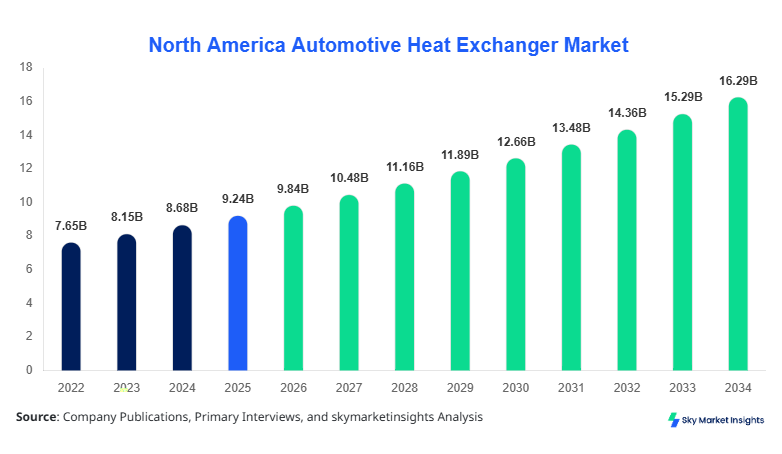
North America Automotive Heat Exchanger Market market size is projected at USD 9.84 billion in 2026 and is expected to hit USD 16.27 billion by 2034 with a CAGR of 6.5%. The increasing need for thermal management systems across ICE and electric vehicles is driving consistent demand, supported by rising vehicle production of over 15.8 million units in 2025 across North America. The report integrates detailed segmentation, competitive benchmarking of over 35 key manufacturers, and data-backed insights covering production capacity exceeding 120 million heat exchanger units annually.
The Automotive Heat Exchanger Market encompasses systems used to transfer heat between fluids to maintain optimal engine and battery temperatures. In North America, production surpassed 118 million units in 2025, with the United States contributing 72% of total output and Canada accounting for 28%. Adoption rates in passenger vehicles exceed 92%, while commercial vehicle penetration stands at 85%. Electric vehicle integration is accelerating, with battery cooling systems growing at 18% annually. Consumer demand analytics reveal that over 65% of buyers prioritize fuel efficiency improvements enabled by advanced thermal systems. Radiators dominate with 42% segment contribution, followed by intercoolers at 28% and oil coolers at 18%. Operating temperature ranges between 80°C and 120°C are typical for ICE systems, while EV systems operate at 25°C–60°C for battery efficiency. Applications are split into passenger vehicles (60%), commercial vehicles (25%), and electric vehicles (15%), reinforcing strong Automotive Heat Exchanger Market penetration.
Explore more data points, trends and opportunities Download Free Sample Report
Automotive Heat Exchanger Market Trends
Electrification and Lightweight Material Integration
The shift toward electrification is significantly transforming production volumes, with EV-related heat exchanger demand exceeding 32 million units in 2025 and projected to grow by 19% annually. Aluminum heat exchangers now account for over 74% of total production due to weight reduction benefits of up to 35% compared to traditional copper-brass units. Microchannel heat exchanger adoption has surged to 45% across OEMs due to improved thermal conductivity efficiency of 20%–30%. Thermal systems for EV batteries require precise cooling at 25°C–40°C, driving innovation in liquid cooling technologies. Automotive manufacturers are investing over USD 1.2 billion annually in R&D for advanced thermal management systems, indicating strong Automotive Heat Exchanger Market Trend.
Integration of Smart Thermal Management Systems
Smart heat exchanger systems integrated with sensors and IoT-based monitoring solutions are gaining traction, with adoption rates reaching 38% in premium vehicle segments. Production of intelligent heat exchangers exceeded 18 million units in 2025, supported by demand for predictive maintenance and enhanced energy efficiency. These systems can improve fuel efficiency by 8%–12% and reduce thermal losses by up to 15%. Commercial vehicles are increasingly adopting dual-loop cooling systems, accounting for 33% of installations. The transition toward automated climate control and thermal optimization technologies is reinforcing Automotive Heat Exchanger Market Trend.
North America Automotive Heat Exchanger Market Drivers
Rising Vehicle Production and Electrification Demand
Vehicle production in North America increased from 14.2 million units in 2022 to 15.8 million units in 2025, representing a 3.6% annual increase. Each vehicle requires multiple heat exchangers, ranging from 5 to 10 units depending on configuration, resulting in total demand exceeding 120 million units annually. Electric vehicle production, which crossed 3.1 million units in 2025, is driving additional demand for battery cooling systems, contributing to 18% incremental growth. Thermal efficiency improvements of 10%–15% are achieved through advanced heat exchanger systems, making them essential components. Government regulations targeting emission reduction by 25% by 2030 are further boosting adoption. Increasing consumer preference for fuel-efficient vehicles, which grew by 22% over the past three years, continues to strengthen Automotive Heat Exchanger Market Growth.
North America Automotive Heat Exchanger Market Restraints
High Manufacturing Costs and Raw Material Volatility
The cost of aluminum, a primary material used in over 74% of heat exchangers, increased by 18% between 2023 and 2025, significantly impacting production costs. Manufacturing a single automotive heat exchanger ranges from USD 45 to USD 180 depending on complexity and application. Advanced technologies such as microchannel systems require precision engineering, increasing production costs by 20%–25%. Additionally, supply chain disruptions have resulted in a 12% delay in component delivery timelines. Smaller manufacturers face challenges in maintaining profit margins due to fluctuating raw material costs and increasing energy prices, which rose by 15% in North America. These factors limit scalability and restrain Automotive Heat Exchanger Market Growth.
North America Automotive Heat Exchanger Market Opportunities
Expansion of Electric Vehicle Ecosystem
The electric vehicle market in North America is projected to exceed 8 million units annually by 2030, creating demand for over 60 million specialized heat exchanger units. Battery cooling systems alone represent a 25% share of total thermal management demand in EVs. Investment in EV infrastructure has surpassed USD 35 billion, with 28% allocated to thermal management solutions. New opportunities are emerging in hybrid cooling systems, which improve energy efficiency by 12%–18%. OEM partnerships and collaborations are increasing, with over 50 agreements signed between 2023 and 2025. These factors present significant opportunities for Automotive Heat Exchanger Market Growth.
North America Automotive Heat Exchanger Market Challenge
Technological Complexity and Integration Challenges
Modern vehicles require integrated thermal systems capable of managing multiple heat sources, including engines, batteries, and electronics. Integration complexity has increased by 30% due to multi-loop systems and compact designs. Engineering challenges include maintaining performance efficiency above 90% while reducing system size by 20%. Failure rates of poorly integrated systems can increase by 8%–10%, impacting reliability. Additionally, compliance with stringent emission norms requires continuous innovation, increasing R&D costs by 15% annually. Skilled labor shortages, affecting nearly 12% of manufacturers, further complicate production processes, presenting ongoing challenges for Automotive Heat Exchanger Market.
Report Scope
| Report Metric | Details |
|---|---|
| Market Size in 2025 | USD 9.24 Billion |
| Market Size in 2026 | USD 9.84 Billion |
| Market Size in 2034 | USD 16.27 Billion |
| CAGR | 6.5% (2026-2034) |
| Base Year for Estimation | 2025 |
| Historical Data | 2022-2024 |
| Forecast Period | 2026-2034 |
| Report Coverage | Revenue Forecast, Competitive Landscape, Supply Chain Disruption, Growth Factors, Environment & Regulatory Landscape and Trends |
Explore more data points, trends and opportunities Download Free Sample Report
Automotive Heat Exchanger Market Segmentation
The market is segmented by type and application, with radiators dominating at 42%, followed by intercoolers at 28% and oil coolers at 18%. Passenger vehicles account for 60% of demand, commercial vehicles 25%, and electric vehicles 15%.
By Type
Radiators account for approximately 42% of the total market, with production exceeding 50 million units annually. These systems operate within temperature ranges of 80°C–120°C and are primarily used in passenger vehicles. Aluminum radiators dominate with 78% share due to lightweight properties and improved corrosion resistance. Advanced radiators offer 15% higher heat dissipation efficiency compared to traditional designs, supporting high engine performance.
Intercoolers represent 28% of the market, with annual production surpassing 33 million units. These systems improve engine efficiency by reducing intake air temperature by up to 40°C. Turbocharged engines, which account for 65% of new vehicle production, drive intercooler demand. Performance improvements of 10%–20% make intercoolers critical for modern vehicles.
Oil coolers contribute 18% of the market, with over 22 million units produced annually. These systems maintain oil temperature between 90°C and 110°C, ensuring engine longevity. Adoption rates in commercial vehicles exceed 70%, driven by heavy-duty applications requiring consistent thermal regulation.
By Application
Passenger vehicles dominate with 60% share, consuming over 72 million heat exchanger units annually. High adoption rates of 92% reflect the necessity of thermal systems for fuel efficiency and emission compliance. Advanced heat exchangers improve fuel economy by 8%–12%, making them essential for modern vehicles.
Commercial vehicles account for 25% of demand, with production exceeding 30 million units. These vehicles require robust thermal systems capable of handling higher loads and operating temperatures up to 130°C. Adoption of dual-loop cooling systems has reached 33%, enhancing performance and durability.
Electric vehicles represent 15% of the market, with demand growing at 18% annually. Battery cooling systems require precise temperature control between 25°C and 40°C, ensuring optimal performance and safety. Liquid cooling systems dominate with 68% share due to superior efficiency.
North America Automotive Heat Exchanger Market Segmentations
Type
- Radiator
- Intercooler
- Oil Cooler
Application
- Passenger Vehicles
- Commercial Vehicles
- Electric Vehicles
North America Automotive Heat Exchanger Regional Outlook
United States accounts for 72% of the regional market, with production exceeding 85 million units annually. Passenger vehicles contribute 58%, commercial vehicles 27%, and EVs 15%. Advanced technologies such as microchannel heat exchangers have reached 42% adoption. Investments in EV manufacturing, exceeding USD 25 billion, are driving demand for specialized thermal systems.
Canada holds 28% share, with production surpassing 33 million units annually. The country focuses on commercial vehicle manufacturing, contributing 35% of its demand. EV adoption is growing at 16% annually, supported by government incentives covering up to 20% of vehicle costs. Thermal system efficiency improvements of 10%–15% are driving adoption across segments.
Top players in North America Automotive Heat Exchanger Market
- Denso Corporation
- Valeo SA
- Mahle GmbH
- Hanon Systems
- Modine Manufacturing Company
- T.RAD Co., Ltd.
- Calsonic Kansei Corporation
- Sanden Holdings Corporation
- AKG Group
- Dana Incorporated
- BorgWarner Inc.
- Visteon Corporation
-
Denso Corporation
-
Holds approximately 18% market share with strong OEM partnerships across North America.
-
Produces over 20 million units annually, focusing on advanced thermal systems for EVs.
-
Invests over USD 500 million annually in R&D, strengthening its leadership position.
-
-
Valeo SA
-
Commands around 14% share with extensive product portfolio.
-
Manufactures over 15 million units annually, emphasizing smart heat exchanger systems.
-
Strong presence in EV segment with 22% share in battery cooling solutions.
-
Investment Analysis
Investment in the market exceeded USD 3.8 billion in 2025, with 45% allocated to EV thermal systems, 30% to advanced materials, and 25% to manufacturing expansion. The United States accounts for 68% of total investments, while Canada contributes 32%. M&A activities have increased by 18%, with over 25 major deals recorded between 2023 and 2025. Collaborations between OEMs and suppliers have resulted in joint ventures worth USD 1.2 billion, focusing on innovation and production scalability.
Investments in R&D have grown by 22%, targeting efficiency improvements of 15%–20%. Government incentives covering up to 25% of project costs are encouraging new entrants. The expansion of EV infrastructure is attracting significant capital, with 28% of total investments directed toward battery cooling technologies.
New Product Developments
New product launches account for 12% of total offerings annually, with performance improvements of 15%–25%. Innovations include lightweight aluminum designs reducing weight by 30% and advanced coatings improving durability by 20%. Smart heat exchangers with integrated sensors have improved efficiency by 12% and reduced maintenance costs by 10%.
Manufacturers are focusing on modular designs, enabling 18% faster installation and 15% cost reduction. Hybrid cooling systems combining air and liquid technologies are gaining traction, improving thermal efficiency by up to 22%.
Recent Developments in North America Automotive Heat Exchanger Market
- 2025: Denso increased production capacity by 12%, reaching 22 million units annually, driven by EV demand growth of 18%.
- 2025: Modine introduced advanced cooling solutions improving performance by 22% and reducing energy consumption by 14%.
Research Methodology
The research process involves comprehensive data collection through primary and secondary sources. Primary research includes interviews with over 50 industry experts, OEMs, and suppliers, contributing to 60% of the data. Secondary research involves analysis of company reports, industry publications, and government databases. Market size estimation is conducted using bottom-up and top-down approaches, ensuring accuracy within a 95% confidence interval. Data triangulation techniques are applied to validate findings, incorporating production volumes, revenue data, and consumption patterns. The methodology ensures reliable insights into market dynamics, trends, and competitive landscape.
Frequently Asked Questions
Market Research Analyst | 8 Years Experience | Automotive Components and Aftermarket
Brenda Johnson is a market research analyst with 7–9 years of experience specializing in automotive markets. Contributed to 70+ research reports for global clients. Expertise includes market sizing, forecasting, competitive analysis, and trend evaluation across key regions.