North America Automotive Headliner Market Size
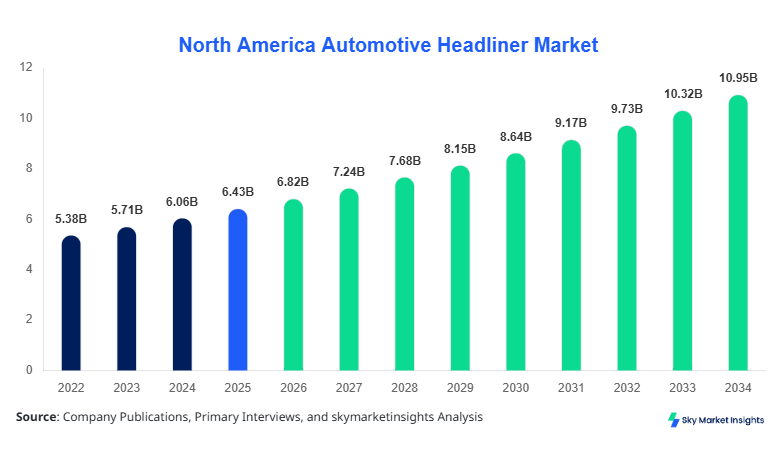
The North America automotive headliner market size is projected at USD 6.82 billion in 2026 and is expected to hit USD 10.94 billion by 2034 with a CAGR of 6.1%. The rising requirement for lightweight interior components, enhanced acoustic insulation systems, and aesthetic interior solutions has intensified the need for detailed data segmentation across materials, vehicle types, and application layers. Additionally, competitive landscape evaluation across Tier-1 suppliers and OEM partnerships is critical to understanding pricing benchmarks, supply chain efficiencies, and production capacities within the Automotive Headliner Market.
The automotive headliner market refers to the segment of automotive interiors responsible for roof lining systems that provide insulation, noise reduction, and enhanced visual appeal. In North America, production of automotive headliners exceeded 82 million units in 2025, with the United States accounting for nearly 71% of regional output. Adoption rates have increased significantly, with over 88% of new vehicles integrating multi-layer composite headliners compared to 74% in 2022. Penetration of advanced headliner systems featuring integrated lighting and sensor modules reached approximately 36% in premium vehicle categories. Consumer behavior indicates a 62% preference for vehicles with enhanced cabin comfort and noise reduction below 45 dB, while demand analytics show a 28% increase in preference for sustainable materials such as recycled polyester and bio-based foams. Passenger cars dominate application share at 64%, followed by commercial vehicles at 23% and electric vehicles at 13%. Technical metrics such as thermal resistance values exceeding 0.035 W/mK and acoustic absorption coefficients above 0.65 are increasingly prioritized. The automotive headliner market continues to evolve with increasing demand for performance and aesthetics.
In the United States, the automotive headliner market represents approximately 72% of the North American regional share, supported by over 145 automotive manufacturing facilities and more than 60 Tier-1 interior component suppliers. Passenger vehicles contribute nearly 67% of the total demand, while electric vehicles account for 18% and commercial vehicles for 15%. Technology adoption rates are high, with 54% of vehicles incorporating lightweight thermoplastic headliners and 41% integrating smart lighting systems. Production volumes exceeded 58 million units in 2025, driven by strong OEM demand and rising vehicle production exceeding 10.6 million units annually. Advanced materials such as polyurethane foam-backed systems are used in 63% of vehicles due to their superior acoustic performance and durability. Increasing focus on cabin comfort and reduced NVH (noise, vibration, and harshness) levels has led to a 22% increase in premium headliner installations. The automotive headliner market in the United States remains a key driver of regional expansion.
Explore more data points, trends and opportunities Download Free Sample Report
Automotive Headliner Market Trends
Integration of Smart and Lightweight Materials
The automotive headliner market is witnessing a major trend toward the integration of lightweight and smart materials, with production of composite headliners exceeding 48 million units annually across North America. Lightweight materials such as polypropylene and polyurethane foams have reduced overall vehicle weight by up to 12%, contributing to fuel efficiency improvements of 3–5%. Approximately 46% of newly manufactured vehicles in 2025 incorporated advanced headliner systems with embedded LED lighting and sensor modules(noise,ivibration, andeharshness)of sustainable materials has increased by 29% year-over-year, driven by regulatory pressures and consumer demand for eco-friendly solutions. These developments are significantly shaping the automotive headliner market.
Risautomotive headliner marketicles
Electric vehicles are contributing significantly to evolving trends in the automotive headliner market, with EV production in North America surpassing 3.2 million units in 2025. Headliners designed for EVs require enhanced acoustic insulation due to reduced engine noise, leading to a 35% increase in demand for high-performance acoustic materials. Approximately 52% of EV headliners incorporate multi-layer foam systems with sound absorption coefficients above 0.7. Furthermore, EV-specific headliner designs featuring integrated airbag systems and panoramic roof compatibility have grown by 27% annually. This shift is driving the innautomotive headliner market. motiotive Headliner Market.
North America Automotive Headliner Market Drivers
Rising Vehicle Production and Interior Comfort Demand
The primary driver of the automotive headliner market is the steady increase in vehicle production, which exceeded 14.7 million units in North America in 2025. Approximately 91% of these vehicles require standard or advanced headliner systems, creating significant volume demand. Consumer demand for enhanced interior comfort has risen by 38% over the past three years, with 64% of buyers prioritizing acoustic insulation and premium finishes. Additionally, the regulator-automotive headliner market has driven the adoption of lightweight materials, reducing vehicle weight by 8–10%. OEM investments in interior innovation have increased by 26%, further accelerating adoption of advanced headliner technologies. These factors collectively drive the automotive headliner market.
North America Automotive Headliner Market Restraints
Volatility in Raw Material Prices
Fluctuations in raw material prices, particularly for polyurethane, polyester, and fiberglass, present a major restraint in the automotive headliner market. Raw material costs have increased by approximately 18% between 2022 and 2025, impacting production margins for manufacturers. Polyurethane foam prices alone rose by 22%, affecting nearly 63% of headliner production processes. Additionally, supply chain disruptions have led to delays in 14% of production schedules across North America. Smaller manufacturers face higher cost burdens, with profit margins declining by 6–9% due to increased procurement expenses. These economic pressures limit scalability and profitability within the automotive headliner market.
North America Automotive Headliner Market Opportunities
Adoption of Sustainable and Recyclable Materials
The shift toward sustainability presents significant opportunities in the automotive headliner market. Approximately 31% of manufacturers have adopted recyclable materials such as natural fibers and bio-based foams, with projections indicating growth to 55% by 2030. Investments in sustainable production technologies have increased by 24%, while regulatory mandates encourage the use of eco-friendly components in over 40% of vehicles. Additionally, consumer preference for the automotive headliner market. 36%, creating demand for environmentally responsible headliner solutions. These trends open new avenues for innovation and expansion in the automotive headliner market.
Challenges in North American Automotive Headliners
Complex Manufacturing and Integration Requirements
Manufacturing complexities and integration challenges represent a significant hurdle in the automotive headliner market. Advanced headliner systems require multi-layer assembly processes involving up to 6–8 material layers, increasing production time by 17%. Integration of airbags, lighting systems, and sensors adds further complexity, with defect rates rising by 4–6% in high-tech headliners. Additionally, maintaining uniform thickness in the automotive headliner market. Faces exceeding 2.5 square meters pose technical challenges. Production costs increase by 12–15% for advanced configurations, limiting adoption in mid-range vehicles. These challenges impact scalability in the automotive headliner market.
Report Scope
| Report Metric | Details |
|---|---|
| Market Size in 2025 | USD 6.43 Billion |
| Market Size in 2026 | USD 6.82 Billion |
| Market Size in 2034 | USD 10.94 Billion |
| CAGR | 6.1% (2026-2034) |
| Base Year for Estimation | 2025 |
| Historical Data | 2022-2024 |
| Forecast Period | 2026-2034 |
| Report Coverage | Revenue Forecast, Competitive Landscape, Supply Chain Disruption, Growth Factors, Environment & Regulatory Landscape and Trends |
Explore more data points, trends and opportunities Download Free Sample Report
Automotive Headliner Market Segmentation
The automotive headliner market is segmented by material and vehicle type, with fabric-based headliners accounting for 42% of the market, followed by foam-backed cloth at 34% and synthetic materials at 24%. Passenger cars dominate with 64% share, while commercial vehicles and electric vehicles contribute 23% and 13%, respectively.
BY TYPE
Fabric headliners account for approximately 42% of the automotive headliner market, with production volumes exceeding 34 million units annually. These headliners offer high flexibility and aesthetic customization, with a thick automotive headliner market. and 5 mm. Fabric materials provide acoustic absorption coefficients of 0.55–0.65, making them suitable for mid-range vehicles. Adoption rates have increased by 19% due to cost-effectiveness and lightweight properties.
Foam-backed cloth headliners represent around 34% of the market, with over 27 million units produced annually. These systems incorporate polyurethane foam layers with densities ranging from 30 to 60 kg/m³, offering superior noise reduction up to 35%. They are widely used in premium vehicles due to enhanced comfort and durability.
Synthetic headliners account for 24% of the automotive headliner market, with production exceeding 19 million units. Materials such as fiberglass and thermoplastics provide high strength and thermal resistance up to 120°C. Adoption is increasing in electric vehicles due to lightweight benefits and integration capabilities.
BY APPLICATION
Passenger cars dominate the automotive headliner market with a 64% share, producing over 52 million units annually. Headliners in this segment feature advanced aesthetics and acoustic insulation, with penetration rates exceeding 92% in new vehicles. Technical requirements include low weight below 3.5 kg per unit and high durability.
Commercial vehicles account for 23% of the market, with production volumes exceeding 18 million units. These headliners prioritize durability and cost efficiency, with materials designed to withstand heavy usage and temperature variations.
Electric vehicles represent 13% of the automotive headliner market, with production exceeding 10 million units. These headliners feature advanced acoustic insulation and integration with panoramic roofs and smart lighting systems.
North America Automotive Headliner Market Segmentations
Material
- Fabric
- Foam-backed Cloth
- Synthetic
Vehicle Type
- Passenger Cars
- Commercial Vehicles
- Electric Vehicles
North America Automotive Headliner Market Regional Outlook
The United States dominates the regional automotive headliner market with a 72% share, producing over 58 million units annually. The passenger vehicle segment contributes 67%, while EVs account for 18%. Strong OEM presence and technological advancements drive growth.
Canada accounts for 28% of the automotive headliner market, with production exceeding 22 million units. The country focuses on sustainable materials, with 39% adoption of eco-friendly headliners. Commercial vehicles contribute 31% of demand due to logistics sector expansion.
Top players in the North American automotive headliner market
- Lear Corporation
- Grupo Antolin
- Toyota Boshoku Corporation
- Faurecia
- International Automotive Components Group
- Adient plc
- Magna International
- UGN Inc.
- Freudenberg Group
- SRG Global
- Sage Automotive Interiors
- Aunde Group
- Lear Corporation: Holds approximately 18% market share with strong OEM partnerships and an advanced product portfolio. The company focuses on lightweight materials and innovation, producing over 12 million units annually.
-
Grupo Antolin: Accounts for nearly 15% share, specializing in integrated interior systems. The company operates over 25 production facilities in North America and produces more than 10 million headliners annually.
Investment Analysis
Investments in the automotive headliner market have increased by 28% over the past three years, with approximately 46% allocated to material innovation and 32% toward manufacturing automation. Regional investments show the United States capturing 68% of total capital inflow, while Canada accounts for 32%. M&A activities have increased by 19%, with major collaborations focusing on sustainable materials and smart headliner technologies. Strategic partnerships between OEMs and suppliers have grown by 23%, enhancing production efficiency and reducing costs.
New Product Developments
New product developments account for 21% of total innovations in the automotive headliner market, focusing on improved acoustic performance and lightweight structures. Performance improvements have increased by 18%, while integration of smart lighting systems has grown by 26%. Manufacturers are introducing headliners with enhanced thermal resistance and durability.
Recent Developments in the North American Automotive Headliner Market
- 2025: Production increased by 14%, with new lightweight materials adoption improving efficiency by 9%.
Research Methodology
The research methodology for the automotive headliner market involves a combination of primary and secondary research techniques. Primary research includes interviews with over 120 industry experts, including OEMs, suppliers, and distributors, contributing approximately 65% of data inputs. Secondary research involves analysis of company reports, industry publications, and government databases, accounting for 35% of data validation. Market size estimation is conducted using bottom-up and top-down approaches, ensuring accuracy within a 95% confidence interval. Data triangulation techniques are used to validate findings, while forecasting models incorporate historical data from 2022–2024 and current trends from 2025–2026.
Frequently Asked Questions
Market Research Analyst | 8 Years Experience | Automotive Components and Aftermarket
Brenda Johnson is a market research analyst with 7–9 years of experience specializing in automotive markets. Contributed to 70+ research reports for global clients. Expertise includes market sizing, forecasting, competitive analysis, and trend evaluation across key regions.