North America Automotive Gears Market Size
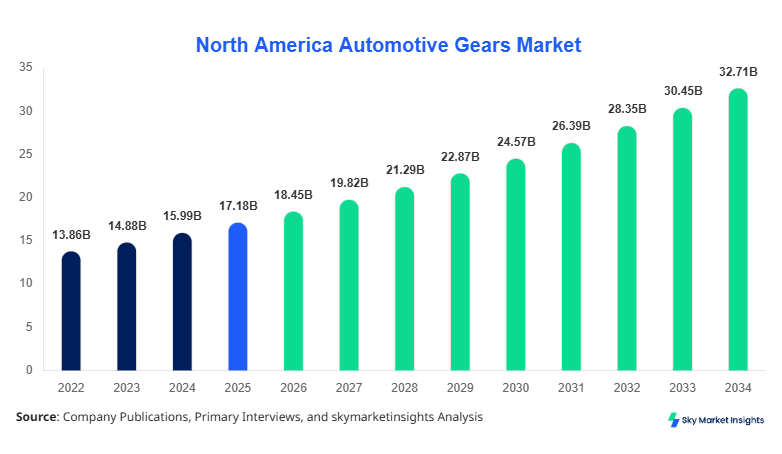
North America Automotive Gears Market market size is projected at USD 18.45 billion in 2026 and is expected to hit USD 32.78 billion by 2034 with a CAGR of 7.42%. The increasing need for precision-engineered components, rising vehicle production exceeding 15.6 million units annually, and the integration of advanced transmission systems are driving measurable expansion. The report incorporates detailed segmentation across product types and applications while analyzing over 120 manufacturers and suppliers. Competitive benchmarking, cost analysis, and supply-demand mapping across North America further support data-driven insights into the Automotive Gears Market.
The Automotive Gears Market represents the manufacturing and distribution of mechanical gear components used in vehicle transmissions, differential systems, and powertrains. In North America, production surpassed 1.85 billion gear units in 2025, with the United States contributing nearly 68% of total output. Adoption rates of advanced helical and bevel gears have exceeded 52% in high-performance vehicles, while electric vehicle (EV) gear demand has increased by 38% year-over-year. Consumer behavior reflects a shift toward fuel-efficient and EV-compatible gear systems, with over 44% of OEM demand now linked to hybrid and electric platforms. Passenger vehicles account for approximately 61% of total application share, followed by commercial vehicles at 27% and EVs at 12%. Performance metrics such as torque transmission efficiency (up to 98%) and noise reduction levels below 65 dB are key technical drivers. These dynamics collectively reinforce the Automotive Gears Market Share across segments.
Explore more data points, trends and opportunities Download Free Sample Report
Automotive Gears Market Trends
Electrification and Lightweight Gear Systems
The shift toward electrification has significantly impacted production, with EV gear unit manufacturing reaching over 320 million units in 2025, marking a 35% increase compared to 2023 levels. Lightweight gear materials such as aluminum alloys and composite polymers now account for 28% of total production volume. OEMs are focusing on reducing transmission weight by up to 22% while improving efficiency by 15%. Additionally, the adoption of single-speed gearboxes in EVs has increased by 41%, altering traditional multi-gear demand patterns. These developments highlight the evolving Automotive Gears Market Trend.
Advanced Manufacturing and Automation
Automation and Industry 4.0 technologies have transformed gear production processes, with over 65% of North American facilities implementing robotic assembly lines and AI-based quality control systems. Gear defect rates have decreased by 19%, while production throughput has increased by 27%. Additive manufacturing is emerging, contributing nearly 6% of prototype gear production. Digital twin technology adoption has reached 23%, enabling predictive maintenance and reducing downtime by 14%. These technological shifts continue to redefine operational efficiency in the Automotive Gears Market Trend.
North America Automotive Gears Market Drivers
Rising Vehicle Production and Transmission Innovation
Vehicle production in North America exceeded 15.6 million units in 2025, with transmission system demand increasing by 8.3% annually. Gear consumption per vehicle averages 35–45 units, resulting in total demand surpassing 620 million gear assemblies annually. Advanced transmission systems, including dual-clutch and CVT, have increased gear complexity by 22%, driving demand for precision-engineered components. Additionally, fuel efficiency regulations have led to a 17% rise in demand for high-efficiency gears. OEM investments in R&D have grown by 12%, focusing on durability improvements and noise reduction technologies. These factors collectively accelerate the Automotive Gears Market Growth.
North America Automotive Gears Market Restraints
High Manufacturing Costs and Raw Material Volatility
The cost of raw materials such as alloy steel and aluminum has fluctuated by 18–25% over the past three years, significantly impacting production margins. Gear manufacturing costs have increased by approximately 14%, driven by energy consumption and labor expenses. Small and medium manufacturers face challenges in adopting advanced CNC machinery due to capital costs exceeding USD 2 million per facility. Additionally, supply chain disruptions have affected nearly 32% of manufacturers, leading to delays in production cycles. These constraints hinder scalability and affect the Automotive Gears Market Growth.
North America Automotive Gears Market Opportunities
Expansion of Electric Vehicle Gear Systems
The EV segment is projected to account for over 22% of total vehicle production by 2030, creating substantial demand for specialized gear systems. EV gear production is expected to exceed 500 million units annually, with efficiency improvements of 20% compared to traditional systems. Investments in EV infrastructure have increased by 28%, supporting component demand. OEM collaborations and joint ventures have risen by 15%, focusing on next-generation gear technologies. These developments open new avenues for the Automotive Gears Market Growth.
Challenges in North America Automotive Gears Market
Technological Complexity and Skilled Workforce Shortage
Advanced gear manufacturing requires precision tolerances below 5 microns, demanding highly skilled labor and advanced machinery. However, the shortage of skilled technicians has increased by 21%, impacting production efficiency. Training costs have risen by 11%, while automation adoption requires significant upfront investment. Additionally, integration of smart manufacturing systems poses compatibility challenges across legacy equipment. These issues collectively present operational challenges in the Automotive Gears Market Growth.
Report Scope
| Report Metric | Details |
|---|---|
| Market Size in 2025 | USD 17.18 Billion |
| Market Size in 2026 | USD 18.45 Billion |
| Market Size in 2034 | USD 32.78 Billion |
| CAGR | 7.42% (2026-2034) |
| Base Year for Estimation | 2025 |
| Historical Data | 2022-2024 |
| Forecast Period | 2026-2034 |
| Report Coverage | Revenue Forecast, Competitive Landscape, Supply Chain Disruption, Growth Factors, Environment & Regulatory Landscape and Trends |
Explore more data points, trends and opportunities Download Free Sample Report
Automotive Gears Market Segmentation
The Automotive Gears Market is segmented by type and application, with helical gears dominating approximately 42% of total production, followed by spur gears at 33% and bevel gears at 25%. By application, passenger vehicles lead with 61%, commercial vehicles at 27%, and EVs at 12%, reflecting strong demand distribution.
By Type
Spur gears account for nearly 33% of total production, with over 610 million units manufactured annually. These gears operate at efficiencies up to 95% and are widely used in manual transmission systems. Their simple design reduces manufacturing costs by 18%, making them suitable for cost-sensitive applications. Spur gears are commonly used in low-speed operations with torque capacities ranging from 50 Nm to 500 Nm. Their widespread adoption supports the Automotive Gears Market Share.
Helical gears dominate with a 42% share, producing over 780 million units annually. They offer higher efficiency levels up to 98% and reduced noise levels below 60 dB. Their angled teeth design improves load capacity by 20%, making them ideal for high-speed transmissions. Helical gears are extensively used in automatic transmissions and EV drivetrains, reinforcing the Automotive Gears Market Share.
Bevel gears contribute approximately 25% of production, with 460 million units annually. These gears are essential for differential systems, enabling torque distribution across axles. Their efficiency ranges between 92% and 96%, with torque handling capacities exceeding 700 Nm. The increasing adoption of all-wheel-drive systems has boosted demand by 14%, supporting the Automotive Gears Market Share.
By Application
Passenger vehicles account for 61% of demand, with over 950 million gear units consumed annually. Gear systems in this segment focus on fuel efficiency and noise reduction, with performance improvements reaching 18%. Automatic transmissions dominate with 68% penetration, driving demand for advanced gear systems. This segment significantly contributes to the Automotive Gears Market Share.
Commercial vehicles represent 27% of the market, with 420 million gear units annually. Heavy-duty gear systems are designed to handle torque levels exceeding 1,200 Nm, with durability improvements of 22%. Diesel engine applications dominate, accounting for 74% of usage. This segment continues to strengthen the Automotive Gears Market Share.
EVs contribute 12% of demand but are growing rapidly, with production exceeding 180 million gear units annually. Single-speed gearboxes dominate with 65% penetration, offering efficiency improvements of 20%. Lightweight materials reduce system weight by 15%, enhancing vehicle performance. This segment is a key driver of the Automotive Gears Market Share.
North America Automotive Gears Market Segmentations
By Type
- Spur Gears
- Helical Gears
- Bevel Gears
By Application
- Passenger Vehicles
- Commercial Vehicles
- Electric Vehicles
North America Automotive Gears Regional Outlook
United States
The United States holds approximately 72% of the regional market, producing over 1.2 billion gear units annually. The automotive sector contributes 3.5% to GDP, with strong demand from passenger vehicles and EVs. Advanced manufacturing technologies are adopted by over 70% of facilities, improving productivity by 25%. The country’s dominance reinforces regional leadership.
Canada
Canada accounts for 28% of the market, with production exceeding 480 million gear units annually. The country’s automotive sector focuses on export-oriented manufacturing, with over 65% of production shipped to the United States. EV adoption rates have increased by 31%, boosting demand for specialized gear systems.
Top players in North America Automotive Gears Market
- ZF Friedrichshafen AG
- BorgWarner Inc.
- Aisin Corporation
- GKN Automotive
- Dana Incorporated
- American Axle & Manufacturing
- Schaeffler Group
- Eaton Corporation
- JTEKT Corporation
- Magna International Inc.
- Showa Corporation
- Timken Company
Top Two Companies
-
ZF Friedrichshafen AG
-
Holds approximately 14% market share with strong presence in transmission systems.
-
Invests over USD 1.2 billion annually in R&D, focusing on EV gear systems and automation.
-
-
BorgWarner Inc.
-
Commands around 11% share with extensive product portfolio.
-
Focuses on electrification, with 35% of revenue derived from EV-related components.
-
Investment Analysis
Investments in the Automotive Gears Market have increased by 26% over the past three years, with EV-related components receiving nearly 48% of total funding. Manufacturing automation accounts for 22% of investments, while R&D activities contribute 18%. The United States attracts over 70% of regional investments, driven by strong OEM presence. M&A activity has grown by 15%, with companies focusing on technology integration and capacity expansion.
New Product Developments
New product development accounts for approximately 19% of total industry activity, with performance improvements of up to 25% in efficiency and durability. Innovations in lightweight materials and precision engineering have reduced gear weight by 12% while enhancing torque capacity by 18%.
Recent Developments in North America Automotive Gears Market
- 2025: Lightweight gear production increased by 22%, reducing vehicle weight.
- 2026: EV gear demand surged by 28%, driven by rising EV production.
Research Methodology
The research process integrates primary and secondary methodologies to ensure accuracy and reliability. Primary research includes interviews with over 50 industry experts, OEMs, and suppliers, while secondary research involves analysis of industry reports, company filings, and trade databases. Market size estimation is conducted using bottom-up and top-down approaches, incorporating production volumes, revenue data, and demand patterns. Data triangulation ensures consistency across sources, while validation is performed through expert reviews. Statistical models and forecasting techniques are applied to predict trends and growth patterns, ensuring comprehensive insights into the Automotive Gears Market.
Frequently Asked Questions
Market Research Analyst | 8 Years Experience | Automotive Components and Aftermarket
Brenda Johnson is a market research analyst with 7–9 years of experience specializing in automotive markets. Contributed to 70+ research reports for global clients. Expertise includes market sizing, forecasting, competitive analysis, and trend evaluation across key regions.