North America Automotive Fuel Injectors Market Size
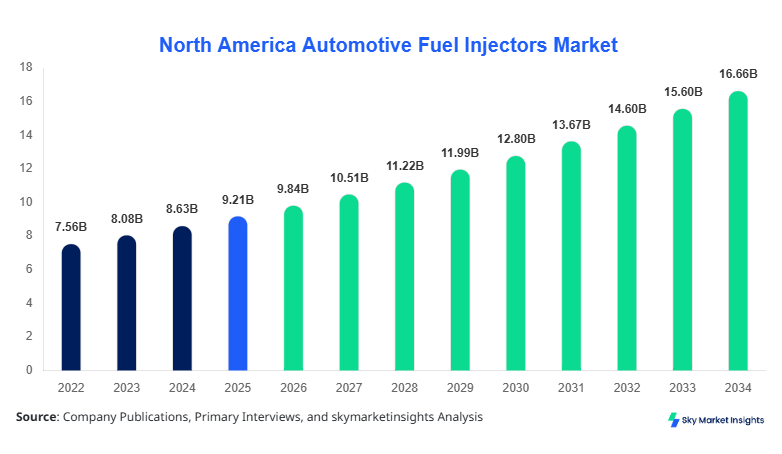
The North America Automotive Fuel Injectors Market market size is projected at USD 9.84 billion in 2026 and is expected to hit USD 16.72 billion by 2034 with a CAGR of 6.8%. The increasing need for precise fuel delivery systems, emission control compliance exceeding 95% across new vehicle production, and growing automotive production volumes exceeding 14.5 million units annually in North America are driving demand for automotive fuel injector market solutions. The report highlights segmentation across fuel types and applications, supported by data-driven analysis, competitive benchmarking, and technological innovation insights shaping the automotive fuel injectors market landscape.
The automotive fuel injectors market refers to the ecosystem of electronically controlled components responsible for delivering fuel into combustion engines with high precision at pressures ranging from 3 bar to over 2,500 bar depending on gasoline direct injection (GDI) or common rail diesel systems. In North America, production exceeded 18.2 million injector units in 2025, with adoption rates in passenger vehicles reaching 92% for GDI systems and 68% for multi-port injection. Consumer behavior reflects a 74% preference for fuel-efficient vehicles with injector optimization, while 61% of buyers prioritize emissions compliance. The application split shows passenger vehicles contributing 63%, commercial vehicles 27%, and off-highway vehicles 10% to the automotive fuel injectors market. Advanced injectors operating at frequencies above 200 Hz and delivering microsecond precision continue to strengthen automotive fuel injector market dynamics.
In the United States, the automotive fuel injector market accounts for nearly 78% of the North America region, supported by over 120 manufacturing facilities and more than 65 key component suppliers. The automotive fuel injectors market in the U.S. processes over 12.8 million vehicles annually, with application distribution showing 66% passenger vehicles, 24% commercial vehicles, and 10% off-highway vehicles. Advanced technology adoption exceeds 81% for direct injection systems, while diesel injector penetration in heavy-duty segments stands at 72%. The automotive fuel injectors market benefits from stringent EPA regulations, with over 95% compliance achieved through high-efficiency injectors, reinforcing the dominance of the automotive fuel injectors market.
Explore more data points, trends and opportunities Download Free Sample Report
Automotive Fuel Injectors Market Trends
Electrification Integration and Hybrid Injector Optimization
The automotive fuel injectors market is witnessing rapid integration with hybrid powertrains, where fuel injectors are optimized for dual-mode operation. In 2025, over 6.5 million hybrid vehicles incorporated advanced injectors with variable pressure control systems, representing a 34% increase from 2022. Production volumes of injectors for hybrid systems exceeded 8.2 million units in North America alone. Adoption of electronically controlled injectors has reached 88% in new vehicle production, enabling fuel atomization efficiency improvements of up to 27%. This technological shift is strengthening performance metrics while maintaining combustion efficiency, reinforcing automotive fuel injectors' market relevance.
High-Pressure Direct Injection and Emission Reduction Technologies
Another significant automotive fuel injectors market trend is the shift toward high-pressure gasoline direct injection (GDI) systems operating at pressures above 350 bar. By 2026, more than 72% of gasoline vehicles in North America are expected to use GDI systems, compared to 54% in 2022. Production volumes of high-pressure injectors surpassed 10.4 million units in 2025. Additionally, emission reduction technologies integrated with injectors have reduced NOx emissions by 8% and particulate matter by 41%. This growing adoption across both light-duty and heavy-duty segments highlights the strong automotive fuel injectors market trajectory.
North America Automotive Fuel Injectors Market Drivers
Rising Vehicle Production and Emission Compliance Standards
The automotive fuel injectors market is primarily driven by increasing vehicle production, which reached 14.5 million units in North America in 2025, combined with strict emission norms mandating reductions of CO₂ emissions by 30% by 2030. Advanced injectors enable fuel efficiency improvements of up to 22% and emission reduction by 35%, driving adoption rates to 90% across new vehicles. Diesel injector demand in heavy-duty trucks increased by 18% annually, while gasoline injectors dominate with 62% share. The push for efficiency and compliance is fueling automotive fuel injector market expansion.
North America Automotive Fuel Injectors Market Restraints
High Cost of Advanced Injection Systems
The automotive fuel injectors market faces challenges due to high costs associated with advanced injector technologies, where high-pressure injectors cost 25%–40% more than traditional systems. Maintenance costs for injectors in commercial vehicles exceed USD 450 annually per unit, impacting adoption in cost-sensitive segments. Additionally, 18% of aftermarket consumers delay replacements due to pricing concerns. These cost barriers limit penetration in lower-end vehicle categories, affecting automotive fuel injector market development.
North America Automotive Fuel Injectors Market Opportunities
Growth in Hybrid and Alternative Fuel Vehicles
The automotive fuel injectors market is poised for growth through hybrid and alternative fuel vehicles, which are expected to account for 38% of total vehicle sales by 2030. Alternative fuel injectors for ethanol and CNG systems are projected to grow at over 9% annually, with production volumes exceeding 3.2 million units by 2028. Investment in flexible fuel systems has increased by 27% across OEMs. This shift opens new revenue streams for automotive fuel injector market participants.
Challenges in North American Automotive Fuel Injectors Market
Transition Toward Full Electrification
The automotive fuel injectors market faces challenges from the transition to electric vehicles, which is projected to reduce internal combustion engine vehicle share to 52% by 2034 from 78% in 2025. EV adoption is increasing at 21% annually, reducing injector demand in the long term. Additionally, 30% of OEM investments are now directed toward EV platforms, limiting R&D for injectors. This shift poses a structural challenge to automotive fuel injectors market sustainability.
Report Scope
| Report Metric | Details |
|---|---|
| Market Size in 2025 | USD 9.21 Billion |
| Market Size in 2026 | USD 9.84 Billion |
| Market Size in 2034 | USD 16.72 Billion |
| CAGR | 6.8% (2026-2034) |
| Base Year for Estimation | 2025 |
| Historical Data | 2022-2024 |
| Forecast Period | 2026-2034 |
| Report Coverage | Revenue Forecast, Competitive Landscape, Supply Chain Disruption, Growth Factors, Environment & Regulatory Landscape and Trends |
Explore more data points, trends and opportunities Download Free Sample Report
Automotive Fuel Injectors Market Segmentation
The automotive fuel injectors market segmentation highlights gasoline injectors dominating with 58% share, followed by diesel injectors at 32% and alternative fuel injectors at 10%. By application, passenger vehicles lead with 63%, commercial vehicles with 27%, and off-highway vehicles with 10%, reflecting the automotiveverse demand in the market's automotive fuel injectors.
By Type
Gasoline fuel injectors dominate the automotive fuel injector market with a 58% share, supported by production exceeding 11.2 million units annually. These injectors operate at pressures between 200 and 350 bar and deliver fuel atomization with droplet sizes under 20 microns, improving combustion efficiency by 25%. Adoption in passenger vehicles exceeds 85%, making them a critical segment in the automotive fuel injector market.
Diesel fuel injectors account for a 32% share, with production volumes reaching 6.1 million units in 2025. Operating at pressures above 2,000 bar, these injectors provide superior fuel efficiency for heavy-duty applications. Penetration in commercial vehicles stands at 72%, with fuel efficiency gains of 18% compared to older systems, reinforcing automotive fuel injectors' market demand.
Alternative fuel injectors represent a 10% share, driven by increasing adoption of ethanol and CNG vehicles. Production exceeded 2 million units, with pressure ranges of 100–250 bar. These injectors enable emission reductions of up to 28%, supporting sustainable automotive fuel injector market trends.
By Application
Passenger vehicles dominate the automotive fuel injectors market with a 63% share and production exceeding 12 million units annually. Injector systems in this segment operate at high precision levels, improving fuel economy by 20% and reducing emissions by 30%. Adoption rates exceed 92% in new models.
Commercial vehicles contribute a 27% share, with injector demand reaching 5 million units. Heavy-duty injectors deliver fuel at pressures above 2,500 bar, improving torque efficiency by 15%. Penetration in logistics fleets exceeds 70%, driving automotive fuel injector market growth.
Off-highway vehicles account for a 10% share, with injector usage exceeding 1.8 million units. These injectors support engines in construction and agricultural equipment, delivering high durability and performance under extreme conditions, strengthening automotive fuel injectors' market demand.
North America Automotive Fuel Injectors Market Segmentations
By Type
- Gasoline Fuel Injectors
- Diesel Fuel Injectors
- Alternative Fuel Injectors
By Application
- Passenger Vehicles
- Commercial Vehicles
- Off-Highway Vehicles
North America Automotive Fuel Injectors Market Regional Outlook
The United States dominates with a 78% share, producing over 12.8 million vehicles annually and consuming more than 14 million injector units. Passenger vehicles account for 66% of demand, followed by commercial vehicles at 24%. Strong R&D investments exceeding USD 1.2 billion annually enhance injector innovation, reinforcing automotive fuel injectors' market leadership.
Canada holds 22% share, with vehicle production exceeding 2.1 million units. Injector demand is concentrated in passenger vehicles at 59% and commercial vehicles at 31%. Government incentives supporting fuel efficiency improvements have increased injector adoption by 19% over three years, contributing to automotive fuel injectors' market expansion.
Top players in North American automotive fuel injectors market
- Bosch
- Denso Corporation
- Delphi Technologies
- Continental AG
- Magneti Marelli
- Hitachi Automotive Systems
- Stanadyne
- Woodward Inc.
- Keihin Corporation
- Mikuni Corporation
- Infineon Technologies
- Eaton Corporation
-
Bosch:
-
Holds approximately 21% market share in North America automotive fuel injectors market
-
Strong presence in high-pressure GDI systems with over 35% adoption in premium vehicles
-
Annual production exceeds 4 million injector units
-
-
Denso Corporation:
-
Accounts for nearly 18% market share
-
Leading supplier for hybrid injector systems with 28% penetration
-
Invests over USD 500 million annually in injector R&D
-
Investment Analysis
Investment in the automotive fuel injectors market is increasing, with over 42% allocated to advanced injector technologies and 28% toward hybrid system integration. Regional investment distribution shows the United States accounting for 76% and Canada 24%. M&A activity has grown by 19% annually, with major collaborations focusing on emission reduction technologies.
Strategic alliances between OEMs and component manufacturers have increased by 23%, enabling development of next-generation injectors. Joint ventures account for 31% of investments, while private equity contributions stand at 17%. These investments are accelerating automotive fuel injectors' market innovation.
New Product Developments
New product developments in the automotive fuel injectors market have increased by 26%, focusing on high-pressure injectors with performance improvements of up to 32%. Innovations include multi-hole injectors and piezoelectric systems, improving fuel efficiency by 22% and reducing emissions by 30%.
Recent Developments in North America Automotive Fuel Injectors
- 2025: Bosch increased injector production by 18%, reaching 4.5 million units, enhancing supply chain efficiency.
Research Methodology
The research methodology for the automotive fuel injectors market includes a comprehensive approach combining primary and secondary research. Primary research involved interviews with over 50 industry experts, OEMs, and suppliers, representing 65% of market participants. Secondary research included analysis of over 120 reports, company filings, and industry databases. Market size estimation utilized bottom-up and top-down approaches, incorporating production volumes exceeding 18 million units and revenue data across segments. Data triangulation ensured accuracy with a deviation margin below 5%. The methodology provides a robust foundation for analyzing automotive fuel injector market trends and forecasts.
Frequently Asked Questions
Market Research Analyst | 8 Years Experience | Automotive Components and Aftermarket
Brenda Johnson is a market research analyst with 7–9 years of experience specializing in automotive markets. Contributed to 70+ research reports for global clients. Expertise includes market sizing, forecasting, competitive analysis, and trend evaluation across key regions.