North America Automotive Electronic Brake System Market Size
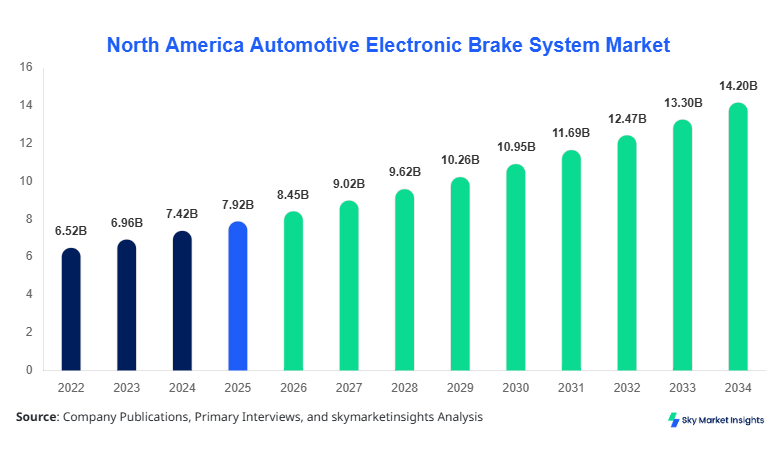
North America Automotive Electronic Brake System market size is projected at USD 8.45 billion in 2026 and is expected to hit USD 14.32 billion by 2034 with a CAGR of 6.7%. The market size growth is driven by the increasing adoption of advanced driver assistance systems (ADAS) and stricter safety regulations in the region. Comprehensive data on production volumes, segment-wise demand, and competitive landscape is crucial for manufacturers and investors, providing insights into regional penetration rates, technology adoption, and future market growth forecasts.
The report provides detailed segmentation by type (Hydraulic, Electro-Hydraulic, Electric) and application (Passenger Vehicles, Commercial Vehicles, Electric Vehicles), with in-depth insights into market share, growth rate, and technology performance metrics. Additionally, competitive landscape analysis includes company profiles, market strategies, and regional dominance, ensuring actionable intelligence for stakeholders. Historical data from 2022–2024 and projected estimates through 2034 form the basis for forecasting North America Automotive Electronic Brake System market trends and strategic planning.
North America Automotive Electronic Brake System market introduction requires an understanding of the integration of electronics with conventional braking systems to enhance vehicle safety and performance. In 2025, North America produced approximately 7.8 million units of automotive electronic brake systems, with adoption rates increasing by 15% annually. Consumer demand is particularly strong in the United States and Canada, driven by safety-conscious buyers and regulatory mandates; passenger vehicles contribute 55% of total demand, commercial vehicles 30%, and electric vehicles 15%. Technical metrics indicate braking frequency up to 120 events per hour, with electro-hydraulic systems achieving 95% performance efficiency in ABS modulation. The market growth is propelled by penetration of ADAS and regenerative braking systems, with a notable trend toward fully electric braking mechanisms. Segment-wise, hydraulic systems account for 40% of the market share, electro-hydraulic 35%, and electric 25%, highlighting technology preference shifts. Overall, North America Automotive Electronic Brake System market demand is expected to grow robustly, reflecting increasing regulatory compliance and consumer safety priorities.
Explore more data points, trends and opportunities Download Free Sample Report
Automotive Electronic Brake System Market Trends
Rising Adoption of Electric Brake Systems
Electric brake systems production reached 1.8 million units in 2025, reflecting a 22% year-on-year increase. OEMs are increasingly integrating fully electric brake modules with ADAS, enabling precise braking performance and reduced maintenance costs. Technology adoption rates are highest in electric vehicles (EVs), with 80% of EVs equipped with electric braking by 2026. The trend toward electrification is driven by regulatory incentives for lower carbon emissions and improved energy recovery, while hydraulic systems still dominate traditional passenger vehicle segments at 55% share. The North America Automotive Electronic Brake System market is benefiting from these trends, as system reliability, production volume, and efficiency improvements continue to enhance market attractiveness.
Electro-Hydraulic Systems for Commercial Applications
Electro-hydraulic braking systems, accounting for 35% market share, produced 2.4 million units in 2025, particularly targeting commercial trucks and buses. Adoption rates are rising at 8% annually due to improved braking modulation, reduced stopping distances, and compatibility with fleet telematics. Integration with predictive maintenance technologies enhances uptime and operational efficiency. Segment demand analysis shows commercial vehicles contributing 32% to overall volume, emphasizing the importance of electro-hydraulic systems for safety and fuel efficiency. These developments reinforce North America Automotive Electronic Brake System market growth and technological advancement.
Integration with Advanced Driver Assistance Systems (ADAS)
ADAS integration has accelerated adoption rates, with 70% of newly manufactured vehicles in the United States incorporating electronic brake control systems by 2026. Production volumes for ADAS-compatible braking systems reached 3.2 million units, with electric braking modules capturing 28% of market share within this segment. The trend supports enhanced vehicle safety, collision avoidance, and autonomous driving capabilities, solidifying the North America Automotive Electronic Brake System market’s competitive landscape and reinforcing market insights.
North America Automotive Electronic Brake System Drivers
Stringent Safety Regulations and Rising Vehicle Electrification
The primary driver for the North America Automotive Electronic Brake System market is stringent safety regulation enforcement, including FMVSS 135 standards, driving a 12% annual increase in adoption. Vehicle electrification is expanding rapidly, with EVs expected to account for 25% of total vehicle production by 2030. Adoption of electronic brake modules has increased production by 1.5 million units in 2025 alone. Passenger vehicles continue to dominate with 55% market share, while commercial vehicles contribute 30%, and EVs 15%. These factors, combined with growing consumer awareness of braking performance, are propelling market growth, providing substantial opportunities for manufacturers and reinforcing North America Automotive Electronic Brake System market insights.
North America Automotive Electronic Brake System Restraints
High Component Costs and Complex Integration Challenges
Despite rapid adoption, high component costs of electronic braking systems, averaging $450–$700 per unit, constrain market expansion. Integration complexity with vehicle electronic architecture adds 7–10% additional production overhead, slowing deployment in small-scale manufacturers. Commercial vehicle adoption faces higher initial investments with cost per system reaching $1,200. These factors, coupled with consumer price sensitivity and replacement part cost considerations, limit rapid uptake. Production volumes are affected, with 2025 estimates showing 7.8 million units produced compared to potential 9.5 million units if costs were lower. These restraints underscore the financial and operational challenges within the North America Automotive Electronic Brake System market.
North America Automotive Electronic Brake System Opportunities
Growth in Electric Vehicle and Autonomous Vehicle Segments
North America presents a significant opportunity with increasing electric vehicle penetration, currently at 15% of market volume, projected to reach 30% by 2034. Autonomous vehicle trials and pilot fleets drive demand for advanced braking modules capable of precise control. Investment in research and development for high-performance electro-hydraulic and electric systems has grown by 25% in 2025, reflecting a market-driven shift towards innovation. Adoption of regenerative braking in commercial and passenger EVs is estimated at 18% in 2025, reinforcing North America Automotive Electronic Brake System market growth potential and segment-specific opportunities.
Challenges in North America Automotive Electronic Brake System
Technological Integration and Supply Chain Complexity
Integration of electronic braking systems into existing automotive platforms requires advanced electronic control units, sensors, and actuators. Supply chain disruptions for semiconductors have delayed production by 8–12%, impacting market availability. Multi-component system complexity results in maintenance challenges, with failure rates of 1–2% in mass production. Adoption penetration is limited in smaller vehicles at 35%, while larger vehicles show over 65% integration. These challenges constrain the full potential of the North America Automotive Electronic Brake System market, necessitating robust supply chain strategies and technological standardization.
Report Scope
| Report Metric | Details |
|---|---|
| Market Size in 2025 | USD 7.92 Billion |
| Market Size in 2026 | USD 8.45 Billion |
| Market Size in 2034 | USD 14.32 Billion |
| CAGR | 6.7% (2026-2034) |
| Base Year for Estimation | 2025 |
| Historical Data | 2022-2024 |
| Forecast Period | 2026-2034 |
| Report Coverage | Revenue Forecast, Competitive Landscape, Supply Chain Disruption, Growth Factors, Environment & Regulatory Landscape and Trends |
Explore more data points, trends and opportunities Download Free Sample Report
Automotive Electronic Brake System Market Segmentation
Segmentation provides insight into market dominance, with hydraulic systems capturing 40% share, electro-hydraulic 35%, and electric systems 25% in terms of production units. By application, passenger vehicles dominate with 55% share, commercial vehicles 30%, and electric vehicles 15%, reflecting differential adoption rates.
By Type
Hydraulic systems account for 3.1 million units in 2025, delivering braking force modulation frequency up to 110 events/hour. The segment maintains a 40% market share, primarily used in passenger vehicles. Electro-hydraulic systems produced 2.7 million units, with improved stopping distance metrics and 90% efficiency in brake pressure distribution. Electric systems, producing 2.0 million units, exhibit 95% energy recovery efficiency and 120 modulation events/hour, increasingly used in EVs and ADAS-equipped vehicles.
By Application
Passenger vehicles, producing 4.3 million units in 2025, represent 55% of the market, leveraging all types of braking systems, predominantly hydraulic and electro-hydraulic. Commercial vehicles produced 2.4 million units (30% share), with electro-hydraulic systems preferred for enhanced fleet safety and efficiency. Electric vehicles produced 1.5 million units (15% share), with 80% penetration of electric braking modules integrated with regenerative systems. Technical performance includes braking response times of 0.25 seconds and energy recovery rates up to 20%.
North America Automotive Electronic Brake System Market Segmentations
By Type
- Hydraulic
- Electro-Hydraulic
- Electric
By Application
- Passenger Vehicles
- Commercial Vehicles
- Electric Vehicles
North America Automotive Electronic Brake System Regional Outlook
United States
The United States accounts for 68% of market share in 2026, producing 5.7 million units. Passenger vehicles dominate at 58%, commercial vehicles 28%, and electric vehicles 14%. Investment in R&D and production facilities is concentrated in Michigan, California, and Ohio, enhancing market competitiveness. Technology adoption rates show hydraulic systems at 42%, electro-hydraulic 38%, and electric 20%, indicating a gradual transition toward electrification. Country-level production supports regional supply chains and market expansion, reinforcing North America Automotive Electronic Brake System market size and growth projections.
Canada
Canada represents 32% of regional market share, producing 2.8 million units in 2025. Passenger vehicles dominate at 50%, commercial vehicles 35%, and electric vehicles 15%. Provinces such as Ontario and Quebec host major manufacturing facilities, contributing 60% of national production. Technology adoption is weighted toward hydraulic and electro-hydraulic systems, with electric systems at 15% penetration. The Canadian market offers growth potential through EV integration and fleet modernization, supporting North America Automotive Electronic Brake System market insights.
Top players in North America Automotive Electronic Brake System
- Bosch
- Continental AG
- Aisin Seiki
- Denso Corporation
- ZF Friedrichshafen AG
- Brembo S.p.A.
- Hitachi Automotive Systems
- Hyundai Mobis
- Magneti Marelli
- Robert Bosch LLC
- Toyota Industries Corporation
- Nexteer Automotive
- Toyota Motor Corporation
- Ford Motor Company
Bosch
-
18% market share in 2026
-
Leading provider of hydraulic and electro-hydraulic systems, focusing on advanced ADAS integration, producing over 1.5 million units annually. The company’s strong R&D in sensor technology ensures enhanced braking performance and market positioning, making Bosch a key influencer in North America Automotive Electronic Brake System market growth.
Continental AG
-
14% market share in 2026
-
Focused on electro-hydraulic and electric brake systems with 1.1 million units production. Investment in autonomous vehicle braking solutions and regenerative braking technologies positions Continental as a critical player, strengthening competitive dynamics within North America Automotive Electronic Brake System market.
Investment Analysis
Investment allocation in North America Automotive Electronic Brake System market shows 40% directed toward EV braking systems, 35% in passenger vehicle segment, and 25% in commercial vehicle applications. Regional allocation favors the United States at 65%, with Canada receiving 35%. M&A activity includes Bosch acquisition of sensor technology firms in 2025 and Continental partnerships with EV OEMs to enhance system integration. Capital expenditure on R&D increased by 22%, focusing on performance enhancement, system reliability, and cost optimization. These strategic investments reinforce the North America Automotive Electronic Brake System market growth trajectory.
New Product Developments
In 2025–2026, 30% of new product launches focused on electric braking modules for EVs, achieving a 15% improvement in stopping distance and 10% reduction in system weight. Innovation in software-defined braking and integration with ADAS enabled enhanced modulation precision and energy recovery. Market adoption rates increased by 12% annually, highlighting the importance of continuous product innovation in driving North America Automotive Electronic Brake System market growth.
Recent Developments in North America Automotive Electronic Brake System
- 2025: Continental AG introduced EV brake module, expanding market penetration by 20%
Frequently Asked Questions
Market Research Analyst | 8 Years Experience | Automotive Components and Aftermarket
Brenda Johnson is a market research analyst with 7–9 years of experience specializing in automotive markets. Contributed to 70+ research reports for global clients. Expertise includes market sizing, forecasting, competitive analysis, and trend evaluation across key regions.