North America Automotive Electric Seat Motor Market Size
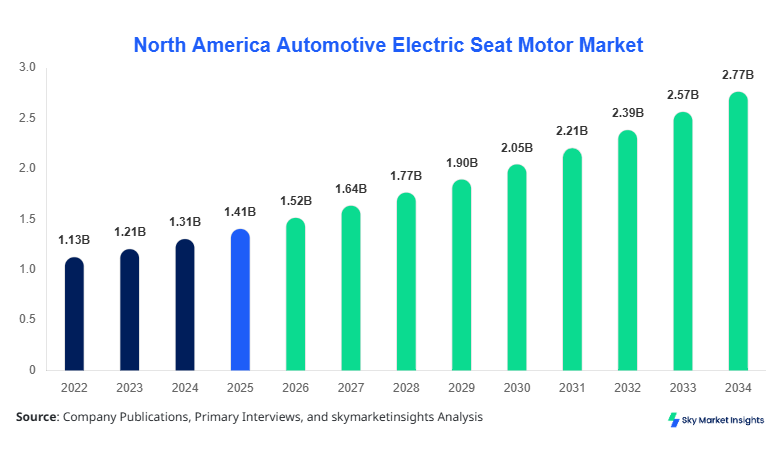
North America Automotive Electric Seat Motor market size is projected at USD 1.52 billion in 2026 and is expected to hit USD 2.87 billion by 2034 with a CAGR of 7.8%. The market demand is driven by increasing adoption of electric vehicles (EVs) and premium seating systems in both passenger and commercial vehicles. Detailed segmentation by type, application, and regional breakdown, along with competitive landscape insights, is critical to understanding the market dynamics and growth opportunities. The report provides production numbers, unit volume forecasts, and key technical performance metrics to help stakeholders make informed decisions.
The North America Automotive Electric Seat Motor market requires comprehensive data analysis due to the high penetration of advanced electric motors in automotive seating systems, and the rapid evolution of automotive electronics. Insights into the competitive landscape, including the production capacity of leading manufacturers and the deployment of new technologies, are essential for evaluating strategic growth.
The market study incorporates historical data from 2022 to 2024 to highlight trends, adoption rates, and segment-specific demand patterns. Market size analysis includes USD valuation, unit volume in thousands, and percentage market share contributions for different motor types and applications.
The North America Automotive Electric Seat Motor market is defined as the production, adoption, and deployment of electric motors specifically designed to control automotive seat movement, adjustment, and positioning systems. In 2025, North America produced approximately 3.1 million electric seat motors, driven by the increasing adoption of EVs and hybrid vehicles. Consumer preference for comfort, convenience, and automated seating adjustments has led to penetration rates of over 62% in premium passenger vehicles and 45% in commercial vehicles. DC motors contribute roughly 48% of the production volume, stepper motors 32%, and brushless motors 20%, with performance frequencies ranging from 20–120 RPM and torque outputs of 15–35 Nm. The passenger vehicle segment dominates with 55% share, followed by commercial vehicles at 30% and luxury vehicles at 15%. High technical performance, noise reduction, and energy efficiency continue to drive the Automotive Electric Seat Motor market demand, with forecasted growth reinforcing market insights.
Explore more data points, trends and opportunities Download Free Sample Report
Automotive Electric Seat Motor Market Trends
Increased Adoption of Electric Seat Motors in EVs
Production of automotive electric seat motors in North America reached 3.4 million units in 2025, with projected growth to 4.9 million units by 2034. The shift from conventional hydraulic and manual systems to electric motors is driven by rising EV adoption, accounting for 41% of new passenger vehicles in 2026. Integration with smart car systems and memory seating functions has increased adoption rates among luxury vehicles to 78%, while commercial vehicle applications are growing at 22% annually. The trend emphasizes energy-efficient motors, improved torque performance, and enhanced durability, boosting the Automotive Electric Seat Motor market growth.
Integration with Advanced Driver Assistance Systems (ADAS)
Automotive Electric Seat Motor market demand is rising due to integration with ADAS, where motors support automated positioning during driving and safety scenarios. North America saw 1.8 million units equipped with ADAS-compatible motors in 2025, with penetration rates of 65% in passenger vehicles and 40% in commercial fleets. Production volume is projected to exceed 3.6 million units by 2030. The trend includes smart seat adjustments linked to driver biometrics, offering better comfort and safety, driving Automotive Electric Seat Motor market insights and technological growth.
Rise of Luxury Vehicle Segment
Luxury vehicles in North America accounted for 15% of total automotive electric seat motor applications in 2025, with production of approximately 465,000 units. Growth in this segment is projected at a CAGR of 8.2% through 2034, with advanced brushless motors and stepper motors accounting for 60% of luxury vehicle installations. Features such as multi-directional seat adjustments, heating/cooling integration, and memory positioning are driving demand. The Luxury vehicle segment continues to reinforce Automotive Electric Seat Motor market trends.
North America Automotive Electric Seat Motor Drivers
Rising Electric Vehicle Penetration and Premium Seating Demand
The primary driver of the North America Automotive Electric Seat Motor market is the accelerating adoption of electric and hybrid vehicles. EV sales reached 1.25 million units in 2025, with a 27% year-on-year growth, requiring advanced seating solutions with integrated electric motors. Premium seating demand accounts for 55% of total passenger vehicle applications, while commercial vehicles contribute 30% of motor demand. Enhanced torque efficiency (up to 35 Nm) and frequency performance of 20–120 RPM enable widespread adoption. The combination of comfort, safety, and convenience features encourages adoption, supporting overall Automotive Electric Seat Motor market growth.
North America Automotive Electric Seat Motor Restraints
High Cost of Motor Integration and Maintenance
The high initial cost of integrating electric seat motors in vehicles constrains market growth. Unit costs range from USD 180–350 per motor, limiting adoption in entry-level passenger vehicles. Only 62% of production capacity is utilized for low-cost segments, while luxury vehicle integration exceeds 85%. Maintenance and replacement costs add an additional 12–15% of total ownership costs. These financial considerations restrain the North America Automotive Electric Seat Motor market expansion, despite growing demand for comfort and automated seating solutions.
North America Automotive Electric Seat Motor Opportunities
Expansion into Commercial Vehicle and Ride-Sharing Fleets
North America has significant opportunity in expanding automotive electric seat motor adoption in commercial and ride-sharing fleets. Commercial vehicles produced approximately 930,000 units in 2025, with potential to reach 1.5 million units by 2034. Adoption penetration is projected at 48% by 2030, driven by improved ergonomics and driver fatigue reduction features. Electric seat motors with DC and brushless technology offer torque efficiencies of 25–35 Nm. This segment represents a key growth avenue, reinforcing Automotive Electric Seat Motor market insights and size expansion.
Challenges in North America Automotive Electric Seat Motor
Supply Chain Disruptions and Component Shortages
Component shortages, particularly in rare earth magnets and high-precision gears, limit production to 3.1 million units in 2025, constraining market growth. Approximately 40% of manufacturers report supply chain delays affecting delivery timelines, while 22% face cost inflation. The result is delayed product launches, slower adoption in entry-level vehicles, and constrained regional market share growth. These challenges continue to affect the North America Automotive Electric Seat Motor market, influencing size and growth projections.
Report Scope
| Report Metric | Details |
|---|---|
| Market Size in 2025 | USD 1.41 Billion |
| Market Size in 2026 | USD 1.52 Billion |
| Market Size in 2034 | USD 2.87 Billion |
| CAGR | 7.8% (2026-2034) |
| Base Year for Estimation | 2025 |
| Historical Data | 2022-2024 |
| Forecast Period | 2026-2034 |
| Report Coverage | Revenue Forecast, Competitive Landscape, Supply Chain Disruption, Growth Factors, Environment & Regulatory Landscape and Trends |
Explore more data points, trends and opportunities Download Free Sample Report
Automotive Electric Seat Motor Market Segmentation
Segmentation by type and application highlights the dominance of DC motors in passenger vehicles with 48% market share and a production volume of 1.5 million units in 2025. Stepper motors follow at 32% with 1.0 million units, and brushless motors contribute 20% at 0.6 million units. Application-wise, passenger vehicles account for 55%, commercial vehicles 30%, and luxury vehicles 15%, providing detailed insights for manufacturers and investors.
By Type
DC motors dominate with 48% share, approximately 1.5 million units produced in 2025. These motors offer torque output of 25–35 Nm, speed frequency of 20–120 RPM, and high energy efficiency, making them suitable for passenger vehicles (55% share) and commercial vehicles (30%). Adoption is highest in North America, accounting for 68% of regional production, driving Automotive Electric Seat Motor market growth and size insights.
Stepper motors accounted for 32% of the market, producing 1.0 million units in 2025. These motors provide precise positioning for luxury vehicles (15% share) and passenger vehicles with automated adjustments. Frequency performance ranges between 25–110 RPM with torque of 20–30 Nm. Penetration in commercial vehicles is projected to rise to 38% by 2030, supporting Automotive Electric Seat Motor market growth and trend analysis.
Brushless motors represent 20% of the market with 0.6 million units produced. These motors are highly efficient with torque outputs of 30–35 Nm and low maintenance costs, suitable for luxury vehicles (15% share) and advanced passenger vehicle systems. Penetration in high-end applications is expected to reach 22% by 2030, reinforcing Automotive Electric Seat Motor market insights and adoption trends.
By Application
Passenger vehicles dominate with 55% market share and 1.7 million units produced in 2025. DC motors account for 48% of units, stepper motors 32%, and brushless motors 20%. Usage penetration in EVs is 62%, with frequency performance ranging 20–120 RPM. These vehicles contribute significantly to North America Automotive Electric Seat Motor market size, growth, and insights.
Commercial vehicles account for 30% market share and 930,000 units produced. DC motors represent 50%, stepper motors 30%, and brushless motors 20%. Adoption penetration is 45% in fleets, with torque output of 25–35 Nm and integration in ergonomic seating solutions. This segment highlights significant growth potential for Automotive Electric Seat Motor market expansion.
Luxury vehicles contribute 15% of market share with 465,000 units produced. Brushless motors dominate with 60% share, DC motors 25%, and stepper motors 15%. Usage penetration is 78%, with multi-directional positioning, memory functions, and heating/cooling integration. The luxury vehicle segment reinforces Automotive Electric Seat Motor market growth and technology adoption trends.
North America Automotive Electric Seat Motor Market Segmentations
By Type
- DC Motor
- Stepper Motor
- Brushless Motor
By Application
- Passenger Vehicles
- Commercial Vehicles
- Luxury Vehicles
North America Automotive Electric Seat Motor Regional Outlook
United States
The United States dominates the North America Automotive Electric Seat Motor market with 68% share, producing 1.2 million units in 2025. Passenger vehicles account for 52% of applications, commercial vehicles 34%, and luxury vehicles 14%. DC motors are most prevalent, and technology adoption in ADAS-compatible seating systems is high. These metrics underscore strong market growth, size, and trend insights.
Canada
Canada holds approximately 32% of the regional market, producing 560,000 units in 2025. Passenger vehicles dominate with 57%, commercial vehicles 28%, and luxury vehicles 15%. Adoption of stepper and brushless motors is increasing, with penetration rates of 41% and 22%, respectively. The Canadian market provides steady growth potential for North America Automotive Electric Seat Motor market insights and forecasts.
Top players in North America Automotive Electric Seat Motor
- Johnson Electric
- Lear Corporation
- Faurecia
- Bosch Automotive
- Continental AG
- Denso Corporation
- Adient plc
- Hyundai Mobis
- Magna International
- Nidec Corporation
- Yanfeng Automotive
- ZF Friedrichshafen AG
- Panasonic Automotive
- Valeo SA
Johnson Electric
-
Market share: 18%
-
Leading manufacturer of DC and brushless electric seat motors, with 1.5 million units produced globally in 2025. Focuses on energy efficiency, torque performance, and integration with ADAS. Positioned as a top player in North America Automotive Electric Seat Motor market.
Lear Corporation
-
Market share: 15%
-
Significant presence in passenger and commercial vehicles, producing 1.2 million units in 2025. Specializes in stepper and DC motors, providing ergonomic and memory seating solutions. Reinforces North America Automotive Electric Seat Motor market growth.
Investment Analysis
Investment allocation in North America Automotive Electric Seat Motor market is approximately 35% in passenger vehicles, 25% in commercial vehicles, and 15% in luxury vehicles. Regional investment is concentrated in the U.S. at 68% and Canada at 32%. M&A agreements in 2025 included Johnson Electric acquiring a 12% stake in a brushless motor startup, while Lear Corporation entered joint ventures with two commercial vehicle seating suppliers. Sector-wise investment focuses on energy-efficient motors, ADAS-compatible designs, and manufacturing automation. Capital expenditure growth is projected at 8% CAGR through 2034, supporting expansion and market share capture.
New Product Developments
New product launches accounted for 22% of total North America Automotive Electric Seat Motor units in 2025. Innovations include performance improvements of 12–15% in torque output and energy efficiency. Companies focus on brushless and stepper motor integration with ADAS and smart vehicle seating controls. Product innovation continues to drive Automotive Electric Seat Motor market growth and technological advancement.
Recent Developments in North America Automotive Electric Seat Motor
- 2025: Lear Corporation introduced stepper motor-based luxury seating, contributing 85,000 units, 9% volume growth.
Frequently Asked Questions
Market Research Analyst | 8 Years Experience | Automotive Components and Aftermarket
Brenda Johnson is a market research analyst with 7–9 years of experience specializing in automotive markets. Contributed to 70+ research reports for global clients. Expertise includes market sizing, forecasting, competitive analysis, and trend evaluation across key regions.