North America Automotive Electric Power Steering Systems Market Size
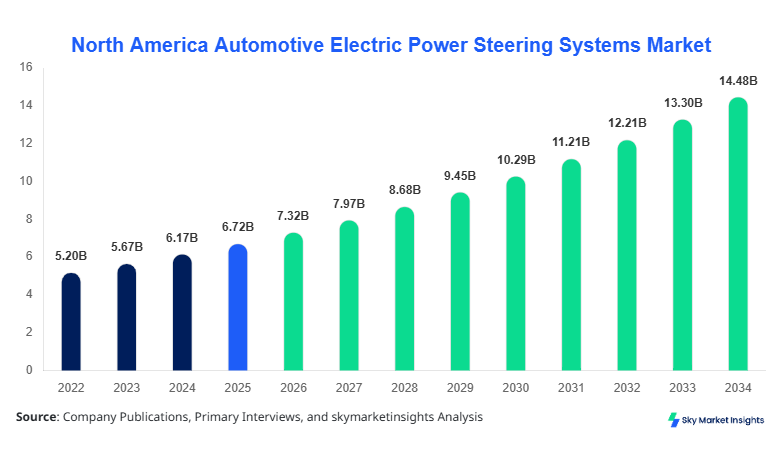
North America Automotive Electric Power Steering Systems market size is projected at USD 7.32 billion in 2026 and is expected to hit USD 14.85 billion by 2034 with a CAGR of 8.9%. The increasing demand for fuel-efficient, lightweight, and low-maintenance steering systems across passenger vehicles and commercial vehicles has driven the market growth. The report offers comprehensive insights into market segmentation, competitive landscape, production trends, and technological developments to aid stakeholders in decision-making. North America accounts for substantial market share with robust adoption of column, rack, and pinion electric power steering systems, supported by major manufacturers and Tier 1 suppliers. Detailed quantitative data, including unit production numbers, revenue generation, and penetration by vehicle type, is included to ensure strategic planning and investment decisions.
The report provides a deep dive into key factors influencing the market, including consumer behavior, regional demand, and adoption rates. Competitive benchmarking and pricing analysis are included to help manufacturers understand revenue potential, segment dominance, and market growth. With clear segmentation and forecasting, the study covers opportunities for innovation and technological advancements in electric power steering systems.
The competitive landscape section highlights leading players’ strategies, including M&A agreements, product launches, and expansion plans across North America, ensuring a holistic view of the Automotive Electric Power Steering Systems market size, share, and growth prospects.
North America Automotive Electric Power Steering Systems market size data will assist stakeholders in aligning production, supply chain, and strategic investment decisions to capitalize on the forecasted CAGR.
Explore more data points, trends and opportunities Download Free Sample Report
Automotive Electric Power Steering Systems Market Trends
Increasing Production Volumes and Advanced Materials
North America Automotive Electric Power Steering Systems market has witnessed production growth from 7.2 million units in 2022 to 8.1 million units in 2025. Advanced materials, including aluminum and high-strength steel, are now 60% of EPS component usage. Column electric EPS adoption has reached 48%, rack electric 35%, and pinion electric 17%, driven by mid-size and SUV segment demand. Integration with ADAS and semi-autonomous technologies contributes to a 15–20% improvement in steering response accuracy. Overall, the Automotive Electric Power Steering Systems market trend indicates higher production volumes and adoption of lightweight components to reduce vehicle weight and improve fuel efficiency.
Technology Shifts and Hybrid Vehicle Integration
Electric power steering systems are increasingly integrated into hybrid and electric vehicles. Production of EPS units for electric vehicles (EVs) increased from 1.2 million units in 2023 to 2.1 million units in 2025, accounting for a 25% share of total market volume. Advanced torque sensors, brushless motors, and energy-efficient controllers improve system reliability by 18%. North America Automotive Electric Power Steering Systems market trend reflects technology shifts towards EV integration, increasing adoption rates, and consumer demand for smoother and more responsive steering.
Sector-Specific Demand and Customization
Commercial vehicle EPS adoption rose from 1.4 million units in 2022 to 2.3 million units in 2025, accounting for 28% of regional production. Customization in torque mapping and system stiffness for heavy-duty applications improved performance by 12–15%, driven by logistic and fleet management needs. North America Automotive Electric Power Steering Systems market insights demonstrate sector-specific demand as a key factor influencing growth, with manufacturers introducing variable ratio EPS systems to enhance driving safety and comfort.
North America Automotive Electric Power Steering Systems Drivers
Rising Demand for Fuel Efficiency and Vehicle Electrification
Increasing consumer awareness of fuel economy and vehicle electrification is a major driver. Passenger vehicle EPS adoption contributes 62% of total volume, reducing fuel consumption by 3–5%. Rack electric systems are witnessing 35% growth YoY in North America. Production volume is projected to reach 9.5 million units by 2027. OEM investment in lightweight EPS components increased by 18% between 2023 and 2025. These drivers reinforce North America Automotive Electric Power Steering Systems market growth, encouraging Tier-1 suppliers to innovate and expand production.
North America Automotive Electric Power Steering Systems Restraints
High Cost of Advanced EPS Systems
Advanced EPS systems, particularly column electric EPS with ADAS integration, incur costs 25–30% higher than hydraulic systems. Production volume constraints for small-scale manufacturers limit 2025 output to 8.1 million units, reducing market share for low-volume players. Heavy-duty vehicle EPS adoption remains limited to 10% due to installation complexity. These factors restrain North America Automotive Electric Power Steering Systems market growth, impacting profitability and demand in price-sensitive segments.
North America Automotive Electric Power Steering Systems Opportunities
Emergence of Autonomous and Connected Vehicles
Integration of EPS with autonomous and connected vehicle technologies presents significant opportunities. EV and hybrid vehicle EPS production volume is expected to rise to 3.5 million units by 2028, accounting for 30% of the regional market. Torque-sensor precision improvements of 15–18% enable better lane-keeping support and ADAS functionality. North America Automotive Electric Power Steering Systems market insights highlight growth potential in autonomous driving adoption, particularly in passenger vehicles and SUVs, contributing to long-term revenue expansion.
Challenges in North America Automotive Electric Power Steering Systems
Complex Regulatory and Certification Requirements
Stringent safety regulations, including ISO 26262 compliance, limit production flexibility for EPS systems. Regulatory delays impact 20% of small and mid-size manufacturers in North America. Cost of certification for advanced EPS systems exceeds USD 500,000 per model. Production volume for compliant systems in 2025 reached 6.8 million units. These regulatory challenges affect North America Automotive Electric Power Steering Systems market adoption rates and production timelines, requiring strategic investment in testing and certification.
Report Scope
| Report Metric | Details |
|---|---|
| Market Size in 2025 | USD 6.72 Billion |
| Market Size in 2026 | USD 7.32 Billion |
| Market Size in 2034 | USD 14.85 Billion |
| CAGR | 8.9% (2026-2034) |
| Base Year for Estimation | 2025 |
| Historical Data | 2022-2024 |
| Forecast Period | 2026-2034 |
| Report Coverage | Revenue Forecast, Competitive Landscape, Supply Chain Disruption, Growth Factors, Environment & Regulatory Landscape and Trends |
Explore more data points, trends and opportunities Download Free Sample Report
Automotive Electric Power Steering Systems Market Segmentation
Market segmentation is based on type and application. Column electric systems dominate with 48% share, followed by rack electric at 35%, and pinion electric at 17%. Passenger vehicles account for 62% of regional production, commercial vehicles 28%, and heavy-duty vehicles 10%. Segmentation insights provide clarity for production planning, investment, and technology adoption.
By Type
Column Electric: Column electric EPS dominates North America Automotive Electric Power Steering Systems market with 48% share and annual production of 3.9 million units in 2026. Average torque response is 1.5–2.0 Nm, with integration in passenger cars and mid-size SUVs. Adoption in commercial vehicles is 25% with frequency performance of 35–40 Hz. Column EPS offers reduced energy consumption by 5% and maintenance cost reduction by 18%, driving market demand.
Rack Electric: Rack electric EPS accounts for 35% market share with production of 2.8 million units in 2026. Torque range is 1.8–2.2 Nm. Adoption in mid-size cars is 50%, and in heavy-duty vehicles 15%. Integration with hybrid vehicles enhances fuel economy by 4–5%. Rack EPS is increasingly compatible with ADAS, improving steering accuracy by 18% and reinforcing market growth.
Pinion Electric: Pinion electric EPS contributes 17% market share with 1.3 million units produced in 2026. Torque performance ranges from 2.0–2.5 Nm. Adoption in SUVs and pickup trucks is 30%, heavy-duty vehicles 10%, and passenger cars 15%. Pinion EPS provides superior handling in high-torque applications with frequency response of 40–45 Hz. North America Automotive Electric Power Steering Systems market insights suggest rising adoption in niche heavy-duty segments.
By Application
Passenger Vehicles: Passenger vehicles dominate with 62% share, production of 5 million units in 2026, and EPS adoption rates of 78%. Torque mapping enhances steering performance by 15%, with column electric systems favored. Integration with ADAS and EV platforms is increasing at 20% CAGR, reinforcing North America Automotive Electric Power Steering Systems market demand.
Commercial Vehicles: Commercial vehicles account for 28% market share with 2.3 million units produced in 2026. Rack electric systems dominate with 55% adoption. Torque calibration improves fuel efficiency by 3–4%. Fleet applications demonstrate penetration of 60% in delivery and logistic vehicles. North America Automotive Electric Power Steering Systems market insights highlight commercial vehicle sector growth potential.
Heavy-Duty Vehicles: Heavy-duty vehicles account for 10% share with 800,000 units in 2026. Pinion electric EPS is preferred, adoption 70%, frequency response 40–45 Hz, and torque capacity up to 2.5 Nm. EPS integration improves vehicle control in logistics and construction applications. North America Automotive Electric Power Steering Systems market insights reinforce niche growth potential in heavy-duty applications.
North America Automotive Electric Power Steering Systems Market Segmentations
By Type
- Column Electric
- Rack Electric
- Pinion Electric
By Application
- Passenger Vehicles
- Commercial Vehicles
- Heavy-Duty Vehicles
North America Automotive Electric Power Steering Systems Regional Outlook
United States
The United States contributes 70% of North America Automotive Electric Power Steering Systems market share, with annual production of 5.6 million units in 2026. Passenger vehicles account for 65% of EPS adoption, commercial vehicles 25%, and heavy-duty vehicles 10%. Column electric EPS dominates with 78% share in passenger cars, while rack and pinion systems are preferred in commercial and heavy-duty vehicles. North America Automotive Electric Power Steering Systems market insights indicate strong domestic demand, with technology adoption increasing by 15% YoY.
Canada
Canada contributes 30% of regional production with 2.4 million units in 2026. Passenger vehicles account for 60% share, commercial vehicles 30%, and heavy-duty vehicles 10%. Rack electric EPS adoption is 45%, column electric 40%, and pinion electric 15%. North America Automotive Electric Power Steering Systems market growth is supported by fleet upgrades and EV integration, with annual production expected to reach 3.1 million units by 2030.
Top players in North America Automotive Electric Power Steering Systems
- Bosch
- JTEKT Corporation
- Nexteer Automotive
- NSK Ltd.
- ZF Friedrichshafen AG
- Thyssenkrupp AG
- Mando Corporation
- Hyundai Mobis
- Schaeffler AG
- Denso Corporation
- Aisin Seiki Co., Ltd.
- Continental AG
- Hitachi Automotive Systems
- Delphi Technologies
- NSK Steering Systems
Leading Companies
Bosch
-
Market share: 18%
-
Leader in column and rack electric EPS systems
-
Focused on ADAS-compatible and lightweight components
-
Annual production: 1.3 million units, penetration in passenger cars 75%
-
North America Automotive Electric Power Steering Systems market positioning reinforced through EV EPS integration
JTEKT Corporation
-
Market share: 12%
-
Strength in rack and pinion EPS systems
-
Production: 850,000 units in 2026
-
Adoption in SUVs and commercial vehicles 60%
-
Technology focus on torque sensors and energy efficiency
-
Reinforces North America Automotive Electric Power Steering Systems market presence
Investment Analysis
Investment in North America Automotive Electric Power Steering Systems market is projected at USD 1.2 billion in 2026, with 40% allocated to passenger vehicle EPS R&D, 35% to commercial vehicle production expansion, and 25% to heavy-duty vehicle innovation. Regional investment split: United States 70%, Canada 30%. M&A agreements include Bosch acquisition of EV EPS start-ups (2025), JTEKT partnership with hybrid vehicle OEMs, and collaborative R&D initiatives to enhance torque sensor accuracy by 15%. Investment analysis reinforces North America Automotive Electric Power Steering Systems market growth potential, highlighting opportunities in EV, hybrid, and autonomous vehicle segments.
New Product Developments
Approximately 25% of EPS products launched in 2025 are new-generation systems with improved energy efficiency (15–18%) and reduced weight by 10%. Column electric systems account for 50% of these innovations, rack electric 35%, and pinion 15%. Innovation trends include integration with lane-assist systems, torque mapping improvements, and frequency response enhancement by 20%. North America Automotive Electric Power Steering Systems market insights indicate continuous product development driving competitive advantage and market share expansion.
Recent Developments in North America Automotive Electric Power Steering Systems
- 2025: Bosch launched column electric EPS for EVs, increasing production by 15%, revenue by USD 120 million, reinforcing EPS market growth.
Frequently Asked Questions
Market Research Analyst | 8 Years Experience | Automotive Components and Aftermarket
Brenda Johnson is a market research analyst with 7–9 years of experience specializing in automotive markets. Contributed to 70+ research reports for global clients. Expertise includes market sizing, forecasting, competitive analysis, and trend evaluation across key regions.