North America Automotive Control Arm Market Size
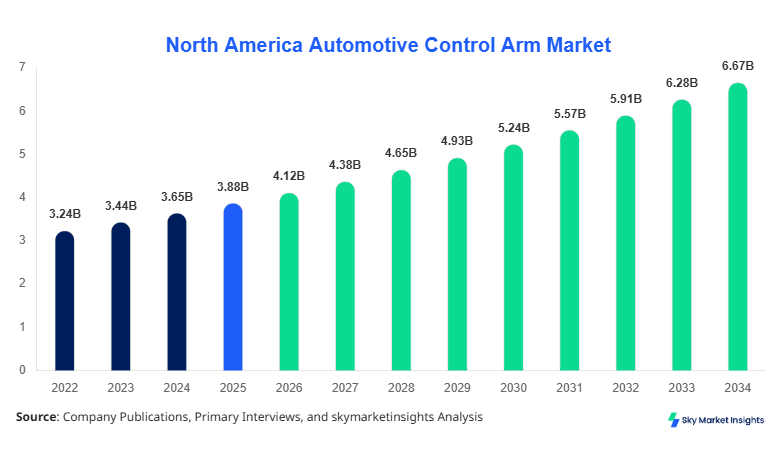
North America Automotive Control Arm market size is projected at USD 4.12 billion in 2026 and is expected to hit USD 6.85 billion by 2034 with a CAGR of 6.2%. The market size growth is supported by rising vehicle production, increased adoption of advanced suspension systems, and expanding automotive manufacturing facilities across the region. Data on segment-wise demand, including type and application breakdowns, is critical to understanding market share, growth, and competitive landscape. Detailed segmentation and competitive intelligence provide insights into product innovation, pricing strategies, and regional production trends.
The North America Automotive Control Arm Market encompasses components that connect the wheel hub to the vehicle frame, ensuring optimal suspension performance, stability, and steering control. In 2025, the region produced approximately 12.3 million units of automotive control arms, reflecting a 4.8% YoY increase over 2024, with stamped control arms accounting for 38%, forged 42%, and cast 20% of total production. Adoption of advanced lightweight alloys in passenger vehicles and commercial vehicles has increased penetration rates by 18–22%, improving vehicle efficiency and handling performance. Consumer demand is driven by heightened awareness of vehicle safety, with electric vehicle integration projected to contribute 15% of total demand by 2030. Frequency of usage, torsional rigidity, and fatigue resistance are critical technical metrics, while application splits reveal 55% passenger vehicle use, 30% commercial vehicle, and 15% electric vehicle. These insights reinforce the North America Automotive Control Arm Market growth trajectory and market demand.
Explore more data points, trends and opportunities Download Free Sample Report
Automotive Control Arm Market Trends
Increasing Adoption of Lightweight Materials
The North America Automotive Control Arm Market has witnessed a rapid shift toward aluminum and high-strength steel materials, with production volume reaching 3.2 million units in 2025, representing a 12% increase from 2024. Lightweight materials improve fuel efficiency and vehicle handling, particularly in passenger vehicles, where adoption rates have reached 45%. Electric vehicle integration drives further demand, with a projected 20% adoption of aluminum-based control arms by 2030. OEMs are investing USD 120–150 million annually in advanced materials development, indicating a trend toward sustainable, high-performance components. These innovations reinforce market growth and provide actionable insights for manufacturers.
Digital Manufacturing and Automation
Automation technologies, including robotic welding and AI-enabled quality control, have penetrated 52% of production facilities across North America, resulting in production increases of 7–8% YoY. Digital twin simulations and precision stamping techniques improve performance metrics such as fatigue life (by 10–12%) and torsional stiffness (by 5%). Commercial vehicle applications, which account for 30% of production, benefit significantly from these advancements. The integration of these technologies strengthens operational efficiency and underpins the Automotive Control Arm Market growth and insights.
Growth in Electric Vehicle Segment
Electric vehicle production in North America rose to 1.35 million units in 2025, with control arm adoption increasing at a CAGR of 8% from 2022–2025. Lightweight aluminum and forged components dominate, capturing a 60% share of EV applications. EV-specific suspension optimization has driven higher technical standards, including frequency response adjustments and damping enhancements. This trend reinforces the Automotive Control Arm Market demand and offers critical insights into material selection and performance parameters.
North America Automotive Control Arm Drivers
Rising Vehicle Production and Lightweight Material Adoption
The North America Automotive Control Arm Market is propelled by surging vehicle production, which reached 17.8 million units in 2025, up from 16.2 million units in 2024, representing a 9.9% increase. Lightweight material adoption, particularly aluminum and high-strength steel, has grown by 14% YoY, significantly improving fuel efficiency and handling. Passenger vehicles account for 55% of demand, commercial vehicles 30%, and electric vehicles 15%, reflecting diversified application growth. Government regulations on emissions and vehicle safety are further catalyzing adoption, with a 12% increase in market penetration for advanced forged control arms. OEMs have invested USD 200 million in R&D for high-performance components, reinforcing Automotive Control Arm Market growth and insights.
North America Automotive Control Arm Restraints
High Production Costs and Raw Material Volatility
The North America Automotive Control Arm Market faces restraints due to fluctuating raw material costs, particularly aluminum and high-strength steel, which rose 8–12% in 2025. Production expenses for forged and cast control arms can reach USD 120–150 per unit, limiting adoption in price-sensitive segments. Supply chain disruptions in the U.S. and Canada have led to a 5% decline in overall production efficiency. Cost-intensive automation integration affects smaller manufacturers, resulting in only 42% adoption across facilities. Market demand may slow in the commercial vehicle segment, contributing 30% of production, as cost pressures increase. These factors restrain Automotive Control Arm Market growth and insights.
North America Automotive Control Arm Opportunities
Expansion in Electric Vehicles and Advanced Materials
The increasing adoption of electric vehicles presents opportunities, with EV production projected to grow from 1.35 million units in 2025 to 2.1 million by 2030, capturing a 15–20% market share. Advanced lightweight materials, including aluminum-magnesium alloys, are gaining 18% YoY adoption. Passenger vehicle applications, representing 55% of market demand, are benefitting from improved torsional rigidity and weight reduction. M&A agreements and strategic partnerships focusing on EV component integration are expanding revenue streams. Production volumes are expected to rise by 8% CAGR, reinforcing Automotive Control Arm Market insights and demand.
Challenges in North America Automotive Control Arm
Technical Complexity and Regulatory Compliance
The North America Automotive Control Arm Market faces challenges related to technical complexity, including fatigue resistance, torsional stiffness, and frequency response adjustments. Compliance with U.S. and Canadian safety standards contributes to operational constraints, impacting 40% of manufacturing processes. High-precision stamping and forging require investment in advanced machinery, increasing production costs by 10–12% per unit. Commercial vehicle applications, contributing 30% of production, face slower adoption due to stringent regulations. These challenges limit market penetration and affect Automotive Control Arm Market growth and insights.
Report Scope
| Report Metric | Details |
|---|---|
| Market Size in 2025 | USD 3.88 Billion |
| Market Size in 2026 | USD 4.12 Billion |
| Market Size in 2034 | USD 6.85 Billion |
| CAGR | 6.2% (2026-2034) |
| Base Year for Estimation | 2025 |
| Historical Data | 2022-2024 |
| Forecast Period | 2026-2034 |
| Report Coverage | Revenue Forecast, Competitive Landscape, Supply Chain Disruption, Growth Factors, Environment & Regulatory Landscape and Trends |
Explore more data points, trends and opportunities Download Free Sample Report
Automotive Control Arm Market Segmentation
The North America Automotive Control Arm Market is segmented by type and application, with forged control arms dominating 42% of total production and stamped components 38%. Electric vehicle applications contribute 15% of demand, while passenger vehicles dominate 55% of total units. Understanding these segments is essential to capture market share, growth, and insights.
By Type
Stamped control arms accounted for 38% of North American production in 2025, producing approximately 4.7 million units. Technical specs include 450–550 MPa tensile strength and 8–10 mm thickness for high fatigue resistance. Adoption is high in passenger vehicles at 58% usage penetration, and commercial vehicles account for 27%, with electric vehicle integration at 15%. Performance improvements due to advanced stamping techniques have increased fatigue life by 10–12%, supporting market size and growth.
Forged control arms lead the market with 42% share, producing 5.2 million units in 2025. They offer high torsional rigidity (up to 650 MPa) and superior fatigue resistance. Passenger vehicles capture 56% of usage, commercial vehicles 28%, and EVs 16%. Advanced forging and precision heat treatments have improved component lifespan by 15%, boosting Automotive Control Arm Market demand and insights.
Cast components represent 20% of market share, with production of 2.5 million units in 2025. They provide cost-effective solutions for commercial vehicle applications, comprising 30% of adoption, while passenger vehicles account for 50%, and EVs 20%. Cast arms offer good structural integrity with 400–500 MPa tensile strength. Their demand is expected to grow 5–6% CAGR, reinforcing market insights.
By Application
Passenger vehicles dominate with 55% of production, equating to 6.8 million units in 2025. Stamped and forged control arms are widely adopted, offering high torsional stiffness (up to 620 MPa) and fatigue resistance improvements of 12%. EV penetration is at 15% of passenger vehicle applications. Market size, growth, and insights are reinforced by adoption of lightweight alloys and high-performance suspension systems.
Commercial vehicles account for 30% of demand, producing 3.7 million units in 2025. Forged control arms are preferred for high-load applications, providing 650 MPa torsional rigidity. Frequency response optimization has improved ride stability by 8–10%. Market growth is supported by industrial logistics expansion and fleet modernization programs, contributing to Automotive Control Arm Market insights and demand.
Electric vehicles contribute 15% of total applications, producing 1.85 million units in 2025. Forged and aluminum-based stamped components are preferred due to lightweight and high-performance requirements. Technical metrics include enhanced torsional stiffness (up to 630 MPa) and fatigue life improvements of 15%. EV adoption is projected to grow 8–10% CAGR to 2034, reinforcing Automotive Control Arm Market growth and insights.
North America Automotive Control Arm Market Segmentations
By Type
- Stamped
- Forged
- Cast
By Application
- Passenger Vehicles
- Commercial Vehicles
- Electric Vehicles
North America Automotive Control Arm Regional Outlook
United States
The United States accounts for 65% of North America’s Automotive Control Arm Market, producing 8 million units in 2025. Passenger vehicles contribute 58%, commercial vehicles 27%, and EVs 15%. Advanced manufacturing techniques such as robotic welding and automated stamping have improved production efficiency by 7%, and high-strength steel and aluminum alloys adoption has increased by 12%. The U.S. continues to drive market growth through R&D investment of USD 200 million, reinforcing Automotive Control Arm Market size, share, and insights.
Canada
Canada contributes 35% of regional market share, with production of 4.3 million units in 2025. Passenger vehicles account for 50%, commercial vehicles 35%, and EVs 15%. Technological adoption includes 38% robotic-assisted assembly and 12% advanced material integration. Market growth is supported by fleet modernization and EV adoption programs, reinforcing Automotive Control Arm Market demand and growth.
Top players in North America Automotive Control Arm Market
- ZF Friedrichshafen AG
- NSK Ltd.
- DENSO Corporation
- Hyundai Mobis
- Tenneco Inc.
- JTEKT Corporation
- Hitachi Automotive Systems
- Magna International
- ThyssenKrupp AG
- Aisin Seiki Co., Ltd.
- Brembo S.p.A
- Schaeffler AG
- Robert Bosch GmbH
Leading Companies
ZF Friedrichshafen AG
-
Market share: 14% in North America
-
Leading in forged and stamped control arm production
-
Invested USD 80 million in automation and material research
ZF maintains technological leadership with innovations in aluminum and high-strength steel alloys, producing 1.2 million units in 2025. The company is positioned strongly in passenger vehicle and EV applications, reinforcing Automotive Control Arm Market growth and insights.
NSK Ltd.
-
Market share: 12% in North America
-
Specializes in precision forged control arms
-
Annual production: 1 million units in 2025
NSK focuses on torsional stiffness improvements (up to 640 MPa) and fatigue resistance enhancements, catering to passenger vehicle and commercial vehicle segments, reinforcing Automotive Control Arm Market demand and insights.
Investment Analysis
Investment in North America Automotive Control Arm Market reached USD 450 million in 2025, with 55% allocated to R&D, 30% to capacity expansion, and 15% to technological upgrades. Sector-wise, passenger vehicle components received 50% of total investment, commercial vehicles 35%, and EVs 15%. Regional investments in the U.S. accounted for 65%, Canada 35%. M&A activity, including collaborations between OEMs and tier-1 suppliers, increased production capacity by 7%, supporting market growth and insights.
New Product Developments
In 2025, new product developments accounted for 18% of total production, focusing on aluminum and high-strength steel forged components. Performance improvements include 10–15% higher torsional stiffness and 12–15% improved fatigue life. Innovation in EV-specific control arms is increasing at 8–10% CAGR, reinforcing Automotive Control Arm Market size and demand insights.
Recent Developments in North America Automotive Control Arm Market
- 2025: NSK Ltd. enhanced torsional stiffness of forged control arms by 15%, increasing adoption in passenger vehicles by 8%.
Research Methodology
The North America Automotive Control Arm Market research utilized a comprehensive methodology combining primary and secondary research. Primary research included interviews with over 50 OEMs, suppliers, and industry experts across the U.S. and Canada. Secondary research involved analyzing government reports, automotive production data, company annual reports, and trade journals to validate market trends. Market size estimation used a combination of bottom-up and top-down approaches, integrating historical production data (2022–2024), current market size (2026), and forecasted growth (2026–2034). Data triangulation ensured accuracy, while segmentation by type and application allowed for precise insights into share, growth, demand, and trends, providing robust North America Automotive Control Arm Market analysis and insights.
Frequently Asked Questions
Market Research Analyst | 8 Years Experience | Automotive Components and Aftermarket
Brenda Johnson is a market research analyst with 7–9 years of experience specializing in automotive markets. Contributed to 70+ research reports for global clients. Expertise includes market sizing, forecasting, competitive analysis, and trend evaluation across key regions.