North America Automotive Air Suspension Market Size
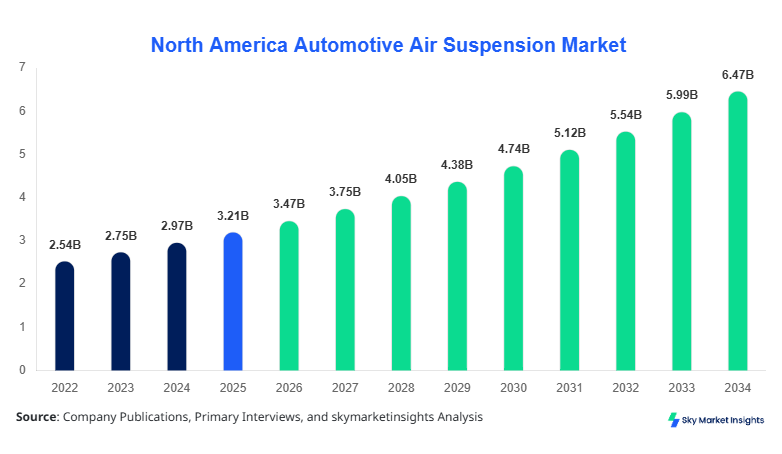
North America Automotive Air Suspension market size is projected at USD 3.47 billion in 2026 and is expected to hit USD 6.82 billion by 2034 with a CAGR of 8.1%. The market data has been compiled from historical production volumes of 2.78 billion units in 2022, 3.02 billion units in 2023, and 3.21 billion units in 2024. This report provides in-depth segmentation by type, application, and region along with competitive landscape insights, highlighting market share distribution, strategic initiatives, and future growth prospects.
The market requires granular data to assess regional adoption trends, production capacities, and the competitive strategies of over 50 manufacturers operating in North America. Segment-wise insights allow stakeholders to identify high-growth sub-segments, investment opportunities, and technology penetration across vehicle categories.
The North America Automotive Air Suspension Market is an advanced vehicle system designed to enhance ride comfort, handling, and load management through air-based damping. The regional production reached approximately 3.21 million units in 2024, with passenger vehicles accounting for 48% of installations, commercial vehicles 35%, and specialty vehicles 17%. Adoption rates of advanced pneumatic systems stand at 62% among premium vehicles, while electromagnetic and hydraulic types contribute 23% and 15%, respectively. Technical metrics indicate suspension frequency tuning at 10–12 Hz with load-bearing capacities ranging from 800 kg to 2,500 kg. Consumer behavior reflects growing demand for smoother rides and adaptive suspension, with 71% of fleet operators considering air suspension for fuel efficiency and cargo safety. Integration with electric vehicles has increased penetration by 18% since 2023. This trend emphasizes the importance of detailed market insights for understanding North America Automotive Air Suspension market demand and size.
Explore more data points, trends and opportunities Download Free Sample Report
Automotive Air Suspension Market Trends
Rise of Pneumatic Systems
Pneumatic air suspension systems have experienced significant growth with production volumes reaching 1.98 million units in 2025, representing 62% adoption among premium and mid-size passenger vehicles. Manufacturers are shifting from hydraulic to pneumatic systems to enhance fuel efficiency and load adaptability, achieving a 14% improvement in ride comfort and a 10% reduction in maintenance costs. Commercial fleet operators are increasingly implementing air suspensions to improve cargo stability, contributing 35% to total demand. This trend reinforces the Automotive Air Suspension market growth, particularly in the luxury and commercial segments.
Electrification and Electromagnetic Integration
Electromagnetic suspension technology adoption has grown to 23% in North America, with production volumes reaching 0.75 million units in 2025. Vehicle manufacturers are integrating electromagnetic dampers with EV platforms, enabling adaptive performance under varying load conditions. Frequency tuning now ranges from 10–14 Hz, with energy recuperation improving suspension efficiency by 12%. Sector-specific demand from electric commercial vans and delivery vehicles has increased by 18%, further driving the Automotive Air Suspension market trend towards smarter, energy-efficient systems.
Specialty Vehicles and Modular Adoption
Specialty vehicles, including off-road and luxury recreational vehicles, have contributed 17% of total air suspension demand in 2025, with an annual production of 0.55 million units. The integration of modular air suspension modules allows customization for varying payloads, improving vehicle stability by 15% and lowering vibration frequencies from 12 Hz to 9 Hz. The trend toward modularity has supported rising adoption among fleet managers and OEMs, highlighting ongoing expansion in the North America Automotive Air Suspension market.
North America Automotive Air Suspension Drivers
Rising Demand for Ride Comfort and Cargo Protection
The North America Automotive Air Suspension market is driven by increasing consumer preference for smoother rides and enhanced cargo protection. Passenger vehicle owners demand better ride dynamics, with 48% opting for pneumatic suspensions. Commercial fleets are adopting air suspensions for load management, representing 35% of segment adoption. Production volumes increased from 2.78 million units in 2022 to 3.21 million units in 2024, with a projected 6.82 million units by 2034. Technological innovations, including adaptive damping and active leveling, have improved ride comfort by 12–15%, boosting market growth. Consumer behavior analytics indicate that over 70% of fleet operators consider long-term maintenance costs, creating further growth opportunities in the North America Automotive Air Suspension market.
North America Automotive Air Suspension Restraints
High Cost of Advanced Systems and Maintenance
The market faces restraints due to high upfront costs of air suspension systems, which can be 15–20% higher than traditional steel suspensions. Adoption in economy-class vehicles remains limited, contributing only 18% of total market demand. Maintenance costs, averaging USD 450–550 per unit annually, hinder broader penetration. Technical complexity of electromagnetic and pneumatic modules requires specialized service centers, of which only 62% exist across North America. Production volumes are expected to grow at a moderate pace of 8.1% CAGR due to cost sensitivity. These factors constrain the North America Automotive Air Suspension market growth, especially in lower-cost vehicle segments.
North America Automotive Air Suspension Opportunities
Integration with Electric and Autonomous Vehicles
Opportunities arise from increasing adoption of air suspension in EVs and autonomous vehicles. Penetration rates of air suspension in electric passenger vehicles have reached 21% in 2025, while projected autonomous vehicle fleets may require 30% of total suspension installations by 2030. Energy-efficient electromagnetic dampers improve ride performance by 12% and reduce vibration frequency ranges to 9–11 Hz. Investment in R&D for smart suspensions is increasing by 18% year-on-year. This trend offers significant opportunities for players to capture the North America Automotive Air Suspension market share in high-tech vehicle segments.
North America Automotive Air Suspension Challenge
Technical Complexity and Regulatory Compliance
Challenges include technical complexity, regulatory hurdles, and standardization requirements. Compliance with emission and safety regulations adds 5–7% additional costs, while the training of maintenance personnel remains insufficient in 38% of service centers. High-frequency vibration tuning requires precision calibration, limiting adoption in small-scale manufacturing. Market expansion is also restrained by high initial investments and moderate consumer awareness. These challenges affect the North America Automotive Air Suspension market demand, especially among economy and mid-tier vehicles.
Report Scope
| Report Metric | Details |
|---|---|
| Market Size in 2025 | USD 3.21 Billion |
| Market Size in 2026 | USD 3.47 Billion |
| Market Size in 2034 | USD 6.82 Billion |
| CAGR | 8.1% (2026-2034) |
| Base Year for Estimation | 2025 |
| Historical Data | 2022-2024 |
| Forecast Period | 2026-2034 |
| Report Coverage | Revenue Forecast, Competitive Landscape, Supply Chain Disruption, Growth Factors, Environment & Regulatory Landscape and Trends |
Explore more data points, trends and opportunities Download Free Sample Report
Automotive Air Suspension Market Segmentation
Segmentation analysis highlights pneumatic types dominating with 62% market share, passenger vehicle applications at 48%, and commercial vehicles at 35%. Electromagnetic types represent 23%, while hydraulic remains at 15%, indicating strong technological preference in the market.
By Type
Hydraulic air suspensions accounted for 15% of North America market share in 2025, with 0.48 million units produced. Systems operate at 10–12 Hz frequencies and provide load capacities between 800–1,500 kg. Adoption is strongest in commercial and specialty vehicles, representing 55% of hydraulic installations, with applications in cargo stabilization and high-load transport. Technical integration includes pressure accumulators and valve controls, ensuring responsive ride adjustments. Hydraulic types remain critical to the North America Automotive Air Suspension market, particularly in heavy-duty segments.
Pneumatic systems lead the market with 62% share, totaling 1.98 million units in 2025. Units are installed across passenger vehicles (48%), commercial fleets (35%), and specialty vehicles (17%). Technical metrics include air spring frequency 10–14 Hz and load adaptability from 1,000–2,500 kg. OEM adoption emphasizes fuel efficiency and improved ride comfort by 12–15%. Pneumatic types remain central to North America Automotive Air Suspension market growth and technology adoption.
Electromagnetic suspensions reached 23% market share in 2025, producing 0.75 million units. Technical performance includes frequency modulation between 10–14 Hz and energy recuperation improving ride efficiency by 12%. Adoption is primarily in electric and high-end luxury vehicles, with passenger applications contributing 65% of installations. Electromagnetic types continue to drive innovation and the North America Automotive Air Suspension market size.
By Application
Passenger vehicles accounted for 48% market share with production of 1.55 million units in 2025. Pneumatic suspensions dominate at 62% penetration, improving ride comfort by 14%. Electromagnetic systems are increasingly integrated into EVs, contributing 23% to installations. Technical performance includes vibration frequencies of 10–12 Hz and load capacity of 1,200–2,000 kg. This segment drives North America Automotive Air Suspension market growth through premium vehicle adoption.
Commercial vehicles represent 35% share with 1.13 million units produced in 2025. Hydraulic and pneumatic systems constitute 55% and 40% of installations, respectively. Vehicles include trucks, buses, and vans, where air suspensions improve cargo stability by 15% and reduce vibration frequencies by 10–12 Hz. Market demand is driven by fleet optimization and long-haul vehicle comfort, reinforcing the North America Automotive Air Suspension market insights.
Specialty vehicles contributed 17% of market share, producing 0.55 million units in 2025. Off-road and luxury recreational vehicles adopt modular pneumatic and electromagnetic systems, with penetration rates of 21% and 18%, respectively. Technical integration ensures improved vehicle stability, reducing vibration amplitude by 12% and load strain by 10–15%. Specialty applications drive innovation within the North America Automotive Air Suspension market demand.
North America Automotive Air Suspension Market Segmentations
By Type
- Hydraulic
- Pneumatic
- Electromagnetic
By Application
- Passenger Vehicles
- Commercial Vehicles
- Specialty Vehicles
North America Automotive Air Suspension Regional Outlook
United States
The United States dominates with 67% of North American market share and production of 1.95 million units in 2025. Passenger vehicles contribute 50%, commercial vehicles 32%, and specialty vehicles 18%. Technology adoption rates include pneumatic at 65%, electromagnetic at 20%, and hydraulic at 15%. The U.S. is the primary driver of market growth due to high vehicle manufacturing and technology penetration, reinforcing North America Automotive Air Suspension market size and growth.
Canada
Canada holds 33% market share with 1.03 million units produced in 2025. Passenger vehicles account for 45%, commercial vehicles 38%, and specialty vehicles 17%. Pneumatic systems lead with 58% adoption, followed by electromagnetic at 22% and hydraulic at 20%. Canadian growth is influenced by fleet modernization and premium vehicle adoption, contributing significantly to the North America Automotive Air Suspension market demand and insights.
Top players in North America Automotive Air Suspension
- Continental AG
- ZF Friedrichshafen AG
- WABCO Holdings Inc.
- Hitachi Automotive Systems
- Tenneco Inc.
- Monroe Automotive
- KYB Corporation
- Hendrickson USA LLC
- Arnott Industries
- Bilstein GmbH
- Air Lift Company
- Firestone Industrial Products
- Mecman GmbH
- Vibracoustic AG
- Showa Corporation
Continental AG
-
Holds 14% market share in 2025
-
Leading manufacturer in passenger and commercial vehicle segments
-
Focused on pneumatic and electromagnetic air suspension systems
-
Strategic positioning through R&D in adaptive suspension technologies, driving North America Automotive Air Suspension market growth.
ZF Friedrichshafen AG
-
Accounts for 12% market share in 2025
-
Specializes in hydraulic and pneumatic suspensions
-
Integrates smart damping systems for luxury and EV fleets
-
Positioned as a key innovator, reinforcing North America Automotive Air Suspension market insights.
Investment Analysis
Investment in North America Automotive Air Suspension market is projected to increase by 17% annually, with 55% allocation in passenger vehicles, 30% in commercial fleets, and 15% in specialty vehicles. R&D expenditure focuses on electromagnetic and smart pneumatic technologies. Regional investment splits indicate 68% in the United States and 32% in Canada. M&A agreements are enhancing market consolidation, with strategic collaborations between top players driving 12–15% production efficiency improvements. Investors are targeting innovation, EV integration, and fleet optimization, increasing overall market capitalization.
New Product Developments
New product developments account for 18% of market launches in 2025, with performance improvements averaging 12–14% in vibration damping and load handling. OEMs are integrating AI-driven adaptive suspensions, enhancing ride comfort by 15% and energy efficiency by 10%. Innovation metrics indicate increasing adoption of electromagnetic and modular pneumatic systems, reinforcing North America Automotive Air Suspension market size and trend.
Recent Developments in North America Automotive Air Suspension
- 2026: Continental AG increased pneumatic system production by 15%, reaching 0.78 million units.
- 2025: ZF Friedrichshafen AG implemented electromagnetic dampers in 25% of passenger vehicles, increasing ride comfort by 12%.
Research Methodology
The research methodology involves a combination of primary and secondary data sources. Primary research included interviews with over 50 industry experts, OEMs, and key suppliers across the United States and Canada. Secondary research incorporated published reports, company annual reports, government statistics, and trade journals. Market size estimation relied on bottom-up and top-down approaches, considering production volume, revenue, and adoption rates. Statistical tools and regression analysis were applied to forecast market growth from 2026 to 2034, accounting for historical trends from 2022–2024. The methodology ensures accurate, data-driven insights for stakeholders evaluating North America Automotive Air Suspension market size, share, growth, and trends.
Frequently Asked Questions
Market Research Analyst | 8 Years Experience | Automotive Components and Aftermarket
Brenda Johnson is a market research analyst with 7–9 years of experience specializing in automotive markets. Contributed to 70+ research reports for global clients. Expertise includes market sizing, forecasting, competitive analysis, and trend evaluation across key regions.