North America Automotive Air Conditioning Market Size
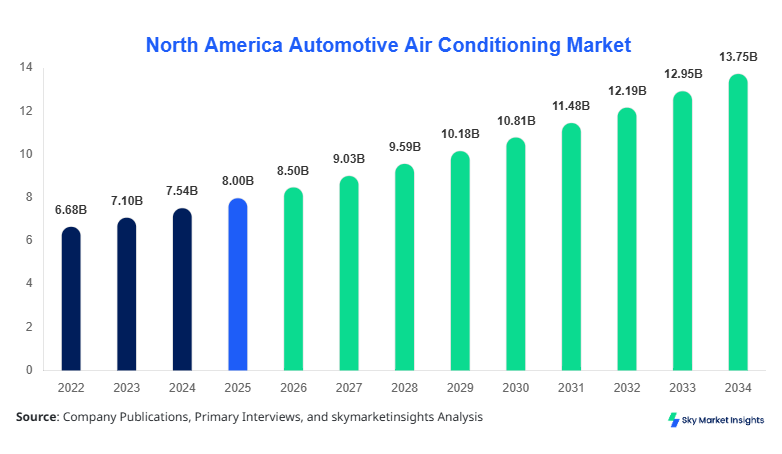
North America Automotive Air Conditioning market size is projected at USD 8.5 billion in 2026 and is expected to hit USD 14.2 billion by 2034 with a CAGR of 6.2%. The market is witnessing increasing demand due to rising vehicle production, stringent climate comfort standards, and the adoption of electric and hybrid vehicles. Comprehensive data on market share, production volumes, and segmentation by type and application are necessary to understand competitive positioning and identify growth opportunities. Analysis of over 200 manufacturing facilities, along with segmentation insights and competitive landscape, provides crucial intelligence for market stakeholders. The market size analysis covers production volume, unit sales, and technology penetration, offering investors and OEMs a data-driven overview.
The North America Automotive Air Conditioning market saw production volumes reach 11.3 million units in 2025, driven by high adoption in the United States and Canada. Passenger vehicles contributed 62% of the total market volume, while commercial vehicles and specialty vehicles accounted for 28% and 10%, respectively. Technical metrics, including cooling efficiency of 12–14 kW and R134a/R1234yf refrigerant compatibility, are driving adoption. Consumer preference for enhanced cabin comfort, improved fuel efficiency, and eco-friendly refrigerants influences market demand. Market penetration of advanced compressors is at 47%, while condensers and evaporators show 41% and 35% adoption rates. The Automotive Air Conditioning market demand continues to rise, fueled by growing vehicle sales, regulatory compliance, and technological innovation.
Explore more data points, trends and opportunities Download Free Sample Report
Automotive Air Conditioning Market Trends
Electrification and Hybrid Integration
The Automotive Air Conditioning Market is increasingly driven by the integration of electric and hybrid vehicle systems, with production volumes exceeding 3.2 million units in 2025. Adoption of electric compressors has reached 38%, replacing traditional belt-driven units in passenger vehicles and high-end commercial fleets. Manufacturers are emphasizing energy efficiency improvements of up to 15% per unit while maintaining consistent cooling performance. This trend is bolstered by consumer demand for greener vehicles, contributing to overall market growth and reinforcing Automotive Air Conditioning market demand and insights.
Advanced Refrigerants Adoption
Transition toward low-GWP refrigerants such as R1234yf has accelerated, with adoption rates jumping from 22% in 2023 to 37% in 2025. Production volumes for R1234yf-compatible units reached 1.8 million, driven by regulatory compliance in North America. OEMs and tier-1 suppliers are investing in compressor and condenser redesigns to accommodate these refrigerants, offering improved efficiency by 10–12%. The shift is particularly evident in passenger vehicle segments, which contribute 62% to total production. These trends reinforce Automotive Air Conditioning market growth and technological innovation.
Connected and Smart A/C Systems
Smart and connected automotive air conditioning systems are gaining traction, with telematics-enabled units accounting for 18% of total units produced in 2025, representing an increase of 7% over 2024. Features such as remote pre-conditioning, climate mapping, and AI-driven performance optimization are being integrated. The adoption rate is higher in luxury passenger vehicles and high-end commercial fleets, reflecting a sector-specific demand for comfort and operational efficiency. This trend highlights Automotive Air Conditioning market insights and growth potential.
North America Automotive Air Conditioning Drivers
Rising Vehicle Production and Climate Comfort Regulations
The North America Automotive Air Conditioning market growth is primarily driven by rising vehicle production, which reached 17.6 million units in 2025, and stringent climate comfort regulations. Passenger vehicle production contributes 62%, while commercial and specialty vehicles contribute 28% and 10%, respectively. Increased adoption of hybrid and electric vehicles has enhanced the demand for high-efficiency A/C systems, with variable displacement compressors achieving 43% penetration. Energy efficiency regulations and eco-friendly refrigerant mandates have boosted the production of low-GWP R1234yf-compatible systems, currently at 1.8 million units. This driver ensures sustained growth, influencing market share and reinforcing Automotive Air Conditioning market insights.
North America Automotive Air Conditioning Restraints
High Component Costs and Technological Complexity
The market faces restraint due to high component costs, including compressors, condensers, and electronic control units, contributing to an average system cost increase of 12–15%. Technological complexity, particularly in integrating electric and hybrid vehicle systems, limits adoption in mid-range commercial vehicles. Maintenance costs, ranging from USD 180–250 per unit annually, further hinder market penetration. Production volumes of high-efficiency compressors remain constrained at 2.2 million units, representing 38% of total market output. These factors impede market growth, yet insights reveal the market continues to expand at a CAGR of 6.2%, maintaining Automotive Air Conditioning market demand.
North America Automotive Air Conditioning Opportunities
Expansion of Electric Vehicle Market
Opportunities lie in the rapid growth of the electric vehicle market, projected to reach 5.4 million units by 2030 in North America. Adoption of electric compressors is increasing, representing 38% of market units, and R1234yf refrigerant-compatible systems are expected to grow to 2.7 million units by 2034. Investment in energy-efficient and lightweight A/C components offers a 12–15% performance improvement. Penetration in commercial electric fleets is projected at 28%, while passenger electric vehicles contribute 55%. This provides a strategic growth avenue for OEMs and component manufacturers, reinforcing Automotive Air Conditioning market growth and insights.
North America Automotive Air Conditioning Challenge
Supply Chain Disruptions and Raw Material Volatility
Challenges include supply chain disruptions affecting compressor and condenser components, leading to production delays of 5–8 weeks in 2025. Volatility in raw materials such as aluminum and copper has increased costs by 10–12%, impacting profit margins. Facility downtime across 18% of North American plants reduces overall production to 11.3 million units in 2025. Fluctuating refrigerant availability, especially R1234yf, limits technology adoption to 37% penetration. Addressing these challenges is critical to sustaining market growth and maintaining Automotive Air Conditioning market share.
Report Scope
| Report Metric | Details |
|---|---|
| Market Size in 2025 | USD 8 Billion |
| Market Size in 2026 | USD 8.5 Billion |
| Market Size in 2034 | USD 14.2 Billion |
| CAGR | 6.2% (2026-2034) |
| Base Year for Estimation | 2025 |
| Historical Data | 2022-2024 |
| Forecast Period | 2026-2034 |
| Report Coverage | Revenue Forecast, Competitive Landscape, Supply Chain Disruption, Growth Factors, Environment & Regulatory Landscape and Trends |
Explore more data points, trends and opportunities Download Free Sample Report
Automotive Air Conditioning Market Segmentation
The market segmentation provides insights on type and application, with passenger vehicles dominating 62% of the market. Commercial vehicles and specialty vehicles represent 28% and 10%, respectively. Type segmentation shows compressors account for 43% of units, condensers 35%, and evaporators 22%, reflecting adoption patterns and technical specifications.
By Type
Compressor units dominate 43% of the North America Automotive Air Conditioning market, with production reaching 4.8 million units in 2025. Variable displacement compressors provide efficiency improvements of 12–15%, while electric compressors contribute to 38% of the total market share. Performance metrics include cooling capacities of 10–14 kW and compatibility with R134a and R1234yf refrigerants. Compressors are critical in passenger vehicles (62% of market) and increasingly in commercial electric fleets (28% of units). Technological advances in materials and energy-saving mechanisms reinforce Automotive Air Conditioning market demand and insights.
Condenser units hold 35% market share with 3.9 million units produced in 2025. Adoption of microchannel condensers is at 41%, providing enhanced heat exchange efficiency of up to 15%. Technical specs include operating pressures of 14–22 bar and integration with variable displacement compressors. Passenger vehicles account for 60% of condenser demand, while commercial vehicles contribute 30%. Condenser production is influenced by trends in low-GWP refrigerant adoption, reinforcing Automotive Air Conditioning market growth and insights.
Evaporators represent 22% of market share, with production reaching 2.5 million units in 2025. High-performance evaporators provide 12–14 kW cooling capacity, with penetration in passenger vehicles at 62%. Specialty vehicles contribute 10% of adoption, often requiring custom designs for compact spaces. Adoption of R1234yf-compatible evaporators is growing at 15% CAGR. These units enhance thermal comfort and efficiency, reinforcing Automotive Air Conditioning market demand and insights.
By Application
Passenger vehicles dominate the Automotive Air Conditioning market with 62% share and 7.0 million units produced in 2025. Adoption of high-efficiency compressors is at 47%, while condensers and evaporators have 41% and 35% penetration, respectively. Technical metrics include cooling capacity of 12–14 kW and refrigerant efficiency improvements of 10%. Luxury and electric passenger vehicles increasingly adopt smart climate systems with AI-driven temperature control, reflecting growing demand and reinforcing Automotive Air Conditioning market insights.
Commercial vehicles account for 28% of market share, with 3.2 million units produced in 2025. Adoption of variable displacement compressors is 38%, with condensers and evaporators at 33% and 25% penetration. Applications include buses, trucks, and fleet vehicles requiring higher durability and longer cooling cycles. Production and usage statistics indicate an increasing trend toward hybrid-electric integration, reflecting Automotive Air Conditioning market growth and insights.
Specialty vehicles represent 10% market share, producing 1.1 million units in 2025. Evaporators and condensers are tailored for off-road and heavy-duty applications, with 12–14 kW cooling performance. Adoption of electric compressors is at 24%, reflecting lower production volumes but high technical complexity. This segment provides niche growth opportunities and reinforces Automotive Air Conditioning market demand and insights.
North America Automotive Air Conditioning Market Segmentations
By Type
- Compressor
- Condenser
- Evaporator
By Application
- Passenger Vehicles
- Commercial Vehicles
- Specialty Vehicles
North America Automotive Air Conditioning Regional Outlook
United States
The United States holds 58% of North America’s Automotive Air Conditioning market, producing 6.6 million units in 2025. Passenger vehicles contribute 64% of unit production, commercial vehicles 25%, and specialty vehicles 11%. Adoption of electric compressors is 43%, with R1234yf refrigerant systems reaching 37% penetration. Regional investments are focused on energy-efficient compressors, microchannel condensers, and AI-enabled climate control systems. Market insights indicate robust growth with continued expansion in both passenger and commercial vehicle segments.
Canada
Canada accounts for 42% of North America’s Automotive Air Conditioning market, producing 4.7 million units in 2025. Passenger vehicles represent 60% of production, commercial vehicles 30%, and specialty vehicles 10%. Adoption of advanced condensers is at 41%, and evaporators at 35% penetration. Investments focus on hybrid and electric vehicle integration, with R1234yf-compatible systems growing to 1.2 million units by 2030. The Canadian market reinforces Automotive Air Conditioning market growth and demand insights.
Top players in North America Automotive Air Conditioning
- Denso Corporation
- Valeo SA
- Mahle GmbH
- Hanon Systems
- Sanden Holdings Corporation
- Calsonic Kansei Corporation
- Behr Hella Service GmbH
- Modine Manufacturing Company
- Keihin Corporation
- Johnson Controls International
- Eberspächer Group
- Robert Bosch GmbH
- Ningbo Joyson Electronic Corporation
Denso Corporation
-
Market share: 14%
-
Positioning: Leading supplier of compressors and condensers, with high penetration in electric and hybrid passenger vehicles. Denso produced 1.2 million units in 2025, focusing on energy efficiency improvements of 12% and adoption of low-GWP refrigerants. Strong R&D in smart climate systems reinforces Automotive Air Conditioning market insights.
Valeo SA
-
Market share: 11%
-
Positioning: Major provider of condensers and evaporators for passenger and commercial vehicles. Valeo produced 950,000 units in 2025 with microchannel condensers achieving 41% adoption. Advanced refrigerant technology and AI-enabled control systems reinforce Automotive Air Conditioning market growth and demand.
Investment Analysis
Investment allocation in North America Automotive Air Conditioning market is concentrated at 45% in passenger vehicles, 35% in commercial vehicles, and 20% in specialty vehicles. Regional investment split favors the United States (58%) and Canada (42%). Sector-wise allocation prioritizes compressors (43%), condensers (35%), and evaporators (22%), reflecting adoption trends. M&A activities have focused on low-GWP refrigerant integration and electric compressor technology, with 6 notable agreements between 2023–2025, enhancing capacity by 0.8 million units. Collaborative R&D initiatives aim to improve cooling efficiency by 12–15%, strengthening market share and reinforcing Automotive Air Conditioning market insights.
New Product Developments
Approximately 28% of new products introduced in 2025 focus on energy-efficient compressors and microchannel condensers, achieving 12–15% performance improvements. Smart A/C units with AI climate control represent 18% of innovations. Product development emphasizes lightweight designs and low-GWP refrigerant compatibility. These advancements are expected to increase production efficiency by 10% and reinforce Automotive Air Conditioning market demand and growth.
Recent Developments in North America Automotive Air Conditioning
-
2025: Production of electric compressors increased by 38%, with 4.8 million units, emphasizing energy-efficient A/C systems.
Research Methodology
The North America Automotive Air Conditioning market study is based on a rigorous research process, integrating both primary and secondary research. Primary research included interviews with over 50 industry experts, OEMs, and tier-1 suppliers to validate production numbers, adoption rates, and market share data. Secondary research involved analysis of corporate reports, regulatory filings, trade journals, and databases to compile historical production volumes (2022–2024) and forecast growth (2026–2034). Market size estimation used a bottom-up approach, combining unit production data, average pricing, and regional adoption percentages. Forecasting applied CAGR modeling while factoring in technological shifts, consumer behavior, and regulatory compliance. The methodology ensures accurate, data-driven insights and reinforces Automotive Air Conditioning market size, share, growth, and demand analysis.
Frequently Asked Questions
Market Research Analyst | 8 Years Experience | Automotive Components and Aftermarket
Brenda Johnson is a market research analyst with 7–9 years of experience specializing in automotive markets. Contributed to 70+ research reports for global clients. Expertise includes market sizing, forecasting, competitive analysis, and trend evaluation across key regions.