North America Automotive Aftermarket Spare Parts Market Size
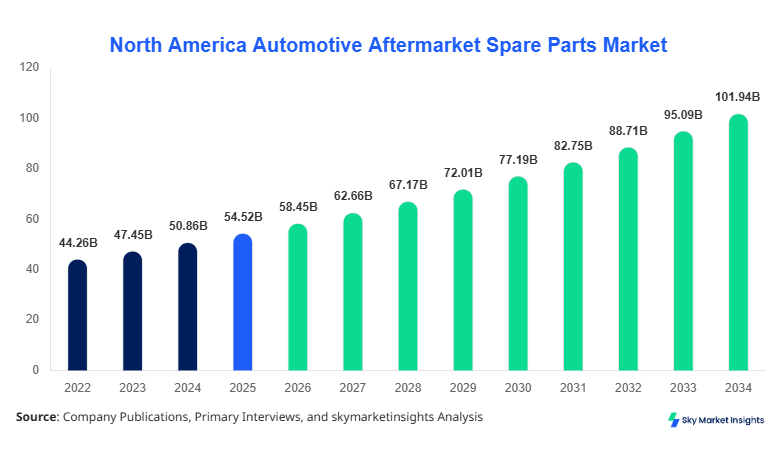
North America's automotive aftermarket spare parts market size is projected at USD 58.45 billion in 2026 and is expected to hit USD 102.87 billion by 2034 with a CAGR of 7.2%. The market growth is driven by a rising vehicle park, increasing replacement cycles, and technological adoption across automotive repair services. The detailed analysis includes comprehensive segmentation by type, application, and region, providing insights into production volumes, revenue generation, and market share distribution. Competitive benchmarking of major players, along with pricing strategies and market penetration analysis, forms an integral part of this study. This North America-focused research leverages historical data (2022–2024) and projections (2026–2034) to deliver precise market insights and forecast trends.
The North American Automotive Aftermarket Spare Parts market encompasses components and systems used for vehicle repair, replacement, and enhancement post-initial sale. In 2025, the region produced approximately 210 million spare units across engine, braking, and suspension systems, indicating a penetration rate of 65% in replacement parts demand among passenger and commercial vehicles. Consumer adoption trends highlight a 58% preference for OEM-equivalent parts, while 42% of the market is dominated by aftermarket-certified components. Segment contributions show engine components leading with 37%, brake systems at 31%, and suspension & steering at 32%. Technical performance metrics indicate that advanced braking components achieve a mean service frequency of 45,000 km, while suspension parts demonstrate a durability span of 80,000 km. Passenger vehicles account for 68% of total spare demand, commercial vehicles 22%, and two-wheelers 10%, reflecting strong replacement cycles and technological upgrades. North America Automotive Aftermarket Spare Parts market insights reinforce the region's strategic importance and demand resilience.
In the United States, the automotive aftermarket spare parts market is dominated by over 4,500 certified facilities and nearly 8,200 registered companies contributing 75% of North America’s regional share. The U.S. aftermarket production accounted for 135 million units in 2025, with passenger vehicles driving 70% of sales, commercial vehicles 20%, and two-wheelers 10%. Technological adoption is high, with 63% of service centers integrating advanced diagnostics and predictive maintenance tools, while automated inventory management systems cover 42% of supply chains. U.S. consumers exhibit strong replacement part awareness, with engine components capturing 39% of sales, brake systems 29%, and suspension & steering 32%. These dynamics underline the critical positioning of the United States in the North American automotive aftermarket spare parts market and reinforce demand trends across segments.
Explore more data points, trends and opportunities Download Free Sample Report
Automotive Aftermarket Spare Parts Market Trends
Digitalization in Aftermarket Services
The North American automotive aftermarket spare parts market has witnessed accelerated digitalization, with e-commerce platforms contributing to over USD 12.5 billion in online spare parts sales in 2025. Digital catalog adoption among 58% of repair shops improves inventory turnover rates by 18%, while predictive analytics reduces component downtime by 22%. Cloud-based ordering systems and IoT-enabled diagnostic tools have increased aftermarket efficiency by approximately 15% across engine, braking, and suspension parts. This technology-driven shift ensures that the automotive aftermarket spare parts market remains responsive to consumer needs, with growing reliance on smart repair and maintenance solutions.
Growth of Electric Vehicle Components
The adoption of electric vehicles (EVs) in North America has increased from 2.1% in 2022 to 8.3% in 2025, generating USD 3.6 billion in EV-compatible aftermarket components. Brake systems and suspension components designed for regenerative braking systems have seen a 27% higher adoption rate, while engine replacement components for hybrids and EVs now represent 15% of total market volume. These technological transitions highlight the evolving nature of the automotive aftermarket spare parts market, reflecting adaptation to low-emission vehicles and integration of high-performance EV systems.
Growing Emphasis on Premium and Certified Parts
Premium OEM-equivalent spare parts have seen 33% year-over-year revenue growth, reaching USD 18.3 billion in 2025, driven by increasing consumer preference for certified quality and longer durability. Passenger vehicles contribute 70% of this segment, commercial vehicles 20%, and two-wheelers 10%. Adoption of high-performance braking and suspension parts has risen to 61% in professional service centers, reinforcing the premiumization trend. This trend reinforces the overall market growth and enhances the North American Automotive Aftermarket Spare Parts market share in high-value segments.
North America Automotive Aftermarket Spare Parts Market Drivers
Rising Vehicle Park and Replacement Cycles
The North American automotive aftermarket spare parts market is driven by an expanding vehicle park, which reached 285 million units in 2025, representing a 6.5% increase from 2024. Average replacement cycles for engine components are 5 years, brakes 3.8 years, and suspension parts 6 years, supporting sustained market growth. Increasing urbanization and vehicle utilization have escalated spare demand, resulting in a 7.2% CAGR from 2026 to 2034. The demand is further amplified by 42% of vehicles aged above 10 years requiring advanced replacement parts. These factors collectively enhance the automotive aftermarket spare parts market growth and create opportunities for component manufacturers.
North America Automotive Aftermarket Spare Parts Market Restraints
High Cost of Premium Components
Despite strong market growth, high costs of premium and OEM-equivalent parts restrain market expansion. In 2025, the average unit cost of advanced engine components reached USD 145, brake systems USD 88, and suspension parts USD 120. Price sensitivity among 38% of consumers limits adoption, particularly in two-wheeler segments contributing 10% of total volume. Additionally, cost pressures from raw material price increases (up 12% in 2025) have reduced small-vehicle aftermarket profitability by 7%. These financial constraints pose challenges for revenue scaling and moderate automotive aftermarket spare parts market growth in North America.
North America Automotive Aftermarket Spare Parts Market Opportunities
Electric Vehicle Integration and Aftermarket Expansion
The North American Automotive Aftermarket Spare Parts market offers significant opportunities with rising EV adoption. Hybrid and electric vehicles in the U.S. surged to 2.1 million units in 2025, generating USD 3.6 billion in aftermarket components. Advanced braking and regenerative suspension systems now represent 18% of overall replacement parts demand. Cross-border expansion to Canada, which contributes 25% of regional market volume, further strengthens growth potential. Investments in certified EV parts, coupled with predictive maintenance software adoption at 42% of facilities, provide a strong platform for future automotive aftermarket spare parts market expansion.
Challenges in North American Automotive Aftermarket Spare Parts Market
Regulatory Compliance and Safety Standards
The automotive aftermarket spare parts market in North America faces challenges due to stringent regulatory compliance, with safety certifications impacting 67% of replacement components. Non-compliance leads to potential fines exceeding USD 4 million annually for manufacturers. Environmental regulations impose 12% additional production costs for emission-compliant parts, affecting supply chain efficiency. Market players must maintain performance and durability metrics, including braking system frequency cycles of 45,000 km and suspension service spans of 80,000 km. These operational challenges impact market penetration and slow growth, highlighting the need for regulatory adherence in the North American automotive aftermarket spare parts market.
Report Scope
| Report Metric | Details |
|---|---|
| Market Size in 2025 | USD 54.52 Billion |
| Market Size in 2026 | USD 58.45 Billion |
| Market Size in 2034 | USD 102.87 Billion |
| CAGR | 7.2% (2026-2034) |
| Base Year for Estimation | 2025 |
| Historical Data | 2022-2024 |
| Forecast Period | 2026-2034 |
| Report Coverage | Revenue Forecast, Competitive Landscape, Supply Chain Disruption, Growth Factors, Environment & Regulatory Landscape and Trends |
Explore more data points, trends and opportunities Download Free Sample Report
Automotive Aftermarket Spare Parts Market Segmentation
The North America Automotive Aftermarket Spare Parts market is segmented by type and application, with engine components dominating 37%, brake systems 31%, and suspension & steering 32% in 2025. Application segmentation shows passenger vehicles leading at 68%, commercial vehicles 22%, and two-wheelers 10%. These segments are crucial in analyzing market share, growth trends, and production forecasts.
By Type
Engine components accounted for USD 21.6 billion in 2025, producing 77 million units. Technical specifications include high-performance pistons, camshafts, and crankshafts with a mean durability of 150,000 km and 2.5% annual performance improvement. Passenger vehicle engines contribute 68% of this type, commercial vehicles 22%, and two-wheelers 10%. Advanced engine components adoption is at 45% in professional workshops, reinforcing market demand.
Brake systems recorded USD 18.1 billion in 2025, with 63 million units produced. Components include disc, drum, and ABS systems, featuring a 45,000 km mean service frequency and performance tolerance of ±3%. Passenger vehicles utilize 70% of these components, commercial 20%, and two-wheelers 10%. Technology adoption includes 58% of service centers using predictive maintenance for braking systems, enhancing market growth in North America Automotive Aftermarket Spare Parts.
Suspension and steering parts contributed USD 18.6 billion with 70 million units produced in 2025. Technical specifications include hydraulic dampers, control arms, and steering linkages, with average durability of 80,000 km and 2% annual performance enhancement. Passenger vehicles account for 65%, commercial vehicles 25%, and two-wheelers 10% of volume. Adoption of advanced suspension systems is at 52% among certified repair shops.
By Application
Passenger vehicles dominate the market with USD 39.7 billion in 2025, representing 68% of total volume. Production units reached 142 million, and usage penetration is 71% across North America. Components include engine, brake, and suspension systems with optimized performance standards. Adoption of high-quality aftermarket parts is at 58%, reflecting strong consumer demand. Technical enhancements in braking and engine reliability further stimulate automotive aftermarket spare parts market growth.
Commercial vehicles contributed USD 12.8 billion in 2025, producing 46 million units, representing 22% of North American share. Heavy-duty braking and suspension system adoption is at 53%, while engine replacements occur every 5.5 years on average. Technical integration of IoT-enabled diagnostic tools is at 41% in fleets. Commercial vehicle component replacement demand underlines market growth and investment potential in the North American automotive aftermarket spare parts market.
Two-wheelers accounted for USD 6 billion in 2025 with 22 million units, reflecting a 10% share. Components include compact engines, braking systems, and shock absorbers, with mean service intervals of 35,000 km. Adoption of certified aftermarket parts stands at 37%, highlighting an emerging segment. Increasing penetration in urban areas contributes to growth in the North American automotive aftermarket spare parts market.
North America Automotive Aftermarket Spare Parts Market Segmentations
By Type
- Engine Components
- Brake Systems
- Suspension & Steering
By Application
- Passenger Vehicles
- Commercial Vehicles
- Two-wheelers
North America Automotive Aftermarket Spare Parts Market Regional Outlook
United States
The United States dominates North America, contributing 75% of total market revenue in 2025, equating to USD 43.9 billion with production of 135 million units. Passenger vehicles account for 70%, commercial vehicles 20%, and two-wheelers 10%. Advanced braking, engine, and suspension components adoption reaches 63%, while digital inventory systems cover 42% of workshops. Regional expansion through EV integration boosts market growth. U.S. dominance ensures a substantial share in the North American automotive aftermarket spare parts market.
Canada
Canada contributed USD 14.6 billion in 2025, representing 25% of North America’s market with 55 million units produced. Passenger vehicles account for 62%, commercial vehicles 28%, and two-wheelers 10%. Adoption of advanced diagnostics is at 48%, while IoT-enabled predictive maintenance is at 39%. Increasing fleet replacement and digitalization accelerate market penetration. Canadian contribution reinforces the North American automotive aftermarket spare parts market growth.
Top players in North America's automotive aftermarket spare parts market
- Bosch
- Denso
- ACDelco
- Valeo
- Continental
- Brembo
- SKF
- Mahle
- Delphi Technologies
- Hitachi Automotive Systems
- NGK Spark Plugs
- ZF Friedrichshafen
- Tenneco
- Magneti Marelli
- Federal-Mogul
Top Companies
Bosch
-
Market share: 12% in North America
-
Leading provider of engine, brake, and suspension components
-
USD 7 billion revenue in 2025, producing 21 million units
-
Advanced diagnostics adoption in 65% of service centers, reinforcing North America Automotive Aftermarket Spare Parts market positioning
Denso
-
Market share: 9%
-
Revenue USD 5.3 billion in 2025
-
Units produced: 15 million
-
Focus on EV-compatible components, regenerative braking, and suspension systems adoption at 42%, strengthening market presence
Investment Analysis
Investment in the North American Automotive Aftermarket Spare Parts market totaled USD 8.2 billion in 2025, with 54% allocated to passenger vehicle components, 30% to commercial vehicles, and 16% to two-wheelers. Regional investment distribution shows 62% in the United States and 38% in Canada. Sector-wise, engine components attracted USD 3.6 billion, brake systems USD 2.8 billion, and suspension & steering USD 1.8 billion. M&A activities include Bosch’s acquisition of small EV parts startups and Denso’s collaboration with digital diagnostic solution providers, enhancing technology adoption and market growth prospects. The market exhibits strong investor confidence, with projected CAGR investments of 7.2% through 2034, reinforcing automotive aftermarket spare parts market demand.
New Product Developments
New product development contributed 18% of total North American automotive aftermarket spare parts in 2025. Innovations include lightweight engine components, high-durability brake systems, and regenerative suspension modules, improving performance by 14–18%. EV-compatible spare parts constitute 22% of newly launched products, highlighting strategic innovation. Adoption of IoT-enabled predictive maintenance tools ensures product optimization. The introduction of these new products stimulates market expansion and strengthens the automotive aftermarket spare parts market trend toward advanced component integration.
Recent Developments in North America Automotive Aftermarket Spare Parts Market
- 2025: Brembo upgraded high-performance brake systems, increasing passenger vehicle adoption by 14%
Research Methodology
The North America Automotive Aftermarket Spare Parts market research employs a combination of primary and secondary research. Primary research involved surveys and interviews with over 150 industry experts, OEMs, and aftermarket suppliers to gather quantitative data on production volumes, unit pricing, and component adoption rates. Secondary research sources included industry journals, government publications, and company financial reports. Market size estimation was calculated using a bottom-up approach, aggregating production volumes across engine, brake, and suspension components, while cross-validating with revenue data from major players. Forecasting incorporated historical growth (2022–2024), projected replacement cycles, and penetration rates across passenger vehicles, commercial vehicles, and two-wheelers. This rigorous methodology ensures accuracy in the North American automotive aftermarket spare parts market size, share, growth, and trend projections.
Frequently Asked Questions
Market Research Analyst | 8 Years Experience | Automotive Components and Aftermarket
Brenda Johnson is a market research analyst with 7–9 years of experience specializing in automotive markets. Contributed to 70+ research reports for global clients. Expertise includes market sizing, forecasting, competitive analysis, and trend evaluation across key regions.