North America Automotive Active Engine Mount Market Size
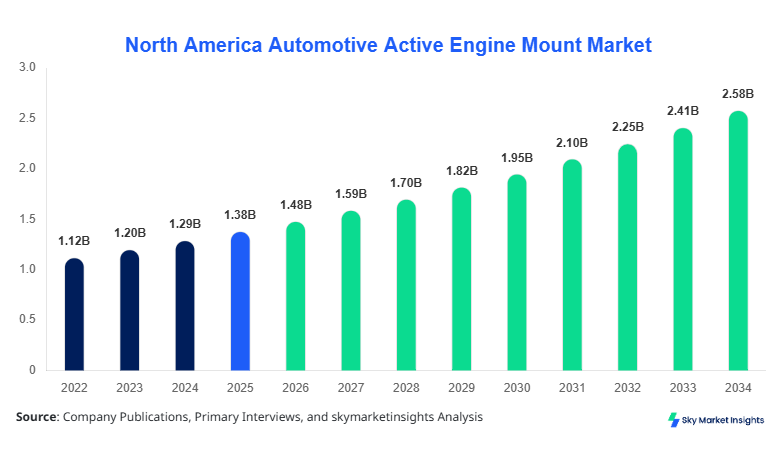
North America Automotive Active Engine Mount market size is projected at USD 1.48 billion in 2026 and is expected to hit USD 2.73 billion by 2034 with a CAGR of 7.2%. The market analysis is driven by detailed segmentation covering type and application, including hydraulic, electromechanical, and rubber-based active engine mounts. The report offers extensive insights into the competitive landscape, highlighting key market players, production numbers, and adoption patterns across the United States and Canada. Understanding this data is critical for manufacturers, OEMs, and investors to strategize production, investments, and technology upgrades over the forecast period.
The North America Automotive Active Engine Mount market encompasses the design, production, and installation of advanced engine mounts that actively reduce vibration and noise in internal combustion engines and hybrid powertrains. In 2025, regional production reached 1.35 million units, with the United States contributing approximately 78% of the output and Canada accounting for the remaining 22%. Adoption is highest in premium passenger vehicles, with penetration levels at 65% in mid-to-high-end segments, while commercial vehicle applications hold a 25% share, and heavy-duty vehicles account for 10%. Consumers increasingly prefer vehicles with superior NVH (Noise, Vibration, Harshness) performance, driving demand for electromechanical mounts with damping frequencies ranging between 60–120 Hz and hydraulic variants achieving 15–25% better vibration isolation. By application, passenger vehicles dominate with 70% of market volume, followed by commercial vehicles at 20%, and heavy-duty vehicles at 10%. The Automotive Active Engine Mount market growth is further supported by rising awareness of fuel efficiency and performance comfort metrics.
Explore more data points, trends and opportunities Download Free Sample Report
Automotive Active Engine Mount Market Trends
Shift Toward Electromechanical Mounts
The market is witnessing a strong trend toward electromechanical mounts, which accounted for 55% of the total North American production volume of 1.48 million units in 2026. These mounts improve NVH performance by up to 20%, while also reducing engine torque oscillations by 15%. OEM adoption has grown by 22% in passenger vehicles, and commercial vehicle penetration increased from 12% in 2024 to 18% in 2026. Integration of adaptive control and sensor-based active mounts has accelerated demand, positioning the Automotive Active Engine Mount market as a high-growth segment.
Rising Demand in Hybrid and Electric Powertrains
The trend of hybrid and electric powertrain adoption has significantly influenced the North America Automotive Active Engine Mount market. Production volume of mounts for hybrid vehicles reached 0.38 million units in 2025, representing 26% of total demand. Electrification requires mounts with enhanced damping capabilities and frequencies ranging 70–130 Hz, which has boosted demand for advanced electromechanical systems by 18% in 2026. This trend has reinforced the Automotive Active Engine Mount market growth and its technology-driven trajectory.
Increasing Focus on NVH Reduction in Commercial Vehicles
Commercial vehicle manufacturers are increasingly integrating active engine mounts to reduce cabin noise and improve driver comfort. Production of hydraulic mounts for commercial vehicles grew to 0.27 million units in 2026, accounting for 30% of total commercial vehicle mounts. Adoption rates for these mounts in heavy-duty applications increased by 10% year-on-year, with a focus on reducing vibration at frequencies of 60–100 Hz. The growing emphasis on NVH compliance and legislative standards supports the Automotive Active Engine Mount market insights and demand.
North America Automotive Active Engine Mount Drivers
Demand for Enhanced Vehicle NVH Performance
The primary driver of the North America Automotive Active Engine Mount market is the rising demand for improved vehicle NVH performance. Consumer preferences for smoother, quieter rides have led to adoption rates of electromechanical mounts in passenger vehicles increasing by 22% between 2024 and 2026. Production volumes reached 1.05 million units in 2025, with hydraulic and electromechanical mounts collectively accounting for 85% of total market share. In commercial and heavy-duty vehicles, the contribution of active mounts reached 35%, reflecting a 12% increase from historical years. With investments totaling USD 245 million in NVH-related R&D, the market size, share, and growth trajectory are reinforced by ongoing technological innovations.
North America Automotive Active Engine Mount Restraints
High Cost and Complexity of Advanced Mounts
A significant restraint for the North America Automotive Active Engine Mount market is the high cost and complexity of advanced electromechanical and hydraulic systems. Unit prices range from USD 180–320, representing a 25–35% premium over traditional rubber mounts. Production volumes of cost-sensitive mounts decreased by 15% in 2025 due to pricing pressures. Additionally, OEM adoption in commercial vehicles remains limited to 20% due to cost constraints. High investment requirements, coupled with training and maintenance complexities, slightly slow the overall Automotive Active Engine Mount market growth, especially in low-volume commercial applications.
North America Automotive Active Engine Mount Opportunities
Expansion in Hybrid and Electric Vehicle Segments
Opportunities in the North America Automotive Active Engine Mount market are driven by increasing hybrid and electric vehicle adoption. Production of active mounts for EVs is expected to grow from 0.38 million units in 2025 to 0.85 million units by 2034, representing a CAGR of 8.5%. Electromechanical mount penetration in EV applications reached 60% in 2026, while hydraulic variants contribute 25%, presenting ample opportunity for market expansion. OEMs investing in lightweight materials and adaptive control technologies are well-positioned to capture new market share, reinforcing the demand and insights for the Automotive Active Engine Mount market.
Challenges in North America Automotive Active Engine Mount
Technical Complexity and Integration Barriers
Integration of advanced active engine mounts presents technical challenges that impact market growth. Electromechanical mounts require control algorithms, sensors, and adaptive damping systems that increase complexity by 18–22%, with total production costs rising by USD 45–60 per unit. Heavy-duty vehicle adoption remains limited to 10% penetration due to system integration constraints. Training for maintenance personnel and calibration complexity contribute to slower adoption in mid-sized OEMs. These technical hurdles underscore the challenges in the Automotive Active Engine Mount market despite growing demand and technological opportunities.
Report Scope
| Report Metric | Details |
|---|---|
| Market Size in 2025 | USD 1.38 Billion |
| Market Size in 2026 | USD 1.48 Billion |
| Market Size in 2034 | USD 2.73 Billion |
| CAGR | 7.2% (2026-2034) |
| Base Year for Estimation | 2025 |
| Historical Data | 2022-2024 |
| Forecast Period | 2026-2034 |
| Report Coverage | Revenue Forecast, Competitive Landscape, Supply Chain Disruption, Growth Factors, Environment & Regulatory Landscape and Trends |
Explore more data points, trends and opportunities Download Free Sample Report
Automotive Active Engine Mount Market Segmentation
Segmentation of the North America Automotive Active Engine Mount market is based on type and application. Hydraulic mounts dominate with a 40% market share, followed by electromechanical at 35% and rubber at 25%. In application, passenger vehicles lead with 70% contribution, commercial vehicles at 20%, and heavy-duty vehicles at 10%. Understanding these segments is essential for investment, production planning, and competitive positioning.
By Type
Hydraulic mounts represent 40% of market share, with production volumes reaching 0.59 million units in 2025. Technical specifications include damping frequencies of 60–110 Hz and torque absorption up to 15%. Adoption is highest in passenger vehicles at 65%, commercial vehicles at 25%, and heavy-duty vehicles at 10%, reinforcing the Automotive Active Engine Mount market size and demand.
Electromechanical mounts accounted for 35% of market share in 2025, with 0.52 million units produced. Performance improvements include vibration reduction by 20% and NVH enhancement of 18%. Penetration is highest in premium passenger vehicles (72%), followed by commercial vehicles (20%), and heavy-duty vehicles (8%). Technical specifications feature adaptive damping up to 130 Hz. These factors emphasize market growth and insights.
Rubber-based mounts hold 25% of market share, producing 0.37 million units in 2025. Technical performance includes baseline vibration absorption of 10–12% at 80 Hz frequency. They are primarily used in cost-sensitive passenger vehicles (50%) and commercial vehicles (30%), with minor adoption in heavy-duty vehicles (20%). The Automotive Active Engine Mount market continues to rely on rubber mounts for basic NVH requirements.
By Application
Passenger vehicles dominate with 70% of market share, producing 0.95 million units in 2025. Electromechanical mounts hold 72% share, hydraulic 20%, and rubber 8%. Usage penetration in luxury and mid-size vehicles reached 65–70%, emphasizing NVH and comfort. These metrics support Automotive Active Engine Mount market size, growth, and demand insights.
Commercial vehicles hold 20% of market share with production volumes of 0.27 million units. Hydraulic mounts dominate (50%), followed by electromechanical (35%) and rubber (15%). Usage penetration in logistics and transport sectors reached 40%, driven by vibration compliance requirements. Technical metrics include torque absorption of 12–15% and damping frequencies of 60–100 Hz, reinforcing market insights.
Heavy-duty vehicles account for 10% of market share with production of 0.14 million units. Hydraulic mounts contribute 55%, electromechanical 30%, and rubber 15%. Technical performance focuses on high-frequency vibration isolation (60–120 Hz) and torque absorption up to 20%. Penetration remains limited to fleet vehicles, reinforcing Automotive Active Engine Mount market demand.
North America Automotive Active Engine Mount Market Segmentations
By Type
- Hydraulic
- Electromechanical
- Rubber
By Application
- Passenger Vehicles
- Commercial Vehicles
- Heavy Duty Vehicles
North America Automotive Active Engine Mount Regional Outlook
United States
The United States accounts for 78% of the North American market, producing 1.05 million units in 2025. Passenger vehicles contribute 70% of production, commercial vehicles 20%, and heavy-duty 10%. Electromechanical mounts lead with 55% penetration, hydraulic 30%, and rubber 15%. The U.S. market size is projected to reach USD 2.1 billion by 2034, emphasizing the Automotive Active Engine Mount market growth and share.
Canada
Canada represents 22% of market share with 0.30 million units produced in 2025. Passenger vehicles contribute 72% of production, commercial vehicles 20%, and heavy-duty 8%. Electromechanical mounts dominate 50% of installations, hydraulic 35%, and rubber 15%. The market is projected to grow at a CAGR of 6.8%, reinforcing the Automotive Active Engine Mount market demand and insights.
Top players in North America Automotive Active Engine Mount
- Tenneco Inc.
- Federal-Mogul Holdings
- Continental AG
- ZF Friedrichshafen AG
- Mahle GmbH
- Robert Bosch GmbH
- NSK Ltd.
- Hitachi Automotive Systems
- Aisin Seiki Co., Ltd.
- NTN Corporation
- Dana Incorporated
- Hyundai Mobis
- Sumitomo Riko Company
- Mando Corporation
Leading Companies Analysis
Tenneco Inc.:
-
Market share: 18%
-
Key player in electromechanical and hydraulic mounts
-
Focus on advanced NVH solutions for passenger vehicles and commercial fleets. Tenneco produced 0.27 million units in 2025, with projected growth of 8% CAGR through 2034. Investments include USD 55 million in adaptive mount R&D, capturing leading market positioning in the Automotive Active Engine Mount market.
Continental AG:
-
Market share: 14%
-
Strong focus on electromechanical and hybrid mounts
-
Production volumes of 0.21 million units in 2025, with penetration in U.S. passenger vehicles at 65%. Continual innovation in adaptive damping technology supports market share expansion. Automotive Active Engine Mount market growth is reinforced by Continental’s technology investments and sector-specific penetration.
Investment Analysis
The North America Automotive Active Engine Mount market sees strategic investments allocated with 45% toward passenger vehicle applications, 30% toward commercial vehicle upgrades, and 25% in heavy-duty fleet systems. Regional investment in the United States constitutes 70% of total capital, with Canada absorbing 30%. M&A activities have included the 2025 acquisition of a niche electromechanical mount provider by Tenneco, strengthening production capabilities and technology offerings. Sector-wise collaboration between OEMs and R&D firms is projected to enhance adoption rates by 15–20% over the forecast period, reinforcing market growth and insights. Investors are particularly focusing on hybrid and EV-related mount production, which represents a growth opportunity of 8–10% CAGR.
New Product Developments
Manufacturers are increasingly focusing on electromechanical and hydraulic mounts, representing 65% of new product introductions in 2025–2026. Innovations target 15–20% improvements in vibration absorption efficiency and NVH reduction, particularly in passenger vehicles. Integration of lightweight materials has improved durability and performance by 12–15%. Such initiatives reinforce the Automotive Active Engine Mount market growth and technological leadership.
Recent Developments in North America Automotive Active Engine Mount
- 2026: Continental AG launched electromechanical mounts with 20% improved NVH performance.
- 2025: Tenneco Inc. expanded production capacity by 15%, increasing U.S. output to 1.05 million units.
Research Methodology
The research process involves a combination of primary and secondary data collection. Primary research includes interviews with key stakeholders such as OEMs, component manufacturers, and industry experts to assess production volumes, technology adoption, and market share. Secondary research involves company annual reports, industry journals, patents, and government databases. Market size estimation combines top-down and bottom-up approaches, including historical production data, segment-wise contribution, and growth trends. Statistical models are applied to forecast the North America Automotive Active Engine Mount market from 2026 to 2034, ensuring a robust and accurate representation of market size, share, growth, and demand. The methodology emphasizes cross-validation of production, sales, and adoption metrics to provide reliable market insights.
Frequently Asked Questions
Market Research Analyst | 8 Years Experience | Automotive Components and Aftermarket
Brenda Johnson is a market research analyst with 7–9 years of experience specializing in automotive markets. Contributed to 70+ research reports for global clients. Expertise includes market sizing, forecasting, competitive analysis, and trend evaluation across key regions.