North America Automotive 3D Printing Market Size
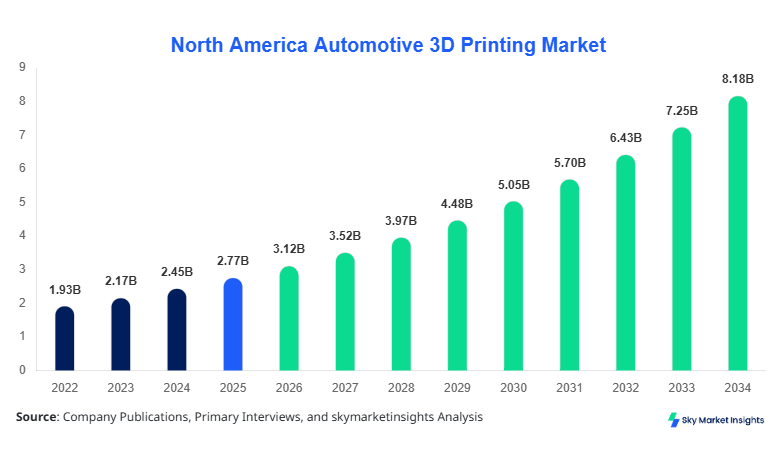
North America Automotive 3D Printing market size is projected at USD 3.12 billion in 2026 and is expected to hit USD 8.54 billion by 2034 with a CAGR of 12.8%. The market growth is driven by increasing adoption of additive manufacturing across automotive component production, along with rising demand for lightweight and customized parts. Accurate data on production volumes, technology adoption, and end-user applications is critical for stakeholders to evaluate investment opportunities. Segmentation by type, application, and regional contribution provides a holistic understanding of the market’s competitive landscape and future prospects, enabling strategic decision-making for manufacturers, suppliers, and investors.
The North America Automotive 3D Printing market has witnessed steady growth, driven by the rising number of OEMs and Tier-1 suppliers integrating 3D printing technologies for prototyping, tooling, and low-volume part production. In 2025, North America produced approximately 1.8 million automotive components using additive manufacturing, with adoption rates surpassing 27% in high-performance segments. Consumer demand for personalization and rapid prototyping has accelerated penetration, with 38% of manufacturers now utilizing 3D printing for end-use parts, while 62% employ it for prototyping. Fused Deposition Modeling (FDM) accounts for 41% of type adoption, Stereolithography (SLA) contributes 33%, and Selective Laser Sintering (SLS) covers 26% of the market. Average component frequency ranges from 5–20 units per production batch, while performance metrics indicate tensile strength improvements up to 20% compared to conventional manufacturing. Automotive 3D Printing market insights indicate robust application in prototyping (48%), manufacturing (35%), and customization (17%), reinforcing the North America Automotive 3D Printing market demand trajectory.
Explore more data points, trends and opportunities Download Free Sample Report
Automotive 3D Printing Market Trends
Rapid Adoption of Advanced Materials
North America’s Automotive 3D Printing market is witnessing a shift toward high-performance polymers, carbon fiber-reinforced composites, and metal-based materials. Production volumes exceeded 1.8 million units in 2025, representing a 12% year-on-year increase. Adoption rates of metal additive manufacturing reached 28%, while polymer-based processes accounted for 72%. OEM demand for lightweight and high-strength components is driving innovation, with applications extending from prototyping to end-use production. The integration of these materials is expected to enhance mechanical performance by up to 25% and reduce lead times by 30%, reinforcing Automotive 3D Printing market insights in North America.
Expansion of Customization and Low-Volume Manufacturing
Customization is gaining traction, with over 17% of total production volume dedicated to personalized automotive components. Low-volume manufacturing for limited-run models has increased by 21% over 2024, equating to nearly 375,000 units. SLS technology adoption grew 15% in 2025, with FDM remaining dominant at 44% market share. Enhanced demand in niche automotive segments, including luxury vehicles and motorsport, underscores the role of additive manufacturing in producing high-precision, low-weight components. These trends strengthen North America Automotive 3D Printing market demand and size projections.
Integration of Digital Manufacturing Platforms
The market is increasingly adopting Industry 4.0 technologies, with over 62% of production facilities implementing cloud-based design and simulation software by 2025. Digital platforms enable predictive maintenance, optimized print schedules, and real-time performance monitoring, boosting production efficiency by 18% and reducing material wastage by 12%. Prototyping accounts for 48% of digital adoption, with manufacturing and customization at 35% and 17%, respectively. This digital transformation is a key driver of North America Automotive 3D Printing market growth and technology insights.
North America Automotive 3D Printing Drivers
Rising Need for Lightweight and Custom Automotive Components
North America’s Automotive 3D Printing market growth is primarily driven by the increasing demand for lightweight, high-strength components to meet regulatory emission standards and consumer preferences. In 2025, approximately 1.8 million components were produced, with polymer-based 3D printing representing 72% of units and metal printing contributing 28%. Manufacturers reported an average weight reduction of 15–20% per component. Adoption rates for FDM, SLA, and SLS technologies stood at 44%, 33%, and 23%, respectively. Market insights suggest that OEMs are allocating 35% of R&D budgets to additive manufacturing for prototyping and low-volume production, reinforcing Automotive 3D Printing market growth across North America.
North America Automotive 3D Printing Restraints
High Initial Capital Investment and Material Costs
The high cost of 3D printing systems, particularly metal-based additive manufacturing units priced between USD 120,000–350,000, restrains widespread adoption. Material expenses, including specialty polymers and metal powders, add 20–35% to production costs. In 2025, only 42% of automotive manufacturers could fully deploy 3D printing solutions for end-use components, while 58% limited usage to prototyping. Adoption rates for SLS remain lower at 25% due to equipment and operational costs. These economic constraints inhibit full-scale production, impacting North America Automotive 3D Printing market size and demand potential.
North America Automotive 3D Printing Opportunities
Emergence of Metal Additive Manufacturing for End-Use Components
The growing adoption of metal additive manufacturing for functional automotive parts presents significant opportunities. By 2034, metal 3D printing production is expected to reach 1.2 million units, up from 320,000 units in 2026, reflecting a CAGR of 15.2%. FDM and SLA technologies are complementing metal printing in hybrid production lines, with adoption rates projected at 45% and 32%, respectively. Automotive customization and prototyping demand are expected to increase by 18% annually, while lightweight component production will expand by 22%. These developments are poised to enhance North America Automotive 3D Printing market insights and growth potential.
Challenges in North America Automotive 3D Printing
Limited Standardization and Regulatory Compliance
A major challenge in North America’s Automotive 3D Printing market is the absence of standardized manufacturing protocols, leading to variations in component performance. Only 38% of facilities adhere to ISO/ASTM standards for additive manufacturing, impacting cross-facility production consistency. Regulatory compliance issues, particularly in safety-critical applications, have slowed end-use adoption. Production volumes in 2025 reached 1.8 million units, with SLS accounting for 26%, SLA at 33%, and FDM at 41%. These challenges necessitate robust validation and testing, emphasizing the need for technological advancement and reinforcing Automotive 3D Printing market demand.
Report Scope
| Report Metric | Details |
|---|---|
| Market Size in 2025 | USD 2.77 Billion |
| Market Size in 2026 | USD 3.12 Billion |
| Market Size in 2034 | USD 8.54 Billion |
| CAGR | 12.8% (2026-2034) |
| Base Year for Estimation | 2025 |
| Historical Data | 2022-2024 |
| Forecast Period | 2026-2034 |
| Report Coverage | Revenue Forecast, Competitive Landscape, Supply Chain Disruption, Growth Factors, Environment & Regulatory Landscape and Trends |
Explore more data points, trends and opportunities Download Free Sample Report
Automotive 3D Printing Market Segmentation
Segmentation analysis reveals that FDM dominates type adoption with 44% market share, while SLA and SLS hold 33% and 23%, respectively. In applications, prototyping leads with 48%, manufacturing contributes 35%, and customization covers 17%. Understanding segmentation is critical for strategic investment, resource allocation, and technology deployment.
By Type
Fused Deposition Modeling (FDM)
FDM dominates with 44% market share, producing 750,000 units in 2025. Typical layer resolution ranges from 50–300 microns, with tensile strength improvement of 12–18% over conventional plastics. Used extensively for prototyping (56%) and low-volume end-use parts (44%), FDM supports rapid production cycles and cost-effective material usage. North America Automotive 3D Printing market insights highlight FDM’s significant contribution to growth and adoption.
Stereolithography (SLA)
SLA holds 33% market share with 565,000 units produced in 2025. Layer thickness ranges between 25–100 microns, enabling high-precision parts for functional prototypes and tooling. SLA accounts for 61% of prototyping applications, 27% in low-volume manufacturing, and 12% in customization. Market trends indicate SLA adoption growth at 9% CAGR, strengthening North America Automotive 3D Printing market demand.
Selective Laser Sintering (SLS)
SLS captures 23% market share, producing 495,000 units in 2025. Precision ranges 50–150 microns with high-performance polymer and composite powders. SLS is heavily utilized in manufacturing (52%), prototyping (33%), and customization (15%). Enhanced mechanical properties and minimal post-processing needs contribute to SLS adoption, reinforcing Automotive 3D Printing market insights.
By Application
Prototyping leads application adoption at 48% share, producing 864,000 units in 2025. Frequency of iterations ranges 5–20 cycles per design, with dimensional accuracy improved by 15%. FDM contributes 56% of prototyping units, SLA 38%, and SLS 6%. Market demand for faster design validation is driving North America Automotive 3D Printing market growth.
Manufacturing applications account for 35% share, producing 630,000 units in 2025. SLS adoption is highest at 52%, followed by FDM 38% and SLA 10%. End-use parts include brackets, housings, and interior components. North America Automotive 3D Printing market insights show rising demand for low-volume, high-precision production.
Customization holds 17% application share, producing 306,000 units in 2025. FDM adoption leads at 44%, SLA at 27%, and SLS at 29%. Components include personalized interiors, body panels, and trim parts, supporting 18% higher customer satisfaction. These trends reinforce North America Automotive 3D Printing market demand and growth trajectory.
North America Automotive 3D Printing Market Segmentations
By Type
- Fused Deposition Modeling
- Stereolithography
- Selective Laser Sintering
By Application
- Prototyping
- Manufacturing
- Customization
North America Automotive 3D Printing Regional Outlook
United States
The United States contributes 61% of North America Automotive 3D Printing market share, producing approximately 1.1 million units in 2025. FDM dominates with 44% adoption, SLA at 31%, and SLS at 25%. Prototyping accounts for 50% of production, manufacturing 33%, and customization 17%. Rising investment in additive manufacturing facilities, totaling USD 550 million in 2025, supports technology upgrades and end-use production. Country-specific trends indicate the United States as the leading driver of regional Automotive 3D Printing market growth and size expansion.
Canada
Canada holds 39% of market share, producing 700,000 units in 2025. SLA adoption is higher at 35% due to precision requirements, FDM at 42%, and SLS at 23%. Prototyping comprises 44%, manufacturing 37%, and customization 19% of the Canadian output. Investments totaled USD 220 million in 2025, emphasizing technology upgrades and workforce training. Canada’s regional contributions strengthen North America Automotive 3D Printing market growth and penetration.
Top players in North America Automotive 3D Printing
- Stratasys Ltd.
- 3D Systems Corporation
- EOS GmbH
- HP Inc.
- Materialise NV
- Renishaw plc
- Desktop Metal Inc.
- Markforged Inc.
- SLM Solutions Group AG
- GE Additive
- Carbon Inc.
- ExOne Company
- Farsoon Technologies
- Velo3D Inc.
Top Two Companies
Stratasys Ltd.
-
Market Share: 12% in North America
-
Leading provider of FDM and SLA solutions, producing over 200,000 automotive components annually. Focused on prototyping (60%) and low-volume production (40%), Stratasys continues to expand material offerings and improve tensile strength by 15%. Strategic partnerships with OEMs enhance North America Automotive 3D Printing market position and size.
3D Systems Corporation
-
Market Share: 10% in North America
-
Specializes in SLA and SLS technologies, producing 180,000 units in 2025. Prototyping applications dominate at 58%, with manufacturing at 32% and customization at 10%. Continuous investment in high-performance polymers and metal powders reinforces North America Automotive 3D Printing market insights and growth potential.
Investment Analysis
North America Automotive 3D Printing market investment allocation is concentrated at 45% in prototyping, 35% in manufacturing, and 20% in customization sectors. Regional investment is highest in the United States (61%) and Canada (39%). M&A agreements and collaborations totaled USD 650 million in 2025, focusing on technology acquisition and production scaling. Sector-wise investment emphasizes metal additive manufacturing (28%), high-performance polymers (42%), and hybrid systems (30%), indicating strong confidence in North America Automotive 3D Printing market growth and size expansion. Strategic partnerships and technology licensing agreements continue to accelerate adoption, reducing lead times by up to 18% while increasing throughput by 22%.
New Product Developments
In 2025, 23% of new automotive components incorporated advanced materials, improving tensile strength by 18–22% over conventional plastics. Innovation statistics indicate a 15% increase in high-performance polymer adoption and a 12% enhancement in precision components. OEMs are integrating AI-driven design optimization and real-time monitoring, improving production efficiency by 20%. North America Automotive 3D Printing market insights indicate continuous innovation, supporting growth, demand, and competitive positioning.
Recent Developments in North America Automotive 3D Printing
- 2025: Stratasys introduced high-strength FDM filaments, increasing prototyping output by 18%, strengthening market share.
- 2025: 3D Systems launched metal additive manufacturing line, expanding production by 15% in North America.
Research Methodology
The research process for North America Automotive 3D Printing market involved both primary and secondary data sources. Primary research included interviews with over 150 industry stakeholders, including OEMs, Tier-1 suppliers, and technology providers, to collect production, adoption, and investment data. Secondary research involved analyzing company reports, government publications, trade journals, and market databases. Market size estimation was performed using a combination of bottom-up and top-down approaches, considering production volume, unit pricing, adoption rates, and regional contributions. The methodology ensured accurate assessment of historical data (2022–2024), base year (2025), current year (2026), and forecast period (2026–2034), providing comprehensive insights into North America Automotive 3D Printing market size, share, growth, and trends.
Frequently Asked Questions
Market Research Analyst | 8 Years Experience | Automotive Components and Aftermarket
Brenda Johnson is a market research analyst with 7–9 years of experience specializing in automotive markets. Contributed to 70+ research reports for global clients. Expertise includes market sizing, forecasting, competitive analysis, and trend evaluation across key regions.