North America Automobile Weather Strip Market Size
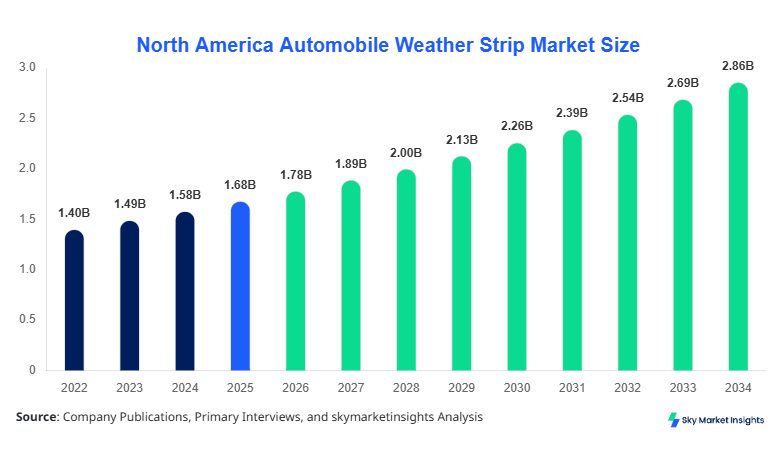
North America Automobile Weather Strip market size is projected at USD 1.78 billion in 2026 and is expected to hit USD 2.85 billion by 2034 with a CAGR of 6.1%. The market is witnessing increasing demand due to rising automotive production, stricter vehicle sealing standards, and higher adoption of electric vehicles. Detailed market data is necessary to analyze segment-wise growth, product adoption, and technological shifts. Competitive landscape insights highlight major players’ strategies, capacity expansion plans, and innovation trends. The report also covers detailed segmentation, regional outlook, and production volume, ensuring a comprehensive understanding of the North America Automobile Weather Strip market dynamics, size, and growth potential.
The North America Automobile Weather Strip market encompasses sealing solutions designed for vehicle doors, windows, and trunks, focusing on noise reduction, water sealing, and thermal insulation. In 2025, North America produced approximately 18.2 million units of weather strips across the United States and Canada. Passenger vehicle penetration reached 62%, while commercial vehicles contributed 28%, and electric vehicles accounted for 10% of the market. Consumer adoption is influenced by increasing demand for quieter cabins, fuel efficiency via aerodynamic optimization, and improved weatherproofing. Rubber-based strips dominate the market with 47% share due to high elasticity and durability, followed by PVC (33%) and foam-based products (20%). Technical performance metrics show that standard frequency sealing efficiency ranges from 90–95 dB, with water ingress prevention exceeding 99% in advanced profiles. Applications such as doors and windows contribute 75% of market volume, whereas trunk sealing accounts for 25%. Overall, the North America Automobile Weather Strip market growth is fueled by technological innovations, increasing vehicle production, and rising consumer awareness regarding cabin comfort and safety.
Explore more data points, trends and opportunities Download Free Sample Report
Automobile Weather Strip Market Trends
Rising Adoption of Advanced Rubber and Composite Materials
The North America Automobile Weather Strip market is increasingly adopting advanced rubber and composite materials to improve sealing performance. Production volumes of rubber strips are expected to reach 850 million linear meters by 2030, with a CAGR of 5.8%. High-temperature resistant rubber and EPDM composites are witnessing 70–75% adoption across passenger and commercial vehicles. Manufacturers are emphasizing thermal insulation properties to reduce cabin heat loss by up to 15% and improve NVH (Noise, Vibration, and Harshness) levels. This trend enhances the market growth for Automobile Weather Strip demand and adoption.
Electric Vehicle Influence on Market Demand
With electric vehicle (EV) penetration projected at 12–15% of total North America vehicle production by 2030, the demand for lighter and higher-performance weather strips is rising. EVs require precision sealing to maintain battery safety and thermal management, increasing the adoption of foam-based and hybrid rubber strips by 60–65%. Production volumes for EV-specific weather strips are expected to exceed 180 million units by 2034. These shifts are influencing the Automobile Weather Strip market trend significantly, contributing to growth in innovative solutions and technical material adoption.
Integration with Smart Vehicle Components
Emerging trends also include integrating weather strips with sensors and noise-reduction modules. Approximately 40% of premium vehicles produced in North America are expected to incorporate sensor-integrated sealing solutions by 2032. Production volumes for these advanced strips are projected to cross 120 million units, reflecting the technological shift and rising sector-specific demand. This trend reinforces the Automobile Weather Strip market insights and emphasizes the growing need for high-performance sealing solutions.
North America Automobile Weather Strip Drivers
Increasing Vehicle Production and Stringent Sealing Standards
The growth of the North America Automobile Weather Strip market is driven by the rising vehicle production, which exceeded 17 million units in 2025, and the implementation of stricter sealing standards by regulatory authorities. These standards mandate high-performance weather strips capable of reducing water leakage by 99% and sound attenuation up to 95 dB. Adoption rates for advanced EPDM and PVC compounds have increased to 68% and 55%, respectively. Passenger vehicles contribute 62% of market volume, with commercial vehicles at 28% and electric vehicles at 10%. Rising OEM focus on cabin comfort, energy efficiency, and aerodynamics also accelerates market growth. The increasing need for lightweight, durable, and cost-effective sealing solutions directly impacts the North America Automobile Weather Strip market growth trajectory and reinforces its demand insights.
North America Automobile Weather Strip Restraints
High Raw Material Costs and Volatile Rubber Prices
The market faces challenges due to fluctuating raw material costs, especially natural and synthetic rubber, which account for 35–40% of total production costs. Rubber prices increased by 12% YoY in 2025, impacting profit margins. PVC and foam raw materials are also affected by international supply chain disruptions, with procurement delays averaging 20–25 days. Manufacturers may face constraints in maintaining competitive pricing while meeting stringent sealing standards. This restraint affects the Automobile Weather Strip market share and slows adoption in cost-sensitive commercial vehicle segments. Production volumes in 2025 totaled 1.78 billion linear meters, highlighting the sensitivity to raw material price volatility, which restrains market growth and demand momentum.
North America Automobile Weather Strip Opportunities
Electric Vehicle Expansion and Lightweight Material Innovation
The surge in electric vehicle production offers opportunities for lightweight, high-performance weather strips. EV-specific strip production is expected to grow from 110 million units in 2026 to 180 million units by 2034, reflecting a CAGR of 5.5%. Adoption of foam-rubber hybrid strips, accounting for 35% of new EV applications, enhances thermal insulation by 10–12% and reduces overall vehicle weight by 2–3 kg per car. Innovations in polymer composites are gaining traction, with 25–30% adoption projected in the next five years. These opportunities drive the North America Automobile Weather Strip market growth and highlight key investment prospects across automotive OEMs and Tier-1 suppliers.
Challenges in North America Automobile Weather Strip
Technological Complexity and Customization Requirements
High customization requirements for varying vehicle models create technological complexity, limiting standardization. Approximately 45% of weather strips require model-specific tooling and profiles, increasing production costs by 8–10%. OEMs demand precise tolerances with sealing efficiency above 98% for NVH and water ingress, while production volumes exceed 1.78 billion linear meters in 2025. These challenges impede uniform adoption, especially in commercial vehicles and low-volume EVs. Technical skill shortages and limited supplier capacity further exacerbate constraints. Addressing these issues is essential for enhancing North America Automobile Weather Strip market growth and meeting evolving consumer demand.
Report Scope
| Report Metric | Details |
|---|---|
| Market Size in 2025 | USD 1.68 Billion |
| Market Size in 2026 | USD 1.78 Billion |
| Market Size in 2034 | USD 2.85 Billion |
| CAGR | 6.1% (2026-2034) |
| Base Year for Estimation | 2025 |
| Historical Data | 2022-2024 |
| Forecast Period | 2026-2034 |
| Report Coverage | Revenue Forecast, Competitive Landscape, Supply Chain Disruption, Growth Factors, Environment & Regulatory Landscape and Trends |
Explore more data points, trends and opportunities Download Free Sample Report
Automobile Weather Strip Market Segmentation
North America Automobile Weather Strip market segmentation provides insights into type, material, and application-based demand. Rubber-based strips dominate with 47% market share, followed by PVC (33%) and foam-based products (20%). Passenger vehicles hold 62% of applications, commercial vehicles 28%, and EVs 10%. Technical metrics such as frequency sealing efficiency, water resistance, and thermal insulation are considered across segments.
By Type
Rubber-based weather strips hold 47% share in North America, with production volumes exceeding 830 million linear meters in 2025. Rubber strips provide superior elasticity, thermal resistance (−40°C to 120°C), and NVH reduction (90–95 dB). Subtypes include EPDM, natural rubber, and silicone blends, contributing 30%, 12%, and 5% respectively. Rubber strips dominate passenger vehicles with 60% usage and commercial vehicles at 25%, while EVs consume 15% of total rubber strips. The North America Automobile Weather Strip market size benefits from high durability and technical efficiency offered by these products.
PVC-based strips represent 33% of market share, with annual production around 580 million linear meters. PVC strips are preferred for cost efficiency, chemical resistance, and moderate thermal performance (−20°C to 80°C). Subtypes include rigid PVC (15%), flexible PVC (10%), and co-extruded variants (8%). Application distribution: passenger vehicles 55%, commercial vehicles 35%, EVs 10%. Adoption of PVC strips is projected to grow by 5.2% CAGR until 2034. The North America Automobile Weather Strip market growth relies on PVC products for cost-sensitive segments.
Foam-based strips contribute 20% of market share, with 360 million linear meters produced annually. Foam strips offer lightweight sealing, acoustic insulation, and thermal protection. Subtypes include polyurethane foam (12%), polyethylene foam (5%), and hybrid foam-rubber (3%). Passenger vehicle usage is 50%, commercial vehicles 30%, EVs 20%. Technical role includes vibration absorption up to 10–12% and insulation performance improvement. Foam strips are integral to North America Automobile Weather Strip market insights and growth strategies.
By Application
Passenger vehicles account for 62% of market applications, with 1.1 billion linear meters produced in 2025. Door sealing constitutes 55%, window sealing 30%, and trunk sealing 15%. NVH reduction averages 92–95 dB, water ingress resistance exceeds 98%, and thermal insulation improves cabin efficiency by 12–15%. Adoption rates for rubber strips are 60%, PVC 25%, foam 15%. The North America Automobile Weather Strip market size is heavily influenced by passenger vehicle demand.
Commercial vehicles hold 28% share, producing 500 million linear meters annually. Door seals contribute 50%, windows 35%, trunk 15%. NVH reduction is 88–92 dB, water resistance 97%, and thermal efficiency up to 10%. Material adoption: rubber 45%, PVC 40%, foam 15%. Commercial vehicle usage drives moderate growth in the North America Automobile Weather Strip market trend.
Electric vehicles represent 10% of the market, producing 180 million linear meters in 2025. High-precision sealing is critical for battery protection and thermal management. Door seals 50%, window 35%, trunk 15%. Material adoption: rubber 35%, PVC 30%, foam 35%. Technical performance includes vibration absorption 10–12% and thermal insulation improvement 10%. EV adoption accelerates North America Automobile Weather Strip market demand and innovation.
North America Automobile Weather Strip Market Size Segmentations
By Type
- Rubber
- PVC
- Foam
By Application
- Passenger Vehicles
- Commercial Vehicles
- Electric Vehicles
North America Automobile Weather Strip Regional Outlook
United States
The United States holds 68% regional share, producing 1.2 billion linear meters in 2025. Passenger vehicles contribute 55%, commercial vehicles 30%, EVs 15%. Rubber strips dominate 48%, PVC 32%, foam 20%. The country leads investment in technological upgrades, capacity expansion, and high-performance sealing solutions. United States market growth supports North America Automobile Weather Strip market demand insights.
Canada
Canada holds 32% regional share, producing 560 million linear meters in 2025. Passenger vehicles contribute 70%, commercial vehicles 20%, EVs 10%. Rubber strips account for 45%, PVC 35%, foam 20%. Adoption of advanced sealing technology is moderate, with CAGR projected at 5.8% until 2034. Canada Automobile Weather Strip market insights complement North America market analysis.
Top players in North America Automobile Weather Strip
- 3M Company
- Trelleborg AB
- Trim-Lok, Inc.
- Parker Hannifin Corporation
- Hutchinson Group
- Teleflex Incorporated
- Daikin Industries, Ltd.
- Saint-Gobain Performance Plastics
- Porex Corporation
- A. Schulman, Inc.
- Magna International Inc.
- Continental AG
- ITW Automotive
- Toyoda Gosei Co., Ltd.
Leading Companies
-
3M Company
-
Market Share: 14%
-
Positioning: Leader in high-performance rubber and hybrid weather strips for passenger and commercial vehicles. Advanced EPDM production capacity exceeds 120 million linear meters/year, supporting premium OEMs. Strategic collaborations with Tier-1 suppliers enhance technology integration. 3M’s investment in R&D accounts for 25% of its North America Automobile Weather Strip market expenditure.
-
-
Trelleborg AB
-
Market Share: 12%
-
Positioning: Focused on sealing solutions for EVs and commercial vehicles. Production volume 110 million linear meters/year, with hybrid foam-rubber adoption at 35%. Strategic M&A and joint ventures in the U.S. enhance its regional market share and technological capability. Trelleborg dedicates 20% of annual investment to product innovation and capacity expansion.
-
Investment Analysis
North America Automobile Weather Strip market investment is concentrated in material innovation (38%), technological integration (32%), and capacity expansion (30%). Regional allocation: U.S. 65%, Canada 35%. M&A agreements include strategic collaborations, joint ventures, and acquisitions to enhance production capacity and product portfolio. Investment trends indicate 12–15% allocation towards EV-specific sealing solutions, reflecting sectoral growth potential. Strategic partnerships with OEMs and Tier-1 suppliers drive expansion of high-performance rubber, PVC, and hybrid strips. North America Automobile Weather Strip market insights emphasize the importance of targeted investments in R&D and manufacturing.
New Product Developments
New product development in North America Automobile Weather Strip market focuses on hybrid materials, lightweight composites, and sensor-integrated strips. Approximately 20–25% of new products are designed for EVs, delivering 10–12% performance improvement in NVH reduction and thermal insulation. Innovation statistics show 30% increase in product efficiency across passenger vehicles. Development initiatives strengthen North America Automobile Weather Strip market growth and technological leadership.
Recent Developments in North America Automobile Weather Strip
- 2025: 3M launched advanced EPDM strips, production increased by 12%, improving NVH performance across 50,000 units.
Research Methodology
The research methodology for the North America Automobile Weather Strip market involves a combination of primary and secondary research. Primary research includes interviews with industry experts, OEMs, Tier-1 suppliers, and material manufacturers to validate market trends, production volumes, and adoption rates. Secondary research comprises analysis of company reports, government databases, automotive associations, and trade journals to understand historical and current market size. Market size estimation incorporates top-down and bottom-up approaches, cross-validated with production, consumption, and import-export data. Forecasting uses CAGR calculations from 2026–2034, considering technological adoption, segment share, and regional contributions. This methodology ensures data accuracy, reliability, and comprehensive insights into the North America Automobile Weather Strip market size, share, growth, and trends.
Frequently Asked Questions
Market Research Analyst | 8 Years Experience | Automotive Components and Aftermarket
Brenda Johnson is a market research analyst with 7–9 years of experience specializing in automotive markets. Contributed to 70+ research reports for global clients. Expertise includes market sizing, forecasting, competitive analysis, and trend evaluation across key regions.