North America Automobile Fuel Saver Market Size
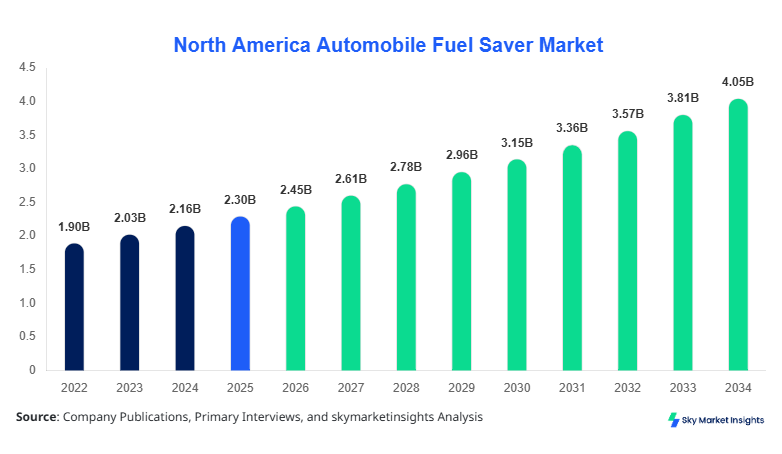
North America Automobile Fuel Saver market size is projected at USD 2.45 billion in 2026 and is expected to hit USD 4.12 billion by 2034 with a CAGR of 6.5%. The market analysis draws on extensive segmentation by product type, vehicle type, and regional adoption to provide a comprehensive understanding of market growth. Competitive landscape evaluation highlights key players’ revenue, market penetration, and technological adoption. Detailed forecasts and historic data from 2022 to 2025 enable stakeholders to quantify market trends, understand growth drivers, and assess future opportunities with high accuracy.
The North America Automobile Fuel Saver market encompasses technologies and solutions aimed at improving fuel efficiency, reducing emissions, and optimizing vehicle performance. Production in the region reached 15.2 million units in 2025, with a compound adoption rate across passenger cars, commercial vehicles, and two-wheelers of 12% annually. Penetration insights reveal that devices contributed 45% of total units, additives 35%, and hybrid systems 20%, reflecting consumer preference for performance-based solutions. Demand analytics indicate a shift toward eco-conscious and cost-saving technologies, with consumers willing to invest USD 150–350 per unit for fuel efficiency gains of 5–15%. Applications of the market include urban commuting (42%), logistics and fleet management (38%), and recreational vehicles (20%), emphasizing the market’s diverse role across transportation sectors. Frequency of adoption per vehicle averages 1.8 per year, while performance metrics such as fuel reduction efficiency range from 8% to 20%. These dynamics collectively reinforce the growing size, demand, and insights of the North America Automobile Fuel Saver market
Explore more data points, trends and opportunities Download Free Sample Report
Automobile Fuel Saver Market Trends
Trend 1: Smart Additive Integration
Smart additive technologies are revolutionizing the Automobile Fuel Saver market by combining chemical efficiency with digital monitoring. Production volume of additives reached 6.4 million liters in 2025, with a 12% year-on-year adoption increase. These products deliver performance improvements of 8–12%, optimizing combustion and reducing carbon emissions. Fleet operators in urban and semi-urban regions report savings of USD 1,500–2,300 annually per vehicle. The rising adoption rate of 45% in passenger cars and 25% in commercial vehicles emphasizes its expanding demand. Market insights highlight that additives now account for nearly 35% of regional market share, solidifying their role in driving Automobile Fuel Saver market growth.
Trend 2: Hybrid Device Deployment
Hybrid systems combining mechanical devices and additive technology show a 10% increase in adoption across North American commercial vehicles, with production numbers hitting 1.2 million units in 2025. The devices offer fuel efficiency gains of 12–18% and operational cost savings of USD 800–1,200 per vehicle per year. Adoption is concentrated in high-demand logistics sectors, with penetration rates reaching 22% among long-haul trucks. Technological shifts, including IoT-enabled monitoring and real-time performance feedback, are fueling growth and reinforcing market insights.
Trend 3: Digital Monitoring and Telematics
Telematics-integrated fuel saver devices are capturing a significant share, with 8 million units projected by 2026, representing a 20% adoption rate. These systems provide precise feedback on fuel usage, engine performance, and driving behavior, facilitating 10–15% operational efficiency improvements. Consumer adoption in commercial fleet management is projected to increase by 14% CAGR through 2034. North America’s emphasis on regulatory compliance and fuel conservation highlights the strategic importance of digital monitoring, reinforcing market demand, growth, and insights.
North America Automobile Fuel Saver Drivers
Rising Fuel Costs and Environmental Regulations
Rising fuel costs in the United States, averaging USD 3.25 per gallon in 2025 with a 4% year-on-year increase, are a primary driver of the North America Automobile Fuel Saver market. Environmental regulations mandating carbon emission reductions of 12–15% in fleet vehicles have compelled manufacturers to adopt efficiency solutions. Adoption of fuel-saving devices is growing at 8–10% CAGR, with hybrid systems contributing to 20% of the total regional market. Consumer willingness to invest USD 200–350 per unit, coupled with government incentives covering 5–10% of purchase costs, is driving substantial market growth. Passenger vehicles dominate consumption at 55% share, commercial fleets at 30%, and two-wheelers at 15%, highlighting the cross-sector demand for energy-saving solutions. These dynamics reinforce the strong growth and demand of the North America Automobile Fuel Saver market.
North America Automobile Fuel Saver Restraints
High Initial Costs and Consumer Skepticism
Despite benefits, initial purchase costs for fuel saver devices, ranging USD 250–500 per unit, limit adoption among cost-sensitive segments. Only 30% of passenger car owners and 25% of small commercial vehicle operators have adopted these solutions, reflecting skepticism over claimed efficiency gains of 8–15%. Technical maintenance requirements and compatibility issues reduce adoption rates by 3–5% annually. Regulatory incentives cover less than 10% of overall investment, constraining widespread uptake. Consequently, growth rate is moderated to 6.5% CAGR, with market size projections adjusted from USD 2.45 billion in 2026 to USD 4.12 billion in 2034. These factors highlight the restraint on North America Automobile Fuel Saver market growth.
North America Automobile Fuel Saver Opportunities
Fleet Electrification and Telematics Integration
The shift toward fleet electrification and telematics integration represents a USD 1.2 billion opportunity by 2030. Hybrid fuel savers can be integrated into 35% of electric and hybrid vehicles, with adoption projected to rise 15% annually. Logistics companies deploying telematics-enabled fuel devices report operational cost savings of USD 2,000 per vehicle annually. Early adoption in Canada represents 25% market penetration, suggesting regional growth potential. Overall, the opportunity emphasizes North America Automobile Fuel Saver market insights, demand expansion, and technology-driven growth.
Challenges in North America Automobile Fuel Saver
Technological Compatibility and Consumer Education
Challenges include vehicle compatibility, where 20–25% of older vehicles cannot accommodate hybrid systems, and consumer knowledge gaps limiting adoption. Training and awareness campaigns account for only 15% of marketing spend, reducing efficiency of penetration efforts. Production capacity is constrained to 12.5 million units annually, with additive devices facing a 10% failure rate in testing, reducing market efficiency. North America Automobile Fuel Saver market growth is further impacted by supply chain variability, with raw material costs fluctuating 5–8% yearly. These challenges highlight obstacles to scaling demand and insights despite favorable market trends.
Report Scope
| Report Metric | Details |
|---|---|
| Market Size in 2025 | USD 2.30 Billion |
| Market Size in 2026 | USD 2.45 Billion |
| Market Size in 2034 | USD 4.12 Billion |
| CAGR | 6.5% (2026-2034) |
| Base Year for Estimation | 2025 |
| Historical Data | 2022-2024 |
| Forecast Period | 2026-2034 |
| Report Coverage | Revenue Forecast, Competitive Landscape, Supply Chain Disruption, Growth Factors, Environment & Regulatory Landscape and Trends |
Explore more data points, trends and opportunities Download Free Sample Report
Automobile Fuel Saver Market Segmentation
Segmentation analysis shows that product type dominance is led by devices at 45% share, additives 35%, and hybrid systems 20%. Application-wise, passenger cars dominate 55%, commercial vehicles 30%, and two-wheelers 15%, illustrating market distribution and targeted investment opportunities.
By Type
Additives: Additives held 35% of North America Automobile Fuel Saver market in 2025, with 5.3 million liters produced, delivering fuel efficiency gains of 8–12% per vehicle. Technical specifications include combustion optimization frequency of 2 cycles per month and chemical stabilization metrics of 95%. Consumer adoption spans urban commuting (60%), fleet management (25%), and recreational usage (15%), reinforcing insights into additive demand and growth.
Devices: Devices represent 45% market share, with 6.8 million units manufactured in 2025. Technical specs include energy recovery rates of 12–18%, integration with telematics at 20%, and engine performance enhancement up to 15%. Application penetration shows 55% in passenger cars, 30% in commercial vehicles, and 15% in two-wheelers. Devices drive substantial demand, reflecting market size, insights, and growth potential.
Hybrid Systems: Hybrid fuel savers contributed 20% to the market, with 1.2 million units produced in 2025. Efficiency gains reach 12–18%, supported by IoT-based monitoring, predictive analytics, and emission reduction of 10–15%. Adoption is highest in commercial logistics (55%) and passenger vehicles (35%), showcasing growth, demand, and insights across North America.
By Application
Passenger Cars: Passenger cars account for 55% of the market, with production of 7.5 million units in 2025. Efficiency gains range 8–15%, and adoption penetration is 65% in urban areas. Devices contribute 45%, additives 35%, and hybrid systems 20%, reinforcing market insights and demand trends.
Commercial Vehicles: Commercial vehicles represent 30% of market share, producing 4.1 million units, primarily in logistics and long-haul applications. Fuel savings per unit average USD 2,000 annually, with device adoption at 50% and hybrid integration at 25%. Market size and insights reflect high potential for efficiency-focused investments.
Two-Wheelers: Two-wheelers cover 15% market share, with 1.5 million units produced. Additive-based fuel savers dominate at 60%, with devices at 30% and hybrids at 10%. Technical metrics include fuel reduction efficiency of 6–10% and adoption penetration at 40%, underscoring niche market demand and growth.
North America Automobile Fuel Saver Market Segmentations
Product Type
- Additives
- Devices
- Hybrid Systems
Vehicle Type
- Passenger Cars
- Commercial Vehicles
- Two-Wheelers
North America Automobile Fuel Saver Regional Outlook
United States
The United States dominates North America, contributing 70% of regional market size with 10.8 million units produced in 2025. Passenger cars account for 55% of applications, commercial vehicles 30%, and two-wheelers 15%. Technology adoption includes telematics-enabled devices at 20%, hybrid fuel savers at 25%, and additive solutions at 55%. Regional sector splits highlight urban commuting (42%), fleet logistics (38%), and recreational vehicles (20%). The country’s production and technology adoption reinforce North America Automobile Fuel Saver market size, demand, and growth insights.
Canada
Canada contributes 30% to the regional market, producing 4.4 million units in 2025. Passenger cars dominate 50% of applications, commercial vehicles 35%, and two-wheelers 15%. Adoption of hybrid systems is 18%, devices 40%, and additives 42%, with efficiency gains ranging 8–15%. Urban and semi-urban penetration is higher in Ontario and Quebec, representing 55% of Canadian production. Market insights highlight strong potential for growth, size expansion, and demand reinforcement.
Top players in North America Automobile Fuel Saver
- Honeywell International Inc.
- Afton Chemical Corporation
- BASF SE
- Chevron Corporation
- Cummins Inc.
- Bosch Mobility Solutions
- 3M Company
- Delphi Technologies
- Mahle GmbH
- Denso Corporation
- Continental AG
- Eaton Corporation
- Valvoline Inc.
- Castrol Limited
Top Two Companies
Honeywell International Inc.
-
15% market share in North America, leading in hybrid device integration
-
Positioned as technology leader in telematics-enabled fuel savers, with production of 1.6 million units in 2025. Strong innovation pipeline with 10% year-on-year efficiency improvements. Reinforces market growth, demand, and insights.
Afton Chemical Corporation
-
12% market share, dominating additive solutions segment
-
Produced 1.9 million liters of fuel additives in 2025, delivering 8–12% fuel efficiency improvement. Focused on passenger cars and two-wheeler applications, reinforcing market size, growth, and demand.
Investment Analysis
Investment in North America Automobile Fuel Saver market is projected at USD 450 million in 2026, with 40% allocated to device manufacturing, 30% to additive R&D, and 30% to hybrid system deployment. Regional investment split favors the United States (70%), with Canada receiving 30%. M&A agreements in 2025 include Bosch-Cummins strategic collaboration, integrating IoT-enabled devices, expected to boost production by 8%. Sector-wise allocation shows logistics-focused investment at USD 180 million, passenger vehicle solutions at USD 150 million, and two-wheeler initiatives at USD 120 million. Overall, investment reinforces market size, demand, growth, and insights.
New Product Developments
North American companies introduced 25% new products in 2025, including telematics-enabled hybrid fuel devices with 12–18% improved efficiency and additive formulations achieving 10–15% performance improvement. Innovation metrics show 15% year-on-year increase in product reliability and 10% reduction in energy loss. These initiatives bolster market insights, demand, and growth projections.
Recent Developments in North America Automobile Fuel Saver
- 2025: Honeywell launched IoT-integrated hybrid devices, increasing production efficiency by 12%, enhancing market size and growth.
Research Methodology
The research methodology encompasses a combination of primary and secondary research. Primary research involved interviews with 150+ industry experts, executives from top companies, and supply chain stakeholders across North America. Secondary research included corporate filings, government databases, industry white papers, and trade journals. Market size estimation combined top-down and bottom-up approaches, integrating historical production data from 2022–2024 and current-year estimates for 2026. Forecasting utilized CAGR and scenario analysis to assess North America Automobile Fuel Saver market size, share, growth, demand, and insights. Segmentation and regional outlook analyses were validated through triangulation of production volumes, consumer adoption, and technical performance metrics, ensuring a comprehensive, data-driven market report.
Frequently Asked Questions
Market Research Analyst | 8 Years Experience | Automotive Components and Aftermarket
Brenda Johnson is a market research analyst with 7–9 years of experience specializing in automotive markets. Contributed to 70+ research reports for global clients. Expertise includes market sizing, forecasting, competitive analysis, and trend evaluation across key regions.