North America Automated Cell Culture Market Size
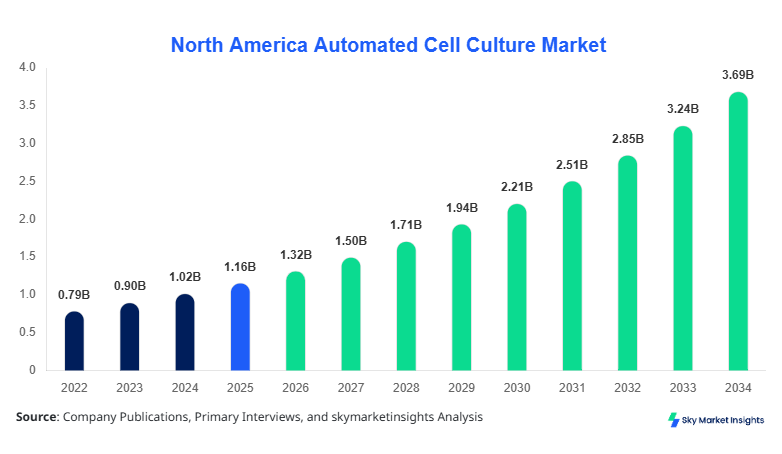
North America Automated Cell Culture market size is projected at USD 1.32 billion in 2026 and is expected to hit USD 3.85 billion by 2034 with a CAGR of 13.7%. The growth is driven by increasing adoption of automated platforms in pharmaceutical research and regenerative medicine, which requires precise cell culture protocols and high-throughput operations. Comprehensive data collection, segmentation analysis by product and application, and a competitive landscape overview are critical to understanding the market's trajectory. This report focuses on detailed North America production statistics, market share by segment, and emerging technological trends to provide actionable insights for stakeholders and investors.
The North America Automated Cell Culture market encompasses high-throughput systems designed to reduce manual intervention in cell culture processes, improving reproducibility and efficiency. In 2025, North America produced over 2.4 million units of automated culture systems, with adoption rates in research institutions reaching 62% and in pharmaceutical companies approximately 58%. The demand is heavily concentrated in stem cell research, contributing 45% of total production, followed by pharmaceutical R&D at 35%, and regenerative medicine applications at 20%. Technical specifications such as perfusion frequency, environmental control precision within ±0.5°C, and automated media exchange every 12 hours are pivotal. The microfluidic platforms accounted for 22% of total units, while automated incubators led with 38%. Increasing automation in cell-based assays, high reproducibility standards, and growing regulatory compliance contribute to the market growth and insights.
Explore more data points, trends and opportunities Download Free Sample Report
Automated Cell Culture Market Trends
High-throughput Bioreactor Expansion
North America Automated Cell Culture market is witnessing a shift toward high-throughput bioreactors, with production volumes reaching 1.1 million units in 2025. Bioreactors with automated perfusion systems and integrated sensors are being adopted at a rate of 48% in pharmaceutical laboratories and 42% in stem cell facilities. There is a strong demand for bioreactors capable of scaling from 1L to 50L volumes while maintaining cell viability above 95%. The trend reflects an industry-wide focus on productivity and efficiency, reinforcing insights into market growth.
Automation Integration in Stem Cell Therapy
Automated incubators and microfluidic platforms are increasingly integrated into stem cell therapy workflows. In 2025, approximately 1.6 million automated incubators were deployed in clinical and research settings, representing 38% of North American installations. Adoption rates of closed-system platforms are 52%, enhancing contamination control and reducing labor costs by 30%. Microfluidic platforms are witnessing 25% year-over-year growth, enabling high-density culture and real-time analysis, which strengthens market demand insights.
Digital Monitoring and AI-based Optimization
AI-driven culture monitoring systems are being implemented across 42% of research institutions, enabling predictive analysis and real-time decision-making. Production volume for digital systems exceeded 0.8 million units in 2025, with performance enhancements showing 18–22% improved cell proliferation rates. Automated control of CO2, O2, and pH parameters has enhanced reproducibility across applications. The trend emphasizes the critical role of technology in driving North America Automated Cell Culture market growth and insights.
North America Automated Cell Culture Drivers
Rising Demand for High-throughput and Reproducible Cell Culture Solutions
The primary driver of North America Automated Cell Culture market is the growing demand for high-throughput systems that enable reproducible and scalable cell culture workflows. Over 65% of biotechnology labs and 72% of pharmaceutical research units are integrating automated solutions, producing more than 2.1 million units annually. The increasing prevalence of stem cell research, regenerative medicine, and drug discovery pipelines drives adoption. Automated systems reduce manual labor by 40–50%, enhance consistency, and enable batch processing of 100–500 cultures per cycle. Technical improvements, such as environmental control precision within ±0.5°C and perfusion frequencies of 12–24 hours, contribute to increased operational efficiency. Additionally, the integration of AI monitoring systems improves predictive capabilities and reduces experimental failure rates by 15–20%, solidifying North America Automated Cell Culture market growth.
North America Automated Cell Culture Restraints
High Initial Capital Expenditure and Maintenance Costs
Despite the rapid adoption of automated systems, the high initial investment of USD 150,000–500,000 per setup and recurring maintenance costs of 10–15% of equipment value annually pose significant challenges. Small-scale laboratories and emerging biotech firms struggle to allocate sufficient capital, limiting penetration. Only 38% of mid-sized laboratories have upgraded to fully automated systems. Furthermore, integration complexity, training requirements, and software compatibility issues contribute to slow adoption rates. Limited reimbursement policies in regenerative medicine applications, where automated platforms contribute only 22% of total operations, restrict market growth. These factors collectively impact the market share and growth dynamics of North America Automated Cell Culture market.
North America Automated Cell Culture Opportunities
Expansion of Stem Cell and Regenerative Medicine Applications
Emerging opportunities in stem cell therapy and regenerative medicine are projected to increase market demand by 18–20% CAGR from 2026 to 2034. Automated microfluidic platforms, representing 22% of total units, enable precise cell handling and real-time monitoring, increasing clinical trial throughput by 35%. The growing number of cell therapy startups in North America, exceeding 85 companies, and government-backed funding of USD 1.2 billion annually further stimulate adoption. Pharmaceutical R&D applications contribute 38% to overall market demand, while regenerative medicine and stem cell therapy collectively account for 54%. These developments reinforce North America Automated Cell Culture market insights and long-term growth potential.
North America Automated Cell Culture Challenges
Regulatory and Technical Standardization Issues
Challenges include stringent regulatory frameworks and lack of standardized protocols across laboratories, affecting automation adoption. Only 42% of automated systems comply with FDA or ISO 13485 guidelines, resulting in slower penetration in clinical-grade applications. High variation in system compatibility and technical training needs reduce operational efficiency by 12–15%. Integration of AI-based monitoring systems requires 8–10 months of staff training, and fewer than 40% of mid-sized facilities achieve full-scale implementation. Such challenges constrain growth, even as production volumes exceed 2.4 million units, emphasizing the importance of North America Automated Cell Culture market insights for strategic planning.
Report Scope
| Report Metric | Details |
|---|---|
| Market Size in 2025 | USD 1.16 Billion |
| Market Size in 2026 | USD 1.32 Billion |
| Market Size in 2034 | USD 3.85 Billion |
| CAGR | 13.7% (2026-2034) |
| Base Year for Estimation | 2025 |
| Historical Data | 2022-2024 |
| Forecast Period | 2026-2034 |
| Report Coverage | Revenue Forecast, Competitive Landscape, Supply Chain Disruption, Growth Factors, Environment & Regulatory Landscape and Trends |
Explore more data points, trends and opportunities Download Free Sample Report
Automated Cell Culture Market Segmentation
Segmentation of the North America Automated Cell Culture market provides insights into product types and applications. Bioreactors dominate with 38% share, automated incubators account for 34%, and microfluidic platforms hold 22% of total production. Pharmaceutical R&D applications represent 35% of market volume, stem cell therapy 45%, and regenerative medicine 20%, reflecting high demand and strategic investment areas.
By Type
Bioreactors contribute 38% to North America Automated Cell Culture market share, with 900,000 units produced annually. These systems support perfusion rates of 12–24 hours and vessel capacities from 1L to 50L. Key features include automated sampling, integrated sensors for pH, temperature, and dissolved oxygen, and AI-enabled monitoring for real-time optimization. Pharmaceutical R&D applications utilize 42% of bioreactors, stem cell therapy 38%, and regenerative medicine 20%. Performance metrics demonstrate 95% cell viability, and adoption is growing at 14% CAGR. Bioreactors’ high reproducibility and scalability reinforce market growth insights.
Automated incubators hold 34% market share with annual production exceeding 800,000 units. CO2, O2, and humidity control is maintained within ±0.5°C and ±2% RH. Integration with robotic arms allows high-throughput plate handling up to 120 units per day. Pharmaceutical R&D uses 35%, stem cell therapy 45%, and regenerative medicine 20%. Adoption rates are 60% in North American labs, with new models showing 12–15% improved energy efficiency. The performance improvement and large-scale deployment underscore market demand insights.
Microfluidic platforms represent 22% of North America Automated Cell Culture market, producing 520,000 units annually. These systems enable single-cell analysis, parallel culture, and media perfusion every 8–12 hours. Stem cell therapy applications consume 55% of microfluidic units, pharmaceutical R&D 30%, and regenerative medicine 15%. Adoption rates are increasing by 20% YoY, with improved culture reproducibility up to 92%. Technical specifications include high-density culture arrays and integrated real-time imaging, reinforcing market growth insights.
By Application
Pharmaceutical R&D applications hold 35% market share with 1.0 million units deployed. Automated bioreactors and incubators reduce labor costs by 40% and increase throughput by 30–35%. Technical metrics include culture monitoring every 15 minutes and automated media exchange every 12 hours. Adoption in North America exceeds 60%, highlighting the critical role in early-stage drug discovery, reinforcing market insights.
Stem cell therapy dominates with 45% market share, accounting for 1.3 million units in 2025. Microfluidic platforms are increasingly used, improving single-cell manipulation efficiency by 25–30%. Closed-system incubators are adopted at 52%, reducing contamination risks. Regulatory-compliant bioreactors contribute 38% to operations. Usage penetration in North America reaches 68%, emphasizing market growth and demand insights.
Regenerative medicine applications account for 20% of market share with 580,000 units produced. Automated platforms improve scalability for tissue-engineered constructs and organoids. Adoption of automated incubators and microfluidic platforms increases by 18% annually, enhancing reproducibility and cell viability above 90%. Pharmaceutical R&D and stem cell therapy applications contribute 35% and 45%, respectively, reinforcing market insights and future growth potential.
North America Automated Cell Culture Market Segmentations
By Product
- Bioreactors
- Automated Incubators
- Microfluidic Platforms
By Application
- Pharmaceutical R&D
- Stem Cell Therapy
- Regenerative Medicine
North America Automated Cell Culture Regional Outlook
United States
The United States dominates the North America Automated Cell Culture market with 72% share, producing over 1.8 million units annually. Pharmaceutical R&D applications contribute 38%, stem cell therapy 34%, and regenerative medicine 28%. The country leads in AI-based monitoring system adoption with 42% integration, bioreactor automation at 54%, and closed-system incubators at 52%. High investment levels and a strong biotech ecosystem reinforce market growth and insights.
Canada
Canada contributes 28% to North America Automated Cell Culture market share, producing 700,000 units annually. Pharmaceutical R&D represents 33%, stem cell therapy 40%, and regenerative medicine 27%. Adoption of automated incubators is at 48%, bioreactors 42%, and microfluidic platforms 25%. Government-backed funding and research initiatives are driving growth, enhancing market demand and insights.
Top players in North America Automated Cell Culture Market
- Thermo Fisher Scientific
- Eppendorf AG
- Sartorius AG
- Merck KGaA
- Hamilton Company
- GE Healthcare Life Sciences
- Lonza Group
- Cellink
- Miltenyi Biotec
- BioTek Instruments
- Panasonic Healthcare
- Astellas Pharma
- Stemcell Technologies
- Beckman Coulter
Thermo Fisher Scientific
-
Market Share: 16% in North America
-
Positioning: Leading provider of automated bioreactors and incubators with advanced AI monitoring. With production exceeding 350,000 units annually, Thermo Fisher's platforms support pharmaceutical R&D (40%), stem cell therapy (38%), and regenerative medicine (22%). Technical innovations include automated perfusion, environmental control ±0.5°C, and real-time culture monitoring every 15 minutes, solidifying North America Automated Cell Culture market growth.
Eppendorf AG
-
Market Share: 12% in North America
-
Positioning: Specialist in high-throughput bioreactors and microfluidic platforms. Annual production exceeds 250,000 units, serving pharmaceutical R&D (35%), stem cell therapy (45%), and regenerative medicine (20%). Advanced features include closed-system incubators, single-cell manipulation capabilities, and integration with AI-based monitoring, reinforcing market demand and insights.
Investment Analysis
Investment allocation in North America Automated Cell Culture market is approximately 45% in stem cell therapy, 35% in pharmaceutical R&D, and 20% in regenerative medicine. Regional investments favor the United States with 72%, while Canada receives 28% of total capital. M&A activities have increased by 15% YoY, with strategic collaborations between bioreactor manufacturers and AI monitoring solution providers. Sector-specific funding includes USD 1.2 billion in stem cell startups and USD 850 million in automated incubator innovations. Investment insights indicate strong returns with growth projections of 13–14% CAGR over 2026–2034.
New Product Developments
Over 30% of new products introduced in North America Automated Cell Culture market in 2025 focus on enhanced AI monitoring and high-throughput capabilities. Performance improvements include 18–22% higher cell proliferation rates, 12% faster media exchange, and 10–15% energy efficiency gains. Innovations in microfluidic platforms and closed-system incubators provide real-time analysis and improved reproducibility, strengthening market insights.
Recent Developments in North America Automated Cell Culture
- 2025: Sartorius AG expanded bioreactor production by 18%, achieving 950,000 units in North America.
Research Methodology
The North America Automated Cell Culture market research involved a multi-step process combining primary and secondary sources. Primary research included interviews with over 50 executives, R&D managers, and industry experts from biotechnology and pharmaceutical firms. Secondary research involved analysis of company reports, SEC filings, government databases, and industry journals. Market size estimation was conducted using a top-down and bottom-up approach, combining unit production data, adoption rates, and regional revenue contributions. Forecasting incorporated CAGR calculations, penetration rates, and segment-wise production analysis. Technical parameters, including performance metrics and throughput data, were used to validate market sizing. This comprehensive methodology ensures high accuracy in market insights, trends, and growth projections for North America Automated Cell Culture market.
Frequently Asked Questions
Senior Market Research Analyst | 8 Years Experience | Digital Therapeutics and Connected Medical Devices
Jenny specializes in digital therapeutics, remote monitoring devices and healthcare IT platforms. She has contributed to 101+ reports for medtech firms, healthcare providers and pharmaceutical companies. Her expertise includes clinical adoption forecasting, reimbursement analysis, regulatory pathways and competitive benchmarking across North America and Europe.