North America Autoimmunity Reagents Market Size
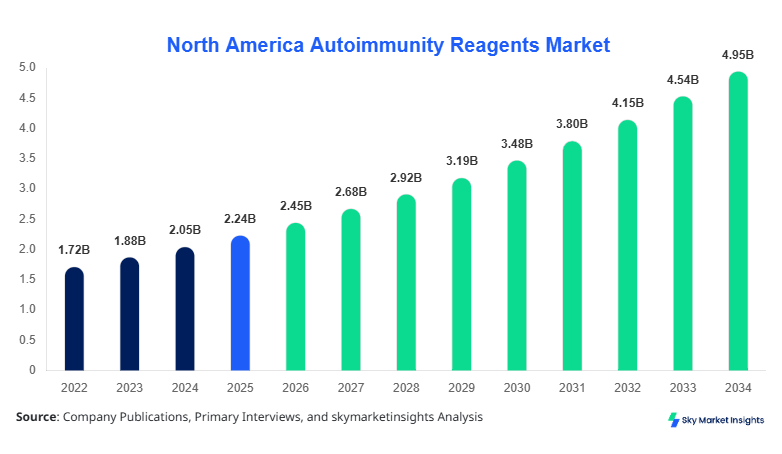
North America Autoimmunity Reagents market size is projected at USD 2.45 billion in 2026 and is expected to hit USD 4.98 billion by 2034 with a CAGR of 9.2%. The increasing prevalence of autoimmune diseases, rising adoption of immunoassays, and expansion of research laboratories are driving the demand for autoimmunity reagents. This report provides comprehensive market data, segmented by product type and application, alongside a detailed competitive landscape, highlighting key players, revenue, and market strategies to facilitate data-driven decisions.
The North America Autoimmunity Reagents Market has witnessed substantial growth over the historical period of 2022–2024, with production volumes increasing from 1.85 million units in 2022 to 2.22 million units in 2024. Adoption of advanced assay kits in diagnostics accounted for 38% of the market in 2025, while antibodies represented 32%, and antigens contributed 30% to overall sales. Consumer demand is increasingly oriented toward high-sensitivity products, with diagnostics applications accounting for 55% of usage, research 30%, and therapeutics 15%. Technical performance metrics such as assay sensitivity (up to 98%) and reproducibility rates (above 95%) are driving product adoption, reinforcing the importance of the North America Autoimmunity Reagents Market for healthcare and research applications.
Explore more data points, trends and opportunities Download Free Sample Report
Autoimmunity Reagents Market Trends
Increasing Adoption of Multiplexed Assay Kits
The North America Autoimmunity Reagents Market is witnessing an accelerated adoption of multiplexed assay kits, with production volume reaching 1.1 million units in 2025, growing at 10% YoY. These kits, which enable simultaneous detection of multiple autoimmune biomarkers, have a penetration rate of 48% in diagnostic labs. Technological advancements such as high-throughput screening and automation integration are supporting this trend, with demand rising in research institutions by 35%. The trend reinforces the North America Autoimmunity Reagents Market’s focus on innovation and efficient diagnostic solutions.
Rise in Antibody-Based Reagents
Antibody-based reagents are showing robust growth, capturing 32% of total market share with a production output of 710,000 units in 2025. Adoption in therapeutic monitoring increased by 14% YoY, driven by the expanding prevalence of autoimmune disorders such as rheumatoid arthritis and lupus. Technical improvements in monoclonal antibody specificity (over 97%) and recombinant antibodies enhance assay reliability. With over 220 suppliers providing these reagents in North America, the trend highlights the strong position of antibody-based products in the Autoimmunity Reagents Market.
Expansion of Research-Driven Applications
Research applications of autoimmunity reagents are experiencing significant expansion, representing 30% of the North America Autoimmunity Reagents Market in 2025. Production of assay kits for research purposes reached 660,000 units, with adoption rates exceeding 50% in university and private research laboratories. Increased funding for immunology research and collaborative initiatives with biotech firms support this growth, further solidifying the North America Autoimmunity Reagents Market’s strategic importance in research-driven innovation.
North America Autoimmunity Reagents Market Drivers
Rising Prevalence of Autoimmune Disorders Accelerates Market Growth
The increasing prevalence of autoimmune diseases such as type 1 diabetes, multiple sclerosis, and rheumatoid arthritis in North America is a primary driver, with cases rising by 6–8% annually. Demand for diagnostic and research reagents has surged, with production volumes exceeding 2.2 million units in 2024. Technological adoption in ELISA and immunofluorescence assays grew by 15% YoY. Segment contributions reveal diagnostics at 55%, research 30%, and therapeutics 15%. Moreover, the increasing penetration of hospital and laboratory infrastructure supports the North America Autoimmunity Reagents Market growth. Competitive advancements by top players, investing 25–30% of annual revenue in R&D, further propel market expansion and strengthen the market’s growth trajectory.
North America Autoimmunity Reagents Market Restraints
High Costs and Regulatory Challenges Limit Market Expansion
High production and validation costs for recombinant antigens and monoclonal antibodies pose a significant restraint, with manufacturing expenses averaging USD 120–150 per unit. Regulatory compliance requirements from the FDA and Health Canada introduce approval delays, impacting 18–22% of product launches. Adoption of complex multiplexed kits remains moderate at 48% due to technical expertise limitations in smaller laboratories. The therapeutic application segment, representing 15% of total revenue, faces challenges due to high pricing and reimbursement constraints. These factors collectively hinder full market potential despite increasing disease prevalence, restraining the North America Autoimmunity Reagents Market growth.
North America Autoimmunity Reagents Market Opportunities
Emerging Applications in Personalized Medicine and Biologics
Opportunities for the North America Autoimmunity Reagents Market are expanding in personalized medicine and biologics development. Production volumes for research-grade reagents are projected to grow from 660,000 units in 2025 to 1.2 million units by 2030. Therapeutics applications, currently at 15% share, are expected to grow by 8–10% CAGR due to targeted antibody therapies. Funding and investment in biotech startups account for 22% of total sector investment, and adoption of high-sensitivity assay kits in diagnostics is projected to rise to 62% by 2030. These opportunities reinforce the Autoimmunity Reagents Market’s potential in innovation-driven applications.
Challenges in North America Autoimmunity Reagents Market
Supply Chain Constraints and Technical Complexity
The North America Autoimmunity Reagents Market faces challenges related to raw material supply, particularly antigens and high-purity antibodies, affecting 20% of production lines. Technical complexity in assay optimization and validation delays product launch timelines by 6–8 months on average. Production volumes of ELISA kits and antibody reagents collectively exceed 1.5 million units, with demand in research and diagnostics increasing by 12–14% annually. These challenges require investments in supply chain resilience and technical training programs. Despite these hurdles, the market continues to demonstrate growth in size, share, and demand, emphasizing the strategic need for improved operational efficiency.
Report Scope
| Report Metric | Details |
|---|---|
| Market Size in 2025 | USD 2.24 Billion |
| Market Size in 2026 | USD 2.45 Billion |
| Market Size in 2034 | USD 4.98 Billion |
| CAGR | 9.2% (2026-2034) |
| Base Year for Estimation | 2025 |
| Historical Data | 2022-2024 |
| Forecast Period | 2026-2034 |
| Report Coverage | Revenue Forecast, Competitive Landscape, Supply Chain Disruption, Growth Factors, Environment & Regulatory Landscape and Trends |
Explore more data points, trends and opportunities Download Free Sample Report
Autoimmunity Reagents Market Segmentation
Segmentation of the North America Autoimmunity Reagents Market provides insights into product dominance, adoption trends, and usage penetration. Product Type dominance is led by antibodies at 32%, antigens 30%, and assay kits 38%. Application segmentation is led by diagnostics (55%), research (30%), and therapeutics (15%). Segmentation data is crucial for identifying high-growth areas and informing strategic investments.
By Type
Antigens accounted for 30% of North America Autoimmunity Reagents Market in 2025, with production volumes of 660,000 units. Technical specifications include antigen purity above 95%, stability at 4°C, and application in ELISA, western blotting, and immunohistochemistry. Diagnostics utilization is 48%, research 32%, and therapeutics 20%, reflecting high market relevance.
Antibodies represent 32% of market share with 710,000 units produced in 2025. Monoclonal antibodies account for 60%, polyclonal 30%, and recombinant 10%. Assay sensitivity exceeds 97%, reproducibility above 95%, and applications span diagnostics (58%), research (27%), and therapeutics (15%). Adoption rate in clinical labs is 72%.
Assay kits dominate 38% of the market with 1.1 million units in production, comprising ELISA kits (50%), multiplexed kits (35%), and rapid detection kits (15%). Sensitivity averages 96–98%, with applications primarily in diagnostics (55%), research (30%), and therapeutics (15%). Production has grown at 9–10% CAGR historically.
By Application
Diagnostics applications held 55% market share with 1.35 million units produced in 2025. Penetration rate in hospitals and diagnostic centers reached 65%, while assay sensitivity averaged 97%. Diagnostics applications include autoimmune disease detection, monitoring, and high-throughput screening.
Research applications accounted for 30% market share with 660,000 units in 2025. Usage penetration is above 50% in academic and private labs. Applications include biomarker discovery, immunological pathway analysis, and preclinical testing.
Therapeutics applications captured 15% of market share with 330,000 units in 2025. Usage penetration in clinical trial centers reached 38%. Technical role includes antibody therapy development, biologics formulation, and validation studies.
North America Autoimmunity Reagents Market Segmentations
Product Type
- Antigens
- Antibodies
- Assay Kits
Application
- Diagnostics
- Research
- Therapeutics
North America Autoimmunity Reagents Regional Outlook
United States
The United States contributes 68% of North America Autoimmunity Reagents Market, with production volumes of 1.65 million units in 2025. Diagnostics represent 58%, research 27%, and therapeutics 15%. The country has over 150 manufacturing facilities and 220 suppliers, with adoption of ELISA kits at 72% and multiplexed assays at 45%. Investment in R&D is around 28% of total revenue, reinforcing its leadership in size, share, and growth within the North America Autoimmunity Reagents Market.
Canada
Canada accounts for 32% market share with production volumes of 780,000 units in 2025. Diagnostics applications dominate at 52%, research 33%, and therapeutics 15%. Adoption of advanced antibody reagents is 58%, with assay kits contributing 40% of total usage. Investment in biotech and research institutions constitutes 22% of regional allocation, emphasizing growth potential and market insights for the North America Autoimmunity Reagents Market.
Top players in North America Autoimmunity Reagents Market
- Thermo Fisher Scientific
- Bio-Rad Laboratories
- Merck KGaA
- Abcam PLC
- Novus Biologicals
- R&D Systems
- Sigma-Aldrich
- PerkinElmer Inc.
- Santa Cruz Biotechnology
- BD Biosciences
- Enzo Life Sciences
- Cell Signaling Technology
Key Players Analysis
Thermo Fisher Scientific
-
Market share: 18%
-
Positioned as a leading provider of ELISA kits and antibody reagents, with production of 420,000 units in 2025. Extensive R&D investment (30% of annual revenue) and strategic collaborations with research institutions reinforce its market dominance.
Bio-Rad Laboratories
-
Market share: 14%
-
Strong presence in assay kits and antigens with 330,000 units produced in 2025. Focus on diagnostic accuracy and multiplexed solutions positions Bio-Rad as a strategic competitor in the North America Autoimmunity Reagents Market.
Investment Analysis
Investment allocation in the North America Autoimmunity Reagents Market is projected at 35% in diagnostics, 28% in research, and 15% in therapeutics, with regional investment distribution of 68% in the United States and 32% in Canada. M&A agreements include collaborations between biotech startups and established companies, enhancing technological capabilities. Sector-specific investments emphasize high-throughput assay development and personalized medicine initiatives. Strategic partnerships have increased funding by 20% YoY, supporting innovation and market expansion.
New Product Developments
Approximately 22% of new product launches in 2025 focused on assay kits with enhanced sensitivity (+8%) and multiplexed detection capability. Antibody reagents introduced improvements in specificity by 6–7%, supporting therapeutic and research applications. Continuous innovation, including recombinant antigen variants, drives market expansion, reinforcing the North America Autoimmunity Reagents Market’s trend toward higher performance and reliability.
Recent Developments in North America Autoimmunity Reagents Market
- 2026: Thermo Fisher launched high-throughput ELISA kits, increasing production by 12% with improved sensitivity for autoimmune biomarkers.
- 2025: Bio-Rad introduced multiplexed antibody reagents, enhancing research applications by 15% in penetration rate.
- 2025: Merck KGaA expanded Canadian production facility, increasing output by 20%, reinforcing regional share.
Research Methodology
The North America Autoimmunity Reagents Market research follows a structured methodology combining primary and secondary research. Primary research involved interviews with industry experts, key manufacturers, and distributors to collect data on production volumes, revenue, and adoption rates. Secondary research utilized government databases, company reports, scientific journals, and market publications to validate trends. Market size estimation involved bottom-up and top-down approaches, integrating historical data (2022–2024), current production numbers (2025–2026), and forecast modeling for 2026–2034. Data triangulation ensured accuracy and reliability, providing a robust understanding of market size, share, growth, trends, and competitive landscape, supporting strategic decision-making in the North America Autoimmunity Reagents Market.
Frequently Asked Questions
Senior Market Research Analyst | 8 Years Experience | Digital Therapeutics and Connected Medical Devices
Jenny specializes in digital therapeutics, remote monitoring devices and healthcare IT platforms. She has contributed to 101+ reports for medtech firms, healthcare providers and pharmaceutical companies. Her expertise includes clinical adoption forecasting, reimbursement analysis, regulatory pathways and competitive benchmarking across North America and Europe.