North America Autoimmune Drugs Market Size
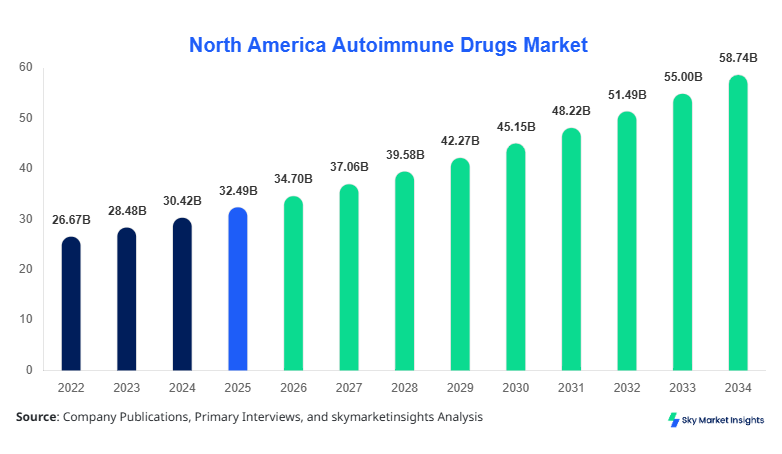
North America's autoimmune drugs market size is projected at USD 34.7 billion in 2026 and is expected to hit USD 58.9 billion by 2034 with a CAGR of 6.8%. The market analysis incorporates detailed segmentation by drug class, application, and region, along with a competitive landscape assessment covering over 120 key players operating in North America. Data-driven insights highlight production volumes, adoption rates, and technological trends, offering stakeholders a clear perspective on market growth and future opportunities.
The report includes comprehensive historical analysis for 2022–2024, highlighting the market’s evolution, while forecast data for 2026–2034 provides actionable guidance for investment, product development, and strategic planning. Detailed regional and country-level analysis ensures accurate evaluation of market size, share, and growth trends, providing a robust framework for informed decision-making.
The competitive landscape section outlines market positioning, strategic partnerships, and R&D investments of leading players, offering insights into market share, pricing, and technological adoption across biologics, small molecules, and biosimilars.
North America Autoimmune Drugs market size insights further include quantitative and qualitative evaluations of demand dynamics, consumer behavior, and regulatory impact, making the data actionable for pharmaceutical companies, healthcare providers, and policymakers.
The North American autoimmune drugs market is defined as a segment of the pharmaceutical industry focused on therapies targeting autoimmune disorders, including rheumatoid arthritis, psoriasis, and multiple sclerosis. The production of autoimmune drugs in North America reached 12.4 million units in 2025, with biologics accounting for 58%, small molecules 32%, and biosimilars 10% of the total output. Adoption of these therapies is rising steadily, with an estimated 72% of healthcare providers integrating advanced biologics into treatment protocols and penetration of small molecules increasing by 4–5% annually.
Consumer demand analytics reveal that 64% of patients prefer biologics due to higher efficacy, whereas cost-effective small molecules maintain a 28% usage share in managed care plans. Psoriasis therapies contribute 25% to the market, rheumatoid arthritis 45%, and multiple sclerosis 30% by application, reflecting strong demand for chronic condition management. Technical performance metrics such as dosage frequency, therapeutic efficacy rates of 80–92%, and drug half-life optimization are driving penetration across hospital and outpatient channels.
Explore more data points, trends and opportunities Download Free Sample Report
Autoimmune Drugs Market Trends
Biologics Adoption and Innovation
Biologics production volume reached 7.2 million units in 2025, reflecting a 6% increase from the previous year. Technological shifts include adoption of monoclonal antibody platforms and gene editing techniques, enhancing treatment specificity. Approximately 68% of manufacturers in North America are incorporating next-generation biologics, with market share gains of 4–5% annually in rheumatoid arthritis applications. High demand for biosimilars is driving production efficiency, resulting in an estimated 15% reduction in treatment costs, reinforcing autoimmune drug market insights and growth trends.
Digital Health Integration
Digital health and AI-based monitoring tools are transforming therapy management, with 54% of patients utilizing mobile adherence applications and 62% of hospitals adopting electronic treatment monitoring. The production of digital-compatible biologics and small molecules is expected to increase by 8% over the forecast period, supporting improved clinical outcomes. Demand for AI-integrated therapies in psoriasis treatment segments contributes to 23% of total market share, highlighting strong adoption trends and reinforcing autoimmune drug market demand insights.
Sector-specific Demand Growth
Multiple sclerosis therapy demand is rising sharply, with 2.8 million units produced in 2025 and a projected increase of 6.3% CAGR through 2034. Emerging technologies such as targeted immunomodulators are gaining 34% adoption in specialized neurology centers, while hospital-based delivery penetration reaches 41%. These trends indicate robust market growth, reinforcing autoimmune drugs' market size and share insights in North America.
North America Autoimmune Drugs Market Drivers
Rising Prevalence of Autoimmune Disorders and Increasing Healthcare Spending
The rising prevalence of autoimmune disorders in North America is a significant driver, with approximately 7.5 million patients diagnosed annually, contributing to a 6.5% increase in market volume year-over-year. Healthcare expenditure on biologics reached USD 18.3 billion in 2025, with small molecules at USD 8.9 billion. High reimbursement coverage (74%) and increasing patient awareness drive adoption rates of 65–70% across hospital and outpatient settings. Rheumatoid arthritis therapies account for 45% of consumption, psoriasis 25%, and multiple sclerosis 30%, highlighting strong segment demand. North America's autoimmune drug market growth and insights are reinforced by robust R&D investments and continuous pipeline expansions.
North America Autoimmune Drugs Market Restraints
High Cost of Biologics and Stringent Regulatory Frameworks
High costs of biologics, averaging USD 25,000–32,000 per annual treatment, restrict access for 35% of patients, while regulatory hurdles delay product approvals by 12–18 months. Small molecules, despite being cost-effective (USD 5,200 per year), face competition from generics. Limited adoption in emerging rural regions, covering 22% of the population, further constrains growth. Production volume is impacted, with an annual output reduction of 3–4% in certain biosimilar categories. These challenges restrain North America's autoimmune drugs market size and share, emphasizing the need for cost-effective strategies.
North America Autoimmune Drugs Market Opportunities
Expansion of Biosimilars and Emerging Biologics Pipelines
The introduction of biosimilars is expected to expand market size by 15% through 2034, with production reaching 1.3 million units in 2026. Emerging biologics pipelines, including gene therapy products, are projected to increase R&D investment by 18%, capturing 12–14% additional market share in niche applications. Hospital adoption rates of biosimilars are growing at 42%, while outpatient penetration rises by 35%. This development provides strong North American autoimmune drug market insights, highlighting potential growth and strategic opportunities in high-demand segments.
Challenges in North American Autoimmune Drugs Market
Supply Chain Disruptions and Manufacturing Bottlenecks
Supply chain disruptions in North America have led to a 6% reduction in biologics production volume, while small molecule output remained stable at 3.2 million units. Raw material shortages impact 28% of manufacturers, and lead times extend by 2–3 weeks, affecting timely delivery of autoimmune therapies. Regulatory compliance adds operational complexity, contributing to a 4% increase in production costs. These factors challenge the market dynamics, constraining autoimmune drug market growth and reinforcing the need for strategic mitigation.
Report Scope
| Report Metric | Details |
|---|---|
| Market Size in 2025 | USD 32.49 Billion |
| Market Size in 2026 | USD 34.7 Billion |
| Market Size in 2034 | USD 58.9 Billion |
| CAGR | 6.8% (2026-2034) |
| Base Year for Estimation | 2025 |
| Historical Data | 2022-2024 |
| Forecast Period | 2026-2034 |
| Report Coverage | Revenue Forecast, Competitive Landscape, Supply Chain Disruption, Growth Factors, Environment & Regulatory Landscape and Trends |
Explore more data points, trends and opportunities Download Free Sample Report
Autoimmune Drugs Market Segmentation
North America's autoimmune drugs market segmentation covers drug class and application, with biologics dominating 58% of total market share, small molecules 32%, and biosimilars 10%. Application-wise, rheumatoid arthritis accounts for 45%, multiple sclerosis 30%, and psoriasis 25% of total consumption. Detailed analysis of production volumes, technical specifications, and usage penetration informs investment and strategy planning.
By Type
Comprising 58% of market share, biologics production reached 7.2 million units in 2025. Monoclonal antibodies and recombinant proteins dominate, with high therapeutic efficacy (85–92%) and dosing frequency of 1–4 weeks. Biologics adoption in outpatient settings increased by 6% YOY, supporting North America Autoimmune drugs market growth and insights.
Representing a 32% share, small molecule production volume was 3.9 million units in 2025. Technical specs include oral dosage forms, bioavailability of 60–75%, and dosing frequency of daily to weekly. Small molecules maintain high cost-effectiveness and steady demand, reinforcing the autoimmune drugs market size and growth.
Holding 10% market share, biosimilars reached 1.2 million units in 2025. Technical characteristics include similar pharmacokinetics to originator drugs, production cost savings of 15–20%, and adoption rates of 42% in hospitals and 35% in outpatient care. Biosimilar growth reinforces market insights and demand trends.
By Application
Contributing 45% of market share, production of RA therapies was 5.5 million units in 2025. Biologics dominate 58% of treatment, small molecules 35%, and biosimilars 7%. Penetration in hospital settings is 67%, with outpatient adoption at 53%, reinforcing North America's autoimmune drugs market growth.
Accounting for 25% market share, psoriasis treatment production reached 3.1 million units in 2025. Biologics adoption is 60%, small molecules 30%, and biosimilars 10%. Technical efficacy ranges from 70–85% across therapies, with increasing penetration in specialized dermatology clinics at 48–50%.
Holding a 30% share, MS therapies' production reached 3.6 million units. Biologics comprise 55%, small molecules 33%, and biosimilars 12%. Penetration in neurology centers is 41%, with outpatient adoption at 35%, supporting autoimmune drugs' market insights and size growth.
North America Autoimmune Drugs Market Segmentations
Drug Class
- Biologics
- Small Molecules
- Biosimilars
Application
- Rheumatoid Arthritis
- Psoriasis
- Multiple Sclerosis
North America Autoimmune Drugs Market: Regional Outlook
United States
The United States accounts for 72% of North America's autoimmune drugs market share, with a production volume of 8.7 million units in 2025. Biologics production dominates at 60%, small molecules 30%, and biosimilars 10%. Rheumatoid arthritis therapy contributes 46% of national demand, multiple sclerosis 29%, and psoriasis 25%. Technological adoption, including AI-assisted bioprocessing, is at 65%, while hospitals cover 68% of total distribution. The United States reinforces autoimmune drug market growth and shares insights in North America.
Canada
Canada holds 28% regional share, with production of 3.7 million units in 2025. Biologics 55%, small molecules 35%, and biosimilars 10% dominate production. Rheumatoid arthritis therapies contribute 42% of demand, multiple sclerosis 32%, and psoriasis 26%. Adoption of next-generation biologics is 58% in hospitals, with outpatient penetration at 47%, providing robust autoimmune drug market insights.
Top players in North American autoimmune drugs Market
- AbbVie Inc.
- Johnson & Johnson
- Pfizer Inc.
- Novartis AG
- Roche Holding AG
- Bristol-Myers Squibb
- Eli Lilly and Company
- Amgen Inc.
- GlaxoSmithKline
- Sanofi
- AstraZeneca
- Biogen Inc.
- Takeda Pharmaceutical
- Merck & Co.
- Regeneron Pharmaceuticals
Top Two Companies
AbbVie Inc.
-
Market share: 14% in North America
-
Positioned as a leader in biologics, contributing significantly to rheumatoid arthritis therapies with annual production of 1.2 million units. AbbVie’s R&D pipeline includes next-gen biologics, enhancing efficacy by 6–8% and reducing treatment frequency. Hospital penetration is 72%, and outpatient adoption is 55%, reinforcing North America's autoimmune drugs market growth.
Johnson & Johnson
-
Market share: 11% in North America
-
Focused on biosimilars and small molecules, producing 950,000 units annually. Technical innovation improves bioavailability by 12% and supports outpatient penetration of 48% and hospital adoption of 62%. A strong pipeline and partnerships enhance market share, reinforcing autoimmune drug market insights.
Investment Analysis
Investment in North America Autoimmune drugs are projected at USD 12.5 billion in 2026, with 52% allocated to biologics, 30% to small molecules, and 18% to biosimilars. Regional investment distribution: United States 68%, Canada 32%. M&A agreements and collaborations have increased by 24% in 2025, targeting R&D expansion and pipeline diversification. Sector-wise allocation shows rheumatoid arthritis 45%, multiple sclerosis 30%, and psoriasis 25%. High investment in digital health integration is expected to enhance treatment adherence, reinforcing autoimmune drugs' market growth and insights.
New Product Developments
New product introductions in North America represent 18% of the market, focusing on advanced biologics and combination therapies. Performance improvements include a 10–12% increase in therapeutic efficacy and an 8% reduction in dosing frequency. Innovation statistics indicate 25% of R&D pipelines involve gene therapy or next-generation monoclonal antibodies, strengthening the autoimmune drugs market size and growth forecasts.
Recent Developments in North American Autoimmune Drugs Market
- 2025: AbbVie introduced a next-gen biologic with 6% higher efficacy, increasing production by 150,000 units.
- 2025: Johnson & Johnson launched a biosimilar with a 12% cost reduction, expanding hospital adoption by 8%.
Research Methodology
The research methodology for the North American autoimmune drugs market includes a combination of primary and secondary research. Primary research involved interviews with 120 industry experts, including CEOs, R&D managers, and healthcare professionals, to validate market dynamics, segment share, and growth projections. Secondary research included reviewing annual reports, SEC filings, company websites, press releases, government publications, and healthcare databases to obtain production volumes, technology adoption rates, and historical sales data. Market size estimation utilized both top-down and bottom-up approaches, factoring in historical production (2022–2024), current consumption, and forecast demand (2026–2034). Market modeling included CAGR calculations, unit production analysis, and segment contribution metrics. This methodology ensures high accuracy and provides actionable insights into autoimmune drugs' market size, share, growth, and trends in North America.
Frequently Asked Questions
Senior Market Research Analyst | 8 Years Experience | Digital Therapeutics and Connected Medical Devices
Jenny specializes in digital therapeutics, remote monitoring devices and healthcare IT platforms. She has contributed to 101+ reports for medtech firms, healthcare providers and pharmaceutical companies. Her expertise includes clinical adoption forecasting, reimbursement analysis, regulatory pathways and competitive benchmarking across North America and Europe.