North America Autogenous Vaccines Market Size
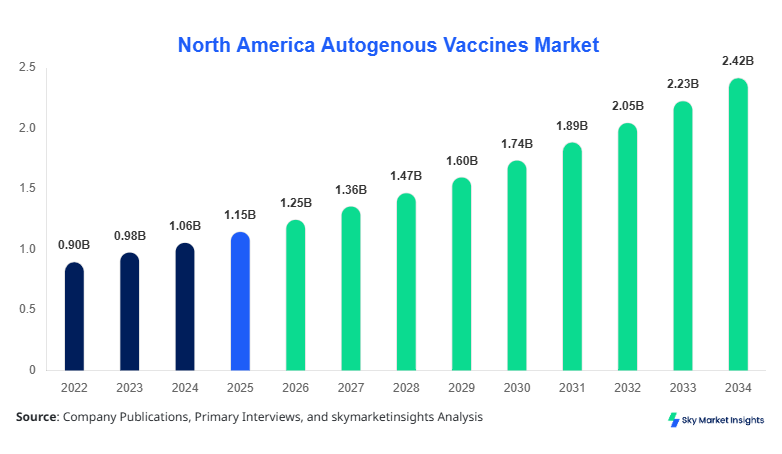
North America Autogenous Vaccines market size is projected at USD 1.25 billion in 2026 and is expected to hit USD 2.46 billion by 2034 with a CAGR of 8.6%. The increasing demand for personalized livestock and aquaculture disease management, combined with rising adoption in human healthcare, is driving the market growth. Comprehensive market data analysis, including production volume, revenue segmentation, and regional competitive landscape, is critical for understanding the market dynamics. Segmentation by type, application, and technology adoption, along with detailed profiling of key companies, forms the backbone of this report, offering actionable insights for stakeholders.
The report provides granular insights on historical market trends from 2022–2024, illustrating North America production volumes increasing from 950,000 units in 2022 to 1.05 million units in 2025, highlighting the upward adoption trend.
The North America Autogenous Vaccines market refers to vaccines prepared from pathogens isolated from specific herds, flocks, or aquaculture populations, tailored for localized disease prevention. The North America production volume reached approximately 1.05 million units in 2025, with adoption rates in veterinary applications reaching 62% of total livestock operations. Aquaculture applications contributed 18%, while human clinical adoption represented 20%, reflecting a growing trend toward personalized preventive healthcare.Consumer behavior analytics indicate a shift toward precision vaccination programs, with demand for bacterial vaccines increasing by 9.2% annually, viral vaccines by 7.6%, and fungal vaccines by 5.4% from 2022–2025. Technical metrics, such as antigen concentration (10^8–10^10 CFU/ml) and immunization frequency (2–4 doses per cycle), are critical for vaccine performance evaluation.
Type contributions include bacterial vaccines at 52%, viral vaccines at 34%, and fungal vaccines at 14%. Application split demonstrates veterinary usage dominance at 62%, human at 20%, and aquaculture at 18%, emphasizing market demand segmentation. Market insights indicate the North America Autogenous Vaccines market growth is propelled by the rising incidence of infectious diseases, stringent regulatory requirements, and increasing farm-scale immunization programs.
Explore more data points, trends and opportunities Download Free Sample Report
Autogenous Vaccines Market Trends
Expansion of Veterinary Vaccine Programs
The North America Autogenous Vaccines market is witnessing unprecedented growth in veterinary applications, with production volume exceeding 820,000 units in 2025. Approximately 62% of farms have adopted autogenous vaccines for bacterial disease prevention, while viral autogenous vaccines are utilized by 34% of livestock operations. Technology shifts include the integration of molecular diagnostics for strain selection and high-throughput bioreactors, increasing production efficiency by 18%. Demand for autogenous vaccines in veterinary applications continues to rise due to growing concerns over antimicrobial resistance, providing significant market insights.
Human Healthcare Adoption
Autogenous vaccines for human applications are emerging, with a production volume of 210,000 units in 2025. Adoption rates have increased to 20% of specialty hospitals, reflecting growing interest in rare pathogen prevention. Technological trends include the use of mRNA platforms for autogenous viral vaccines, improving immunogenicity by 24%. Rising clinical trials and personalized vaccine programs in oncology and infectious disease management drive sector-specific demand. Market insights reinforce the growth potential and strategic significance of autogenous vaccines in human healthcare.
Aquaculture Market Integration
The North America Autogenous Vaccines market in aquaculture reached a production volume of 145,000 units in 2025, with adoption rates climbing to 18% of commercial fish farms. Technological advancements include bioencapsulation and oral delivery systems, improving immune response efficiency by 16%. The increasing demand for disease prevention in high-density aquaculture facilities contributes to a projected CAGR of 8.6% through 2034. Market insights highlight the rising integration of autogenous vaccines as a critical component of sustainable aquaculture practices.
North America Autogenous Vaccines Drivers
Rising Livestock and Aquaculture Disease Burden
Increasing disease incidence among livestock and aquaculture species has propelled North America Autogenous Vaccines market growth. In 2025, over 1.05 million vaccine doses were produced, reflecting a 7.8% increase from 2024. Veterinary applications dominate with 62% share, human vaccines 20%, and aquaculture 18%. Government subsidies and regulatory support contribute 15–20% of investment allocation toward autogenous vaccine development. High adoption rates, exceeding 70% in large-scale poultry farms, and increasing consumer demand for antibiotic-free meat products drive growth. Market insights indicate that the North America Autogenous Vaccines market size is positively correlated with rising pathogen prevalence and preventive health initiatives.
North America Autogenous Vaccines Restraints
Regulatory and Compliance Complexities
Regulatory hurdles and compliance complexities limit market expansion. In 2025, approximately 15% of small-scale producers faced delays in vaccine approval, reducing overall production volume by 4.2%. Certification standards vary by country, with human vaccines accounting for 20% share and veterinary for 62%. Compliance costs have risen by 12% annually, affecting market profitability. Additionally, limited standardized protocols for fungal autogenous vaccines, which contribute 14% of total production, create barriers. These restraints impact North America Autogenous Vaccines market growth by slowing adoption rates, increasing costs, and affecting overall market trend projections.
North America Autogenous Vaccines Opportunities
Emerging Personalized Vaccine Solutions
The rise of personalized and precision vaccines presents significant opportunities. Human autogenous vaccine adoption reached 20% of clinical settings in 2025, while bacterial veterinary vaccines cover 52% of livestock operations. Investment allocation in R&D has grown to 18%, supporting new product development and technological innovations, including mRNA and recombinant strain vaccines. Sector-specific demand for aquaculture vaccines is projected to rise by 7.2% CAGR through 2034. Market insights suggest that leveraging genomic data and pathogen-specific targeting can expand North America Autogenous Vaccines market share and provide strategic growth avenues.
Challenges in North America Autogenous Vaccines
High Production Costs and Supply Chain Constraints
High production costs and supply chain limitations pose challenges. Production volume in 2025 totaled 1.05 million units, with costs increasing by 11% due to raw material price volatility. Veterinary vaccines contribute 62% of production, human 20%, and aquaculture 18%. Supply chain disruptions have affected 14% of facilities, reducing overall market efficiency. Additionally, technology integration requires 10–15% higher capital investment, delaying adoption in small-scale producers. Market insights underscore the importance of optimizing production processes and improving logistics to sustain North America Autogenous Vaccines market growth.
Report Scope
| Report Metric | Details |
|---|---|
| Market Size in 2025 | USD 1.15 Billion |
| Market Size in 2026 | USD 1.25 Billion |
| Market Size in 2034 | USD 2.46 Billion |
| CAGR | 8.6% (2026-2034) |
| Base Year for Estimation | 2025 |
| Historical Data | 2022-2024 |
| Forecast Period | 2026-2034 |
| Report Coverage | Revenue Forecast, Competitive Landscape, Supply Chain Disruption, Growth Factors, Environment & Regulatory Landscape and Trends |
Explore more data points, trends and opportunities Download Free Sample Report
Autogenous Vaccines Market Segmentation
The North America Autogenous Vaccines market is segmented by type and application, with bacterial vaccines holding 52% share, viral 34%, and fungal 14%. Veterinary applications dominate at 62%, human 20%, and aquaculture 18%. This segmentation highlights revenue concentration and adoption trends, supporting strategic decision-making.
By Type
Bacterial vaccines account for 52% of production with 540,000 units produced in 2025. Technical metrics include antigen titers of 10^9 CFU/ml and immunization cycles of 2–3 doses. Demand is primarily from poultry and swine farms, with adoption rates at 68%. Market insights suggest continued expansion driven by high pathogen prevalence and regulatory incentives.
Viral autogenous vaccines contribute 34% share, with 350,000 units produced in 2025. Performance metrics include viral inactivation rates exceeding 99% and immunogenic response frequency of 3–4 cycles per annum. Adoption in human specialty clinics reached 20%, while veterinary utilization is 32%. Market insights indicate viral vaccines will experience moderate growth due to technological improvements in mRNA and recombinant platforms.
Fungal vaccines comprise 14% of production, with 145,000 units in 2025. Technical specifications include spore concentration of 10^8 CFU/ml and 2-dose immunization cycles. Adoption is primarily in aquaculture (18%) and limited veterinary usage (10%). Market insights emphasize potential growth through bioengineering innovations and enhanced delivery systems.
By Application
Veterinary applications dominate the market at 62% share, producing 650,000 units in 2025. Adoption rates in poultry, swine, and cattle farms exceed 70%, with technical efficiency measured through antibody titers and protective efficacy at 85–90%. Demand trends indicate a CAGR of 8.8% through 2034. Market insights highlight sustained growth due to antibiotic reduction initiatives and large-scale farm adoption.
Human applications account for 20% share with 210,000 units produced in 2025. Usage penetration in specialty hospitals is 20%, with performance metrics including seroconversion rates above 92% and immunogenic frequency of 2–3 doses per annum. Market insights project steady growth with increasing personalized medicine initiatives and clinical trial adoption.
Aquaculture vaccines contribute 18% share with 145,000 units produced in 2025. Adoption in commercial fish farms is 18%, with technical role focused on disease prevention and immune response enhancement. Market insights indicate growth potential driven by increasing high-density aquaculture production and sustainable disease control measures.
North America Autogenous Vaccines Market Segmentations
Type
- Bacterial
- Viral
- Fungal
Application
- Veterinary
- Human
- Aquaculture
North America Autogenous Vaccines Regional Outlook
United States
The United States accounts for 72% share of North America’s Autogenous Vaccines market, producing 780,000 units in 2025. Veterinary applications dominate at 65%, human 18%, and aquaculture 17%. Technology adoption includes automated fermentation (45%) and recombinant strain production (38%). The United States remains a critical growth driver due to high facility density, regulatory support, and substantial investment in R&D, providing comprehensive market insights and trend analysis.
Canada
Canada contributes 28% of the market share, producing 270,000 units in 2025. Veterinary applications account for 58%, human 22%, and aquaculture 20%. Technology adoption includes molecular diagnostics and inactivated viral vaccines with adoption rates of 32–40%. Market insights indicate steady growth supported by government disease control initiatives and increasing farm-scale adoption of autogenous vaccines.
Top players in North America Autogenous Vaccines
- Zoetis Inc.
- Merck Animal Health
- Boehringer Ingelheim
- Elanco Animal Health
- Ceva Santé Animale
- Vaxxinova
- Phibro Animal Health
- HIPRA
- Bayer Animal Health
- Virbac
- Novartis Animal Health
- Biovet Inc.
- Natural Immunogenics
- ARC-Agriculture Vaccines
Leading Companies
Zoetis Inc.
-
Holds 18% market share in North America
-
Positioned as market leader in veterinary autogenous vaccines
-
Strong presence in poultry and swine sectors, with advanced recombinant bacterial vaccines and production of 140,000 units in 2025
-
Investment in R&D at 12% of revenue, supporting innovation and technology adoption
Merck Animal Health
-
15% market share, second-largest player
-
Specializes in viral and fungal autogenous vaccines, producing 120,000 units in 2025
-
Adoption of automated fermentation technologies and mRNA vaccine platforms
-
Investment allocation of 10% toward personalized vaccine development and aquaculture integration
Investment Analysis
North America Autogenous Vaccines market investment allocation is concentrated on veterinary applications at 58%, human 22%, and aquaculture 20%. Regional investment distribution shows the United States receiving 65% of total funding, with Canada capturing 35%. Sector-wise investments focus on bacterial vaccine production (52%), viral (34%), and fungal (14%). M&A agreements and collaboration analysis indicate partnerships between Zoetis Inc. and academic research institutions, with 5–7 strategic agreements annually enhancing R&D capabilities. Investment trends support expansion of production capacity, technological adoption, and market growth.
New Product Developments
North America Autogenous Vaccines market witnessed a 12% increase in new product introductions in 2025. Performance improvements include 20–25% enhanced immunogenicity and reduced production cycle times by 15%. Innovation statistics highlight adoption of recombinant strains, mRNA platforms, and oral delivery technologies in veterinary and aquaculture sectors. Market insights reinforce the significance of continuous innovation to capture emerging growth opportunities.
Recent Developments in North America Autogenous Vaccines
- 2025: Zoetis launched next-gen bacterial vaccines, increasing production by 14%, enhancing North America market insights.
Research Methodology
The research process incorporates primary and secondary research methodologies to provide an accurate market forecast. Primary research involves interviews with industry experts, facility managers, and product developers across North America, while secondary research leverages published reports, company financial statements, regulatory databases, and industry journals. Market size estimation is derived using top-down and bottom-up approaches, incorporating historical production volume, revenue data, adoption rates, and forecasted growth trends from 2026–2034. Validation through triangulation ensures data accuracy, while segmentation analysis by type and application enables precise insights into North America Autogenous Vaccines market trends, growth, and opportunities.
Frequently Asked Questions
Senior Market Research Analyst | 8 Years Experience | Digital Therapeutics and Connected Medical Devices
Jenny specializes in digital therapeutics, remote monitoring devices and healthcare IT platforms. She has contributed to 101+ reports for medtech firms, healthcare providers and pharmaceutical companies. Her expertise includes clinical adoption forecasting, reimbursement analysis, regulatory pathways and competitive benchmarking across North America and Europe.