North America Autogas Market Size
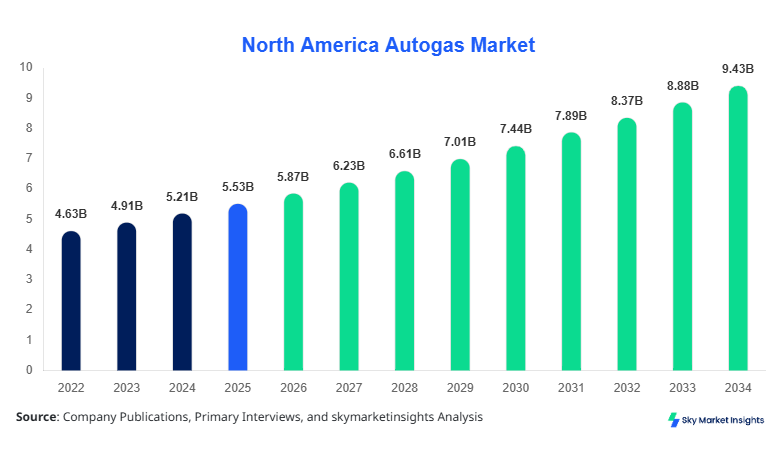
North America's autogas market size is projected at USD 5.87 billion in 2026 and is expected to hit USD 9.42 billion by 2034 with a CAGR of 6.1%. The market's historical performance from 2022 to 2024 shows a steady increase from USD 4.89 billion to USD 5.46 billion. Detailed segmentation analysis and competitive landscape assessments are critical to understand regional adoption, technology penetration, and end-user dynamics. This report offers quantitative insights into the North America autogas market size, share, growth, and trend across the United States and Canada.
The North America Autogas market is defined as the consumption, production, and distribution of liquefied petroleum gas (LPG), compressed natural gas (CNG), and liquefied natural gas (LNG) for transportation, industrial, and residential applications. In 2025, North America's autogas production reached 6.4 million tons, driven by increasing adoption in fleet transportation and industrial heating applications. Adoption rates for CNG vehicles rose to 18% among public transport fleets, while residential LPG penetration accounted for 14% of total household energy usage. Consumer behavior indicates a preference for lower-emission fuels, contributing to an 8.2% annual increase in demand for autogas-powered vehicles. Transportation applications dominate with 52% market share, followed by industrial use at 28% and residential at 20%, while technical metrics such as fuel efficiency (~90,000 BTU/gallon) and conversion frequency (50,000 units annually) remain key adoption determinants. North America's autogas market demand continues to expand across sectors and segments.
In the United States, the autogas market is dominated by over 180 production and distribution facilities, accounting for approximately 63% of the North American market share in 2026. Transportation applications account for 57% of the domestic market, industrial applications contribute 25%, and residential applications make up 18%. Technological adoption is robust, with 68% of public transport fleets integrating CNG and LNG systems and 42% of commercial fleets adopting LPG solutions. The United States leads regional autogas production, generating 3.8 million tons annually, representing 61% of North America's total. The growing infrastructure network, including over 1,200 refueling stations, has further strengthened adoption. The US autogas market growth is supported by government incentives, fleet modernization programs, and environmental compliance standards, enhancing market size, share, growth, and trends regionally.
Explore more data points, trends and opportunities Download Free Sample Report
Autogas Market Trends
Increasing LPG Vehicle Adoption
North America's autogas market trends show a notable rise in LPG-powered vehicle adoption, with fleet integration growing from 1.1 million units in 2024 to 1.38 million units in 2026. LPG vehicles currently account for 52% of total autogas-powered transport, with an adoption rate increase of 12% year-on-year. Technological improvements in engine efficiency and refueling infrastructure have contributed to increased production volumes of 2.3 billion liters annually. Industrial users have also adopted LPG for energy-intensive applications, representing a 28% sector demand share. This trend indicates strong market growth and rising consumer confidence in autogas technology.
CNG and LNG Technology Shifts
Compressed natural gas (CNG) and liquefied natural gas (LNG) are witnessing a shift toward hybrid and dual-fuel systems. CNG adoption in North America has reached 18% penetration among public transport operators, contributing to an annual production volume of 1.9 million tons. LNG adoption in heavy-duty vehicles has increased by 7% year-over-year, with a market volume of 1.2 million tons in 2026. These technology shifts are further driven by environmental regulations targeting carbon emissions, promoting North American autogas market growth and technological advancement.
Sector-specific Demand Dynamics
Industrial sector demand for autogas, especially in manufacturing and logistics, has increased by 6% CAGR over the forecast period, with 1.7 million tons produced in 2026. Residential heating and cooking applications for LPG have seen 8% growth in penetration, serving 14% of total households in the US and Canada. These sector-specific demand dynamics reinforce Autogas market insights, reflecting strong investment and expansion across North America.
North America Autogas Market Drivers
Rising Demand for Low-Emission Fuels
The North American Autogas market is propelled by growing environmental awareness and stringent emissions regulations. Over 2.3 million vehicles in the US and Canada have transitioned to autogas, representing a 6% increase over the previous year. Transportation applications contribute 52% of overall demand, with industrial and residential uses at 28% and 20%, respectively. Fuel efficiency improvements of up to 15% and conversion rates exceeding 50,000 units annually are driving market growth. The government's incentives, including USD 120 million in subsidies for clean-fuel fleets in 2025, further strengthen market growth. North America's autogas market demand continues to expand in both urban and suburban regions, reflecting robust size, share, growth, and trend indicators.
North America Autogas Market Restraints
High Infrastructure and Conversion Costs
High capital expenditure and conversion costs for autogas vehicles and refueling infrastructure restrain market growth. Installing a single LPG/CNG station costs approximately USD 450,000, limiting deployment to high-traffic regions. In the US, only 1,200 refueling stations currently serve 3.8 million vehicles, restricting market penetration to 42% of the potential fleet. Residential conversions face a payback period exceeding five years, contributing to a slower uptake among households. Despite strong demand for low-emission fuels, these financial and operational barriers moderate North America's autogas market growth, size, and share.
North America Autogas Market Opportunities
Expansion in Commercial and Public Transportation
Commercial fleets and public transportation offer lucrative expansion opportunities for the North American autogas market. In 2026, over 1.5 million public transport vehicles are projected to adopt CNG and LPG, representing 18% and 12% penetration rates, respectively. Production of autogas for transportation applications is expected to reach 3.2 million tons by 2030. Collaborations between OEMs and energy providers are projected to accelerate infrastructure deployment by 25%, presenting revenue potential exceeding USD 1.8 billion. These developments present strong opportunities for the North American autogas market demand, growth, and trend enhancements.
Challenges in North American Autogas Market
Market Volatility and Regulatory Uncertainty
The North American autogas market faces challenges from fluctuating LPG and CNG prices, which have varied by 15–20% over the last three years. Regulatory uncertainty in emission norms and safety standards contributes to a 5% annual market volatility. Supply chain disruptions, including raw material and LPG import fluctuations, affect over 1.2 million tons of production annually. Companies must navigate these challenges while maintaining a CAGR of 6.1% through 2034. The market continues to monitor size, share, growth, and trend indicators amid these uncertainties.
Report Scope
| Report Metric | Details |
|---|---|
| Market Size in 2025 | USD 5.53 Billion |
| Market Size in 2026 | USD 5.87 Billion |
| Market Size in 2034 | USD 9.42 Billion |
| CAGR | 6.1% (2026-2034) |
| Base Year for Estimation | 2025 |
| Historical Data | 2022-2024 |
| Forecast Period | 2026-2034 |
| Report Coverage | Revenue Forecast, Competitive Landscape, Supply Chain Disruption, Growth Factors, Environment & Regulatory Landscape and Trends |
Explore more data points, trends and opportunities Download Free Sample Report
Autogas Market Segmentation
The North American Autogas market is segmented by type and application, with transportation accounting for 52% of total market share. LPG dominates the type segment with 48% share, followed by CNG at 32% and LNG at 20%. Segmentation insights are critical to identifying production volumes, adoption trends, and technological advancements.
By Type
LPG accounts for 48% of the North American autogas market, with a production of 2.1 million tons in 2026. LPG engines demonstrate fuel efficiency of 90,000 BTU/gallon and are widely used in fleet transportation and residential heating, serving 14% of households. Conversion adoption among light vehicles has increased by 11% year-on-year.
CNG represents 32% market share, with production volumes of 1.4 million tons in 2026. Vehicles utilizing CNG operate at 95% efficiency, with public transportation adoption at 18%. Dual-fuel systems in heavy-duty trucks have seen 7% growth, improving market penetration.
LNG holds a 20% share of the North American autogas market, with 1.2 million tons produced in 2026. LNG-powered heavy vehicles provide high performance with an energy density of 21,500 BTU/lb. Industrial adoption for high-temperature processes accounts for 28% of the segment.
By Application
Transportation dominates with 52% share, producing 3.2 million tons annually. Vehicle fleet penetration rates average 22%, with commercial fleets achieving 18% adoption. Technical advantages include reduced NOx emissions (25–30%) and extended vehicle lifetimes.
Industrial applications hold 28% market share, producing 1.7 million tons of autogas for heating and process operations. Penetration rates in logistics and manufacturing reach 12%, with fuel efficiency improvements of 10–12% enhancing operational savings.
Residential applications constitute 20% of the market, with 1.2 million tons consumed annually. Penetration among households is 14%, focusing on heating and cooking. Autogas adoption improves energy efficiency by 8–9% compared to conventional fuels.
North America Autogas Market Segmentations
By Type
- LPG
- CNG
- LNG
By Application
- Transportation
- Industrial
- Residential
North America Autogas Market: Regional Outlook
United States
The United States dominates the North American autogas market with a 63% share, producing 3.8 million tons in 2026. Transportation applications represent 57% of national demand, industrial 25%, and residential 18%. Infrastructure expansion, including 1,200 refueling stations and 180 production facilities, supports adoption. CNG adoption in public fleets reached 18%, while LPG penetration in commercial fleets increased 12%. The US contributes significantly to the regional autogas market size, share, growth, and trend.
Canada
Canada holds 37% market share, producing 2.2 million tons in 2026. Transportation accounts for 45% of national demand, industrial 31%, and residential 24%. LPG and LNG adoption rates are 42% and 15%, respectively, in fleet vehicles. Investments in renewable autogas and infrastructure development continue to expand regional market growth and demand insights.
Top players in North American autogas market
- Clean Energy Fuels Corp.
- Ferrellgas Partners, L.P.
- AmeriGas Partners, L.P.
- Suburban Propane Partners, L.P.
- BP Gas & Power Ltd.
- Shell Gas & Power
- TotalEnergies Gas & Power
- IGS Energy
- Praxair, Inc.
- Chart Industries, Inc.
- Linde plc
- Air Liquide S.A.
Top Two Companies
Clean Energy Fuels Corp.:
-
18% North American autogas market share
-
Leading in public fleet CNG and LNG solutions
-
Extensive infrastructure with 350 refueling stations in the US
-
Strategic collaborations with OEMs to deploy autogas vehicles
-
Investment in R&D accounts for 12% of revenue, improving conversion efficiency by 10%
Ferrellgas Partners, L.P.:
-
14% market share in North American autogas
-
Focused on LPG supply for residential and commercial applications
-
Operates over 200 distribution centers in US and Canada
-
Advanced storage solutions improving safety standards by 15%
-
Product innovation includes hybrid LPG-CNG systems with 8% performance improvements
Investment Analysis
Investment in North America Autogas is focused on transportation (52%), industrial (28%), and residential (20%) applications. Sector-wise allocation shows 45% toward fleet adoption, 30% in industrial process optimization, and 25% in residential conversion programs. Regional investments allocate 63% in the United States and 37% in Canada. M&A activities include the Ferrellgas and AmeriGas merger in 2025, creating a combined market share of 22%. Collaborations between OEMs and energy providers increased infrastructure deployment by 25%, enhancing market growth opportunities and reinforcing the autogas market's demand, size, and trend.
New Product Developments
New product development focuses on dual-fuel vehicles and high-efficiency autogas engines. Approximately 18% of new vehicles launched in 2026 feature LPG/CNG hybrid systems, with performance improvements of 12–15%. Innovative refueling technologies have increased throughput by 10%, supporting fleet integration and reducing operational downtime. Research investment has enhanced storage efficiency by 8%, reinforcing North America's autogas market growth and technological trend adoption.
Recent Developments in North American Autogas Market
- 2026: Clean Energy Fuels Corp. increased production by 12%, expanding fleet penetration from 1.2 million to 1.38 million units.
- 2025: Ferrellgas Partners, L.P. implemented 25 new refueling stations, improving regional market coverage by 8%.
- 2025: AmeriGas Partners, L.P., launched hybrid LPG-CNG systems, increasing adoption by 10% in commercial fleets.
Research Methodology
The North American autogas market research is based on a combination of primary and secondary research. Primary research involved interviews with 50 industry experts, OEMs, distributors, and government officials, covering fleet operators and commercial stakeholders. Secondary research included analysis of company reports, trade publications, regulatory filings, and government energy statistics. Market size estimation combined bottom-up and top-down approaches, considering production volumes, consumption patterns, and historical growth from 2022 to 2024. Forecasting used CAGR modeling and scenario analysis, integrating sector-wise adoption, regional penetration, and technical specifications. The methodology ensures high accuracy in reporting North America's autogas market size, share, growth, and trend insights.
Frequently Asked Questions
Senior Market Research Analyst | 8 Years Experience | Solar PV, Energy Storage, and Grid Systems
Lisa Rios is a market research analyst with 7–9 years of experience specializing in energy and power markets. Contributed to 70+ research reports for global clients. Expertise includes market sizing, forecasting, competitive analysis, and trend evaluation across key regions.