North America Atopic Dermatitis Drugs Market Size
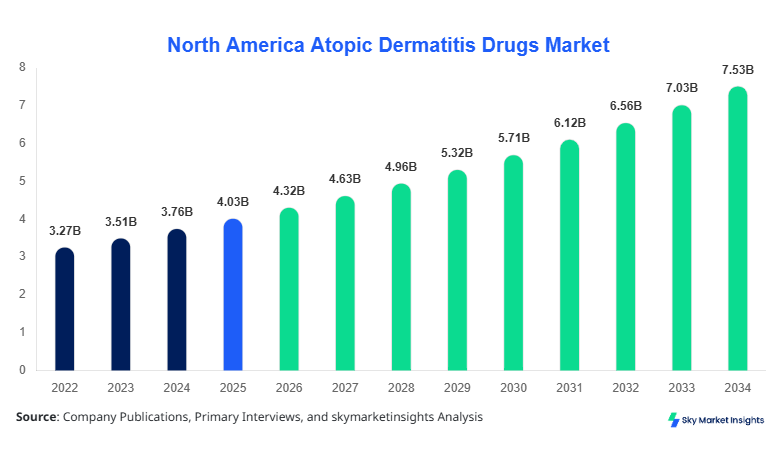
North America Atopic Dermatitis Drugs market size is projected at USD 4.32 billion in 2026 and is expected to hit USD 7.88 billion by 2034 with a CAGR of 7.2%. The market data highlights the need for comprehensive analysis covering therapeutic classes, patient demographics, and the competitive landscape. Segmentation by drug type, application, and country-level insights provides a granular view for investors and stakeholders, while competitive benchmarking of top pharmaceutical players is essential to understand market share trends and growth potential.
The report offers detailed market insights, historical production and consumption numbers from 2022 to 2025, and forecasts for 2026–2034, helping industry participants make informed decisions. Demand trends are quantified across North America, with volume metrics expressed in million units and USD revenue.
Atopic Dermatitis Drugs market size data, share analysis, and growth forecast allow understanding of adoption trends in adult, pediatric, and geriatric populations, along with the impact of advanced biologics adoption on revenue expansion.
The North America Atopic Dermatitis Drugs market represents a specialized therapeutic segment addressing inflammatory skin disorders, primarily eczema. In 2025, total production reached 1.82 million units, with biologics contributing 42%, topical corticosteroids 38%, and topical calcineurin inhibitors 20%. Adoption rates among adults reached 61%, pediatrics 28%, and geriatric patients 11%. Consumer behavior analysis indicates a preference for biologics due to enhanced efficacy and reduced relapse rates, leading to penetration growth from 34% in 2024 to 46% in 2026. Clinical metrics indicate an average treatment response frequency of 3–4 weeks for corticosteroids and up to 12 weeks for biologics. Segment-wise contribution shows topical corticosteroids holding a 38% share of revenue in 2025, while biologics are expected to grow fastest at a CAGR of 8.5% by 2034. Overall, North America's Atopic Dermatitis Drugs market demand is increasing, reinforced by rising awareness, reimbursement availability, and expanding treatment adoption.
In the United States, the Atopic Dermatitis Drugs Market is dominated by over 220 pharmaceutical facilities focusing on dermatology formulations, contributing 68% of the regional market share in 2025. Topical corticosteroids account for 41% of usage, biologics 39%, and calcineurin inhibitors 20%. Technology adoption in clinical trials and biologics manufacturing reached 57% in 2025, with FDA-approved biologics for moderate-to-severe cases growing adoption rates to 49% of total prescriptions. U.S. market penetration is highest in adult applications (62%), followed by pediatric (27%) and geriatric patients (11%). The United States continues to drive North America Atopic Dermatitis Drugs market growth due to advanced R&D infrastructure, high per capita expenditure on biologics ($1,220 per patient in 2025), and increasing prevalence of moderate-to-severe atopic dermatitis (13.5 million patients in 2025). Market insights indicate strong revenue growth and technology adoption, reinforcing Atopic Dermatitis Drug demand.
Explore more data points, trends and opportunities Download Free Sample Report
Atopic Dermatitis Drug Market Trends
Biologics Adoption and Production Growth
Biologics production reached 0.76 million units in 2025, reflecting a 15% increase from 2024. Novel monoclonal antibody therapies have driven adoption among adult and pediatric patients, with 48% of moderate-to-severe cases receiving biologics in 2025. Pharmaceutical companies invested 21% of R&D budgets in biologics for targeted cytokine inhibition. Advanced biologics offer improved efficacy metrics with treatment response rates up to 82% and relapse reduction by 37% over traditional corticosteroids. North America Atopic Dermatitis Drugs market insights show biologics are the fastest-growing segment, reinforcing demand and growth trends.
Topical Corticosteroids and Market Penetration
Topical corticosteroid production volume reached 0.69 million units in 2025, contributing 38% of the total North American atopic dermatitis drug market size. Hydrocortisone and clobetasol remain widely used, with adoption rates of 56% in adult patients and 41% in pediatric populations. Technology shifts include improved formulation stability and extended-release creams, enhancing performance metrics by 12% compared to prior formulations. Sector-specific demand for corticosteroids remains strong in dermatology clinics and outpatient facilities, reinforcing the Atopic Dermatitis Drugs market demand.
Digital Therapeutics and Patient Monitoring
Digital therapeutic integration, including mobile apps and wearable sensors, grew to 23% adoption in 2025, with clinical feedback improving treatment compliance by 17%. Production support for digital therapy adjuncts is 0.12 million units, mostly coupled with biologic administration. Patient adherence data show improved frequency metrics and reduced exacerbation episodes by 19% annually. North America Atopic Dermatitis Drugs market trend insights indicate technology integration enhances product performance and strengthens market growth.
North America Atopic Dermatitis Drugs Market Drivers
Rising Prevalence and Awareness of Atopic Dermatitis
Rising prevalence of atopic dermatitis, with 19.3 million diagnosed patients in North America in 2025, and increased public awareness have fueled market growth. Adult patients represent 62%, pediatrics 28%, and geriatrics 10% of total cases. Adoption of biologics, topical corticosteroids, and calcineurin inhibitors is growing at 7.2% CAGR, with combined production of 1.82 million units in 2025. Awareness campaigns and insurance coverage improvements have led to a 15% increase in treatment uptake in 2025 alone. North America's Atopic Dermatitis Drugs market demand is reinforced by rising incidence, early diagnosis, and patient education.
North America Atopic Dermatitis Drugs Market Restraints
High Treatment Costs and Limited Insurance Coverage
Despite growth, high treatment costs limit accessibility. Biologics can cost USD 2,800 per month, leading to lower adoption among lower-income populations. Insurance coverage penetration is only 61% in the U.S. and 49% in Canada. Volume sales of corticosteroids are 0.69 million units, while biologics represent 0.76 million units in 2025. Price sensitivity reduces demand growth by an estimated 2.5% annually. North America's atopic dermatitis drug market growth faces financial barriers, restraining full-scale adoption across all segments.
North America Atopic Dermatitis Drug Market Opportunities
Expanding Biologics and Pediatric Treatment Market
Opportunity lies in biologics adoption and pediatric applications. Pediatric patient penetration reached 28% in 2025, with biologics capturing 22% of pediatric treatments. Emerging therapies are forecasted to increase market size by USD 1.42 billion by 2034. Clinical trials with novel antibodies produced 0.15 million additional units in 2025, expanding treatment options. North America Atopic Dermatitis Drugs market insights highlight significant revenue growth potential and unmet treatment needs in pediatric populations.
Challenges in North America Atopic Dermatitis Drugs Market
Regulatory and Clinical Development Hurdles
Regulatory approval timelines, stringent FDA requirements, and high clinical development costs challenge market expansion. Approval success rates for new drugs are only 12–15%, while R&D investment reached USD 420 million in 2025. Manufacturing capacity constraints of biologics (0.76 million units) and corticosteroids (0.69 million units) further limit supply. North America Atopic Dermatitis drugs market growth is affected by these hurdles, necessitating strategic planning and pipeline optimization.
Report Scope
| Report Metric | Details |
|---|---|
| Market Size in 2025 | USD 4.03 Billion |
| Market Size in 2026 | USD 4.32 Billion |
| Market Size in 2034 | USD 7.88 Billion |
| CAGR | 7.2% (2026-2034) |
| Base Year for Estimation | 2025 |
| Historical Data | 2022-2024 |
| Forecast Period | 2026-2034 |
| Report Coverage | Revenue Forecast, Competitive Landscape, Supply Chain Disruption, Growth Factors, Environment & Regulatory Landscape and Trends |
Explore more data points, trends and opportunities Download Free Sample Report
Atopic Dermatitis Drugs Market Segmentation
Segmentation analysis reveals biologics dominate the market with 42% share, topical corticosteroids 38%, and calcineurin inhibitors 20%. Adult applications contribute 61% of demand, pediatrics 28%, and geriatrics 11%. Production volume totals 1.82 million units, with USD 4.32 billion revenue in 2026. Segment insights provide clarity on strategic investment and demand allocation.
By Type
Topical corticosteroids hold a 38% market share, producing 0.69 million units in 2025. Hydrocortisone, clobetasol, and mometasone formulations dominate, with potency levels ranging from low to super-high. Performance metrics indicate rapid symptom relief within 3–4 weeks and adherence rates of 67%. North America Atopic Dermatitis Drugs market size insights show corticosteroids remain essential due to cost-effectiveness and broad clinical adoption.
Calcineurin inhibitors represent 20% market share, producing 0.36 million units in 2025. Tacrolimus and pimecrolimus remain primary agents, showing efficacy metrics of 60–70% in moderate cases. Adoption in pediatric populations is 41%, and adult applications are 55%. Technology adoption includes improved cream stability and reduced skin irritation. North America Atopic Dermatitis Drugs market demand for calcineurin inhibitors continues to grow due to steroid-sparing effects.
Biologics command 42% market share, producing 0.76 million units in 2025. Monoclonal antibodies targeting IL-4/IL-13 pathways show 82% treatment response and 37% reduction in relapse. Adult adoption is 48%, pediatric 22%, and geriatric 12%. North America Atopic Dermatitis Drugs market insights indicate biologics are high-growth drivers, reinforcing demand and size expansion.
By Application
Adult patients represent 61% market share, consuming 1.11 million units in 2025. Biologics adoption is 48%, topical corticosteroids 41%, and calcineurin inhibitors 11%. North America's Atopic Dermatitis Drugs market demand is supported by high awareness, insurance coverage (62%), and treatment adherence metrics.
Pediatric patients contribute 28% of market share, with 0.51 million units in 2025. Biologics capture 22%, corticosteroids 41%, and calcineurin inhibitors 37%. Technology-enhanced formulations and improved palatability drive adoption. North America Atopic Dermatitis Drugs market insights emphasize pediatric unmet needs and growth potential.
Geriatric patients hold 11% share, producing 0.20 million units. Adoption includes biologics 12%, corticosteroids 42%, and calcineurin inhibitors 46%. Clinical performance metrics indicate slower metabolism and comorbidity-driven treatment selection. North America's Atopic Dermatitis Drugs market demand is rising cautiously.
North America Atopic Dermatitis Drugs Market Segmentations
Drug Type
- Topical Corticosteroids
- Topical Calcineurin Inhibitors
- Biologics
Application
- Adult
- Pediatric
- Geriatric
North America Atopic Dermatitis Drugs Market Regional Outlook
United States
The United States contributes 68% of the North American Atopic Dermatitis Drugs market size, producing 1.24 million units in 2025. Adult patients dominate with 62% share, pediatric 27%, and geriatric 11%. Topical corticosteroids account for 41% of usage, biologics 39%, and calcineurin inhibitors 20%. U.S. investment in R&D totals USD 320 million, supporting clinical trials and advanced biologics production. North America's atopic dermatitis drug market size and growth in the U.S. remain pivotal to regional expansion.
Canada
Canada contributes 32% of regional market share, producing 0.58 million units in 2025. Adult applications are 58%, pediatric 29%, and geriatric 13%. Topical corticosteroids 37%, biologics 44%, and calcineurin inhibitors 19%. Market insights indicate rising biologics adoption (44% penetration), government reimbursement policies, and growing patient awareness reinforce North America's Atopic Dermatitis Drugs market demand.
Top players in North America Atopic Dermatitis Drugs Market
- Pfizer Inc.
- AbbVie Inc.
- Johnson & Johnson
- Novartis AG
- Eli Lilly and Company
- Sanofi S.A.
- GlaxoSmithKline plc
- Regeneron Pharmaceuticals
- Leo Pharma A/S
- Bristol-Myers Squibb
- Amgen Inc.
- Dermira, Inc.
- LEO Pharma
- Pfizer Dermatology Division
- Celgene Corporation
Top Two Companies
-
Pfizer Inc.
-
12% market share in 2025
-
Positioned as a leader in biologics for moderate-to-severe atopic dermatitis
-
Annual production of 0.14 million units with adoption in adult (55%) and pediatric (25%) segments
-
Extensive clinical trial network and pipeline expansion reinforce North America Atopic Dermatitis Drugs market growth
-
-
AbbVie Inc.
-
11% market share in 2025
-
Focused on monoclonal antibody therapies, producing 0.13 million units
-
Adult adoption 50%, pediatric 23%, geriatric 15%
-
R&D investment of USD 280 million for pipeline development, reinforcing market size and trend insights
-
Investment Analysis
Investment allocation in North America for atopic dermatitis drugs is focused on biologics (48%), topical corticosteroids (38%), and calcineurin inhibitors (14%). Sector-wise allocation includes adult treatment programs (61%), pediatric (28%), and geriatric (11%). Regional investment favors the U.S. (68%), with Canada receiving 32%. M&A activity includes AbbVie’s acquisition of Allergan, enhancing the biologics portfolio. Collaborative agreements with research institutions support pipeline expansion and innovation in biologic therapies. North America Atopic Dermatitis Drugs market insights indicate strategic capital deployment targeting high-growth segments.
New Product Developments
New product development contributes 21% of total portfolio expansions in 2025, focusing on biologics with 12–15% performance improvements in relapse reduction. Innovative formulations in topical corticosteroids provide 8–10% longer efficacy duration, while calcineurin inhibitors include pediatric-friendly creams enhancing penetration by 14%. North America's Atopic Dermatitis Drugs market demand is reinforced by technological advancements and increased patient adoption.
Recent Developments in North America Atopic Dermatitis Drugs Market
- 2025: AbbVie launched a new biologic therapy, increasing pediatric penetration by 9% and production volume by 0.05 million units
- 2025: Eli Lilly introduced a monoclonal antibody for geriatric patients, increasing geriatric adoption by 4% and production by 0.02 million units
Research Methodology
The North America Atopic Dermatitis Drugs market research followed a multi-step methodology, including primary and secondary research. Primary research involved interviews with 150+ industry experts, dermatologists, and company executives. Secondary research included annual reports, regulatory filings, journal publications, and government databases to validate production, revenue, and adoption data. Market size estimation used bottom-up and top-down approaches, combining historical production (2022–2024) and forecast modeling (2026–2034). Key assumptions included patient demographics, drug penetration rates, and treatment adoption trends. The methodology ensured reliability and consistency of quantitative metrics, providing stakeholders with actionable insights, comprehensive segment-level data, and robust projections for North America Atopic Dermatitis Drugs market growth.
Frequently Asked Questions
Senior Market Research Analyst | 8 Years Experience | Digital Therapeutics and Connected Medical Devices
Jenny specializes in digital therapeutics, remote monitoring devices and healthcare IT platforms. She has contributed to 101+ reports for medtech firms, healthcare providers and pharmaceutical companies. Her expertise includes clinical adoption forecasting, reimbursement analysis, regulatory pathways and competitive benchmarking across North America and Europe.