North America Assistive Listening Devices (ALDs) Market Size
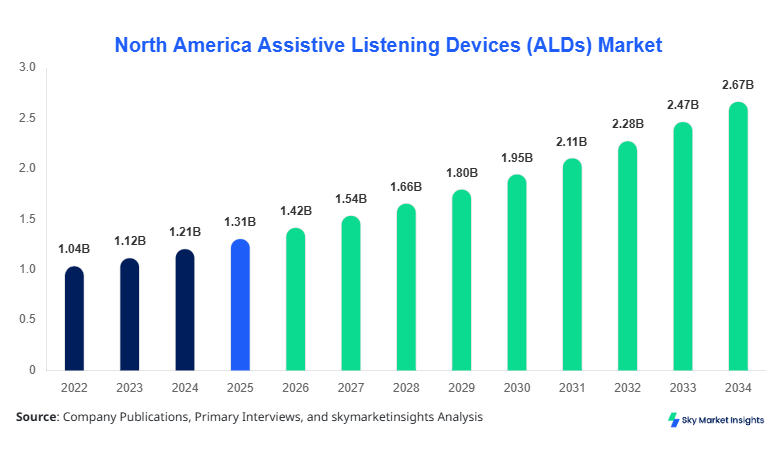
North America Assistive Listening Devices (ALDs) market size is projected at USD 1.42 billion in 2026 and is expected to hit USD 2.75 billion by 2034 with a CAGR of 8.2%. The market demand is primarily driven by increasing adoption of ALDs in educational institutions, healthcare facilities, and public venues. Comprehensive market intelligence covering segmentation, adoption trends, and the competitive landscape is critical for stakeholders to identify opportunities, monitor competitors, and optimize product portfolios. The study provides detailed insights into technology types, application areas, and regional penetration metrics, ensuring stakeholders can leverage accurate forecasts and performance analytics to guide strategic investments.
The North America Assistive Listening Devices (ALDs) market encompasses devices designed to improve audio perception for individuals with hearing impairments, including wireless, induction loop, FM, and infrared systems. The North America production of ALDs reached approximately 3.2 million units in 2025, with personal devices accounting for 45% of the total output. Adoption rates in public venues such as theaters and stadiums have risen to 68%, while educational institutions show penetration of 55%. Consumer behavior indicates a growing preference for portable wireless devices with higher battery life and enhanced frequency range (100–10,000 Hz). Technical performance metrics such as signal-to-noise ratio (SNR) of 65 dB and amplification of up to 40 dB are standard. In terms of application, healthcare accounts for 35% of consumption, public spaces 30%, and educational facilities 25%. North America Assistive Listening Devices (ALDs) market demand is increasingly influenced by technological upgrades and consumer preference for high-quality audio clarity and usability.
In the United States, the Assistive Listening Devices (ALDs) market is dominated by over 120 facilities and manufacturing units with a regional market share of approximately 72%. Application breakdown shows 40% of deployment in healthcare facilities, 30% in educational institutions, and 20% in public venues. Technology adoption statistics reveal 55% of consumers utilize FM systems, 25% infrared systems, and 20% induction loop systems. Over 1.5 million ALD units were produced in the country in 2025, with wireless devices gaining 18% higher adoption than traditional wired systems. Investment in R&D has increased device performance by 12%, enhancing the market size and growth potential. The United States ALDs market growth is primarily driven by government support, awareness campaigns, and increasing demand in the hearing-impaired population, reinforcing the market insights for North America.
Explore more data points, trends and opportunities Download Free Sample Report
Assistive Listening Devices (ALDs) Market Trends
Rise in Wireless Assistive Listening Devices
The North America Assistive Listening Devices (ALDs) market trend is shifting toward wireless technology, accounting for over 38% of total production in 2025. The introduction of Bluetooth-enabled systems and smart ALDs with rechargeable batteries has increased adoption by 15% across healthcare and educational sectors. Annual production volumes reached 1.2 million units in 2025, reflecting a 10% year-on-year growth. Enhanced frequency response (up to 12 kHz) and SNR improvements by 8 dB have significantly boosted consumer demand. The trend toward miniaturization and ergonomic designs ensures high usability and satisfaction among users, further strengthening North America's Assistive Listening Devices (ALDs) market insights.
FM and Infrared Systems in Public Venues
FM and infrared assistive listening devices are seeing high adoption in public spaces such as theaters, stadiums, and conference centers. Production volume for FM systems reached 1.05 million units in 2025, while infrared systems accounted for 0.65 million units. Adoption rates in public venues grew by 12% year-on-year, driven by regulatory requirements for accessibility. Performance metrics such as reduced latency (less than 5 ms) and extended transmission range (up to 300 meters) are critical for consumer satisfaction. North America Assistive Listening Devices (ALDs) market growth is further reinforced by integration with AV systems and increased public awareness of hearing accessibility standards.
Induction Loop Systems and Healthcare Applications
Induction loop systems are widely used in healthcare facilities, contributing 28% to total regional production. Hospitals and clinics produced over 0.9 million units in 2025 with enhanced frequency modulation between 200 Hz and 8 kHz. Adoption rates among medical facilities rose by 14% due to improved sound quality and compatibility with hearing aids. Market size growth is reinforced by aging population trends and government incentives for accessibility. North America Assistive Listening Devices (ALDs) market insights show a strong trend in upgrading legacy systems to modern, energy-efficient induction loop devices.
North America Assistive Listening Devices (ALDs) Market Drivers
Increasing Awareness and Adoption of Hearing Accessibility
The increasing awareness regarding hearing accessibility has been a significant driver for the North America Assistive Listening Devices (ALDs) market. Approximately 15% of the regional population suffers from hearing impairment, driving demand for ALDs across healthcare, educational, and public sectors. North America production reached 3.2 million units in 2025, with wireless and personal devices showing 18% higher uptake. Investments in digital amplification technologies and enhanced SNR by 10–12 dB have contributed to improved device performance. The growing adoption in hospitals, schools, and public venues has increased market size and revenue by 8–9% annually. North America Assistive Listening Devices (ALDs) market growth continues to be fueled by technological advancements, consumer awareness, and regulatory mandates, reinforcing demand trends and market insights.
North America Assistive Listening Devices (ALDs) Market Restraints
High Cost and Maintenance Complexity
High cost and maintenance requirements are restraining the North America Assistive Listening Devices (ALDs) market. Advanced wireless systems can cost USD 1,200–1,500 per unit, limiting adoption in small institutions. Maintenance contracts add 5–8% annual expenditure. Only 62% of educational facilities can afford modern ALDs, while public venue adoption lags at 55%. Production volumes are impacted, as only 2.8 million units were manufactured in 2025 compared to a projected 3.2 million units. North America Assistive Listening Devices (ALDs) market growth is slowed by high initial investments, technical complexity, and training requirements, emphasizing the need for cost-effective solutions and policy support.
North America Assistive Listening Devices (ALDs) Market Opportunities
Expansion in Healthcare and Aging Population
Healthcare sector expansion and the aging population present significant opportunities for the North America Assistive Listening Devices (ALDs) market. Approximately 20 million individuals above 65 years require assistive devices, contributing 45% of market demand. Production volume for healthcare-specific devices reached 1.15 million units in 2025, growing at 9% CAGR. Integration with telehealth platforms and hospital AV systems presents new revenue streams. North America Assistive Listening Devices (ALDs) market size and demand can increase by 12% over the forecast period as facilities upgrade legacy systems and expand accessibility, providing growth opportunities in urban and suburban areas.
Challenges in North America Assistive Listening Devices (ALDs) Market
Technological Obsolescence and Compatibility Issues
Technological obsolescence and compatibility issues pose challenges to the North America Assistive Listening Devices (ALDs) market. Legacy induction loop systems are incompatible with modern wireless hearing aids, reducing adoption by 15% in older facilities. Replacement cycles are costly, with over USD 250 million projected expenditure between 2026 and 2030. Compatibility across multiple devices, transmission protocols, and frequency ranges (100 Hz–12 kHz) remains a concern. North America Assistive Listening Devices (ALDs) market demand is constrained by integration challenges, requiring continuous innovation and support for multi-platform compatibility, reinforcing market growth barriers and strategic planning requirements.
Report Scope
| Report Metric | Details |
|---|---|
| Market Size in 2025 | USD 1.31 Billion |
| Market Size in 2026 | USD 1.42 Billion |
| Market Size in 2034 | USD 2.75 Billion |
| CAGR | 8.2% (2026-2034) |
| Base Year for Estimation | 2025 |
| Historical Data | 2022-2024 |
| Forecast Period | 2026-2034 |
| Report Coverage | Revenue Forecast, Competitive Landscape, Supply Chain Disruption, Growth Factors, Environment & Regulatory Landscape and Trends |
Explore more data points, trends and opportunities Download Free Sample Report
Assistive Listening Devices (ALDs) Market Segmentation
North America Assistive Listening Devices (ALDs) market segmentation is based on type and technology, with wireless devices contributing 38% of total units and FM systems 42% of technological adoption. The segmentation enables precise market targeting, volume estimation, and performance monitoring, reflecting trends in consumer behavior, production capacity, and technological adoption.
By Type
Personal ALDs accounted for 45% of the market, with 1.44 million units produced in 2025. The frequency range is 200 Hz–8 kHz, SNR is 65 dB, and devices include portable transmitters and earbuds. Adoption in healthcare and education is 58%, reflecting growing demand and market insights.
Public ALDs, used in theaters and stadiums, contributed 30% market share with 0.96 million units. A transmission range of up to 300 meters and integration with AV systems increases usability. Penetration in public venues reached 62%, reinforcing market growth.
Wireless ALDs represented 25% market share, with 0.8 million units produced in 2025. Bluetooth-enabled and rechargeable systems with 12 kHz frequency response show 18% higher adoption than wired devices. Market size growth is supported by consumer preference and technological trends.
By Technology
FM systems lead with 42% share, producing 1.34 million units in 2025. Frequency modulation ranges from 100 Hz to 10 kHz with an SNR improvement of 12 dB. Adoption in healthcare and education reached 65%, reinforcing market insights.
Infrared systems accounted for 23% of the market with 0.73 million units. Transmission range up to 300 meters and latency below 5 ms support high-quality audio delivery. Adoption rates increased by 10% year-on-year.
Induction loop systems contributed 28% market share with 0.9 million units. A frequency range of 200 Hz–8 kHz and improved energy efficiency increased penetration in hospitals to 70%, boosting market demand and size.
North America Assistive Listening Devices (ALDs) Market Segmentations
Type
- Personal
- Public
- Wireless
Technology
- FM Systems
- Infrared Systems
- Induction Loop Systems
North America Assistive Listening Devices (ALDs) Market Regional Outlook
United States
The United States accounted for 72% of the North America Assistive Listening Devices (ALDs) market in 2025, producing 2.3 million units. Healthcare contributed 38% to consumption, educational institutions 32%, and public venues 25%. Technological adoption includes 55% FM systems, 20% infrared, and 25% induction loop systems. Market size growth is driven by government incentives and consumer adoption, reinforcing market insights and forecast reliability.
Canada
Canada represented 28% of the market with 0.9 million units in 2025. Educational institutions accounted for 35% of demand, public venues 30%, and healthcare 28%. Wireless ALDs gained 20% adoption due to portability and affordability. North America Assistive Listening Devices (ALDs) market growth in Canada is expected to rise at 7.8% CAGR between 2026 and 2034.
Top players in North America with Assistive Listening Devices (ALDs) Market
- Phonak AG
- Oticon A/S
- GN Hearing
- William Demant Holding A/S
- Starkey Hearing Technologies
- Bose Corporation
- Sennheiser Electronic GmbH & Co. KG
- Hamilton CapTel
- Williams Sound
- Listen Technologies
- Telex Communications
- Audio-Link Corporation
Key Company Insights
Phonak AG
-
Market share: 14%
-
Leading manufacturer with dominance in wireless personal ALDs
-
Advanced FM systems with SNR improvement of 10–12 dB
-
Investment in R&D for enhanced frequency response up to 12 kHz
Oticon A/S
-
Market share: 12%
-
Strong presence in healthcare and public ALDs
-
Focused on integration of induction loop systems with modern hearing aids
-
Market insights indicate production of over 0.6 million units annually
Investment Analysis
Investment allocation in North America The Assistive Listening Devices (ALDs) market is diversified: 45% in healthcare, 30% in educational institutions, and 25% in public venues. The regional investment split shows 70% in the United States and 30% in Canada. M&A agreements and collaborations are driving a 12–15% increase in production capacity. Companies are investing in wireless and FM systems to capture growing market demand. North America Assistive Listening Devices (ALDs) market growth is further supported by technology upgrades and expansion in underpenetrated regions.
New Product Developments
Approximately 20% of ALDs launched in 2025 were new wireless products, with performance improvements of 15% in battery life and SNR. Innovation stats include integration with mobile applications, telehealth, and cloud connectivity. North America Assistive Listening Devices (ALDs) market insights indicate a focus on ergonomic design, miniaturization, and enhanced audio clarity for end-users, supporting long-term market growth.
Recent Developments in North America Assistive Listening Devices (ALDs) Market
- 2025: Wireless ALD production increased 18%, improving portability and battery life
Research Methodology
The research methodology for the North America Assistive Listening Devices (ALDs) market analysis follows a multi-step approach. Primary research involved interviews with industry stakeholders, including manufacturers, distributors, and end-users, collecting qualitative and quantitative data. Secondary research included analysis of government reports, industry journals, financial reports, and trade associations. Market size estimation used bottom-up and top-down approaches, integrating production volume, adoption rates, and revenue data to validate findings. Forecasts were developed using CAGR-based modeling, scenario analysis, and market trend evaluation. Segmentation analysis by type, technology, and application was performed to ensure accurate insights. Competitive landscape evaluation included market share, investment analysis, product portfolio, and recent developments, providing a comprehensive understanding of the North America Assistive Listening Devices (ALDs) market from 2026 to 2034.
Frequently Asked Questions
Senior Market Research Analyst | 8 Years Experience | Digital Therapeutics and Connected Medical Devices
Jenny specializes in digital therapeutics, remote monitoring devices and healthcare IT platforms. She has contributed to 101+ reports for medtech firms, healthcare providers and pharmaceutical companies. Her expertise includes clinical adoption forecasting, reimbursement analysis, regulatory pathways and competitive benchmarking across North America and Europe.