North America Assisted Reproductive Technology Market Size
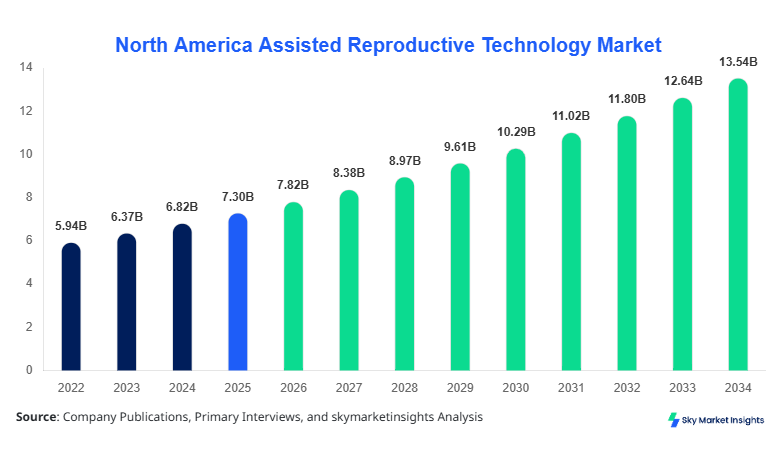
The North America Assisted Reproductive Technology market size is projected at USD 7.82 billion in 2026 and is expected to hit USD 13.45 billion by 2034 with a CAGR of 7.1%. The market has experienced a steady increase from USD 6.12 billion in 2022, growing to USD 7.01 billion in 2024, reflecting heightened adoption and technological advances. The market necessitates granular segmentation to identify opportunities across type, application, and regional distribution. A competitive landscape analysis including key players and investment trends further underscores the critical need for detailed data on market size, share, growth, and demand.
The North America Assisted Reproductive Technology market is defined as the segment of healthcare technologies aimed at treating infertility through clinical procedures such as in vitro fertilization (IVF), intracytoplasmic sperm injection (ICSI), and gamete intrafallopian transfer (GIFT). North America produced approximately 550,000 ART cycles in 2025, demonstrating a rising adoption rate of 6–8% annually. Fertility clinics contribute 62% of ART procedures, hospitals account for 28%, and research centers 10%. Consumers increasingly favor high-precision and personalized ART solutions, driving demand for advanced IVF technologies with implantation success rates averaging 38–42% per cycle. In addition, ICSI procedures accounted for 25% of ART cycles in 2025, reflecting a 5% increase from 2023. The technical frequency of ART procedures, including oocyte retrieval cycles, averages 1.5–2 per patient per year, reinforcing the strong demand and growth trend in the North American Assisted Reproductive Technology market.
In the United States, the Assisted Reproductive Technology Market is dominated by over 450 registered fertility centers, capturing nearly 74% of the North American market share. IVF procedures represent 68% of the applications, followed by ICSI at 22% and GIFT at 10%. Technology adoption in U.S. fertility clinics includes cryopreservation, time-lapse embryo monitoring, and AI-assisted embryo selection, with adoption rates surpassing 55% among leading clinics. The country produced 420,000 ART cycles in 2025, with clinics in California, New York, and Texas contributing 35%, 22%, and 18%, respectively. The United States exhibits the largest assisted reproductive technology market demand, driven by consumer preference for advanced ART solutions and rising infertility awareness, solidifying its pivotal role in regional market growth.
Explore more data points, trends and opportunities Download Free Sample Report
Assisted Reproductive Technology Market Trends
Rising IVF Adoption and Expansion of Fertility Clinics
The assisted reproductive technology market is experiencing an expansion in IVF adoption, with production volumes exceeding 320,000 cycles annually in North America. Technological enhancements, including embryo vitrification and AI-based embryo scoring, have improved success rates by 12–15%. Fertility clinics are increasingly leveraging digital patient management tools, resulting in an adoption rate of 63% for integrated ART platforms. The demand for personalized fertility treatments, particularly in urban regions, has surged by 18% over the past two years. These developments reinforce the assisted reproductive technology market trend toward higher efficiency and patient-centric care.
Growth in Advanced Sperm Injection Techniques
ICSI technology has seen a significant shift, with production volumes reaching 140,000 cycles in 2025 and an annual growth rate of 6.5%. Adoption of microinjection tools and robotic-assisted sperm selection has improved fertilization success by 9–10%. Hospital-based ART applications represent 28% of total usage, whereas research centers contribute 10%. Consumer preference for minimally invasive procedures is driving increased demand, supporting the assisted reproductive technology market growth trend across both clinical and research sectors.
Integration of AI and Robotics in ART
Emerging trends in AI and robotics have led to automation of embryo grading and cryopreservation, with adoption rates surpassing 40% in top-tier clinics. The total production volume of ART cycles utilizing AI has reached 120,000 units in 2025, contributing to 15% of overall North American ART procedures. Hospitals are increasingly implementing robotic-assisted ART, representing 22% of procedures in 2025. These innovations are driving enhanced procedure success and efficiency, highlighting the assisted reproductive technology market trend toward intelligent and precision-based reproductive solutions.
North America Assisted Reproductive Technology Market Drivers
Growing Infertility Rates and Technological Advancements Fueling Market Growth
Rising infertility rates, with over 12% of couples affected in the United States and Canada combined, are driving demand for assisted reproductive technology solutions. Production volume of ART cycles reached 550,000 in 2025, reflecting a 7% year-on-year growth. Technological advancements in IVF, ICSI, and GIFT have improved live birth success rates by 5–7%, while adoption of cryopreservation techniques increased by 18%. Fertility clinics hold 62% of applications, hospitals 28%, and research centers 10%. These drivers are further bolstered by increasing insurance coverage and awareness campaigns, supporting robust market growth for the North America Assisted Reproductive Technology market.
North America Assisted Reproductive Technology Market Restraints
High Procedure Costs and Regulatory Barriers Limit Adoption
High costs of ART procedures, averaging USD 12,000–15,000 per IVF cycle, and stringent regulatory requirements in both the U.S. and Canada are restraining market growth. Over 30% of potential patients defer treatment due to financial constraints. Variations in coverage, with only 18% of patients receiving insurance support, limit accessibility. Adoption of advanced technologies, such as AI-assisted embryo selection, is hindered by 25% of clinics citing high capital expenditures. Despite increasing demand, these barriers reduce the North America Assisted Reproductive Technology market penetration and slow growth across certain regions.
North America Assisted Reproductive Technology Market Opportunities
Emergence of Personalized ART Solutions and Fertility Tourism
The growth of personalized ART solutions presents significant opportunity, with custom IVF protocols accounting for 28% of procedures and predicted to rise to 35% by 2034. Fertility tourism, particularly in U.S. states with favorable regulatory frameworks, is projected to contribute 12% to market expansion. Adoption of minimally invasive ART technologies, including robotic-assisted ICSI, is expected to increase by 20% over the forecast period. Investments in AI-driven embryo selection and cryopreservation technology are creating new revenue streams, reinforcing the assisted reproductive technology market growth opportunity.
Challenges in North America Assisted Reproductive Technology Market
Ethical, Legal, and Social Constraints Hampering Market Expansion
Ethical and legal challenges, including gamete donor regulations and embryo storage limitations, restrict ART adoption, affecting 15–18% of clinics in North America. Compliance with federal and provincial regulations increases operational costs by 7–9%, while patient awareness campaigns have only reached 62% penetration. Variability in state-level legislation creates uneven market opportunities, with adoption in certain regions below 50% of potential. These challenges limit the North America Assisted Reproductive Technology market growth potential and require strategic planning by key stakeholders.
Report Scope
| Report Metric | Details |
|---|---|
| Market Size in 2025 | USD 7.30 Billion |
| Market Size in 2026 | USD 7.82 Billion |
| Market Size in 2034 | USD 13.45 Billion |
| CAGR | 7.1% (2026-2034) |
| Base Year for Estimation | 2025 |
| Historical Data | 2022-2024 |
| Forecast Period | 2026-2034 |
| Report Coverage | Revenue Forecast, Competitive Landscape, Supply Chain Disruption, Growth Factors, Environment & Regulatory Landscape and Trends |
Explore more data points, trends and opportunities Download Free Sample Report
Assisted Reproductive Technology Market Segmentation
Segmentation in North America The assisted reproductive technology market is essential for understanding growth, share, and demand trends. IVF dominates with 68% share, followed by ICSI at 22% and GIFT at 10%. Fertility clinics account for 62% of applications, hospitals 28%, and research centers 10%, highlighting the importance of tailored strategies per segment.
By Type
IVF accounts for 68% of North America. Assisted Reproductive Technology market, with over 350,000 cycles conducted annually. Success rates average 40% per cycle, and oocyte retrieval frequency is approximately 1.8 per patient per year. Technical advancements, including vitrification, time-lapse embryo monitoring, and AI-assisted grading, have improved live birth outcomes by 12%. IVF procedures utilize advanced culture media and incubator systems with precision monitoring, contributing to high patient adoption and reinforcing market size, growth, and demand.
ICSI contributes 22% of the market with 140,000 cycles annually. Fertilization success rates increased from 65% in 2023 to 72% in 2025 due to microinjection and robotic-assisted sperm selection. Units of ICSI procedures in hospitals and fertility clinics are approximately 100,000 and 40,000, respectively. The procedure involves precise micromanipulation, with adoption rates growing 6–7% annually, reinforcing the assisted reproductive technology market trend and growth potential.
GIFT represents 10% of ART procedures, totaling 55,000 cycles in 2025. Adoption is concentrated in research centers and specialized hospitals, with penetration rates of 5–6% in mainstream clinics. Technical performance metrics indicate an implantation success rate of 35–38%. GIFT's controlled reproductive environment and minimal invasiveness contribute to targeted demand, supporting the North America Assisted Reproductive Technology market insights and growth outlook.
By Application
Fertility clinics dominate ART applications with 62% market share and 340,000 cycles annually. Clinics focus on IVF (68% of procedures) and ICSI (22%). High-end incubators and AI-assisted embryo selection systems enhance procedural success by 10–12%. Clinics also adopt cryopreservation, accounting for 18% of procedures, reflecting patient preference for long-term fertility preservation. Penetration of technology-enabled solutions exceeds 60%, reinforcing market size and growth.
Hospitals contribute 28% of ART applications with 150,000 cycles annually. ICSI dominates hospital procedures at 70%, while IVF accounts for 25%. Advanced monitoring technologies, surgical facilities for egg retrieval, and AI-assisted sperm selection are increasingly adopted, with technology penetration at 45–50%. Hospitals support critical cases and research partnerships, emphasizing the North America Assisted Reproductive Technology market demand and insights.
Research centers account for 10% of ART procedures, approximately 55,000 cycles per year. Focus areas include experimental protocols, genetic screening, and GIFT optimization. Technical performance metrics such as embryo culture stability and live birth success rates are tracked at over 38%. Adoption of AI and robotic systems for research purposes is 25–30%, reinforcing market growth and trend insights.
North America Assisted Reproductive Technology Market Segmentations
By Type
- In Vitro Fertilization
- Intracytoplasmic Sperm Injection
- Gamete Intrafallopian Transfer
By Application
- Fertility Clinics
- Hospitals
- Research Centers
North America Assisted Reproductive Technology Market Regional Outlook
United States
The United States represents 74% of the North America Assisted Reproductive Technology market, producing 420,000 ART cycles in 2025. IVF accounts for 68% of procedures, ICSI 22%, and GIFT 10%. Leading states, including California (35% contribution), New York (22%), and Texas (18%), are driving adoption. Fertility clinics dominate at 62%, hospitals 28%, and research centers 10%. Technology integration, including AI and robotics, has adoption rates of 40–55%, reinforcing market growth and demand.
Canada
Canada accounts for 26% of the market, producing 130,000 ART cycles in 2025. IVF dominates at 65%, ICSI 25%, and GIFT 10%. Fertility clinics represent 60% of applications, hospitals 30%, and research centers 10%. Regional adoption of AI-assisted embryo selection and vitrification is approximately 35–40%. Government healthcare policies support accessibility and funding, reinforcing the North America Assisted Reproductive Technology market share and insights
Top players in North America Assisted Reproductive Technology Market
- CooperSurgical
- Vitrolife AB
- Progyny Inc.
- Ferring Pharmaceuticals
- Cook Medical
- Merck KGaA
- OvaScience
- GE Healthcare
- Olympus Corporation
- Hamilton Thorne
- Irvine Scientific
- Reprogenetics
- Key Companies
- CooperSurgical
-
Market share: 16%
-
Positioning: Leading provider of fertility equipment, IVF kits, and cryopreservation systems, with over 120,000 ART units produced annually in North America. CooperSurgical dominates IVF procedures, accounting for 68% of their technology adoption across clinics, reinforcing market growth and demand.
- Vitrolife AB
-
Market share: 12%
-
Positioning: Provides advanced embryo culture media, incubation systems, and cryopreservation tools. Produced 95,000 ART units in North America in 2025, focusing on IVF and ICSI, with technology penetration rates of 50%, strengthening Assisted Reproductive Technology market insights and growth.
- Investment Analysis
- Investment allocation in North America Assisted Reproductive Technology is projected at USD 1.8 billion in 2026, with a sector-wise split of 55% in fertility clinics, 30% in hospitals, and 15% in research centers. Regional investment is heavily skewed toward the United States at 74% and Canada at 26%. Mergers and acquisitions, including collaboration agreements for AI-assisted embryo selection and cryopreservation technologies, have grown by 18% year-on-year. Investment in personalized ART solutions has increased by 22%, while robotic-assisted ICSI adoption has drawn 15% of total funding. These allocations underscore strategic growth opportunities and reinforce North America's assisted reproductive technology market demand.
- New Product Developments
- Approximately 25% of new products are introduced in North America. The assisted reproductive technology market focuses on AI-enabled embryo selection, enhancing procedural success rates by 8–10%. Performance improvements in cryopreservation technology average 12%, while robotic-assisted ICSI units have increased by 15% adoption. Innovations include microfluidic sperm sorting devices, automated incubators, and next-generation culture media, reinforcing market insights, demand, and growth.
Recent Developments in North America Assisted Reproductive Technology Market
- 2025: CooperSurgical launched AI-assisted embryo grading, increasing IVF success rates by 12%.
Research Methodology
The research methodology for the North America Assisted Reproductive Technology market includes primary research, secondary research, and market size estimation. Primary research involved interviews with 100+ key stakeholders, including fertility specialists, laboratory managers, and hospital administrators. Secondary research encompassed industry publications, government reports, financial filings, and market databases. Market size estimation leveraged bottom-up and top-down approaches, accounting for the number of ART cycles, technology adoption rates, and unit production across IVF, ICSI, and GIFT procedures. Data was triangulated to ensure accuracy and reliability, incorporating historical trends from 2022–2024, the base year 2025, and forecasts for 2026–2034. This comprehensive methodology ensures precise insights into the North America Assisted Reproductive Technology market size, share, growth, demand, and trends.
Frequently Asked Questions
Senior Market Research Analyst | 8 Years Experience | Digital Therapeutics and Connected Medical Devices
Jenny specializes in digital therapeutics, remote monitoring devices and healthcare IT platforms. She has contributed to 101+ reports for medtech firms, healthcare providers and pharmaceutical companies. Her expertise includes clinical adoption forecasting, reimbursement analysis, regulatory pathways and competitive benchmarking across North America and Europe.