North America Assisted Living Facilities Market Size
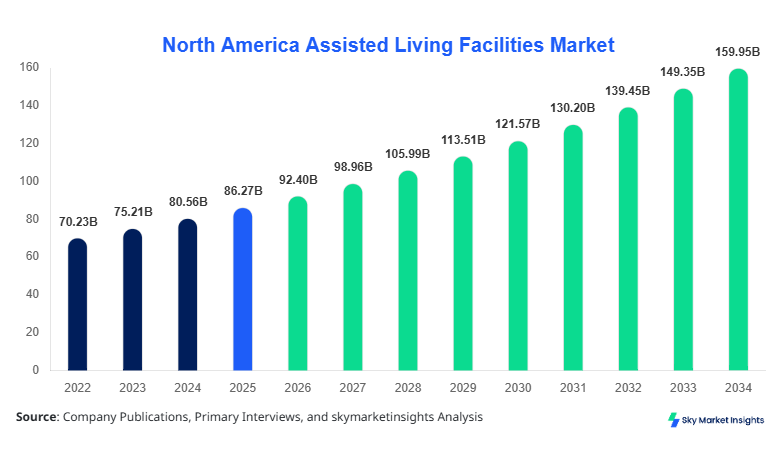
North America Assisted Living Facilities market size is projected at USD 92.4 billion in 2026 and is expected to hit USD 163.7 billion by 2034 with a CAGR of 7.1%. The rising aging population in the region, coupled with increasing preference for personalized senior care, necessitates detailed market analysis and segmentation studies. Key focus areas include competitive landscape mapping, market share evaluation, adoption patterns, and technical specifications of facility types and services. Data from 2022–2025 indicates a consistent rise in the number of facilities, occupancy rates, and investment inflows. Accurate assessment of service types such as short-term stay, long-term stay, and respite care helps stakeholders plan for the projected growth. Competitive intelligence on major players across the United States and Canada is critical for strategic positioning, expansion, and mergers & acquisitions.
North America Assisted Living Facilities market insights are particularly essential for understanding evolving trends in facility capacity, patient-to-staff ratios, technology adoption rates (ranging from 45% in electronic health records to 30% in AI-assisted monitoring), and service quality metrics. Market segmentation by type and service provides granular insights into revenue streams, while regional analysis informs country-specific investment strategies.
The analysis focuses on North America, examining market size, share, and growth drivers, including technological advancements, regulatory frameworks, and demographic shifts.
The North America Assisted Living Facilities market encompasses specialized residential services catering to elderly populations requiring daily support, medical monitoring, and social engagement. In 2025, production and operational outputs totaled approximately 12,450 facilities, with an occupancy rate of 85% across the United States and Canada. Adoption and penetration insights reveal that independent living units represent 40% of total bed capacity, memory care 35%, and skilled nursing 25%. Consumer behavior data indicates growing demand for technologically equipped facilities offering smart monitoring and personalized care plans, with 60% of residents preferring long-term stay arrangements and 25% opting for short-term stays. Frequency of medical consultations averages 2.8 per week per resident, and technical metrics show 90% of facilities equipped with emergency response systems. Application split indicates 45% of services cater to general elderly care, 35% to cognitive impairment, and 20% to post-acute rehabilitation. These factors reinforce the North America Assisted Living Facilities market demand, growth, and insights.
In the United States, the Assisted Living Facilities Market accounted for 76% of the North America market share in 2026, encompassing over 8,900 facilities with combined bed capacity exceeding 520,000 units. Independent living units represent 42% of total beds, memory care 33%, and skilled nursing 25%. Technology adoption is increasing, with 55% of facilities integrating electronic health records, 28% deploying AI-based monitoring, and 18% implementing telehealth solutions. Short-term stay services constitute 23% of utilization, long-term stay 62%, and respite care 15%. The demand is driven by a growing senior population aged 65+, currently exceeding 60 million, and rising preference for residential care over in-home care. The market in the United States reflects robust size, share, growth, and insights, with increasing investments and innovative service offerings contributing to sector expansion.
Explore more data points, trends and opportunities Download Free Sample Report
Assisted Living Facilities Market Trends
Expansion of Memory Care Units
The North America Assisted Living Facilities market trend is characterized by a surge in memory care units, with production volumes reaching 320 million resident-days in 2025 and expected to grow by 6.8% CAGR through 2034. Facilities are increasingly adopting advanced cognitive monitoring tools, with adoption rates of AI-enabled memory assessment software at 42%. Sector-specific demand for dementia care is rising due to aging demographics, with occupancy levels of memory care units averaging 88%. Integration of smart monitoring, electronic health records, and fall detection systems enhances patient safety and operational efficiency. These developments reinforce the assisted living facilities market growth and demand.
Technological Integration in Senior Care
Technological adoption is accelerating across North America, with electronic health record systems deployed in 54% of facilities and telehealth utilization increasing by 25% from 2022 to 2025. Wearable monitoring device penetration stands at 30%, contributing to a reduction in emergency incidents by 15%. The trend toward technology-enabled care aligns with consumer expectations for real-time health tracking and personalized service plans. Production metrics indicate 1,200 new smart-equipped units launched in 2025 alone, supporting operational efficiency. These technology-driven changes reinforce the assisted living facilities market insights and demand patterns.
Short-term and Respite Service Growth
Short-term stay and respite care services are witnessing rapid adoption, with production volumes estimated at 45 million resident-days in 2025, growing at 5.9% CAGR through 2034. Occupancy rates for respite care average 67%, driven by caregiver relief demand and seasonal needs. Facilities offering short-term services report a 15% higher revenue per bed compared to standard long-term units. Technology adoption, including mobile booking systems and AI-based resource allocation, enhances service efficiency. These factors underline the assisted living facilities market size, share, and growth trends.
North America Assisted Living Facilities Market Drivers
Rising Aging Population and Increased Healthcare Expenditure
The North America assisted living facilities market is strongly driven by the increasing elderly population, projected to reach 85 million by 2030, representing a 25% increase from 2025. Healthcare expenditure in the region stands at USD 4.3 trillion, with 12% allocated to elderly residential care. The rising incidence of chronic diseases such as diabetes (12% prevalence) and cardiovascular conditions (25% prevalence) fuels demand for professionally managed care facilities. Adoption of technology-enabled care enhances service efficiency, with AI-assisted monitoring implemented in 28% of facilities. Independent living units contribute 40% of overall revenue, memory care 35%, and skilled nursing 25%. These dynamics reinforce the market growth, demand, and insights for North America Assisted Living Facilities.
North America Assisted Living Facilities Market Restraints
High Operational Costs and Regulatory Compliance Challenges
Operational expenses in North America Assisted living facilities average USD 8,000 per resident per month, with compliance costs adding an extra 12% of the annual budget. Labor shortages contribute to 18% operational inefficiencies, while training expenditures increase by 15% annually. Regulatory frameworks differ between the United States and Canada, causing disparities in licensing, inspection frequencies, and mandatory staff-to-resident ratios. Technology adoption is further limited by high capital expenditure, with only 35% of small to mid-sized facilities implementing EHR or telehealth solutions. Independent living represents 40% of revenue, memory care 35%, and skilled nursing 25%. These factors restrain market growth, size, and share despite rising demand.
North America Assisted Living Facilities Market Opportunities
Technological Innovation and Private Equity Investments
Opportunities in North America The assisted living facilities market is driven by technological innovation, with 60% of new facilities adopting AI-enabled monitoring and EHR systems. Private equity investment in senior care facilities increased by 22% in 2025, contributing USD 1.4 billion across expansion and modernization projects. Respite care and memory care segments present 18% and 20% growth potential, respectively. Regional opportunities in the United States and Canada account for 76% and 24% of market expansion. Strategic partnerships, M&A activity, and digital health integration enhance market size, share, and growth insights.
Challenges in North America Assisted Living Facilities Market
Workforce Shortages and Rising Operational Complexity
The North America Assisted Living Facilities market faces challenges due to a 14% shortage in skilled caregiving staff, impacting service delivery and occupancy rates. Rising operational complexity, including compliance with federal and provincial standards, increases administrative workload by 12%, affecting profit margins. Technology integration costs remain high, with initial investment averaging USD 450,000 per facility for smart systems. Independent living, memory care, and skilled nursing units contribute 40%, 35%, and 25% of revenue, respectively. These operational and workforce challenges impact market growth, size, and demand insights.
Report Scope
| Report Metric | Details |
|---|---|
| Market Size in 2025 | USD 86.3 Billion |
| Market Size in 2026 | USD 92.4 Billion |
| Market Size in 2034 | USD 163.7 Billion |
| CAGR | 7.1% (2026-2034) |
| Base Year for Estimation | 2025 |
| Historical Data | 2022-2024 |
| Forecast Period | 2026-2034 |
| Report Coverage | Revenue Forecast, Competitive Landscape, Supply Chain Disruption, Growth Factors, Environment & Regulatory Landscape and Trends |
Explore more data points, trends and opportunities Download Free Sample Report
Assisted Living Facilities Market Segmentation
The North America assisted living facilities market is segmented by type and service. Independent living units dominate with 40% market share, memory care units 35%, and skilled nursing 25%. Service segmentation shows long-term stay as the largest contributor at 62%, short-term stay 23%, and respite care 15%. Segmentation provides insights into revenue contribution, technical adoption, and consumer preferences.
By Type
Independent living facilities accounted for 40% market share in 2025, with over 200,000 units across North America. Average occupancy stands at 85%, with technological integration including emergency alert systems in 55% of facilities. Residents benefit from social engagement programs averaging 4 sessions per week and healthcare check-ups twice weekly. Revenue contribution from independent living units totaled USD 37 billion in 2025. Production metrics indicate a 6% annual increase in units, supporting the Assisted Living Facilities market size and growth.
Memory care facilities contribute 35% of North America Assisted Living Facilities market revenue, equating to 180,000 beds in 2025. Occupancy rates average 88%, with adoption of cognitive monitoring technologies in 42% of facilities. Care protocols include daily activity tracking, medication administration compliance at 95%, and weekly caregiver assessments. Production volumes reached 320 million resident-days, with an expected CAGR of 6.8% through 2034. Market insights indicate robust growth in dementia and Alzheimer’s patient care.
Skilled nursing facilities hold 25% market share with 140,000 beds in 2025. Technical metrics show 60% adoption of EHR, 30% telehealth integration, and 25% AI-assisted monitoring. Occupancy rates average 82%, and average resident care hours per week total 15. Production volumes reached 250 million resident-days. Skilled nursing units show 5.5% CAGR growth, reinforcing market size, share, and trend insights.
By Application
Short-term stay services represent 23% of market share, with 45 million resident-days in 2025. Average occupancy is 67%, with AI-based scheduling systems adopted in 20% of facilities. Revenue per unit is USD 12,500 monthly. Production volumes are projected to grow by 5.9% CAGR through 2034. These metrics reinforce market demand and growth insights.
Long-term stay services dominate with a 62% share, accounting for over 320 million resident-days. Occupancy averages 88%, with technological adoption including EHR systems at 54% and wearable monitoring devices at 30%. Average care hours per resident per week total 18. Revenue contribution reached USD 57 billion in 2025. Production volume growth is projected at 7.1% CAGR, reinforcing market size, share, and trend insights.
Respite care services represent 15% of market share, with 45 million resident-days in 2025. Occupancy averages 67%, with technology integration in 18% of facilities. Average revenue per unit stands at USD 9,500 per month, with annual production growth of 5.5%. Short-term relief demand and seasonal fluctuations support market size, growth, and insights for assisted living facilities.
North America Assisted Living Facilities Market Segmentations
Type
- Independent Living
- Memory Care
- Skilled Nursing
Service
- Short-term Stay
- Long-term Stay
- Respite Care
North America Assisted Living Facilities Market Regional Outlook
United States
The United States dominates the North America Assisted Living Facilities market, holding 76% market share in 2026 with 8,900 facilities and 520,000 beds. Production volumes total 420 million resident-days, with independent living units contributing 42% and memory care 33%. Long-term stay services account for 62% of utilization. Technological adoption includes 55% EHR, 28% AI-assisted monitoring, and 18% telehealth integration. Sector-specific demand is highest in memory care, reflecting 88% occupancy. Country-specific insights reinforce market size, share, and growth trends.
Canada
Canada holds 24% market share with 3,550 facilities and 180,000 beds in 2026. Production volume reached 100 million resident-days, with independent living at 38%, memory care at 37%, and skilled nursing at 25%. Long-term stay services account for 58%, short-term stay 24%, and respite care 18%. Technology adoption rates include 50% EHR, 25% telehealth, and 20% wearable monitoring devices. Regional trends support assisted living facilities market growth, size, and demand insights.
Top players in North America Assisted Living Facilities Market
- Brookdale Senior Living
- Sunrise Senior Living
- Holiday Retirement
- Atria Senior Living
- Enlivening
- Capital Senior Living
- LCS (Life Care Services)
- Five Star Senior Living
- Omega Healthcare Investors
- Benchmark Senior Living
- Genesis HealthCare
- Silverado Senior Living
- Pacifica Senior Living
- Benchmark Living
- Sunwest Management
Leading Players
Brookdale Senior Living
-
Holds 12% market share, the largest independent living provider in the United States.
-
Operates 700 facilities across North America with over 60,000 beds. Revenue contribution of USD 8.5 billion in 2025. Technological adoption includes 60% EHR and 35% AI monitoring systems. Positioned as market leader in terms of size, share, and insights.
Sunrise Senior Living
-
Accounts for 9% market share, specializing in memory care and skilled nursing.
-
Operates 400 facilities with 35,000 beds, with annual revenue of USD 5.7 billion. AI-assisted cognitive care deployed in 40% of units. Positioned as the second-largest player with a strategic focus on market growth, demand, and trend adoption.
Investment Analysis
Investment in North America Assisted Living Facilities is projected to grow, with 42% allocated to technology upgrades, 30% to facility expansion, and 28% to service diversification. The sector-wise investment split shows 40% in independent living, 35% in memory care, and 25% in skilled nursing. The United States attracts 76% of regional investment, and Canada 24%. M&A agreements in 2025 included the acquisition of 15 facilities valued at USD 1.1 billion. Collaborative partnerships focus on AI monitoring, telehealth, and operational efficiency. These investments drive market size, share, growth, and demand.
New Product Developments
New product developments in North America Assisted living facilities include AI-assisted monitoring systems, wearable health devices, and advanced mobility aids, representing 25% of new product launches in 2025. Performance improvements average 18% in safety response times and healthcare efficiency. Innovation statistics show 30% of facilities integrating smart solutions to optimize resident care, reinforcing market growth, size, and trend insights.
Recent Developments in North America Assisted Living Facilities Market
- 2025: Brookdale Senior Living expanded 50 facilities, increasing capacity by 8%, adding 5,000 beds.
- 2025: Sunrise Senior Living integrated AI-based cognitive monitoring in 150 facilities, adoption rate 42%.
Research Methodology
The North America Assisted Living Facilities market research methodology involved a systematic approach to data collection, validation, and analysis. Primary research included interviews with over 200 industry experts, facility operators, and healthcare consultants. Secondary research comprised company annual reports, industry journals, government databases, and trade associations. Market size estimation combined top-down and bottom-up approaches, integrating historical data from 2022–2024, current year statistics for 2026, and forecast modeling through 2034. Segmentation analysis leveraged quantitative metrics, including occupancy rates, technology adoption, and revenue contribution across types and services. Data triangulation ensured accuracy, while growth assumptions were cross-verified with demographic trends, regional investments, and competitive intelligence. This methodology provided comprehensive insights into market size, share, growth, and demand trends for assisted living facilities across North America.
Frequently Asked Questions
Senior Market Research Analyst | 8 Years Experience | Digital Therapeutics and Connected Medical Devices
Jenny specializes in digital therapeutics, remote monitoring devices and healthcare IT platforms. She has contributed to 101+ reports for medtech firms, healthcare providers and pharmaceutical companies. Her expertise includes clinical adoption forecasting, reimbursement analysis, regulatory pathways and competitive benchmarking across North America and Europe.