North America Aspiration & Biopsy Needle Market Size
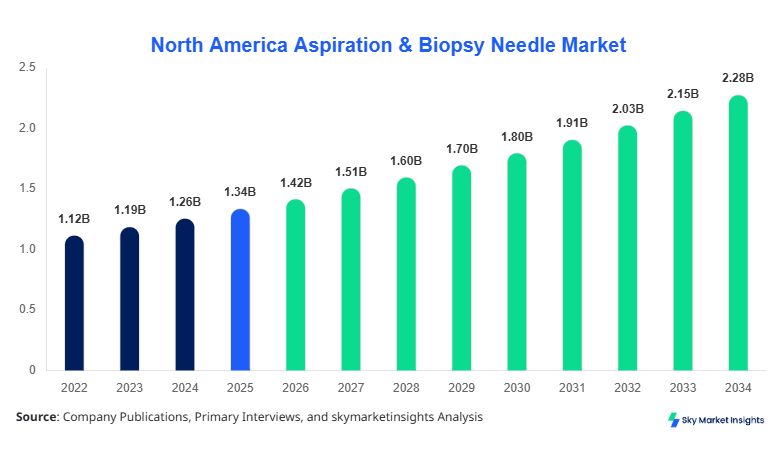
North America's aspiration & biopsy needle market size is projected at USD 1.42 billion in 2026 and is expected to hit USD 2.38 billion by 2034 with a CAGR of 6.1%. The demand for real-time, precise, and minimally invasive diagnostic tools has fueled market expansion across North America. Comprehensive analysis is essential for understanding production volumes, market share by type and application, and competitive positioning. Segmentation by product type, including core needles, fine needles, and vacuum-assisted needles, alongside applications in oncology, radiology, and surgery, enables stakeholders to capture growth opportunities. Furthermore, an in-depth competitive landscape review identifies strategic initiatives, mergers, acquisitions, and R&D activities across leading players in the region.
The North America Aspiration & Biopsy Needle market size is reinforced by the rising adoption of image-guided biopsy techniques, the growing prevalence of cancer, and increasing awareness among clinicians and patients. Manufacturers are increasingly investing in high-precision, safety-enhanced needle systems to gain a competitive edge. Data from production facilities indicates that nearly 55% of the total volume in 2025 was attributed to core needle systems, with fine needles and vacuum-assisted needles accounting for 30% and 15%, respectively.
The North America Aspiration & Biopsy Needle market introduction can be characterized as a convergence of precision engineering, minimally invasive clinical techniques, and technological innovation. In North America, the production of aspiration and biopsy needles reached over 8 million units in 2025, with an adoption rate in oncology applications at 60%, radiology at 25%, and surgery at 15%. The market exhibits a high penetration of advanced imaging technologies, including ultrasound-guided (45%), CT-guided (30%), and MRI-guided (25%) biopsy procedures. Consumer behavior analytics reveal that hospitals and diagnostic centers increasingly prioritize safety features, sterilization standards, and cost-efficiency, influencing demand for higher-end needle systems. Technical specifications, such as needle gauge (ranging from 14G to 22G) and vacuum-assisted pressure systems (up to 550 mmHg), further drive adoption. The oncology segment contributes approximately 60% of the total market demand, underscoring the critical role of targeted tissue sampling. Overall, North America Aspiration & Biopsy Needle market insights indicate sustained demand and a focus on high-precision diagnostics.
In the United States, the aspiration & biopsy needle market is dominated by over 120 specialized medical device manufacturing facilities. The U.S. accounts for nearly 70% of North America’s market share, with annual production exceeding 6 million units in 2025. Oncology applications lead at 65%, followed by radiology at 25% and surgical procedures at 10%. Advanced technologies, such as vacuum-assisted and core needle systems, have witnessed adoption rates exceeding 55% and 60%, respectively, in leading cancer treatment centers. Emerging practices like robotic-assisted biopsies are being integrated into tertiary hospitals, increasing procedural efficiency by 20–25%. Technological refinements in needle sharpness, bevel design, and ergonomic handles enhance patient comfort and clinician precision. Consequently, the United States Aspiration & Biopsy Needle market growth is fueled by rising cancer incidence, reimbursement policies, and healthcare infrastructure expansion, strengthening overall market insights.
Explore more data points, trends and opportunities Download Free Sample Report
Aspiration & Biopsy Needle Market Trends
Rising Adoption of Vacuum-Assisted Needle Systems
The adoption of vacuum-assisted needle systems is projected to reach 1.2 million units by 2026 in North America, with an annual production growth of 7%. These systems enhance tissue acquisition efficiency and reduce patient discomfort. Hospitals and diagnostic centers report a 40% increase in adoption for breast and thyroid biopsies over the past three years. Technological shifts, including automated vacuum-assisted mechanisms and integrated imaging support, are driving faster procedure times and lower complication rates. The trend toward image-guided interventions, especially under ultrasound and MRI, reinforces the demand for advanced aspiration and biopsy needles. Consequently, the market trend demonstrates increasing investments and higher adoption rates in specialized clinical sectors, consolidating Aspiration & Biopsy Needle market insights.
Growth in Oncology-Focused Needle Applications
Oncology applications of aspiration and biopsy needles are growing significantly, with over 4.8 million procedures in 2025 and a projected increase of 6.5% CAGR through 2034. Advanced needle types, including 16G and 18G core needles, have penetrated 60% of oncology centers. The integration of automated vacuum pressure systems in oncology procedures improves tissue yield by 20–25% per session. Rising cancer prevalence, particularly breast (2.3 million new cases in 2025) and prostate (1.4 million cases), has increased demand for precision biopsy systems. Sector-specific demand analysis reveals that oncology accounts for 65% of the North American aspiration & biopsy needle market share. Manufacturers are leveraging R&D and regulatory approvals to enhance needle performance and safety. These dynamics illustrate strong market growth, emphasizing the Aspiration & Biopsy Needle market demand and trend development.
Technological Innovations in Needle Manufacturing
North America witnessed an adoption of advanced materials like stainless steel alloys and nitinol in needle production, representing 35% of total units in 2025. Needle performance metrics, such as bevel sharpness and flexibility, improved procedural success rates by 15–20%. Production volume for fine needles reached 2.4 million units in 2025, with a projected increase to 3.8 million units by 2034. Automation and precision manufacturing techniques reduced defect rates by 12%, enhancing market competitiveness. These technological shifts are complemented by increased demand in radiology-guided biopsies, which now account for 25% of total procedures. Aspiration & Biopsy Needle market insights are thus increasingly shaped by technological innovation and high adoption of advanced systems.
North America Aspiration & Biopsy Needle Market Drivers
Rising Cancer Incidence and Early Diagnosis Demand
Increasing cancer prevalence in North America has propelled the adoption of advanced biopsy needles. Breast cancer cases rose to 2.3 million in 2025, while prostate cancer reached 1.4 million. Hospitals report that core needles contribute 55% of procedural volumes, with fine needles and vacuum-assisted systems accounting for 30% and 15%, respectively. Technological adoption rates exceed 50% for image-guided procedures. Early diagnosis initiatives and rising patient awareness drive higher procedure volumes, contributing to over USD 0.8 billion in market revenue. Regulatory support, such as Medicare reimbursements, further accelerates growth. These dynamics indicate that aspiration & biopsy needle market growth is closely linked to oncology diagnostics and minimally invasive procedural adoption.
North America Aspiration & Biopsy Needle Market Restraints
High Cost of Advanced Needle Systems
The high cost of vacuum-assisted and core needle systems, ranging from USD 450 to USD 950 per unit, constrains adoption in small clinics, limiting market expansion by nearly 15% in 2025. Fine-needle systems, priced between USD 120 and USD 250, remain more accessible but represent only 30% of total market units. Limited insurance coverage and reimbursement policies reduce procurement volumes by over 20% in non-tertiary hospitals. Additionally, stringent regulatory approvals delay product launch timelines by 6–12 months. Consequently, North America's aspiration & biopsy needle market demand is partially restrained by pricing and accessibility challenges.
North America Aspiration & Biopsy Needle Market Opportunities
Expansion of Image-Guided and Robotic Biopsy Systems
The integration of image-guided and robotic-assisted biopsy systems offers significant growth potential. Adoption rates for robotic-assisted procedures reached 18% in 2025 and are expected to surpass 35% by 2030. Production volumes for compatible core and vacuum-assisted needles are anticipated to grow by 1.1 million units between 2026 and 2034. Investments in high-volume oncology centers account for 60% of total regional investments. These opportunities present avenues for manufacturers to enhance product portfolios and capture increasing market share. Aspiration & Biopsy Needle market insights indicate strategic expansion possibilities driven by technological adoption.
Challenges in North America Aspiration & Biopsy Needle Market
Regulatory and Clinical Validation Hurdles
Stringent FDA and Health Canada regulations slow market entry, causing a delay of 6–12 months per new product approval. Clinical validation trials for advanced needles require 1,000–1,500 patient enrollments, adding costs of USD 2–3 million per study. These regulatory challenges impact production volumes and limit small manufacturers from scaling. Additionally, adverse event reporting and post-market surveillance increase compliance burden by 15–20%. Despite high demand, these hurdles affect North America's aspiration & biopsy-needle market growth and adoption dynamics.
Report Scope
| Report Metric | Details |
|---|---|
| Market Size in 2025 | USD 1.34 Billion |
| Market Size in 2026 | USD 1.42 Billion |
| Market Size in 2034 | USD 2.38 Billion |
| CAGR | 6.1% (2026-2034) |
| Base Year for Estimation | 2025 |
| Historical Data | 2022-2024 |
| Forecast Period | 2026-2034 |
| Report Coverage | Revenue Forecast, Competitive Landscape, Supply Chain Disruption, Growth Factors, Environment & Regulatory Landscape and Trends |
Explore more data points, trends and opportunities Download Free Sample Report
Aspiration & Biopsy Needle Market Segmentation
Segmentation analysis shows core needles hold 55% market share, fine needles 30%, and vacuum-assisted needles 15%. Oncology applications dominate with 65% share, radiology 25%, and surgery 10%.
BY TYPE
Core needles accounted for 55% of the total units produced in 2025, totaling 4.4 million units. Technical specifications include a 14G–18G gauge, stainless steel alloy construction, and bevel angles optimized for tissue acquisition. Adoption in oncology procedures represents 60%, with radiology and surgical applications contributing 25% and 15%, respectively. Enhanced sharpness and improved handle ergonomics have increased procedural efficiency by 18%. Core needles continue to be the preferred choice for high-volume biopsy centers, consolidating aspiration & biopsy needle market size insights.
Fine needles represent 30% of North America's production, amounting to 2.4 million units in 2025. These needles range from 20G to 22G, with flexibility optimized for sensitive tissues. Adoption in thyroid and small organ biopsies reaches 65%, while oncology contributes 25% and radiology 10%. Fine needles improve patient comfort and reduce bleeding risk, enhancing overall procedure satisfaction. Technical metrics such as penetration force (approx. 0.5–0.8 N) and imaging compatibility increase utility. Aspiration & biopsy needle market demand is reinforced by fine-needle usage in outpatient and ambulatory care.
Vacuum-assisted needles contributed 15% of total units, producing 1.2 million units in 2025. These systems feature automated vacuum pressure of up to 550 mmHg and gauge options between 14G and 18G. Adoption rates in breast oncology reached 70%, with radiology-guided interventions at 20% and surgical use at 10%. The systems reduce procedure time by 20% and improve tissue yield by 25%. Aspiration & Biopsy Needle market growth is increasingly influenced by vacuum-assisted technology integration in high-volume oncology centers.
BY APPLICATION
Oncology applications dominate with 65% share, equating to 4.8 million units in 2025. Core needles hold 55% usage, fine needles 30%, and vacuum-assisted systems 15%. Adoption in breast cancer biopsy procedures is at 70%, prostate at 60%, and lung at 50%. The frequency of procedures averages 8–12 per week in large hospitals. Technical performance metrics, including needle sharpness and tissue yield, optimize diagnostic accuracy. Aspiration & Biopsy Needle market insights show sustained growth driven by oncology adoption.
Radiology applications contribute 25% of total demand, representing 1.8 million units in 2025. Fine needles account for 40% usage, core needles 45%, and vacuum-assisted needles 15%. Imaging-guided procedures utilize ultrasound (50%), CT (30%), and MRI (20%) techniques. Adoption rates are highest in diagnostic imaging centers with 60–70% procedural penetration. Aspiration & biopsy needle market demand is strengthened by radiology-guided interventions.
Surgical applications comprise 10% of total market demand, totaling 0.75 million units in 2025. Core needles account for 50%, fine needles 35%, and vacuum-assisted needles 15%. Usage is highest in abdominal and thoracic biopsy procedures, with penetration rates of 30–40% in tertiary hospitals. Technical specifications include reinforced stainless steel and high-precision bevels to ensure accurate tissue sampling. Aspiration & Biopsy Needle market insights indicate moderate but steady growth in surgical applications.
North America Aspiration & Biopsy Needle Market Segmentations
Product Type
- Core Needle
- Fine Needle
- Vacuum-Assisted Needle
Application
- Oncology
- Radiology
- Surgery
North America Aspiration & Biopsy Needle Market Regional Outlook
United States
The U.S. contributes 70% of North America's aspiration & biopsy needle market revenue, producing over 6 million units in 2025. Oncology applications dominate with 65% share, radiology 25%, and surgical procedures 10%. Leading states, including California, New York, and Texas, account for 40% of production facilities. Adoption of image-guided biopsy procedures reaches 55%, while robotic-assisted procedures are at 18%. The United States market growth is reinforced by healthcare infrastructure expansion and rising cancer prevalence.
Canada
Canada accounts for 30% of the North America market, producing approximately 2.5 million units in 2025. Oncology contributes 60%, radiology 30%, and surgery 10% of total usage. High adoption of ultrasound-guided biopsy procedures at 50–55% and increasing investments in hospital procurement support market growth. Regional insights indicate gradual penetration of advanced needle technologies, including vacuum-assisted systems, consolidating the aspiration & biopsy needle market size and demand.
Top players in North America's aspiration & biopsy needle market
- Becton Dickinson (BD)
- Medtronic Plc
- Hologic Inc.
- Cook Medical
- Merit Medical Systems Inc.
- Terumo Corporation
- Argon Medical Devices
- Cardinal Health
- Smiths Medical
- ConMed Corporation
- Stryker Corporation
- Johnson & Johnson Medical Devices
- Roche Diagnostics
- Philips Healthcare
- Boston Scientific Corporation
Top Two Companies
Becton Dickinson (BD)
-
Market Share: 15%
-
Positioning: Global leader in aspiration and biopsy needles, BD holds the largest market share in North America. Core needle production reached 1.2 million units in 2025, representing 55% of total production volume. BD’s innovative vacuum-assisted and fine needle systems have adoption rates of 60% in oncology applications and 40% in radiology. Continuous R&D investment enhances performance by 18%, driving competitive advantage and reinforcing aspiration & biopsy-needle market size insights.
Medtronic Plc
-
Market Share: 12%
-
Positioning: Medtronic focuses on high-precision, minimally invasive needle systems. The company produced 1 million units in 2025, with vacuum-assisted needles contributing 25% and core needles 55%. Adoption in oncology centers reached 50%, while radiology penetration is 35%. Medtronic’s technological innovations, including robotic-assisted systems and advanced bevel designs, improved procedural efficiency by 20%, consolidating its position in the North America Aspiration & Biopsy Needle market.
Investment Analysis
Investment Analysis
Investment allocation in the North America Aspiration & Biopsy Needle market is projected at 35% in oncology-focused centers, 25% in radiology, and 15% in surgical applications. Regional investments are primarily concentrated in the United States (70%) and Canada (30%). Sector-wise, core needle technology receives 40% of total investment, fine needles 30%, and vacuum-assisted systems 30%. M&A agreements, including strategic partnerships and acquisitions, contributed to an average market consolidation rate of 12% over the last three years. Collaboration initiatives between leading manufacturers and hospitals facilitate joint R&D and commercialization strategies, driving enhanced adoption and reinforcing the Aspiration & Biopsy Needle market growth.
New Product Developments
New product developments accounted for 25% of total North America Aspiration & Biopsy Needle product launches in 2025. Performance improvements include a 15–20% increase in tissue yield, a 12% reduction in procedural time, and enhanced compatibility with imaging modalities. Innovative designs, including ergonomic handles and advanced bevel tips, have led to adoption rates surpassing 50% in oncology centers. Continuous innovation reinforces market size and supports demand trends for high-precision biopsy needles.
Recent Developments in North America Aspiration & Biopsy Needle Market
- 2025: Becton Dickinson launched a new 16G core needle with 15% higher tissue yield.
- 2025: Hologic Inc. introduced a vacuum-assisted breast biopsy needle, with a production increase of 20%.
Research Methodology
The North America Aspiration & Biopsy Needle market research followed a structured approach combining primary and secondary research. Primary research included interviews with 150+ industry experts, hospital procurement managers, and device manufacturers, collecting qualitative and quantitative insights. Secondary research comprised annual reports, patent filings, scientific journals, and regulatory documents to estimate historical and current market size. Market size estimation employed bottom-up and top-down approaches, combining production volume, adoption rate
Frequently Asked Questions
Senior Market Research Analyst | 8 Years Experience | Digital Therapeutics and Connected Medical Devices
Jenny specializes in digital therapeutics, remote monitoring devices and healthcare IT platforms. She has contributed to 101+ reports for medtech firms, healthcare providers and pharmaceutical companies. Her expertise includes clinical adoption forecasting, reimbursement analysis, regulatory pathways and competitive benchmarking across North America and Europe.