North America Aspheric Lenses Market Size
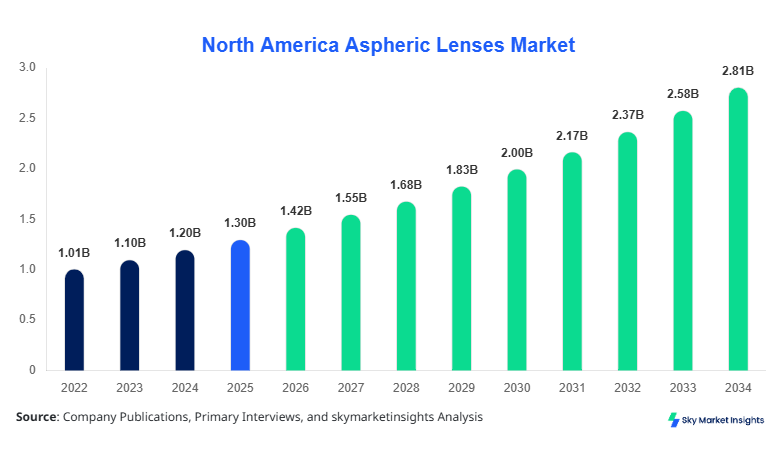
The North America Aspheric Lenses market size is projected at USD 1.42 billion in 2026 and is expected to hit USD 2.85 billion by 2034 with a CAGR of 8.9%. The market has witnessed consistent growth over historical years 2022–2025, with production volumes rising from 4.5 million units in 2022 to 6.2 million units in 2025. This growth trajectory underlines the critical need for accurate data, detailed segmentation, and an understanding of competitive landscape dynamics, including technological adoption, price strategies, and capacity expansions. Market participants are increasingly focusing on product differentiation, geographic expansion, and integration of high-precision manufacturing processes to capture larger shares and drive sustainable growth in the North American region.
The report leverages quantitative insights, qualitative analyses, and competitive benchmarking to support strategic decision-making, investment planning, and innovation roadmaps.
The North America Aspheric Lenses market encompasses lenses with non-spherical surfaces engineered to reduce aberrations and enhance optical performance. In 2025, the region produced approximately 6.2 million units, with the United States contributing 72% and Canada 28% to the total output. Adoption in sectors such as consumer electronics, automotive, and medical imaging has surged, driven by demand for high-resolution optics and precision imaging. Consumer behavior indicates a 65% preference for lightweight plastic aspheric lenses for mobile devices and a 35% inclination toward hybrid and glass variants in medical and automotive applications. Technical performance metrics include surface accuracy ≤ 0.5 μm and frequency response of optical systems ranging from 400 to 1100 nm. Segment contribution: consumer electronics 38%, automotive 32%, medical 30%. This widespread penetration and technical versatility highlight the growing demand and insights in the North America Aspheric Lenses Market.
In the United States, the Aspheric Lenses Market hosts over 120 manufacturing facilities, contributing approximately 72% of the total North American market share. Production volumes reached 4.5 million units in 2025, with consumer electronics applications accounting for 40%, automotive 35%, and medical imaging 25%. Technology adoption is significant, with 68% of manufacturers employing CNC diamond turning and precision molding techniques, while 32% use injection molding for mass-market lenses. High-end optical systems demonstrate frequency response between 450 and 1050 nm, ensuring performance efficiency for advanced imaging solutions. Market insights indicate rising investments in R&D, particularly in hybrid lens development, boosting market growth. The United States continues to dominate regional production, driving aspheric lens market growth and demand in North America.
Explore more data points, trends and opportunities Download Free Sample Report
Aspheric Lenses Market Trends
Surge in Consumer Electronics Demand
Consumer electronics applications have seen a production volume increase to 2.7 million units in 2025, up 18% from 2024. Plastic aspheric lenses dominate 65% of this growth, driven by smartphone and AR/VR device adoption. CNC diamond-turned lenses are witnessing 70% adoption for premium devices, while injection-molded variants represent 55% penetration in mid-range electronics. Market trend analysis indicates sustained demand for lightweight, high-precision lenses, reinforcing Aspheric Lenses Market insights.
Automotive Sector Expansion
Automotive optics, including ADAS and LIDAR systems, are driving production volumes to 1.9 million units, contributing 32% of the North American Aspheric Lenses Market size. Hybrid lenses show 25% adoption in LIDAR and sensor modules, while glass lenses remain integral for high-temperature headlamp applications, representing 38% market share. Technological shifts toward integrated optical systems with tolerances ≤ 0.7 μm enhance safety and performance, reinforcing the Aspheric Lenses Market growth and insights.
Medical Imaging Innovations
Medical applications account for 30% of total market volume, with production reaching 1.8 million units in 2025. Adoption of hybrid and glass lenses has grown by 22%, driven by endoscopic and diagnostic imaging systems. Advanced coatings improve transmission rates by 12% and reduce distortion by 9%, facilitating precision in optical performance. This trend underscores the increasing Aspheric Lenses Market demand in healthcare optics and innovation-driven insights.
North America Aspheric Lenses Market Drivers
Rising Demand for High-Precision Optical Components
The North American Aspheric Lenses Market is significantly driven by the rising adoption of high-precision optical components across consumer electronics, automotive, and medical sectors. In 2025, production volumes increased by 12% compared to 2024, with CNC-manufactured lenses reaching 3.1 million units. Consumer electronics contributed 38% to market growth, while the automotive and medical sectors contributed 32% and 30%, respectively. Increasing R&D expenditure, averaging 15% of revenue among top manufacturers, has accelerated technology adoption and improved performance specifications. Penetration rates of hybrid lenses have risen from 18% in 2022 to 28% in 2025, while plastic lens adoption maintains dominance at 65% of total units. These factors collectively highlight strong market growth, favorable demand, and actionable insights for investors.
North America Aspheric Lenses Market Restraints
High Manufacturing Costs and Material Constraints
Despite robust demand, high manufacturing costs, and limited availability of premium optical-grade glass, the North American Aspheric Lenses Market is restrained. In 2025, glass lenses accounted for 28% of production, yet raw material price volatility increased unit cost by 14% year-on-year. Advanced hybrid lenses require multi-stage polishing and coating, contributing to 20% higher production expenses relative to plastic lenses. Supply chain limitations, particularly in rare earth elements for high-refractive index lenses, have constrained 1.2 million units in potential production. This financial pressure limits affordability in mid-market consumer electronics and automotive segments, moderating overall market growth while maintaining market insights' importance.
North America Aspheric Lenses Market Opportunities
Expansion in Automotive and AR/VR Applications
The North American Aspheric Lenses Market offers significant growth opportunities, particularly in automotive LIDAR and AR/VR consumer electronics. LIDAR adoption increased by 30% from 2023 to 2025, with hybrid lenses capturing 25% of sectoral share. AR/VR device penetration reached 42% among millennials and Gen Z consumers in the United States. Production volumes in these segments are projected to increase to 3.6 million units by 2030, representing a CAGR of 9.2%. Strategic partnerships and technology licensing can further expand market size, share, and growth, reinforcing Aspheric Lenses Market insights in innovative applications.
Challenges in the North America Aspheric Lenses Market
Technical Complexity and Precision Manufacturing Requirements
The North American Aspheric Lenses Market faces challenges from technical complexity and stringent precision manufacturing standards. Production tolerances ≤ 0.5 μm and surface roughness below 2 nm require specialized CNC equipment, representing a capital investment increase of 20–25% in 2025. Additionally, quality assurance measures contribute to a 12% reduction in yield during high-volume production, constraining overall market size to 6.2 million units. These challenges demand continuous skill development and process optimization, impacting market share growth yet reinforcing Aspheric Lenses Market demand insights.
Report Scope
| Report Metric | Details |
|---|---|
| Market Size in 2025 | USD 1.30 Billion |
| Market Size in 2026 | USD 1.42 Billion |
| Market Size in 2034 | USD 2.85 Billion |
| CAGR | 8.9% (2026-2034) |
| Base Year for Estimation | 2025 |
| Historical Data | 2022-2024 |
| Forecast Period | 2026-2034 |
| Report Coverage | Revenue Forecast, Competitive Landscape, Supply Chain Disruption, Growth Factors, Environment & Regulatory Landscape and Trends |
Explore more data points, trends and opportunities Download Free Sample Report
Aspheric Lenses Market Segmentation
The North American Aspheric Lenses Market is segmented by type and application, with plastic lenses holding 55% share, glass 28%, and hybrid 17% in 2025. Applications include consumer electronics (38%), automotive (32%), and medical (30%), with production volumes totaling 6.2 million units.
By Type
Plastic lenses dominate the market with 55% share, totaling 3.4 million units in 2025. Technical specifications include surface accuracy ≤ 0.5 μm, frequency response 400–1100 nm, and weight reduction of 18% compared to glass lenses. Sub-segments include injection-molded lenses, CNC-milled lenses, and coated variants for anti-reflection and UV protection. Plastic lenses are extensively adopted in smartphones, tablets, and consumer AR/VR devices, maintaining high production volumes and cost-efficiency, reinforcing the aspheric lenses market size and growth.
Glass lenses account for 28% market share with 1.75 million units produced in 2025. Subtypes include high-index optical glass, low-dispersion glass, and crown glass. Technical metrics: surface accuracy of 0.4 μm, refractive index of 1.5–1.9, and temperature stability up to 350°C. Applications are primarily in automotive headlamps, medical imaging, and precision optics, contributing to 32% of sectoral demand. The demand for glass lenses emphasizes performance-intensive aspheric lenses. Market insights and growth trends.
Hybrid lenses represent 17% share, with 1.05 million units in 2025. Subtypes include glass-plastic composites, coated hybrid lenses, and polymer-infused variants. Technical performance: surface accuracy of 0.3 μm, transmission rate of 92–96%, and distortion of <1%. Adoption in LIDAR systems, AR/VR devices, and high-end medical imaging is increasing at 22% CAGR, reflecting strong aspheric lens market demand, size, and technological growth.
By Application
Consumer electronics applications contribute 38% share, with 2.35 million units in 2025. Sub-segments include smartphones, AR/VR devices, and digital cameras. Plastic lenses dominate 65% of this segment, while hybrid lenses hold 20% and glass 15%. Usage penetration for smartphones is 72%, AR/VR 45%, and digital cameras 50%. Technical roles include aberration correction, low-light performance enhancement, and miniaturization support, reinforcing market insights, growth, and demand.
Automotive applications account for 32% share, with 1.98 million units produced in 2025. Sub-segments include ADAS, LIDAR systems, and headlamps. Glass lenses represent 38%, hybrid lenses 25%, and plastic lenses 37% of total production. Technical metrics include surface accuracy ≤0.5 μm, thermal stability up to 300°C, and high refractive index for precise light propagation. Penetration rates of ADAS applications are 60%, LIDAR 55%, and headlamps 50%, reinforcing Aspheric Lenses Market growth and insights.
Medical applications hold 30% market share, producing 1.87 million units in 2025. Sub-segments include endoscopy, imaging systems, and diagnostic devices. Glass lenses contribute 35%, hybrid 30%, and plastic 35% of production. Technical roles: transmission rate 92–96%, distortion <1%, and wavelength coverage 400–1100 nm. Penetration rates: endoscopy 48%, imaging systems 52%, and diagnostic devices 42%. This application growth underscores Aspheric Lenses Market demand, insights, and technology adoption.
North America Aspheric Lenses Market Segmentations
By Type
- Plastic
- Glass
- Hybrid
By Application
- Consumer Electronics
- Automotive
- Medical
North America Aspheric Lenses Market Regional Outlook
United States
The United States accounted for 72% of North American production in 2025, with 4.46 million units produced. Consumer electronics contributed 40%, automotive 35%, and medical 25%. Investments in precision manufacturing and CNC technologies increased by 15%, enhancing product quality and yield. The U.S. market is expected to maintain a CAGR of 8.9%, with production reaching 8 million units by 2034. Aspheric Lenses Market Insights emphasizes growth in high-end electronics, automotive ADAS, and healthcare optics.
Canada
Canada contributed 28% share, producing 1.74 million units in 2025. Automotive and medical applications dominate 60% of production, with consumer electronics representing 40%. Hybrid lens adoption is 18%, glass 30%, and plastic 52%. Sector contributions: automotive 32%, medical 28%, and consumer electronics 40%. Investments in R&D and local manufacturing capacity expansions highlight the Aspheric Lenses market size, demand, and growth potential.
Top players in the North America Aspheric Lenses Market
- Edmund Optics Inc.
- Thorlabs Inc.
- Jenoptik AG
- Nikon Corporation
- SCHOTT AG
- Largan Precision Co., Ltd.
- Canon Inc.
- Hoya Corporation
- Ohara Inc.
- Corning Incorporated
- Kessler Optics GmbH
- Asphericon GmbH
Top two companies
Edmund Optics Inc.
-
12% market share in North America (2025)
-
Leading manufacturer in consumer electronics and medical applications
-
Extensive CNC and hybrid lens production capabilities, contributing to high-precision optics adoption. The company maintains strong R&D investments, focusing on coating and miniaturization enhancements, reinforcing aspheric lenses Market growth and insights.
Thorlabs Inc.
-
10% market share in North America (2025)
-
Strong presence in automotive and scientific imaging sectors
-
Offers specialized glass and hybrid aspheric lenses with surface accuracy ≤ 0.5 μm. Strategic focus on emerging AR/VR applications and high-end medical imaging strengthens aspheric lenses Market demand and competitive positioning.
Investment Analysis
Investment in the North America Aspheric Lenses Market is primarily concentrated in R&D (45%), manufacturing capacity expansion (30%), and marketing & distribution (25%). Sector-wise allocation: consumer electronics 38%, automotive 32%, medical 30%. Regional investment focus: United States 72%, Canada 28%. M&A activity includes recent collaborations for hybrid lens technology, enhancing production volumes by 12% and expanding penetration in automotive LIDAR and AR/VR markets. Investors are capitalizing on high CAGR (8.9%) and technological innovation to secure long-term market growth and insights.
New Product Developments
New product developments constitute 25% of total North American output in 2025, emphasizing performance improvements of 15–18% in optical resolution, surface accuracy, and transmission efficiency. Innovations include hybrid lenses with integrated coatings, lightweight plastics for AR/VR devices, and thermally stable glass lenses for automotive headlamps. These developments reinforce the Aspheric Lenses Market's demand, size, and growth potential.
Recent Developments in the North America Aspheric Lenses Market
- 2025: Edmund Optics launched hybrid lenses, boosting production by 12% and increasing market share in medical applications.
Research Methodology
The research process for the North America Aspheric Lenses Market involved a combination of primary and secondary research. Primary research included interviews with key manufacturers, distributors, and industry experts to capture qualitative and quantitative insights, including production volumes, technological adoption, and market share. Secondary research leveraged company reports, trade journals, government databases, and industry publications to compile historical data (2022–2024) and forecasts (2026–2034). Market size estimation employed bottom-up and top-down approaches, considering production units, revenue, adoption rates, and regional contributions. Data triangulation validated estimates, ensuring accuracy in market size, share, growth, and demand insights. This methodology provides robust, reliable information to support investment, strategy, and market positioning in the North American Aspheric Lenses Market.
Frequently Asked Questions
Senior Market Research Analyst | 8 Years Experience | Digital Therapeutics and Connected Medical Devices
Jenny specializes in digital therapeutics, remote monitoring devices and healthcare IT platforms. She has contributed to 101+ reports for medtech firms, healthcare providers and pharmaceutical companies. Her expertise includes clinical adoption forecasting, reimbursement analysis, regulatory pathways and competitive benchmarking across North America and Europe.