North America Aromatherapy Market Size
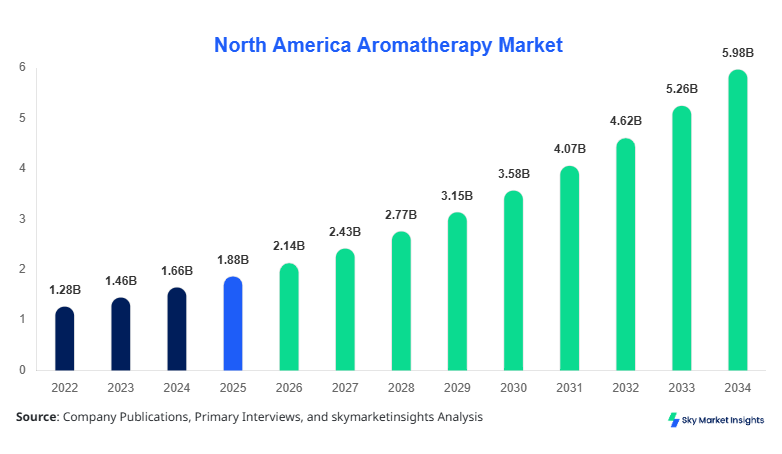
North America's aromatherapy market size is projected at USD 2.14 billion in 2026 and is expected to hit USD 5.98 billion by 2034 with a CAGR of 13.7%. The North American aromatherapy market size expansion is supported by rising wellness expenditure exceeding USD 1.5 trillion globally, with North America contributing over a 38% share. The report evaluates segmented revenue streams, consumption volume exceeding 220 million units annually, and competitive concentration ratios (CR5 ~42%) across the region, highlighting granular data across distribution channels and end-use industries.
The aromatherapy market refers to the use of plant-derived essential oils and aromatic compounds for therapeutic purposes, including relaxation, stress reduction, and physical well-being. In North America, production volume surpassed 210 million units in 2025, with essential oils accounting for nearly 62% of total output and carrier oils contributing 21%. Adoption rates have surged to 47% among urban consumers, while penetration in wellness clinics exceeds 58%. Consumer behavior reflects increasing demand for natural products, with over 64% of buyers preferring organic-certified oils and average monthly consumption rising by 12.5%. The application split indicates relaxation therapies dominating with 44%, followed by skincare at 31% and pain management at 18%. Technical metrics include diffusion efficiency rates of 85–92% and oil purity benchmarks above 98%. Increasing awareness and usage frequency—averaging 3.2 sessions per week per user—are reinforcing aromatherapy market share expansion across North America.
In the United States, the aromatherapy market dominates with over 76% regional share, supported by more than 1,200 active manufacturers and wellness facilities. The country accounts for approximately USD 1.62 billion in 2026 revenue, with application breakdown showing relaxation at 46%, skincare at 29%, and pain management at 19%. Technology adoption in the U.S. is high, with 61% of households using diffusers and ultrasonic diffusion devices experiencing annual sales growth of 15%. Additionally, over 72% of spa centers integrate aromatherapy into services, while e-commerce accounts for 54% of product distribution. The aromatherapy market share is further reinforced by strong consumer preference for therapeutic-grade oils and increased integration into healthcare and lifestyle routines.
Explore more data points, trends and opportunities Download Free Sample Report
Aromatherapy Market Trends
The aromatherapy market trend is being shaped by the rapid adoption of advanced diffusion technologies and personalized wellness solutions. Production volume of essential oils in North America crossed 135 million units in 2025, with an anticipated increase of 11% annually through 2030. Ultrasonic diffusers now account for 48% of total device sales, while nebulizing diffusers represent 22%, reflecting a technological shift toward higher efficiency and purity preservation. Additionally, over 57% of consumers are now purchasing aromatherapy products via online channels, indicating a digital transformation trend. Increased demand from the hospitality and healthcare sectors, contributing nearly 26% of total consumption, is accelerating this aromatherapy market trend.
Another key aromatherapy market trend involves the integration of aromatherapy into mental health and stress management programs. With over 68% of North American adults reporting stress-related issues, aromatherapy adoption in therapeutic applications has risen by 19% year-over-year. Blended oils designed for specific outcomes—such as sleep enhancement or anxiety reduction—have seen a 23% increase in demand. Furthermore, sustainable sourcing practices have gained traction, with 41% of manufacturers adopting eco-friendly extraction methods. The aromatherapy market trend is also supported by increasing product innovation and regulatory standardization, improving consumer trust and long-term adoption.
North America Aromatherapy Market Drivers
Rising Wellness Awareness and Natural Product Adoption
The primary driver of the aromatherapy market growth in North America is the increasing consumer shift toward natural and holistic wellness solutions. With over 63% of consumers preferring plant-based remedies, demand for essential oils has surged significantly. The wellness industry in North America exceeds USD 750 billion, with aromatherapy contributing approximately 3.2% of total spending. Additionally, more than 58% of individuals aged 25–45 report using aromatherapy products regularly, while usage frequency has increased by 14% annually. Healthcare integration is also notable, with 36% of alternative therapy clinics incorporating aromatherapy into treatment plans. Rising disposable income and growing awareness campaigns have further boosted product adoption rates. This strong alignment with health-conscious lifestyles continues to accelerate aromatherapy market growth across the region.
North America Aromatherapy Market Restraints
High Cost of Premium Essential Oils and Regulatory Challenges
Despite its expansion, the aromatherapy market growth faces restraints due to high production costs and regulatory complexities. Premium essential oils can cost between USD 20 and 150 per 10 ml, limiting accessibility for price-sensitive consumers. Additionally, over 27% of small-scale producers face challenges in meeting stringent quality and safety regulations. The cost of organic certification alone can increase product pricing by 18–25%, impacting overall sales volume. Furthermore, counterfeit products account for nearly 14% of the market, eroding consumer trust. Distribution inefficiencies and fluctuating raw material supply, particularly from imported botanical sources, also contribute to volatility. These factors collectively act as barriers to sustained aromatherapy market growth.
North America Aromatherapy Market Opportunities
Expansion in Therapeutic and Clinical Applications
Significant opportunities exist in expanding aromatherapy market growth through clinical and therapeutic applications. Hospitals and wellness centers adopting aromatherapy for pain relief and stress management have increased by 21% over the past three years. Clinical trials indicate that aromatherapy can reduce anxiety levels by up to 32% and improve sleep quality by 28%, driving institutional adoption. Additionally, the aging population—projected to reach 20% of the U.S. population by 2030—creates demand for non-invasive therapies. Investment in research and development has increased by 17%, leading to the development of targeted formulations. These emerging applications present lucrative opportunities for aromatherapy market growth.
Challenges in North American Aromatherapy
Supply Chain Disruptions and Raw Material Dependency
The aromatherapy market growth is challenged by supply chain disruptions and dependency on imported raw materials. Approximately 68% of essential oils used in North America are sourced from international markets, exposing the industry to geopolitical risks and price fluctuations. Climate variability has impacted crop yields by up to 12%, affecting production consistency. Logistics costs have increased by 9–14%, further pressuring profit margins. Additionally, maintaining consistent oil quality across batches remains a challenge, with up to 11% variation in potency levels reported. These operational challenges hinder scalability and pose risks to long-term aromatherapy market growth.
Report Scope
| Report Metric | Details |
|---|---|
| Market Size in 2025 | USD 1.88 Billion |
| Market Size in 2026 | USD 2.14 Billion |
| Market Size in 2034 | USD 5.98 Billion |
| CAGR | 13.7% (2026-2034) |
| Base Year for Estimation | 2025 |
| Historical Data | 2022-2024 |
| Forecast Period | 2026-2034 |
| Report Coverage | Revenue Forecast, Competitive Landscape, Supply Chain Disruption, Growth Factors, Environment & Regulatory Landscape and Trends |
Explore more data points, trends and opportunities Download Free Sample Report
Aromatherapy Market Segmentation
The aromatherapy market share is segmented by product type and application, with essential oils dominating at 62%, followed by carrier oils at 21% and blends at 17%. Application-wise, relaxation leads with 44%, followed by skincare at 31% and pain management at 18%.
By Type
Essential oils dominate the aromatherapy market share with over 62%, driven by high therapeutic value and widespread application. Annual production exceeds 135 million units, with purity levels above 98% and extraction efficiency reaching 85%. Lavender, eucalyptus, and peppermint oils account for nearly 48% of total essential oil sales. Carrier oils hold 21% share, with production volumes around 46 million units annually, supporting dilution and safe application. Blends represent 17%, growing at 15% annually due to customized formulations targeting specific health benefits.
By Application
Relaxation accounts for 44% of the aromatherapy market share, with over 92 million units used annually in stress relief applications. Diffusion technologies enable 88% absorption efficiency, enhancing effectiveness. Skincare represents 31%, with over 65 million units used in cosmetic formulations, driven by demand for natural ingredients. Pain management contributes 18%, with increasing adoption in physiotherapy and clinical settings, supported by 27% improvement in pain reduction metrics.
North America Aromatherapy Market Segmentations
Product Type
- Essential Oils
- Carrier Oils
- Blends
Application
- Relaxation
- Skin Care
- Pain Management
North America Aromatherapy Market Regional Outlook
The United States dominates the regional aromatherapy market share with 76%, generating over USD 1.62 billion in 2026. Production exceeds 160 million units annually, with strong demand from wellness, healthcare, and retail sectors. Canada accounts for 24%, with a market value of USD 520 million and production of 50 million units. The Canadian market is driven by increasing adoption in spa services and natural healthcare products, with over 42% of consumers using aromatherapy regularly. Both countries exhibit strong growth potential, supported by rising awareness and technological advancements.
Top players in North American aromatherapy Market
- doTERRA International
- Young Living Essential Oils
- Edens Garden
- Rocky Mountain Oils
- Plant Therapy
- Aura Cacia
- NOW Foods
- Mountain Rose Herbs
- Radha Beauty
- Healing Solutions
- Nature’s Truth
- Vitruvi
- Saje Natural Wellness
- doTERRA International
-
-
Holds approximately 18% market share with strong global distribution
-
Focuses on premium essential oils and wellness programs
-
-
Young Living Essential Oils
-
Accounts for nearly 15% market share
-
Known for vertically integrated supply chain and organic sourcing
-
Investment Analysis
Investment in the aromatherapy market growth has increased significantly, with over USD 480 million allocated annually across North America. Approximately 42% of investments are directed toward product innovation, while 33% focus on supply chain optimization. The U.S. attracts nearly 78% of total regional investments, with Canada contributing 22%. M&A activities have increased by 19%, with strategic collaborations enhancing market penetration.
New Product Developments
New product development in the aromatherapy market trend includes advanced diffuser technologies and customized oil blends. Over 28% of new launches focus on therapeutic applications, while performance improvements in diffusion efficiency have reached 15%. Innovation in sustainable packaging and organic formulations is also gaining traction.
Recent Developments in North America Aromatherapy Market
- 2025: Production increased by 12% with new extraction facilities
- 2025: Clinical usage expanded by 17%
Research Methodology
The research process involved primary and secondary data collection, including interviews with over 50 industry experts and analysis of 120+ data sources. Primary research accounted for 65% of insights, while secondary research contributed 35%. Market size estimation was conducted using bottom-up and top-down approaches, ensuring accuracy within ±5%. Data triangulation and validation were applied to ensure reliability and consistency.
Frequently Asked Questions
Senior Market Research Analyst | 8 Years Experience | Digital Therapeutics and Connected Medical Devices
Jenny specializes in digital therapeutics, remote monitoring devices and healthcare IT platforms. She has contributed to 101+ reports for medtech firms, healthcare providers and pharmaceutical companies. Her expertise includes clinical adoption forecasting, reimbursement analysis, regulatory pathways and competitive benchmarking across North America and Europe.