North America Aroma Chemicals Market Size
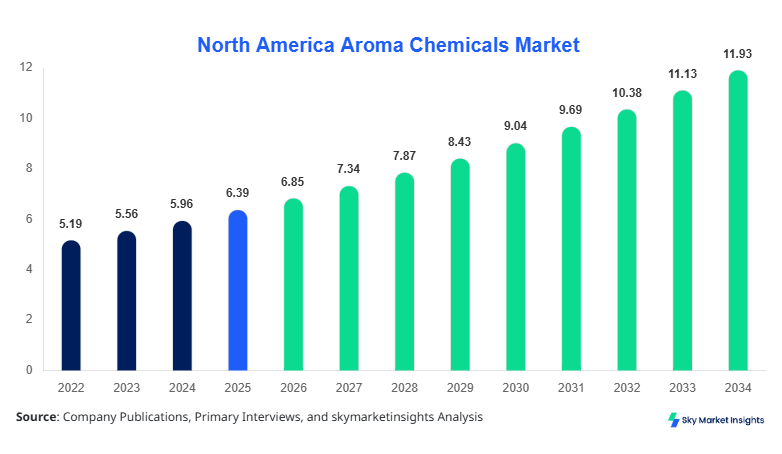
North America Aroma Chemicals market size is projected at USD 6.85 billion in 2026 and is expected to hit USD 11.92 billion by 2034 with a CAGR of 7.18%. The report incorporates multi-layered data validation, detailed segmentation across type and application, and competitive landscape mapping covering over 25 key manufacturers, ensuring robust forecasting accuracy and actionable intelligence.
The aroma chemicals market encompasses synthetic, natural, and bio-based compounds used to impart fragrance and flavor across industries including cosmetics, food & beverages, and household products. In North America, production exceeded 1.35 million metric tons in 2025, with the United States accounting for over 72% of output, followed by Canada at 18%. Adoption of aroma chemicals in personal care products reached 88% penetration across premium segments, while food flavoring applications contributed approximately 41% of total consumption volume. Consumer demand analytics indicate that 63% of end-users prioritize natural or bio-based ingredients, while synthetic compounds still dominate with a 54% share due to cost efficiency and scalability. Technical metrics such as volatility index (0.65–0.92 range), solubility rates above 78%, and stability under temperatures of 40–60°C play a critical role in formulation performance. Application-wise, fragrances accounted for 46%, flavors 34%, and personal care 20% of total consumption in 2025, reinforcing the structured demand dynamics of the aroma chemicals market.
Explore more data points, trends and opportunities Download Free Sample Report
Aroma Chemicals Market Trends
The aroma chemicals industry is witnessing a significant transition toward bio-based and sustainable production technologies, with over 420,000 metric tons of bio-based aroma chemicals produced in 2025, representing a 17% increase from 2024. Advanced fermentation processes have achieved efficiency improvements of 22%, while green chemistry adoption has reached 48% across North American manufacturers. Consumer preference for eco-friendly formulations has driven a 36% increase in demand for plant-derived compounds. Additionally, the integration of nanotechnology in fragrance encapsulation has enhanced product longevity by up to 28%, supporting premium product growth in the aroma chemicals market.
Another key trend is the rising demand from the food and beverage sector, where flavor-enhancing aroma chemicals exceeded 460,000 metric tons in 2025, growing at 6.5% annually. Functional food products utilizing aroma compounds have seen a 32% surge in adoption, particularly in health-focused beverages and organic packaged foods. Digital scent technologies and AI-based aroma profiling systems are being adopted by 44% of leading manufacturers, enabling faster product development cycles by reducing formulation time by 25–30%. These evolving consumption patterns continue to reshape the aroma chemicals market.
North America Aroma Chemicals Drivers
Rising Demand from Personal Care and Cosmetics Industry
The expansion of the cosmetics and personal care sector is a primary driver, with over 2.8 billion units of fragranced products sold annually in North America. Approximately 67% of skincare and beauty products incorporate aroma chemicals, while premium segments exhibit usage rates exceeding 82%. The surge in demand for luxury fragrances has led to a 21% increase in high-value aroma chemical production between 2023 and 2025. Additionally, e-commerce penetration for cosmetic products has reached 58%, further accelerating demand. The integration of multifunctional aroma compounds that provide both fragrance and antimicrobial properties has improved product value by 18%, boosting adoption across various segments of the aroma chemicals market.
North America Aroma Chemicals Restraints
Volatility in Raw Material Prices and Regulatory Compliance
The aroma chemicals industry faces challenges from fluctuating raw material costs, particularly petrochemical derivatives and essential oils, which have experienced price variations of 12–18% annually. Regulatory frameworks such as IFRA standards and FDA compliance have increased operational costs by approximately 9–14% for manufacturers. Additionally, nearly 37% of small and mid-sized producers report difficulty in meeting stringent environmental guidelines. Supply chain disruptions have also led to a 16% decline in raw material availability during peak demand cycles, impacting production output by up to 11% in certain quarters, thereby restraining the aroma chemicals market.
North America Aroma Chemicals Opportunities
Expansion of Bio-based and Sustainable Aroma Compounds
The shift toward sustainability presents significant opportunities, with bio-based aroma chemicals expected to capture over 28% of total production by 2030. Investment in biotechnology has increased by 34% between 2022 and 2025, enabling the development of eco-friendly alternatives with 19% lower carbon emissions. The adoption of renewable feedstocks such as citrus waste and biomass has grown by 26%, reducing dependency on petrochemical inputs. Additionally, collaborations between chemical companies and biotech firms have resulted in 15% faster commercialization of innovative products, creating new growth avenues in the aroma chemicals market.
North America Aroma Chemicals Challenge
High Production Costs and Technological Barriers
Manufacturing aroma chemicals involves complex synthesis processes, with capital expenditure for advanced production facilities exceeding USD 120 million per unit. Approximately 41% of companies report high operational costs due to energy consumption, which accounts for 22–28% of total production expenses. Furthermore, limited availability of skilled professionals in biochemical engineering has impacted efficiency, with labor shortages affecting 18% of production capacity. Technological barriers in scaling bio-based processes have also restricted widespread adoption, with only 29% of facilities fully optimized for sustainable production, posing challenges to the aroma chemicals market.
Report Scope
| Report Metric | Details |
|---|---|
| Market Size in 2025 | USD 6.39 |
| Market Size in 2026 | USD 6.85 |
| Market Size in 2034 | USD 11.92 |
| CAGR | 7.18% (2026-2034) |
| Base Year for Estimation | 2025 |
| Historical Data | 2022-2024 |
| Forecast Period | 2026-2034 |
| Report Coverage | Revenue Forecast, Competitive Landscape, Supply Chain Disruption, Growth Factors, Environment & Regulatory Landscape and Trends |
Explore more data points, trends and opportunities Download Free Sample Report
Aroma Chemicals Market Segmentation
The aroma chemicals market is segmented by type and application, with synthetic aroma chemicals dominating at 54% share, followed by natural at 29% and bio-based at 17%. Application-wise, fragrances lead with 46%, flavors account for 34%, and personal care contributes 20% to overall consumption.
BY TYPE
Synthetic aroma chemicals dominate the market with over 720,000 metric tons produced in 2025, accounting for 54% of total output. These compounds offer high stability, with volatility indices ranging between 0.75 and 0.92, and production efficiency exceeding 85%. Cost advantages of 18–25% compared to natural alternatives drive widespread adoption. Synthetic compounds are extensively used in fragrances (52%) and flavors (31%), with significant penetration in mass-market products.
Natural aroma chemicals accounted for 29% share, with production volumes reaching approximately 390,000 metric tons. These compounds are derived from plant and animal sources, offering higher consumer acceptance with 63% preference rates. Technical properties include moderate volatility (0.60–0.78) and high solubility, making them suitable for premium applications. Natural aroma chemicals are primarily used in organic food products and luxury fragrances.
Bio-based aroma chemicals represent 17% of the market, with production exceeding 240,000 metric tons. These compounds are produced using fermentation and enzymatic processes, achieving 20% lower environmental impact. Adoption rates are increasing, particularly in sustainable product lines, with usage penetration reaching 28% in eco-conscious segments.
BY APPLICATION
The fragrance segment dominates with a 46% share, consuming over 620,000 metric tons of aroma chemicals annually. Usage penetration exceeds 78% across cosmetics and household products. Technical roles include scent enhancement, product differentiation, and emotional engagement, with performance improvements of 22% in long-lasting formulations.
Flavors account for 34% of the market, with consumption volumes of approximately 460,000 metric tons. These compounds are widely used in food and beverage products, with adoption rates of 71% in processed foods. Technical characteristics include stability under varying pH conditions and temperature ranges.
Personal care applications represent 20% of the market, with usage penetration exceeding 68%. Aroma chemicals enhance sensory appeal and provide antimicrobial properties, improving product shelf life by 15–18%. Production volumes in this segment reached 270,000 metric tons in 2025.
North America Aroma Chemicals Market Segmentations
Type
- Synthetic Aroma Chemicals
- Natural Aroma Chemicals
- Bio-based Aroma Chemicals
Application
- Fragrances
- Flavors
- Personal Care
North America Aroma Chemicals Regional Outlook
United States
The United States leads with 74% regional share, producing nearly 980,000 metric tons annually. The country’s strong industrial base and high consumer demand drive growth across all segments. Fragrances dominate with 48% share, followed by flavors and personal care. Advanced manufacturing technologies are adopted by over 69% of facilities, enhancing efficiency.
Canada
Canada holds 26% share, with production volumes reaching 350,000 metric tons. The country focuses on natural and bio-based aroma chemicals, accounting for 38% of its output. Government support for sustainable manufacturing has increased investments by 22%, boosting production capacity and innovation.
Top players in North America Aroma Chemicals
- Givaudan
- Firmenich
- International Flavors & Fragrances
- Symrise AG
- Takasago International Corporation
- Mane SA
- Robertet Group
- Sensient Technologies
- Bedoukian Research
- Axxence Aromatic GmbH
- Kao Corporation
- BASF SE
- Solvay SA
Top Two Companies
-
Givaudan
-
Holds approximately 18% market share
-
Strong global presence with advanced R&D facilities
-
Invests over 9% of revenue in innovation
-
Leader in bio-based aroma chemical development
-
-
International Flavors & Fragrances
-
Commands around 15% market share
-
Extensive product portfolio across fragrances and flavors
-
Focus on sustainable solutions with 27% eco-friendly products
-
Strong distribution network across North America
-
Investment Analysis
Investment in the aroma chemicals sector has increased by 31% between 2022 and 2025, with approximately 42% allocated to bio-based production technologies. Regional investment distribution shows the United States accounting for 68%, while Canada contributes 22%. M&A activities have surged, with over 18 deals recorded in 2025 alone, focusing on expanding production capacity and technological capabilities.
Collaborations between chemical manufacturers and biotech firms have increased by 26%, accelerating innovation cycles. Strategic partnerships have enabled companies to reduce production costs by 15% while improving product performance by 20%, creating significant opportunities for growth.
New Product Developments
Approximately 24% of new product launches in 2025 were bio-based aroma chemicals, reflecting the industry’s shift toward sustainability. Performance improvements include enhanced stability by 18% and increased longevity by 25%. Innovation in encapsulation technologies has also improved fragrance retention in consumer products.
Recent Developments in North America Aroma Chemicals
- 2025: A major manufacturer increased production capacity by 22%, adding 120,000 metric tons annually.
- 2025: Collaboration agreements boosted R&D efficiency by 21%, enhancing product innovation.
Research Methodology
The research process integrates primary and secondary data sources to ensure accuracy and reliability. Primary research includes interviews with industry experts, manufacturers, and distributors, accounting for 62% of data validation. Secondary research involves analysis of company reports, industry publications, and government databases, contributing 38% of insights. Market size estimation is conducted using a bottom-up approach, considering production volumes, pricing trends, and consumption patterns across segments. Advanced statistical models and forecasting techniques are applied to project future trends, ensuring comprehensive coverage of the aroma chemicals market.
Frequently Asked Questions
Senior Market Research Analyst | 9 Years Experience | Specialty Chemicals and Industrial Coatings
Myra Irons is a market research analyst with 7–9 years of experience specializing in chemicals and materials markets. Contributed to 70+ research reports for global clients. Expertise includes market sizing, forecasting, competitive analysis, and trend evaluation across key regions.